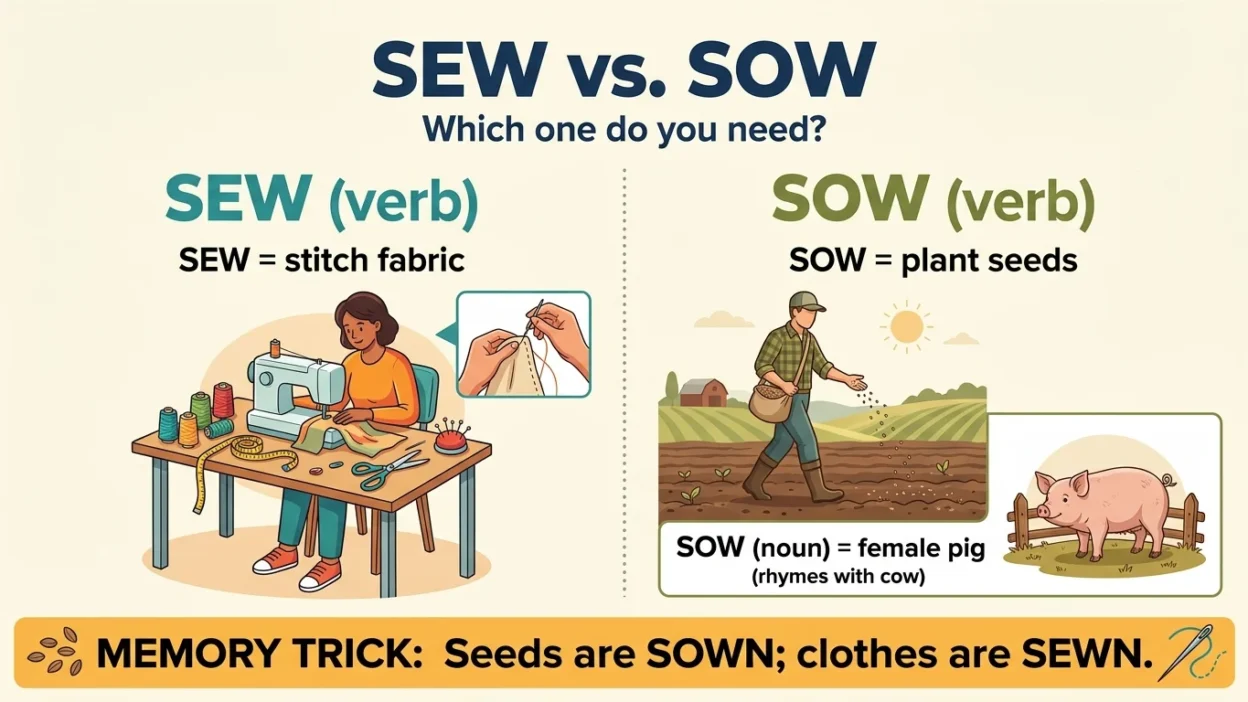
The words sew and sow are easy to confuse because they look similar and, in one common pronunciation of sow, they sound exactly alike. However, their meanings are completely different. Sew means to join, repair, or decorate fabric using a needle and thread or a sewing machine. You can sew a button onto a shirt, sew a dress, or sew two pieces of fabric together. Sow, meanwhile, can mean to plant or scatter seeds so that they can grow.
There is an additional twist: sow has another meaning and another pronunciation. As a noun, sow can mean an adult female pig, and in that sense it rhymes with cow, not sew. This pronunciation difference makes sew vs sow especially interesting for English learners. Fortunately, context makes the correct choice much easier. This guide explains their meanings, pronunciations, grammar rules, examples, common expressions, and simple memory tricks.
Quick Answer
Sew means to join or repair fabric with a needle and thread, as in “She can sew a dress.” Sow usually means to plant or scatter seeds, as in “Farmers sow seeds in spring.” As a noun, sow can also mean an adult female pig and is pronounced differently.
Sew vs Sow Definition and Meaning
The basic difference between sew and sow is what action or object each word describes.
Sew is a verb associated with fabric, clothing, needlework, and stitching.
For example:
“She sewed the button onto her coat.”
Sow, as a verb, means to plant or scatter seeds.
For example:
“They sow wheat in the field.”
It can also be used figuratively:
“His comments sowed confusion.”
As a noun, sow refers to an adult female pig.
Therefore, the simplest distinction is:
Sew = stitching fabric
Sow = planting seeds
Sow = female pig in its separate noun meaning.
Context and pronunciation help distinguish these meanings.
Why People Confuse Sew and Sow
People confuse sew vs sow mainly because sew and the verb sow are homophones in standard English.
They are both pronounced like “so.”
That means:
“sew a shirt”
and:
“sow some seeds”
begin with words that sound identical.
Writers therefore cannot rely on pronunciation to choose the correct spelling.
The situation becomes even more confusing because sow, meaning a female pig, has a different pronunciation and rhymes with cow.
English learners must therefore connect each spelling with its meaning.
Think about the object involved:
If you are working with fabric, thread, clothes, or stitches, choose sew.
If you are planting seeds or causing something to spread, choose sow.
What Does Sew Mean?
Sew is a verb meaning to join, attach, repair, or decorate material using stitches made with a needle and thread or a sewing machine.
For example:
“My grandmother taught me how to sew.”
You can sew:
- clothes
- buttons
- curtains
- dresses
- fabric
- patches
- costumes
For example:
“She sewed a patch onto her jacket.”
Sewing can be done by hand or with a machine.
The word also appears in the phrasal verb sew up, which can literally mean to close something with stitches:
“The doctor sewed up the wound.”
It can also have figurative meanings, such as securing an outcome:
“The team hopes to sew up the championship.”
What Does Sow Mean?
As a verb, sow means to plant or scatter seeds so that plants can grow.
For example:
“The farmer sowed wheat in the field.”
You can sow:
- seeds
- wheat
- corn
- grass
- crops
The word also has important figurative meanings. To sow something can mean to cause an idea, feeling, problem, or situation to begin and spread.
For example:
“The rumor sowed confusion among employees.”
Common figurative expressions include:
- sow doubt
- sow confusion
- sow fear
- sow discord
- sow the seeds of change
As a noun, sow has a completely different meaning: an adult female pig.
Its pronunciation also changes in that meaning.
Sew vs Sow Comparison Table
| Feature | Sew | Sow |
|---|---|---|
| Main meaning | Stitch or join fabric | Plant/scatter seeds |
| Common part of speech | Verb | Verb; also noun |
| Related to clothing? | Yes | No |
| Related to farming? | No | Yes |
| Can mean female pig? | No | Yes |
| Verb pronunciation | Sounds like “so” | Sounds like “so” |
| Pig pronunciation | — | Rhymes with “cow” |
| Example | Sew the button on. | Sow the seeds. |
| Memory clue | Sew = stitching | Sow = seeds |
The key is to identify whether the sentence involves stitching, planting, or a pig.
Sew vs Sow Pronunciation Guide
Pronunciation is particularly important for this pair.
Sew is pronounced like “so.”
Example:
“I need to sew this shirt.”
Sow, when it means to plant seeds, is also pronounced like “so.”
Example:
“Farmers sow seeds.”
These two words are therefore homophones in these meanings.
However, sow, meaning an adult female pig, is pronounced differently. In that sense, it rhymes with cow and how.
So remember:
sew → sounds like so
sow seeds → sounds like so
sow, female pig → rhymes with cow
The spelling remains sow for both the planting verb and the female-pig noun, even though their pronunciations differ.
Sew Grammar Rules Explained
Sew is primarily a verb.
Its important forms include:
- sew
- sews
- sewed
- sewn/sewed
- sewing
Examples:
“I sew my own clothes.”
“She sews costumes.”
“He sewed the button back on.”
“She has sewn the pieces together.”
“They are sewing curtains.”
Both sewed and sewn can appear as past participles, although sewn is especially common in constructions such as “has sewn” or “was sewn.”
The simple past is sewed:
“She sewed the dress yesterday.”
Do not write sowed when you mean stitching. Sowed belongs to the verb sow.
Sow Grammar Rules Explained
When sow means to plant or scatter seeds, it is a verb.
Common forms include:
- sow
- sows
- sowed
- sown/sowed
- sowing
Examples:
“Farmers sow wheat.”
“He sows seeds every spring.”
“They sowed the field yesterday.”
“The seeds have been sown.”
“She is sowing flowers in the garden.”
The simple past is sowed, while sown is commonly used as a past participle.
Compare:
“They sowed the seeds.”
“The seeds have been sown.”
When sow means a female pig, it is a noun:
“The sow is feeding her piglets.”
The plural is sows.
When to Use Sew
Use sew whenever you are talking about stitching fabric or similar material with thread.
For example:
“Can you sew this button onto my shirt?”
Use it for making clothing:
“She knows how to sew dresses.”
Use it for repairs:
“I need to sew the tear in my jacket.”
Use it for crafts:
“They spent the afternoon sewing decorations onto the costumes.”
You may also encounter sew in medical or figurative contexts:
“The wound was sewn closed.”
“They hope to sew up the deal this week.”
A simple question can help:
Does the action involve stitches, thread, fabric, or joining something as if with stitches?
If yes, choose sew.
When to Use Sow
Use sow when you mean planting or scattering seeds.
For example:
“Farmers sow wheat in autumn.”
You can also use sow figuratively when something causes an idea, emotion, conflict, or condition to develop.
Examples:
“The false report sowed panic.”
“His remarks sowed doubt.”
“The policy could sow the seeds of future growth.”
Use sow as a noun when referring to an adult female pig:
“The sow stayed close to her piglets.”
Remember that this noun pronunciation rhymes with cow.
If your sentence involves seeds, planting, spreading an idea or condition, or a female pig, sow is the spelling you need.
When to Use Each Word
Choosing between sew and sow is easy when you identify the context.
Use sew for:
- stitching
- clothing
- fabric
- needle and thread
- sewing machines
- attaching buttons
- repairing tears
Use sow for:
- planting seeds
- growing crops
- spreading ideas or emotions
- creating confusion or doubt
- an adult female pig
Compare:
“She will sew a dress.”
“He will sow seeds.”
“The rumor may sow confusion.”
“The sow has several piglets.”
The words may look similar, but their meanings are clearly separated by context.
Sew vs Sow Examples
Here are 15 examples showing correct usage:
- My mother taught me how to sew.
- Farmers sow wheat in the field.
- She can sew her own dresses.
- We will sow the seeds tomorrow.
- He sewed a button onto his shirt.
- The farmer sowed corn last spring.
- She is sewing new curtains.
- They are sowing grass seed.
- The rumor sowed confusion.
- He has sewn the pieces together.
- The seeds have been sown carefully.
- Can you sew this tear?
- Good farmers know when to sow crops.
- The sow was feeding her piglets.
- Her comments may sow doubt among voters.
The surrounding words usually make the intended spelling obvious.
Sew a Dress vs Sow a Dress
The correct expression is:
sew a dress
For example:
“She learned to sew a dress.”
A dress is made by cutting and joining fabric, usually with stitches, so sew is required.
You would not normally sow a dress, because sow refers to planting seeds or causing something to develop.
Compare:
“She sews dresses.”
“She sows flower seeds.”
A useful association is:
Sew → sewing machine → clothes
If the sentence involves making or repairing garments, sew is almost certainly the word you want.
This applies to shirts, dresses, trousers, curtains, costumes, blankets, and many other fabric items.
Sow Seeds vs Sew Seeds
The correct expression is:
sow seeds
For example:
“We sow seeds in early spring.”
The verb sow refers to planting or scattering seeds so they can grow.
Writing:
❌ “sew seeds”
would incorrectly suggest an action involving needle and thread.
Correct examples include:
- sow vegetable seeds
- sow grass seed
- sow wheat
- sow crops
- sow flower seeds
You can remember this with the letter O:
SOW → SOIL
Both words contain the letter O, and seeds are sown in soil.
This gives you an easy spelling connection whenever your sentence involves farming, gardening, crops, or planting.
Sewing vs Sowing
Sewing and sowing are the -ing forms of sew and sow, respectively.
Sewing means making or repairing something with stitches:
“She is sewing a dress.”
Sowing means planting or scattering seeds:
“He is sowing seeds.”
Compare:
“Her hobby is sewing.”
“Spring is a good time for sowing certain seeds.”
These forms are especially easy to distinguish in writing because sowing keeps the o from sow, while sewing keeps the spelling of sew.
Think:
Sewing → needle and thread
Sowing → seeds and soil
These associations make the correct spelling much easier to remember.
Sewed vs Sowed
Sewed is the simple past tense of sew.
For example:
“She sewed the button onto my shirt.”
Sowed is the simple past tense of sow when it means planting or spreading something.
For example:
“The farmer sowed wheat.”
It can also be figurative:
“The announcement sowed confusion.”
Compare:
“She sewed the fabric together.”
“He sowed seeds in the garden.”
The difference is only one letter, but that letter changes the meaning.
A quick memory aid is:
SEWed → sewing
SOWed → sowing seeds
Always identify whether the past action involved stitching or planting/spreading.
Sewn vs Sown
Sewn and sown are also easily confused.
Sewn is a past participle of sew:
“The dress was sewn by hand.”
“The pieces have been sewn together.”
Sown is a past participle of sow:
“The seeds have been sown.”
“The field was sown with wheat.”
The distinction follows the same basic rule:
sewn → stitching
sown → planting
Compare:
“The patch was sewn onto the jacket.”
“The seeds were sown across the field.”
The pronunciations can be very similar or identical, so spelling must come from meaning rather than sound.
What Does Reap What You Sow Mean?
The expression “you reap what you sow” means that your actions eventually produce consequences.
The phrase comes from farming.
To sow means to plant seeds.
To reap means to harvest the resulting crop.
Figuratively, the expression suggests that good actions can produce good results, while harmful actions can lead to negative consequences.
For example:
“If you treat people respectfully, remember that you often reap what you sow.”
The correct spelling is always:
reap what you sow
not:
reap what you sew
The expression is based on planting seeds, so sow is required.
What Does Sow the Seeds Mean?
Sow the seeds can be used literally or figuratively.
Literally:
“The gardener sowed the seeds in spring.”
Figuratively, sow the seeds of something means to begin a process that may develop later.
For example:
“The conversation sowed the seeds of a new partnership.”
Another example:
“The disagreement sowed the seeds of future conflict.”
The phrase creates a metaphor: just as a planted seed can grow into a plant, an idea or action can develop into a larger result.
Common expressions include:
- sow the seeds of doubt
- sow the seeds of change
- sow the seeds of conflict
- sow the seeds of success
Because the image comes from planting, the correct word is sow.
Sew vs Sow in Real Life Usage
Imagine someone working at home with fabric.
They might say:
“I need to sew this button back onto my shirt.”
Now imagine someone working in a garden:
“I’m going to sow tomato seeds.”
The first action involves a needle and thread. The second involves planting.
In a news report, you might read:
“The announcement sowed confusion.”
Here, sow is figurative because confusion is being caused or spread.
On a farm, you could hear:
“The sow has six piglets.”
Here, sow is a noun and has the pronunciation that rhymes with cow.
Context makes each meaning much easier to identify.
Sew vs Sow in Business English
Sew is less common in general business writing unless the business involves clothing, textiles, manufacturing, fashion, or crafts.
For example:
“The factory sews garments for international brands.”
Sow, however, can appear figuratively in many professional contexts.
For example:
“Poor communication can sow confusion among employees.”
Or:
“The investment could sow the seeds of future growth.”
These figurative expressions can be useful, but they should be used carefully in formal writing because simpler wording may sometimes be clearer.
For instance, cause confusion may be more direct than sow confusion.
Regardless of style, the spelling remains sow when the meaning involves creating or spreading a condition.
Sew vs Sow in Academic Writing
Both words can appear in academic writing depending on the subject.
In textile, fashion, or manufacturing studies:
“The pieces were sewn together by hand.”
In agricultural research:
“The seeds were sown at equal depths.”
In historical, literary, or social analysis, sow may also be used figuratively:
“The policy sowed distrust among different groups.”
Academic writers should pay particular attention to sewn vs sown, because these forms can sound alike while carrying completely different meanings.
A simple check is:
Textile or stitches → sewn
Agriculture or figurative spreading → sown
Using precise terminology is especially important in academic writing, where a small spelling error can change the technical meaning of a sentence.
Formal vs Informal Use
Both sew and sow are standard words that can be used in formal and informal English.
Informal:
“I need to sew my shirt.”
Formal:
“The garments were sewn using traditional techniques.”
Informal:
“We’re going to sow some seeds.”
Formal:
“The crop was sown in early spring.”
The figurative uses of sow also work across different registers:
“His comments sowed confusion.”
The choice between sew and sow therefore has nothing to do with formality. It depends entirely on meaning.
Use sew for stitching and sow for planting or figuratively spreading something. When sow is a noun meaning a female pig, pronunciation and context distinguish it from the other meanings.
American vs British English
The core distinction between sew and sow is the same in American and British English.
In both varieties:
Sew means to stitch or join material.
Sow means to plant seeds or figuratively cause something to develop.
Sow can also mean an adult female pig.
Examples remain the same:
“She sewed the dress.”
“They sowed the seeds.”
“The sow had several piglets.”
The pronunciation distinction is also broadly consistent: the verb sow sounds like sew, while the noun referring to a pig rhymes with cow.
Therefore, you do not need separate American and British spelling rules for this word pair.
Synonyms and Alternatives
Synonyms for sew depend on context and may include:
- stitch
- mend
- repair
- attach
- embroider
For example:
“She sewed the tear.”
could sometimes become:
“She stitched the tear.”
Possible alternatives for sow, meaning to plant, include:
- plant
- scatter
- seed
For figurative uses, alternatives may include:
- spread
- create
- cause
- introduce
For example:
“The rumor sowed confusion.”
could become:
“The rumor caused confusion.”
These synonym tests can help you choose correctly. If stitch fits, use sew. If plant or spread fits, use sow.
Common Sentences With Sew and Sow
Here are some useful sentences:
- I know how to sew.
- She sews her own clothes.
- He sewed the button back on.
- The dress was sewn by hand.
- Farmers sow seeds in spring.
- We sow vegetables every year.
- They sowed wheat last month.
- The seeds have been sown.
- His comments sowed doubt.
- Do not sow unnecessary confusion.
- The sow stayed with her piglets.
- She is sewing a new costume.
Notice how the context consistently identifies the meaning.
Fabric and stitches → sew
Seeds and spreading → sow
Female pig → sow, pronounced differently.
Common Mistakes With Sew and Sow
One common mistake is using sow for making clothes:
❌ “She can sow a dress.”
Correct:
✅ “She can sew a dress.”
Another mistake is using sew for planting:
❌ “Farmers sew seeds.”
Correct:
✅ “Farmers sow seeds.”
Writers also confuse their past participles:
❌ “The dress was sown by hand.”
✅ “The dress was sewn by hand.”
And:
❌ “The seeds were sewn yesterday.”
✅ “The seeds were sown yesterday.”
A further mistake appears in the expression:
❌ “You reap what you sew.”
Correct:
✅ “You reap what you sow.”
Remember whether the context involves stitches or seeds.
Memory Trick for Sew vs Sow
Use two simple connections:
SEW → needle
Think of the E in sew as reminding you of embroidery, which involves stitching.
And:
SOW → SOIL
Both sow and soil contain an O.
Seeds are sown in soil.
So remember:
SEW → stitching and fabric
SOW → seeds and soil
You can also memorize this sentence:
“She sews clothes while he sows seeds.”
For the pig meaning, remember:
SOW the pig rhymes with COW.
These three associations cover the most important meanings and pronunciations.
Expert Tips for Choosing Sew or Sow
When you are unsure, replace the word with a simpler synonym.
If stitch works:
“I need to ___ this button.”
“I need to stitch this button.”
Choose sew.
If plant works:
“We will ___ seeds tomorrow.”
“We will plant seeds tomorrow.”
Choose sow.
If cause or spread works:
“The rumor may ___ confusion.”
“The rumor may cause confusion.”
Choose sow.
Finally, if the word refers to an adult female pig, use sow, but remember that its pronunciation rhymes with cow.
This synonym method is much more reliable than choosing based on sound because the verb sow and sew are pronounced alike.
Mistakes to Avoid
Do not assume that sew and sow are alternative spellings of the same word.
They represent different concepts.
Avoid:
❌ sew crops
❌ sow clothes
❌ sewn seeds
❌ sown fabric
Instead, write:
✅ sow crops
✅ sew clothes
✅ sown seeds
✅ sewn fabric
Also remember that sow has two pronunciations depending on meaning.
The planting verb sounds like so.
The female-pig noun rhymes with cow.
Finally, pay attention to common expressions such as sow doubt, sow confusion, and reap what you sow. These all use sow because they metaphorically connect consequences or ideas with planting seeds.
Related Confusing Words
If sew vs sow is difficult, you may also encounter these confusing homophones:
- so vs sew
- sea vs see
- right vs write
- flour vs flower
- pair vs pear
- hear vs here
- brake vs break
- plain vs plane
- hole vs whole
- allowed vs aloud
- weather vs whether
- stationary vs stationery
Homophones can be difficult because pronunciation may not reveal the correct spelling.
The most effective strategy is to connect each spelling with a clear image.
For this pair:
SEW → sewing machine
SOW → farmer planting seeds
These mental pictures make the distinction easier to recall while writing.
FAQs About Sew vs Sow
What is the difference between sew and sow?
Sew means to stitch or join fabric using thread. Sow means to plant or scatter seeds and can also mean to cause something such as doubt or confusion to develop.
Is it sew or sow seeds?
Sow seeds is correct. The verb sow means to plant or scatter seeds.
Is it sew or sow clothes?
Use sew for clothes. For example: “She knows how to sew clothes.”
Is it sewn or sown?
Sewn relates to stitching: “The dress was sewn.” Sown relates to planting: “The seeds were sown.”
Is it sewed or sowed?
Sewed is the past tense of sew. Sowed is the past tense of sow when it means planting or spreading something.
Do sew and sow sound the same?
Sew and the verb sow, meaning to plant, sound the same. However, the noun sow, meaning an adult female pig, rhymes with cow.
Is it “reap what you sew” or “reap what you sow”?
The correct expression is “reap what you sow.” It comes from farming: you harvest what you previously planted.
What is an easy way to remember sew vs sow?
Remember sew = stitching and sow = soil. Seeds are sown in soil, while fabric is sewn with thread.
Final Verdict on Sew vs Sow
The difference between sew vs sow becomes easy once you connect each spelling with its main context. Sew means to stitch, repair, or join fabric using thread. You can sew clothes, sew a button onto a shirt, or sew pieces of fabric together. Its related forms include sewed, sewn, and sewing.
Sow usually means to plant or scatter seeds, and it can also figuratively mean to cause something to develop or spread, as in sow doubt or sow confusion. Its related forms include sowed, sown, and sowing. As a noun, sow also means an adult female pig and rhymes with cow. Remember: sew for stitches; sow for seeds and soil.
Remember This
The easiest rule is:
SEW = stitch with thread
“She can sew a dress.”
SOW = plant seeds
“They sow wheat every year.”
SOW = adult female pig
“The sow is with her piglets.”
Use this memory trick:
SOW → SOIL
SEW → SEWING
And remember:
Seeds are sown; clothes are sewn.

Kevin Brian is a passionate author at BiblyWord, dedicated to sharing the message of the Bible through thoughtful and inspiring content. He focuses on creating clear and meaningful writings that help readers understand scripture, strengthen their faith, and find guidance in everyday life through God’s Word.