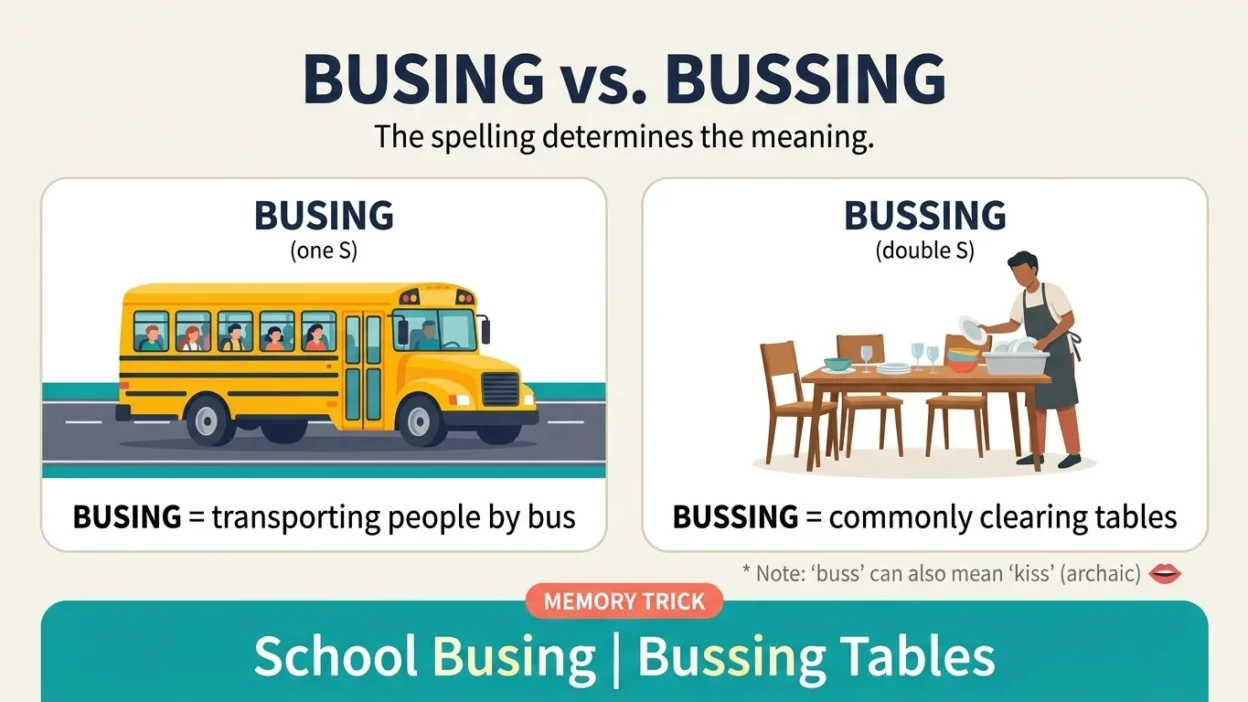
The difference between bussing vs busing can be surprisingly confusing because both spellings exist in English, but they are usually associated with different meanings.
Busing is the standard spelling when the word comes from the noun and verb bus and refers to transporting people by bus. For example, a school district may provide busing for students who live far from school. Bussing, with a double s, also exists, but it traditionally comes from the verb buss, meaning to kiss.
There is another reason the distinction is not completely straightforward. In restaurant contexts, bussing is widely used for clearing tables, as in bussing tables. Dictionaries and usage can vary on forms related to bus in this sense, and busing may also occur.
Therefore, the best spelling depends on what you are trying to say. This guide explains bussing vs busing, their meanings, pronunciation, grammar, examples, common mistakes, and easy ways to remember the difference.
Quick Answer
Busing is the standard spelling for transporting people by bus, as in school busing. Bussing traditionally means kissing and is also widely used for clearing tables in restaurants. When referring specifically to transportation by bus, busing with one s is the safest and standard choice.
Bussing vs Busing Definition and Meaning
Both bussing and busing are legitimate spellings, but their meanings and usage can differ.
Busing comes from bus and commonly means transporting people by bus.
For example:
“The school provides busing for students.”
Bussing, historically, is the present participle of buss, an old-fashioned or informal verb meaning to kiss.
For example:
“The couple was bussing each other on the cheek.”
However, bussing is also widely encountered in restaurants to describe clearing used dishes and preparing tables for new customers.
For example:
“He spent the evening bussing tables.”
The important point is that bussing is not simply an incorrect spelling of busing. Both forms exist, but context determines which one is appropriate.
Why People Confuse Bussing and Busing
The confusion around bussing vs busing comes largely from English spelling rules.
When adding -ing to many short verbs ending in a consonant, writers may expect the final consonant to double.
For example:
run → running
sit → sitting
stop → stopping
Following this pattern, bus might seem as though it should become bussing.
However, the standard transportation form is commonly spelled:
bus → busing
That unusual-looking single s can make writers think a letter is missing.
The situation becomes even more confusing because bussing is itself a valid spelling with other uses.
Instead of assuming that one spelling is always wrong, remember their strongest associations: busing = transportation, while bussing = kissing or commonly clearing restaurant tables.
What Does Busing Mean?
Busing is the present participle and gerund form commonly used when bus means to transport people by bus.
For example:
“The district is busing students to another school.”
Here, busing describes transportation using buses.
The word is particularly familiar in phrases such as:
- school busing
- student busing
- busing children
- busing passengers
In U.S. historical and educational contexts, busing can also refer to transporting students to schools as part of efforts to address racial segregation.
In ordinary modern usage, however, it can simply mean transporting people by bus.
If your sentence is clearly about bus transportation, busing is the spelling you will normally want.
What Does Bussing Mean?
Bussing is the -ing form of the verb buss, which means to kiss. This meaning is relatively old-fashioned and is less common in everyday modern English.
For example:
“They were bussing each other affectionately.”
More commonly today, many people encounter bussing in restaurant terminology.
A restaurant worker may be responsible for bussing tables, which means removing dirty dishes, glasses, utensils, and other items after customers leave and preparing the table for the next guests.
For example:
“She was bussing tables during the dinner rush.”
Because restaurant usage overlaps with forms of the verb bus, spelling practices are not always as cleanly separated as the transportation/kissing distinction suggests. Still, bussing tables is extremely familiar in restaurant English.
Bussing vs Busing Comparison Table
| Feature | Bussing | Busing |
|---|---|---|
| Correct English spelling? | Yes | Yes |
| Means transporting by bus? | Sometimes encountered, but “busing” is standard | Yes |
| Means kissing? | Yes | No |
| Restaurant table clearing? | Very common | Also possible in some usage |
| Related to “buss” | Yes | No |
| Related to transportation by bus | Less preferred spelling | Yes |
| Example | She is bussing tables. | The school is busing students. |
| Best memory clue | Buss = kiss/table clearing | Bus = transportation |
The context is more important than simply counting the number of s letters.
Bussing vs Busing Pronunciation Guide
Bussing and busing are generally pronounced the same way.
Both sound approximately like:
BUS-ing
This means you cannot reliably determine the spelling from spoken English.
Consider:
“They are busing students.”
and:
“They are bussing tables.”
The key words sound essentially identical, but the contexts reveal different meanings.
This makes spelling especially important in written communication.
When you hear the word, ask what action is taking place.
If people are being transported in buses, busing is the standard spelling.
If restaurant tables are being cleared, bussing is common.
If the meaning is kissing, bussing is correct because it comes from the verb buss.
Grammar Rules Explained
Both words can function as present participles or gerunds.
Busing comes from the verb bus:
“They are busing students across town.”
Here, busing forms part of the present progressive verb phrase.
It can also function as a gerund or verbal noun:
“Busing students requires careful planning.”
Bussing comes traditionally from buss:
“The couple was bussing affectionately.”
In restaurant usage:
“He is bussing tables tonight.”
The key spelling distinction comes from the base word and established usage rather than a simple universal consonant-doubling rule.
That is why trying to derive the answer from spelling rules alone can be misleading. It is safer to learn the standard forms together with their common contexts.
When to Use Busing
Use busing when referring to transporting people by bus.
For example:
“The school is busing children from rural areas.”
Another example:
“The company began busing employees to the temporary office.”
Common situations include:
- schools transporting students
- companies transporting employees
- event organizers transporting attendees
- organizations moving groups by bus
You may also encounter busing as a noun referring broadly to the practice or policy of transporting people by bus.
For example:
“The district changed its busing policy.”
If the sentence could naturally be rephrased as transporting by bus, then busing is normally the correct choice.
When to Use Bussing
Use bussing when the base verb is buss, meaning to kiss.
For example:
“The grandparents were bussing the children on their cheeks.”
This use may sound old-fashioned to many modern speakers, but it is legitimate.
You will probably encounter bussing more often in restaurant contexts:
“The employees were bussing tables.”
Here, the action involves clearing tables after customers have finished eating.
Common expressions include:
- bussing tables
- bussing dishes
- bussing station
- bussing staff
Because usage related to restaurant table clearing can vary, you may encounter both bussing and busing in dictionaries or published material. However, the double-s spelling is very familiar in the restaurant industry.
When to Use Each Spelling
A practical way to choose is to identify the context.
Use busing for:
- transportation by bus
- school transportation
- moving employees by bus
- transporting groups or passengers
- policies involving bus transportation
Use bussing for:
- kissing
- commonly, clearing restaurant tables
Examples:
“The district is busing students.”
“She is bussing tables tonight.”
“The couple was bussing affectionately.”
This distinction handles most everyday situations.
Just remember that restaurant terminology is an area where usage is not completely uniform. If you are following a publication, employer, or organization’s style guide, use its preferred spelling consistently.
Bussing vs Busing Examples
Here are 15 examples showing the words in context:
- The school is busing students across town.
- The company began busing workers to the new facility.
- The district provides busing for eligible students.
- They are busing passengers from the airport.
- Student busing begins early in the morning.
- He spent the evening bussing tables.
- She started bussing dishes after the dinner rush.
- The restaurant hired extra workers for bussing tables.
- They were bussing each other on the cheek.
- The city considered busing attendees to the event.
- The school changed its busing schedule.
- He earned extra money bussing tables.
- The hotel began busing guests to the venue.
- She was responsible for bussing and resetting tables.
- The organization arranged busing for participants.
Context makes the intended meaning clear.
Busing Students Meaning
Busing students means transporting students to or from school using buses.
For example:
“The district is busing students from several neighborhoods.”
In the United States, the word busing also has an important historical meaning connected with school desegregation. Court-ordered or policy-driven busing was used in various places to transport students between schools as part of efforts to reduce racial segregation.
However, not every modern reference to school busing carries that specific historical meaning.
A school may simply discuss:
- busing schedules
- transportation costs
- student eligibility
- bus routes
- safety procedures
When the meaning is transportation by bus, the standard spelling is busing.
School Bussing vs School Busing
If you are referring to the transportation of children to and from school, school busing is the standard spelling.
Correct:
“School busing begins at 7 a.m.”
Another example:
“The district reviewed its school busing policy.”
You may occasionally see school bussing, particularly because doubling the final s feels natural to many writers. Nevertheless, busing is the conventional spelling in edited English when discussing transportation.
A useful way to remember this is to keep the base word visible:
bus → busing
So if a school is transporting students by bus, think busing.
This distinction is especially useful in educational, administrative, historical, and transportation-related writing.
Bussing Tables vs Busing Tables
This is one of the trickiest parts of bussing vs busing.
In restaurants, to bus a table means to remove used dishes and prepare the table for new customers.
Both spellings may be encountered for the -ing form, but bussing tables is extremely common and helps prevent visual confusion with the transportation meaning of busing.
For example:
“He is bussing tables at a local restaurant.”
A worker who performs this job may be called a busser.
Restaurant duties can include:
- removing dishes
- collecting glasses
- wiping tables
- resetting place settings
- helping servers
If you are writing for a specific restaurant or publication, follow its house style. Otherwise, bussing tables is a clear and familiar choice.
What Does Bussing Tables Mean?
Bussing tables means clearing and often resetting tables in a restaurant or similar food-service environment.
After customers finish eating, someone needs to remove:
- plates
- cups
- glasses
- utensils
- napkins
- leftover items
The table may then be cleaned and prepared for the next guests.
For example:
“The new employee spent his first shift bussing tables.”
The person responsible for this work is commonly called a busser.
Bussing is an important part of restaurant operations because it helps servers, keeps dining areas organized, and allows tables to become available for new customers quickly.
This meaning should not be confused with busing people, which involves transportation by bus.
Busing People vs Bussing People
When you mean transporting people by bus, use busing.
For example:
“The company is busing people from the parking area to the stadium.”
Here, buses are being used as transportation.
Bussing people, on the other hand, could theoretically be interpreted according to the older verb buss, meaning kissing people.
That creates a potentially amusing misunderstanding.
Compare:
“The organization is busing guests to the hotel.”
This clearly describes transportation.
“The actor was bussing fans on the cheek.”
This uses the older kissing meaning.
Because the words sound alike, correct spelling is especially important when the context does not immediately reveal the intended meaning.
Is Bussing a Misspelling?
No. Bussing is not automatically a misspelling.
It is a legitimate form of buss, meaning to kiss.
It is also widely used in restaurant contexts, particularly in the phrase bussing tables.
The mistake occurs when writers assume that bussing is always the standard form for transportation by bus.
For transportation, busing is the conventional spelling:
✅ “The school is busing students.”
So rather than thinking:
“bussing = wrong”
remember:
Bussing has legitimate uses, but busing is standard for bus transportation.
This distinction is more accurate and useful because it recognizes how both forms actually function in English.
Is Busing a Misspelling?
No. Busing is a correct standard English spelling.
Some writers think it looks wrong because they expect the final s in bus to double before adding -ing.
However:
bus → busing
is the conventional spelling when the verb means transporting someone by bus.
For example:
“The hotel is busing guests to the airport.”
Similarly, the past-tense form is commonly:
bused
and the noun for a person clearing restaurant tables is commonly:
busser
English spelling does not always follow one simple pattern, so it is better to learn these forms individually rather than relying exclusively on consonant-doubling rules.
Bussing vs Busing in Real Life Usage
Imagine two different workplaces.
At a school district office, someone might say:
“We are busing 300 students each morning.”
The meaning is transportation.
At a restaurant, a manager might say:
“We need another employee bussing tables tonight.”
The meaning is clearing tables.
In an older romantic story, you might even encounter:
“They were bussing each other on the cheek.”
Here, it means kissing.
These examples show why context matters more than pronunciation.
If a bus is physically transporting people, choose busing.
If dishes are being cleared from restaurant tables, bussing is common.
If someone is kissing another person, bussing is the traditional spelling.
Bussing vs Busing in Business English
In business writing, busing may appear when companies arrange transportation.
For example:
“The conference organizer will be busing attendees between the hotel and venue.”
Another example:
“The company is busing employees from the temporary parking facility.”
In hospitality and restaurant businesses, bussing commonly appears in descriptions of dining-room duties:
“The position includes bussing tables and assisting servers.”
Because these spellings can represent different activities, using the right one improves clarity.
A transportation company, school, hotel, restaurant, or event organizer may use these words differently depending on the service being described.
For professional documents, consistency with the organization’s preferred style is also important.
Bussing vs Busing in Academic Writing
In academic and historical writing, busing is particularly important when discussing transportation and U.S. school desegregation.
For example:
“The study examined the effects of school busing policies.”
Researchers may also use the word in transportation, urban planning, education, and public-policy contexts.
Bussing, meanwhile, is unlikely to appear frequently in formal academic writing unless the subject involves linguistics, restaurant labor, historical vocabulary, or another context where the form itself is relevant.
Because academic writing values precision, avoid treating bussing and busing as simple interchangeable spelling variants in every context.
Identify the intended meaning first, then choose the spelling that most clearly communicates it.
Formal vs Informal Use
Busing is standard in both formal and informal contexts when referring to transportation by bus.
Informal:
“They’re busing everyone to the game.”
Formal:
“The district provides busing for eligible students.”
Bussing can also be legitimate in both settings when the context supports it.
Restaurant context:
“She works evenings bussing tables.”
Older kissing meaning:
“He was bussing the child on the cheek.”
The main distinction is therefore not simply formal versus informal English.
Instead, the choice depends primarily on meaning and established usage.
For professional writing, it is worth checking a preferred dictionary or style guide if your context involves restaurant terminology, where spelling practices may overlap.
American vs British English
The bussing vs busing distinction can be influenced by regional usage, but busing is well established in American English for transportation by bus.
The word became particularly prominent in American historical and political discussions surrounding school desegregation.
In British English, bus is also used as a verb, although writers may encounter spelling variation in inflected forms depending on source and style.
For international writing, busing is a clear choice when specifically discussing transportation by bus, especially when targeting an American audience.
For restaurant table clearing, terminology itself can vary by region because bus/bussing tables is particularly associated with North American restaurant English.
Always consider both your meaning and your intended audience.
Synonyms and Alternatives
For busing in the transportation sense, possible alternatives include:
- transporting
- carrying
- shuttling
- conveying
- taking by bus
For example:
“The company is busing employees to the site.”
could become:
“The company is shuttling employees to the site.”
For bussing tables, possible alternatives include:
- clearing tables
- cleaning tables
- resetting tables
For the older meaning of bussing, alternatives include:
- kissing
- giving a kiss
Using synonyms can also help you determine the intended spelling.
If transporting by bus fits, choose busing.
If kissing fits, choose bussing.
If clearing tables fits, bussing is a common choice.
Common Sentences With Bussing and Busing
Here are several natural examples:
- The school is busing students home.
- The district changed its busing policy.
- They are busing passengers to the airport.
- The hotel provides busing to the convention center.
- The company began busing workers to the site.
- He works evenings bussing tables.
- She was busy bussing dishes.
- The restaurant hired someone to help with bussing.
- The couple was bussing each other affectionately.
- School busing can require careful route planning.
- They are busing guests from the parking lot.
- He gained restaurant experience by bussing tables.
These examples highlight how meaning determines which spelling is most appropriate.
Common Mistakes With Bussing and Busing
One common mistake is automatically doubling the s whenever bus takes -ing.
For transportation:
❌ “The district is bussing students.”
Preferred standard spelling:
✅ “The district is busing students.”
Another mistake is assuming bussing is never correct.
That is also inaccurate.
Correct:
“He is bussing tables.”
Correct, though less common in modern usage:
“They were bussing each other on the cheek.”
A better approach is not to memorize one form as “correct” and the other as “wrong.”
Instead, connect each spelling to meaning:
busing → transportation
bussing → kissing / commonly table clearing
This gives you a much more reliable rule.
Memory Trick for Bussing vs Busing
Use this simple memory trick:
BUS + transportation = BUSING
Imagine a BUS carrying people. Keep that single s in mind:
BUS → BUSING
For bussing, remember the extra S with:
BUSS → SMOOCH
Both ideas can be linked to kissing:
Buss = kiss
You can also remember restaurant usage with:
Bussing = clearing plates
So your quick guide becomes:
Busing → buses transporting people
Bussing → kissing or clearing restaurant tables
The distinction is not perfect in every dictionary or regional usage, especially for restaurant work, but it is an effective rule for most everyday writing.
Expert Tips for Choosing Bussing or Busing
First, identify the action rather than focusing on the spelling.
Ask:
Are people being transported by bus?
Use busing.
Are restaurant tables being cleared?
Bussing is a common spelling.
Does the word mean kissing?
Use bussing.
For example:
“The district is ___ students to another school.”
Because the students are being transported by bus:
“The district is busing students.”
Now consider:
“He spent the evening ___ tables.”
Because this describes restaurant work:
“He spent the evening bussing tables.”
This meaning-first method is more reliable than trying to apply a general spelling rule to every situation.
Mistakes to Avoid
Do not assume that every verb ending in a short vowel plus consonant must double the consonant before -ing.
English contains exceptions and established spelling conventions.
Also avoid assuming that bussing and busing are completely interchangeable.
For transportation, use:
busing
For example:
“The city is busing passengers.”
For the traditional kissing meaning:
bussing
For restaurant work, bussing is widely used, though variation exists.
Another mistake is confusing busser with the transportation term. A busser is commonly a restaurant worker who clears and resets tables.
Learning the words through complete phrases—school busing and bussing tables—is often easier than memorizing isolated spelling rules.
Related Confusing Words
English has many words where adding suffixes creates spelling uncertainty.
Examples include:
- canceled vs cancelled
- traveled vs travelled
- focused vs focussed
- labeling vs labelling
- modeling vs modelling
- benefiting vs benefitting
- worshiped vs worshipped
- kidnaped vs kidnapped
Some differences depend on American versus British spelling conventions, while others involve stress patterns or established dictionary preferences.
Bussing vs busing is particularly tricky because both spellings can be legitimate while their meanings and contexts may differ.
Instead of assuming that a double consonant is always required, check the word’s meaning and standard form.
For this pair, remembering school busing and bussing tables gives you two useful anchors.
FAQs About Bussing vs Busing
Is it bussing or busing?
Both spellings exist. Busing is standard when referring to transporting people by bus. Bussing traditionally means kissing and is also widely used for clearing restaurant tables.
Is it school bussing or school busing?
School busing is the conventional spelling, especially in American English, when referring to transporting students by bus.
Is it bussing tables or busing tables?
Both forms may be encountered, but bussing tables is very common in restaurant English and clearly refers to clearing and resetting tables.
What does bussing tables mean?
Bussing tables means removing used plates, glasses, utensils, and other items and usually preparing the table for the next customers.
Does bussing mean kissing?
Yes. Buss is a verb meaning to kiss, although this use is relatively old-fashioned. Bussing can therefore mean kissing.
Is busing a correct word?
Yes. Busing is a standard spelling, particularly when referring to transporting people by bus.
Why does busing have only one s?
Although writers may expect the consonant to double, busing is an established spelling for the transportation sense of the verb bus. English suffix rules have exceptions and conventional forms.
What is an easy way to remember bussing vs busing?
Remember busing = transportation by bus. Associate bussing with buss, the word meaning kiss, and with the common restaurant phrase bussing tables.
Final Verdict on Bussing vs Busing
Both bussing and busing can be correct, so this is not a simple case where one spelling is always a mistake. Busing is the conventional spelling when the meaning is transporting people by bus. Therefore, phrases such as school busing, busing students, and busing passengers normally use one s.
Bussing, with two s letters, traditionally comes from buss, meaning to kiss. It is also widely used in restaurant English in expressions such as bussing tables. Because restaurant-related spelling can show some variation, context and house style may matter. For everyday writing, remember the practical distinction: busing for transportation; bussing for kissing and commonly for clearing tables.
Remember This
The simplest rule is:
BUSING = transportation by bus
“The school is busing students.”
BUSSING = traditionally kissing
“They were bussing each other on the cheek.”
BUSSING TABLES = clearing restaurant tables
“He works evenings bussing tables.”
For most writing, remember:
School busing → one S after “bu”
Bussing tables → double S

Donald Andrew is a dedicated author at BiblyWord, passionate about sharing biblical teachings in a clear and inspiring way. He creates meaningful content that helps readers understand scripture, reflect on their faith, and apply God’s Word in daily life. His work supports spiritual growth, guidance, and a deeper connection with biblical wisdom.