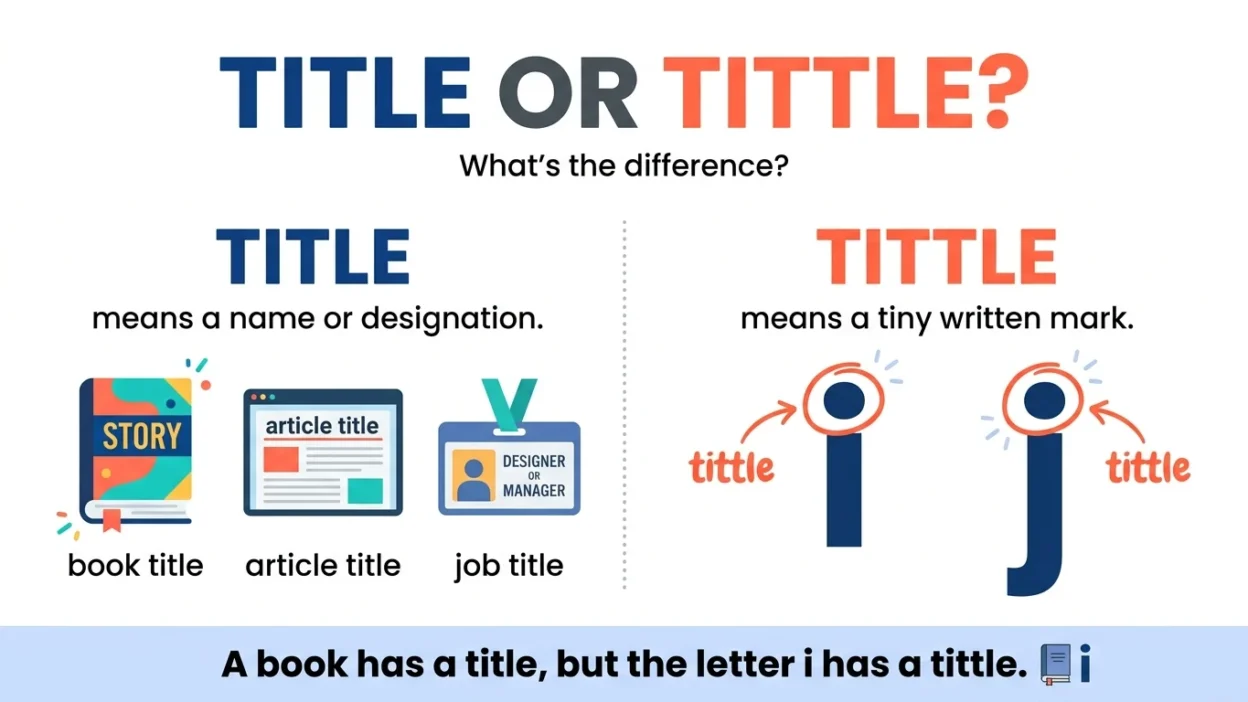
Choosing between title or tittle can be confusing because the two words differ by only one letter. However, title and tittle are both real English words with completely different meanings. Title is the common word used for the name of a book, movie, article, song, job position, or other work. For example, “What is the title of the book?” is correct.
Tittle is a much less common word. It refers to a small written or printed mark, especially the dot above a lowercase i or j. It also appears in the traditional expression jot or tittle, referring to even the smallest detail. Therefore, tittle is not simply an incorrect spelling of title, although it is often typed accidentally when someone intends to write title. If you are talking about the name of an article, book, movie, page, or position, title is almost certainly the word you need.
Quick Answer
Title is the correct word for the name of a book, article, movie, song, position, or other work. Tittle is also a real word, but it means a tiny written or printed mark, especially the dot above i or j. The two words are not interchangeable.
Title or Tittle Definition and Meaning
Title and tittle are separate English words.
Title commonly means the name given to a book, article, movie, song, artwork, or other work.
Example:
“The title of the article caught my attention.”
It can also refer to a person’s official position or designation.
Example:
“Her job title is manager.”
Tittle means a very small written or printed mark.
A familiar example is the dot above the lowercase letters i and j.
Therefore:
title means a name, heading, designation, or position
tittle means a small mark
Understanding these meanings makes the spelling difference easy to remember.
Why People Confuse Title and Tittle
People confuse title and tittle mainly because their spellings are extremely similar.
Compare:
title
tittle
The second word contains an additional t.
Because title is much more common, tittle may look like a spelling mistake. However, it is a legitimate English word with a specialized meaning.
The opposite problem also occurs. Someone intending to write title may accidentally type tittle because of the repeated letters.
For example:
Incorrect if referring to a book:
“What is the tittle of this book?”
Correct:
“What is the title of this book?”
If you mean a book, article, movie, song, or heading, title is normally the correct choice.
What Does Title Mean?
Title has several related meanings.
Most commonly, it refers to the name of a creative work, document, article, or other piece of content.
Examples:
“the title of a book”
“the title of a movie”
“the title of an article”
“the title of a song”
“the title of a report”
It can also refer to an official position:
“Her job title is director.”
In sports and competitions, title can refer to championship status:
“He won the world title.”
The word can also have legal meanings connected with ownership rights, particularly property.
Although the meanings vary, title is the common spelling in all these contexts.
What Does Tittle Mean?
Tittle is a noun referring to a small written, printed, or distinguishing mark.
The best known examples are the dots above lowercase i and j.
Those dots can be called tittles.
For example:
“The dot above the letter i is called a tittle.”
The word is uncommon in everyday conversation, so many English speakers may rarely encounter it.
Tittle can also refer more generally to a very small amount or detail, especially in older or traditional expressions.
Therefore, tittle is a legitimate word, but its meaning is much narrower than that of title.
Is Tittle a Word?
Yes, tittle is a real English word.
It is not automatically a misspelling of title.
However, whether it is correct depends entirely on meaning.
Correct:
“The dot above the lowercase i is a tittle.”
Incorrect:
“What is the tittle of your article?”
For an article, the correct word is:
“What is the title of your article?”
Because tittle is rare, it often appears accidentally when a writer intends title.
The easiest way to choose is to ask what you mean.
If you mean a name or heading, use title.
If you mean a tiny written mark, tittle may be correct.
Title vs Tittle Comparison Table
| Feature | Title | Tittle |
|---|---|---|
| Standard English word | Yes | Yes |
| Common in everyday English | Yes | No |
| Means name of a work | Yes | No |
| Means job designation | Yes | No |
| Can mean championship status | Yes | No |
| Means a small written mark | No | Yes |
| Dot above lowercase i or j | No | Yes |
| Example | The book has an interesting title. | The dot above i is a tittle. |
The simplest distinction is:
TITLE means a name or designation
TITTLE means a tiny mark
Title or Tittle Pronunciation Guide
Title and tittle are pronounced differently.
Title sounds approximately like:
“TY tul”
The first syllable contains the vowel sound heard in words such as my.
Tittle sounds approximately like:
“TIT ul”
The first syllable sounds like tit.
This pronunciation difference helps distinguish the two words in speech.
Compare:
title
“the title of the book”
tittle
“the tittle above the letter i”
Although the spellings are very similar, the words are not homophones.
Their different pronunciations reflect their different meanings.
How to Spell Title Correctly
If you mean the name of a book, article, movie, song, page, or document, spell the word:
TITLE
It contains one t after the first vowel sound in the written sequence:
t i t l e
A common typing error is:
tittle
That spelling adds an extra t and creates a different English word.
Examples of correct spelling include:
“article title”
“book title”
“movie title”
“job title”
“page title”
“song title”
“professional title”
If you are writing about names, headings, or designations, title is the spelling you will normally need.
When to Use Title
Use title when referring to the name or heading of something.
Examples:
“The book’s title is memorable.”
“Please enter the article title.”
“What is the movie title?”
“She changed the title of the report.”
You can also use title for positions:
“What is your job title?”
And for championships:
“She won the national title.”
In legal contexts, title can relate to a person’s right to ownership of property.
Because the word has several common meanings, context determines the exact interpretation.
However, none of these ordinary meanings should be spelled tittle.
When to Use Tittle
Use tittle when you specifically mean a small written or printed mark.
For example:
“The dot above the i is a tittle.”
“The lowercase j also has a tittle in many typefaces.”
The word is especially useful when discussing typography, writing systems, lettering, or the history of written symbols.
It can also appear in expressions where it means a tiny detail or amount.
Because this meaning is specialized, most everyday situations require title, not tittle.
If you are unsure, ask:
Am I talking about a tiny mark?
If yes, tittle may be correct.
Otherwise, title is probably the intended word.
When to Use Each Word
Use title for names, headings, official designations, championship status, and certain legal concepts.
Examples:
“book title”
“article title”
“job title”
“movie title”
“championship title”
Use tittle for a tiny written or printed mark.
Example:
“the tittle above the i”
Compare:
“The title of the book is printed in large letters.”
“The tittle above the lowercase i is very small.”
The words may look similar, but their meanings are completely different.
For most everyday writing, title is much more common.
Title or Tittle Examples
Here are 15 examples showing the correct usage:
- What is the title of the book?
- The article has an interesting title.
- She changed the title of her presentation.
- His official job title is manager.
- The movie title appears on the screen.
- I cannot remember the song title.
- Please write your report title at the top.
- The boxer won the championship title.
- The page title should be clear.
- This title attracts attention.
- The dot above the lowercase i is called a tittle.
- A lowercase j normally has a tittle.
- The designer adjusted the tittle above the letter.
- Tittle is much less common than title.
- Do not use tittle when you mean the name of a book.
Book Title or Book Tittle?
The correct expression is:
book title
For example:
“What is the title of the book?”
Do not write:
“What is the tittle of the book?”
unless you are somehow discussing a tiny typographical mark printed in the book.
A book title is the name given to the book.
Examples include:
“The book title appears on the cover.”
“She is trying to choose a title for her new book.”
“The title immediately caught my attention.”
When discussing books, title is the standard word.
A useful memory connection is:
A book has a title.
Article Title or Article Tittle?
The correct expression is:
article title
For example:
“The article title should clearly communicate the topic.”
If you are writing content for a website, newspaper, magazine, blog, or academic publication, use title.
Correct:
“Choose an attractive article title.”
Incorrect:
“Choose an attractive article tittle.”
A tittle is a small mark, not the name of an article.
For SEO writing, the title can be particularly important because it tells readers and search systems what the content is about.
Therefore, remember:
article title
not:
article tittle
Page Title or Page Tittle?
The correct expression is:
page title
For example:
“The page title should accurately describe the content.”
A page title gives a page its identifying name or heading.
Correct examples include:
“website page title”
“SEO title”
“page title tag”
“webpage title”
Do not use tittle for this meaning.
The spelling mistake is easy to make because only one extra t separates the words.
Remember:
The name of a page is its title.
A tittle is a tiny written mark.
Job Title or Job Tittle?
The correct expression is:
job title
A job title describes a person’s position or role within an organization.
Examples:
“Her job title is marketing manager.”
“What is your current job title?”
“Please enter your job title on the form.”
Common job titles include:
“manager”
“director”
“accountant”
“administrator”
“software engineer”
The phrase job tittle is incorrect when referring to a professional position.
Remember:
position equals title
Therefore:
job title
is the correct expression.
Movie Title or Movie Tittle?
The correct phrase is:
movie title
For example:
“I forgot the title of the movie.”
“The movie title appears at the beginning.”
“Can you remember the movie title?”
A title identifies a film just as it identifies a book, song, article, or television program.
Movie tittle is incorrect when referring to the name of a movie.
The distinction is simple:
title equals name
tittle equals tiny mark
Therefore, whenever you are talking about the name of a movie, choose title.
Song Title or Song Tittle?
The correct expression is:
song title
For example:
“What is the title of that song?”
“I remember the singer but not the song title.”
“The song title appears on the album.”
Do not use:
“song tittle”
when referring to the name of a song.
The same rule applies to:
“album title”
“poem title”
“story title”
“book title”
“movie title”
“article title”
In all of these expressions, title means the identifying name of a creative work.
Title of a Person
Title can also describe a person’s official, professional, social, or formal designation.
Examples include:
“Doctor”
“Professor”
“President”
“Director”
“Manager”
For example:
“Her professional title is Professor.”
“What title should I use when addressing him?”
The exact meaning depends on context, but the correct spelling remains title.
Do not use tittle for a person’s position or designation.
The easiest connection is:
A position can have a title.
A tiny mark can be a tittle.
Title as a Championship
Title can refer to a championship or the status of being a champion.
For example:
“She won the national title.”
“He successfully defended his world title.”
“The team is competing for the league title.”
This usage is common in sports.
Related expressions include:
“world title”
“championship title”
“league title”
“national title”
In all of these examples, title is correct.
Tittle does not have this meaning.
Therefore:
“He won the title.”
is correct when discussing a championship.
Title in Legal English
Title also has an important legal meaning related to ownership rights, especially ownership of property.
For example:
“The buyer received title to the property.”
You may also encounter expressions such as:
“property title”
“title document”
“clear title”
“transfer of title”
The precise legal meaning can depend on jurisdiction and context, but the spelling remains title.
Tittle is unrelated to this legal meaning.
This demonstrates how broad the word title can be. It can refer to names, positions, championships, and legal rights, while tittle has a much narrower meaning.
What Is the Dot Above I Called?
The dot above a lowercase i is called a tittle.
The dot above a lowercase j is also commonly described as a tittle.
This is probably the most interesting and memorable meaning of the word.
For example:
“The tittle distinguishes the lowercase i visually.”
Most people simply call it a dot, which is perfectly understandable in everyday conversation.
However, tittle is the specialized term.
This gives you an easy memory trick:
The tiny dot is a tittle.
The similarity between tiny and tittle can help you remember that the word refers to something very small.
Jot or Tittle Meaning
The expression jot or tittle is an old traditional phrase referring to even the smallest detail or amount.
A jot can mean a very small amount.
A tittle can refer to a tiny mark.
Together, the expression emphasizes something extremely small or precise.
For example, in contexts where the expression appears, it can suggest that not even the smallest detail should be changed or overlooked.
The phrase is much less common in everyday modern conversation than ordinary uses of title.
Still, it helps demonstrate that tittle is a genuine English word with a long history rather than simply a spelling error.
Title and Tittle in Real Life Usage
Imagine you are writing an article.
You might say:
“I need a better title for my article.”
Here, title means the name or heading of the article.
Now imagine you are designing a font and examining the lowercase letter i.
You might say:
“The tittle above the i is too large.”
Here, tittle refers to the small dot.
This comparison makes the difference clear:
Title identifies something.
Tittle is a tiny mark.
Because discussions about books, movies, articles, jobs, and webpages are much more common than discussions about tiny typographical marks, title appears far more frequently in everyday English.
Title in Business English
Title is frequently used in professional communication.
Examples include:
“job title”
“professional title”
“report title”
“presentation title”
“document title”
For example:
“Please enter your job title.”
“The report title should be clear and professional.”
“Change the presentation title before the meeting.”
Tittle would rarely appear in ordinary business communication unless the discussion involved typography, fonts, publishing, or graphic design.
Therefore, if you are writing about positions, reports, presentations, or documents, title is almost certainly the word you need.
Title in Academic Writing
Title is extremely common in academic writing.
Academic works usually have titles, including:
“essay title”
“research paper title”
“thesis title”
“article title”
“chapter title”
For example:
“The title of the research paper clearly identifies the topic.”
“Students should place the essay title at the top of the page.”
Tittle would normally appear only if the academic subject specifically involved typography, writing systems, linguistics, or related fields.
For ordinary academic assignments, title is the appropriate word for the name of the work.
Formal vs Informal Use
Both title and tittle are legitimate English words, but their frequency and contexts differ greatly.
Title is common in both formal and informal English.
Informal:
“What is the movie title?”
Formal:
“The title of the report accurately reflects its subject.”
Tittle is much less common and is more likely to appear in specialized, historical, linguistic, typographical, or literary contexts.
In everyday conversation, people usually say dot rather than tittle when referring to the mark above i or j.
The difference is therefore based on meaning, not simply on formality.
American vs British English
Both title and tittle exist in American and British English.
The basic meanings are the same.
In both varieties:
title can mean the name of a book, article, movie, song, position, or other work.
tittle can refer to a small written or printed mark, particularly the dot above lowercase i or j.
Therefore, there is no major American versus British spelling distinction for these words.
Whether you are writing for an American or British audience, choose the word according to its meaning.
Common Mistakes With Title and Tittle
The most common mistake is writing tittle when title is intended.
Incorrect:
“What is the tittle of the book?”
Correct:
“What is the title of the book?”
Incorrect:
“Enter your job tittle.”
Correct:
“Enter your job title.”
Incorrect:
“Write an attractive article tittle.”
Correct:
“Write an attractive article title.”
However, do not assume tittle is always incorrect.
Correct:
“The dot above the i is a tittle.”
The key is meaning.
Use title for names and designations.
Use tittle for a tiny mark.
Memory Trick for Title or Tittle
Use this simple memory trick:
TITLE equals NAME
A book has a title.
A movie has a title.
An article has a title.
A job can have a title.
Now remember:
TITTLE equals TINY MARK
The extra t can remind you of a tiny dot.
Think:
Tittle is tiny.
For example:
“The tiny dot above i is a tittle.”
This makes the difference easy:
Title means name
Tittle means tiny mark
Expert Tips for Choosing Title or Tittle
First ask whether you are referring to the name of something.
If yes, use:
title
Examples:
“book title”
“article title”
“movie title”
“song title”
Next ask whether you are referring to a professional position.
Again, use:
title
Example:
“job title”
If you are specifically discussing the small dot above a lowercase i or j, use:
tittle
Because title is far more common, it will be the correct choice in most everyday contexts.
However, knowing the specialized meaning of tittle prevents you from incorrectly labeling it as a nonexistent word.
Mistakes to Avoid
Do not add an extra t when you mean the name of something.
Incorrect:
“article tittle”
Correct:
“article title”
Incorrect:
“book tittle”
Correct:
“book title”
Incorrect:
“job tittle”
Correct:
“job title”
At the same time, do not claim that tittle is always a misspelling.
It is correct when referring to a small mark.
Example:
“The dot above the i is a tittle.”
Remembering both meanings is more accurate than simply memorizing one spelling as correct and the other as wrong.
Similar Words
Several English words have spellings that differ by only one letter but have completely different meanings.
Examples include:
title and tittle
later and latter
quite and quiet
lose and loose
desert and dessert
form and from
angle and angel
These pairs can be confusing because a small spelling change produces a different word.
The best approach is to learn each word together with a memorable example.
For this pair:
“the title of a book”
“the tittle above an i”
These examples make the distinction immediately clear.
Related Confusing Words
If title or tittle is confusing, these related spelling topics may also be useful:
later vs latter
quite vs quiet
lose vs loose
desert vs dessert
angle vs angel
form vs from
principal vs principle
stationary vs stationery
complement vs compliment
capital vs capitol
foreword vs forward
discrete vs discreet
These word pairs demonstrate why checking both spelling and meaning is important.
For the current pair, remember:
Title is the common word for a name or designation.
Tittle is the uncommon word for a tiny mark.
FAQs About Title or Tittle
Is it title or tittle?
Both are real words, but title is used for the name of a book, article, movie, song, or position. Tittle refers to a tiny written mark.
Is tittle a correct word?
Yes. Tittle is a legitimate English word meaning a small written or printed mark.
What is the difference between title and tittle?
Title commonly means a name, heading, designation, or championship. Tittle means a tiny mark, especially the dot above lowercase i or j.
Is it book title or book tittle?
Book title is correct when referring to the name of a book.
Is it article title or article tittle?
Use article title. A tittle is not the name of an article.
Is it job title or job tittle?
Job title is correct.
What is the dot above the letter i called?
The dot above a lowercase i is called a tittle.
Are title and tittle pronounced the same?
No. Title begins with the vowel sound heard in my, while tittle begins with the short vowel sound heard in sit.
Final Verdict on Title or Tittle
When choosing between title or tittle, remember that both are genuine English words, but they have very different meanings. Title is the common word used for the name of a book, article, movie, song, report, webpage, or other work. It can also refer to a job designation, championship status, or certain legal rights. Therefore, expressions such as book title, article title, job title, movie title, and page title are correct.
Tittle is much less common. It refers to a tiny written or printed mark, especially the dot above a lowercase i or j. It can also appear in older expressions such as jot or tittle. Therefore, tittle should not be dismissed as a spelling mistake in every situation. The easiest distinction is simple: title means a name or designation, while tittle means a tiny mark.
Remember This
Memorize these two meanings:
TITLE
A name or designation
“book title”
“article title”
“movie title”
“job title”
TITTLE
A tiny written mark
“the tittle above i”
The easiest memory trick is:
TITLE equals NAME
TITTLE equals TINY MARK
Remember the sentence:
A book has a title, but the letter i has a tittle.

Donald Andrew is a dedicated author at BiblyWord, passionate about sharing biblical teachings in a clear and inspiring way. He creates meaningful content that helps readers understand scripture, reflect on their faith, and apply God’s Word in daily life. His work supports spiritual growth, guidance, and a deeper connection with biblical wisdom.