The words ladder and latter can confuse English learners because their spellings and pronunciations are somewhat similar, especially in accents where the middle consonants may sound alike. However, their meanings are completely different. A ladder is a piece of equipment with steps or rungs that allows someone to climb up or down. You might use a ladder to reach a roof, paint a wall, or replace a light bulb. The word can also be used figuratively, as in career ladder or corporate ladder.
Latter, on the other hand, is used when referring to the second of two people, things, ideas, or options previously mentioned. For example, in “I like tea and coffee, but I prefer the latter,” the latter means coffee. Latter can also describe the later part of a period, as in the latter half of the year. This guide explains ladder vs latter, pronunciation, grammar, examples, common mistakes, and easy memory tricks.
Quick Answer
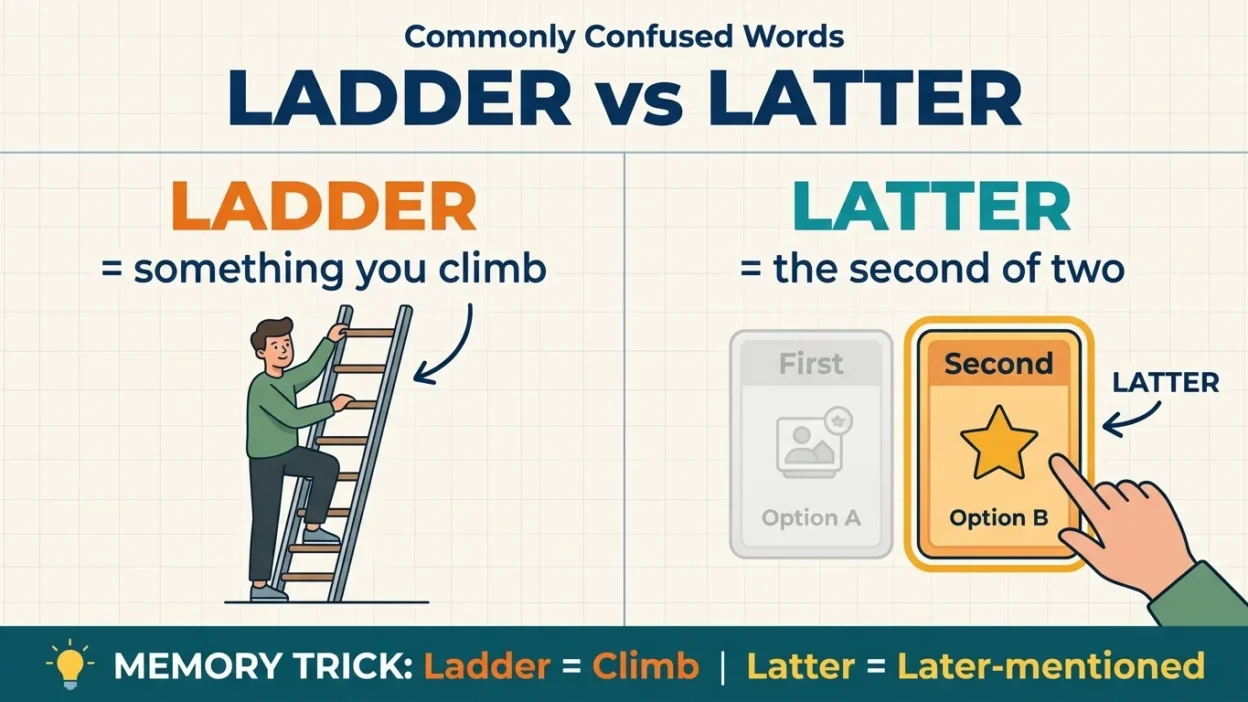
Ladder is something used for climbing, with steps or rungs: “He climbed the ladder.” Latter usually means the second of two things already mentioned: “Tea and coffee are available; I prefer the latter.” Remember: ladder = climb; latter = second or later-mentioned option.
Ladder vs Latter Definition and Meaning
The main difference between ladder and latter is their meaning and grammatical function.
A ladder is primarily a noun. It refers to a structure or piece of equipment used for climbing.
For example:
“She climbed the ladder to reach the roof.”
Latter is usually an adjective or noun-like expression referring to the second of two previously mentioned things.
For example:
“We can travel by train or plane; I prefer the latter.”
Here, the latter means plane, because plane was mentioned second.
The simplest distinction is:
Ladder = something you climb
Latter = the second of two
Once you connect each spelling with these meanings, choosing the correct word becomes much easier.
Why People Confuse Ladder and Latter
People often confuse ladder vs latter because the words look similar and can sound quite close in some varieties of English.
Their spellings differ mainly in the middle:
laDDer
laTTer
In some American accents, the sounds represented by d and t in these positions can become similar in rapid speech. This makes relying on pronunciation alone difficult.
However, their meanings are unrelated.
Compare:
“He climbed the ladder.”
“I was offered two jobs; I chose the latter.”
The first refers to climbing equipment. The second refers to the second option.
A good strategy is therefore to focus on meaning rather than sound. If you can physically or figuratively climb it, you probably need ladder. If you mean the second of two choices, use latter.
What Does Ladder Mean?
A ladder is a structure with a series of horizontal steps or rungs between two side supports. It is used for climbing up or down.
For example:
“He used a ladder to reach the window.”
Ladders are commonly used for:
- reaching roofs
- painting walls
- cleaning windows
- accessing high shelves
- construction work
- home repairs
The word also has figurative meanings.
A career ladder describes progress through increasingly important positions.
For example:
“She quickly moved up the career ladder.”
Similarly, climbing the corporate ladder means advancing to higher positions within a company.
Whether literal or figurative, ladder usually carries the idea of moving upward or downward through levels.
What Does Latter Mean?
Latter most commonly refers to the second of two people, things, or ideas previously mentioned.
For example:
“I enjoy reading novels and watching movies, but I prefer the latter.”
Here, the latter means watching movies because that option was mentioned second.
Another example:
“John and David applied for the position; the latter was selected.”
The latter refers to David.
Latter can also mean belonging to a later part of a period:
“The company performed better in the latter half of the year.”
In this sentence, latter means the later or second part of the year.
Therefore, latter is associated with being later, second, or nearer the end.
Ladder vs Latter Comparison Table
| Feature | Ladder | Latter |
|---|---|---|
| Main meaning | Equipment for climbing | Second of two mentioned things |
| Common part of speech | Noun | Adjective / “the latter” expression |
| Related to climbing? | Yes | No |
| Related to choices? | No | Yes |
| Can be figurative? | Yes | Yes |
| Common phrase | Career ladder | The latter option |
| Example | He climbed the ladder. | I prefer the latter. |
| Memory clue | Ladder = climb | Latter = later/second |
The key is to remember that ladder is associated with levels and climbing, while latter identifies a later-mentioned option.
Ladder vs Latter Pronunciation Guide
Ladder and latter may sound distinct in some accents and very similar in others.
Ladder is pronounced with the consonant sound associated with d:
LAD-er
Latter traditionally contains a t sound:
LAT-er
However, in many varieties of American English, the middle t in latter may be pronounced as a flap, making it sound quite similar to the middle sound in ladder.
Because pronunciation can vary by accent, sound alone is not a reliable way to choose the spelling.
Instead, remember:
Ladder → climbing
Latter → second of two
Meaning provides a much more dependable clue than pronunciation.
Ladder Grammar Rules Explained
Ladder is primarily a countable noun.
Singular:
“A ladder is leaning against the wall.”
Plural:
“Several ladders are stored in the garage.”
You can use articles before it:
- a ladder
- the ladder
You can also combine it with other words:
- step ladder
- extension ladder
- rope ladder
- career ladder
- corporate ladder
As a noun, ladder can be the subject or object of a sentence:
“The ladder fell.”
“He moved the ladder.”
In figurative expressions, it can represent a series of levels or stages:
“She climbed the career ladder quickly.”
The plural in such contexts is ladders.
Latter Grammar Rules Explained
Latter is often used in the expression the latter.
For example:
“Tea and coffee were offered; I chose the latter.”
Because coffee was mentioned second, it is the latter.
Latter can also modify a noun:
“During the latter half of the year, sales increased.”
Other examples include:
- latter part
- latter stages
- latter years
- latter period
- latter option
When using the latter to refer back to something previously mentioned, it traditionally works best when exactly two alternatives are being compared.
If you have a longer list, it is usually clearer to name the specific item rather than calling it the latter.
Former vs Latter
To understand latter, it helps to learn its common partner: former.
When two things are mentioned:
former = first
latter = second
For example:
“Sarah and Emma applied for the job; the former had more experience, but the latter performed better in the interview.”
Here:
the former = Sarah
the latter = Emma
Another example:
“You can study online or attend classes in person. The former offers flexibility, while the latter provides more face-to-face interaction.”
The former refers to the first option; the latter refers to the second.
Remember:
Former = first mentioned
Latter = last of the two mentioned
This pairing is especially common in formal and academic writing.
When to Use Ladder
Use ladder when referring to equipment designed for climbing.
For example:
“Please hold the ladder while I climb.”
Use it for different kinds of climbing equipment:
“The firefighter raised the ladder.”
You can also use it figuratively when describing progression through levels.
For example:
“He wants to climb the corporate ladder.”
Other common figurative uses include:
- career ladder
- social ladder
- property ladder
- promotional ladder
Ask yourself:
Can someone literally or figuratively climb it?
If yes, ladder is probably correct.
The double d spelling is always used for this climbing-related noun.
When to Use Latter
Use latter when referring to the second of two previously mentioned alternatives.
For example:
“Should we drive or take the train? I prefer the latter.”
The latter = the train.
You can also use latter to describe the later portion of something:
“Business improved during the latter part of the year.”
Other common phrases include:
- latter half
- latter part
- latter stages
- latter years
- latter option
If you are choosing between two previously mentioned things, ask:
Do I mean the second one?
If yes, the latter is appropriate.
Think of latter as being closely connected to later.
When to Use Each Word
Use ladder for:
- climbing equipment
- steps or rungs
- construction equipment
- career advancement
- corporate advancement
- a hierarchy of levels
Use latter for:
- the second of two things
- the second of two people
- the second of two choices
- the later part of a period
- the final stages of something
Compare:
“He climbed the ladder.”
“He could choose the stairs or elevator; he chose the latter.”
“She moved up the corporate ladder.”
“Sales increased during the latter half of the year.”
The contexts are completely different even though the words may sound similar.
Ladder vs Latter Examples
Here are 15 examples demonstrating correct usage:
- He climbed the ladder carefully.
- The ladder is leaning against the wall.
- She bought a new ladder for the garage.
- The firefighter climbed the ladder.
- He is moving up the corporate ladder.
- We need a taller ladder to reach the roof.
- I can choose tea or coffee; I prefer the latter.
- Sarah and Maria applied; the latter got the job.
- Sales increased in the latter half of the year.
- The story becomes more interesting in its latter stages.
- Between walking and driving, I prefer the latter.
- The ladder has twelve rungs.
- She reached the top of the career ladder.
- Of the two proposals, the latter is more practical.
- The company expanded rapidly during the latter part of the decade.
The Latter Meaning
The latter means the second of two things or people just mentioned.
For example:
“I have visited Lahore and Karachi, but I prefer the latter.”
The two places are:
- Lahore
- Karachi
Therefore:
the latter = Karachi
Another example:
“David and Michael were interviewed; the latter was hired.”
Here:
the latter = Michael
The phrase is particularly useful when you want to avoid repeating the second noun.
However, clarity matters. If the reader may struggle to remember which option came second, repeating the actual name or noun can be better than using the latter.
Latter Half Meaning
The phrase latter half means the second half or later portion of a period or event.
For example:
“The team performed much better in the latter half of the season.”
This means its performance improved during the second half.
Another example:
“Sales increased during the latter half of the year.”
The expression is common with:
- latter half of the year
- latter half of the century
- latter half of the season
- latter half of the decade
- latter half of the book
Here, latter does not refer directly to a previously named second item. Instead, it identifies the later of two portions of something.
Latter Part Meaning
Latter part refers to the later section or period of something.
For example:
“The latter part of the movie was more exciting.”
This means the later portion of the movie.
Another example:
“He became more successful during the latter part of his career.”
The phrase commonly appears with periods of time:
- latter part of the day
- latter part of the year
- latter part of the century
- latter part of a career
- latter part of a season
The connection with later makes this use easy to remember.
Latter part = later part
However, latter is generally used attributively in expressions such as these rather than as a simple replacement for later in every sentence.
Career Ladder Meaning
A career ladder is a figurative series of positions or levels through which someone can progress professionally.
For example:
“She started as an assistant and gradually climbed the career ladder.”
The expression compares career advancement to climbing a physical ladder.
Each higher rung represents greater:
- responsibility
- authority
- experience
- salary
- seniority
Another common expression is:
climb the corporate ladder
For example:
“He hopes to climb the corporate ladder and become a senior manager.”
Because the image involves moving upward through levels, ladder is the correct spelling.
Do not write career latter or corporate latter when describing professional advancement.
Corporate Ladder Meaning
The corporate ladder represents the hierarchy of positions within a company and the process of advancing to higher levels.
For example:
“She worked hard to climb the corporate ladder.”
A person might begin in an entry-level position and progress through roles such as:
assistant → supervisor → manager → director → executive
This resembles climbing the rungs of a physical ladder.
Common phrases include:
- climb the corporate ladder
- move up the corporate ladder
- rise through the corporate ladder
- reach the top of the corporate ladder
The correct word is always ladder because the expression is based on the metaphor of climbing.
Latter has no climbing-related meaning.
Ladder vs Latter in Real Life Usage
Imagine doing repairs around your home.
You might say:
“I need a ladder to reach the ceiling.”
Now imagine deciding between two tools:
“I can use the old tool or the new one; I prefer the latter.”
The first sentence refers to physical equipment.
The second refers to the second of two choices.
At work, someone might say:
“She is climbing the corporate ladder.”
In a report, you might read:
“Performance improved during the latter half of the year.”
These real-life examples demonstrate that ladder and latter belong to very different contexts despite their similar sound and appearance.
Ladder vs Latter in Business English
Both words can appear in business English, but in different contexts.
Ladder commonly appears in discussions of career progression:
“She quickly moved up the corporate ladder.”
Other phrases include:
- career ladder
- leadership ladder
- promotional ladder
Latter is useful when comparing two business options:
“The company considered expansion and consolidation; it ultimately chose the latter.”
It can also describe time periods:
“Revenue increased during the latter half of the fiscal year.”
Because latter can make formal writing concise, it appears regularly in reports and analyses. However, use it only when the reference is clear. If readers might be uncertain about what the latter refers to, repeat the specific term instead.
Ladder vs Latter in Academic Writing
Latter is particularly common in academic writing because researchers often compare two concepts, theories, approaches, or results.
For example:
“The study considered qualitative and quantitative methods; the latter produced a larger dataset.”
Here, the latter refers to quantitative methods.
Ladder may appear literally or metaphorically depending on the subject.
For example:
“The model represents social mobility as a ladder.”
Academic writers should avoid ambiguous uses of former and latter, especially after long or complicated descriptions. If the reader must look backward to determine what the latter means, repeating the specific noun may improve clarity.
Precise references are generally more important than avoiding repetition.
Formal vs Informal Use
Ladder is neutral and works naturally in formal and informal English.
Informal:
“Can you bring me the ladder?”
Formal:
“The technician used a ladder to access the equipment.”
Latter is also standard, but the latter tends to appear more often in formal, academic, analytical, and professional writing.
Formal:
“Both approaches were considered; the latter was selected.”
In casual conversation, people may simply repeat the noun:
“We could take the train or bus. I’d rather take the bus.”
rather than:
“I prefer the latter.”
Neither approach is wrong. The important point is that latter should have a clear reference so the reader or listener knows which second item you mean.
American vs British English
The basic meanings and spellings of ladder and latter are the same in American and British English.
In both:
ladder refers to climbing equipment or, figuratively, a progression of levels.
latter refers to the second of two mentioned items or to a later portion of something.
For example:
“He climbed the ladder.”
“I prefer the latter option.”
The pronunciation may vary according to accent. In some American accents, ladder and latter can sound especially similar because of the way the middle consonants are pronounced.
British accents may preserve a clearer distinction in many cases.
Regardless of pronunciation, the spelling and core meanings remain different.
Former vs Latter vs Later
Latter and later are related in appearance and meaning, but they are not interchangeable.
Former = first of two previously mentioned things.
Latter = second of two previously mentioned things.
Later = after a particular time or subsequently.
Examples:
“Tea and coffee were offered; I chose the latter.”
“I will drink coffee later.”
These sentences require different words.
Another example:
“John and Mark applied. The former had more experience, while the latter had stronger qualifications.”
Here:
former = John
latter = Mark
A useful memory connection is that latter points toward the item mentioned later in a pair, but the two words perform different grammatical functions.
Synonyms and Alternatives
Depending on context, alternatives for ladder may include:
- steps
- climbing equipment
- hierarchy
- progression
- advancement path
For figurative use:
“career ladder”
might sometimes be replaced with:
“career progression.”
Alternatives for the latter include:
- the second
- the second option
- the last-mentioned one
- the second-mentioned person
For example:
“I prefer the latter.”
could become:
“I prefer the second option.”
When clarity is important, explicitly naming the second item is often better than using the latter.
Synonyms can also help distinguish the words:
If climbing equipment fits, use ladder.
If the second one fits, use latter.
Common Sentences With Ladder and Latter
Here are some useful sentence patterns:
- He climbed the ladder.
- Please hold the ladder.
- The ladder is too short.
- She moved up the career ladder.
- He wants to climb the corporate ladder.
- I like both options, but I prefer the latter.
- Tea and coffee are available; I’ll choose the latter.
- Of the two plans, the latter is cheaper.
- Sales improved in the latter half of the year.
- The latter part of the book is excellent.
- John and Peter applied; the latter was selected.
- We considered driving and flying; the latter was faster.
Learning these common patterns makes the distinction easier to remember naturally.
Common Mistakes With Ladder and Latter
One common mistake is writing latter when referring to climbing equipment.
Incorrect:
❌ “He climbed the latter.”
Correct:
✅ “He climbed the ladder.”
Another mistake is using ladder when referring to the second option.
Incorrect:
❌ “I like tea and coffee, but I prefer the ladder.”
Correct:
✅ “I like tea and coffee, but I prefer the latter.”
Also avoid using the latter when its reference is unclear.
For example, if you mention several complicated ideas and then write “the latter,” readers may not know exactly which one you mean.
In such cases, repeat the specific noun for clarity.
Memory Trick for Ladder vs Latter
Use this simple memory trick:
LADDER = CLIMB
Imagine the double D as two sides of a ladder with rungs between them.
You can also associate:
Ladder → up and down
For latter, think:
LATTER → LATER
The latter is the option mentioned later when two things are listed.
Example:
“Tea or coffee? I prefer the latter.”
Coffee came later in the sentence, so coffee is the latter.
Your quick memory rule is:
Ladder = something you climb
Latter = second/later-mentioned choice
This simple visual and word association makes the spellings much easier to separate.
Expert Tips for Choosing Ladder or Latter
Use a substitution test whenever you are uncertain.
If something to climb fits the sentence, use ladder.
“He climbed the ___.”
Something to climb:
“He climbed the ladder.”
If the second one fits, use latter.
“I can buy the red car or blue car; I prefer the ___.”
“The second one” fits:
“I prefer the latter.”
You can also test for a time-related meaning.
“The latter half of the year”
means:
“the later/second half of the year.”
These meaning-based tests are much more reliable than pronunciation, especially in accents where ladder and latter sound similar.
Mistakes to Avoid
Do not use ladder as a substitute for latter simply because the words sound similar.
Avoid:
❌ “Of the two options, I prefer the ladder.”
Use:
✅ “Of the two options, I prefer the latter.”
Likewise, avoid:
❌ “He used a latter to reach the roof.”
Use:
✅ “He used a ladder to reach the roof.”
Also be cautious about using latter with more than two choices. Traditional usage works most clearly with a pair.
Instead of writing:
“Red, green, and blue were available; I selected the latter,”
write:
“I selected blue.”
Specific wording eliminates unnecessary ambiguity.
Similar Words
Several similar-looking words can add to the confusion:
Ladder
A structure used for climbing.
Latter
The second of two mentioned things or the later part.
Later
At a subsequent time.
Latest
Most recent.
Last
Final in order.
Former
The first of two previously mentioned things.
Compare:
“I’ll call you later.”
“I prefer the latter option.”
“He climbed the ladder.”
“The latest report arrived today.”
“The former was cheaper, but the latter was better.”
Learning these words together helps clarify the different roles they play.
Related Confusing Words
If ladder vs latter is difficult, you may also want to review:
- latter vs later
- former vs latter
- latest vs last
- affect vs effect
- accept vs except
- farther vs further
- than vs then
- loose vs lose
- passed vs past
- stationary vs stationery
- complement vs compliment
- principal vs principle
These word pairs often cause problems because they have similar spelling or pronunciation but different meanings.
For ladder vs latter, the easiest mental pictures remain:
Ladder → climb
Latter → second
Connecting each word to one strong meaning is often more effective than memorizing a long definition.
FAQs About Ladder vs Latter
What is the difference between ladder and latter?
A ladder is equipment used for climbing. Latter usually refers to the second of two previously mentioned people, things, or choices.
Is it ladder or latter option?
Use latter option when you mean the second of two options. For example: “Of the two plans, I prefer the latter option.”
What does “the latter” mean?
The latter means the second of two things or people previously mentioned.
What does “former and latter” mean?
When two things are mentioned, the former means the first one and the latter means the second one.
Is it career ladder or career latter?
Career ladder is correct. It describes progression through increasingly advanced professional positions.
What does latter half mean?
Latter half means the second or later half of something, such as the latter half of a year, season, century, or book.
Do ladder and latter sound the same?
They can sound very similar in some accents, particularly certain American accents. In other accents, the middle consonants are more clearly distinguished.
How can I remember ladder vs latter?
Remember: ladder = climb and latter = second of two. You can also connect latter with later: the latter item is the one mentioned later.
Final Verdict on Ladder vs Latter
The difference between ladder vs latter is straightforward once you focus on meaning. A ladder is a structure used for climbing and can also figuratively represent progression through levels, as in career ladder or corporate ladder. If the sentence involves climbing, steps, rungs, or advancement through levels, ladder is the correct word.
Latter, meanwhile, commonly refers to the second of two previously mentioned people, things, ideas, or options. It can also describe a later portion of something, as in the latter half of the year. Remember that the former is the first of two and the latter is the second. The easiest rule is: ladder = climb; latter = second or later-mentioned option.
Remember This
The easiest way to remember the difference is:
LADDER = CLIMB
“He climbed the ladder.”
“She’s moving up the career ladder.”
LATTER = SECOND OF TWO
“Tea or coffee? I prefer the latter.”
Use this extra trick:
LATTER → LATER
The latter is the one mentioned later in a pair.
So remember:
Ladder = rungs and climbing
Latter = second/later-mentioned choice

Carol Amanda is a passionate writer and faith-driven author dedicated to sharing the wisdom of the Bible. At BiblyWord, she creates inspiring and meaningful content that encourages spiritual growth and daily reflection. Her work focuses on helping readers connect with God’s Word and find guidance, peace, and strength in their faith journey.