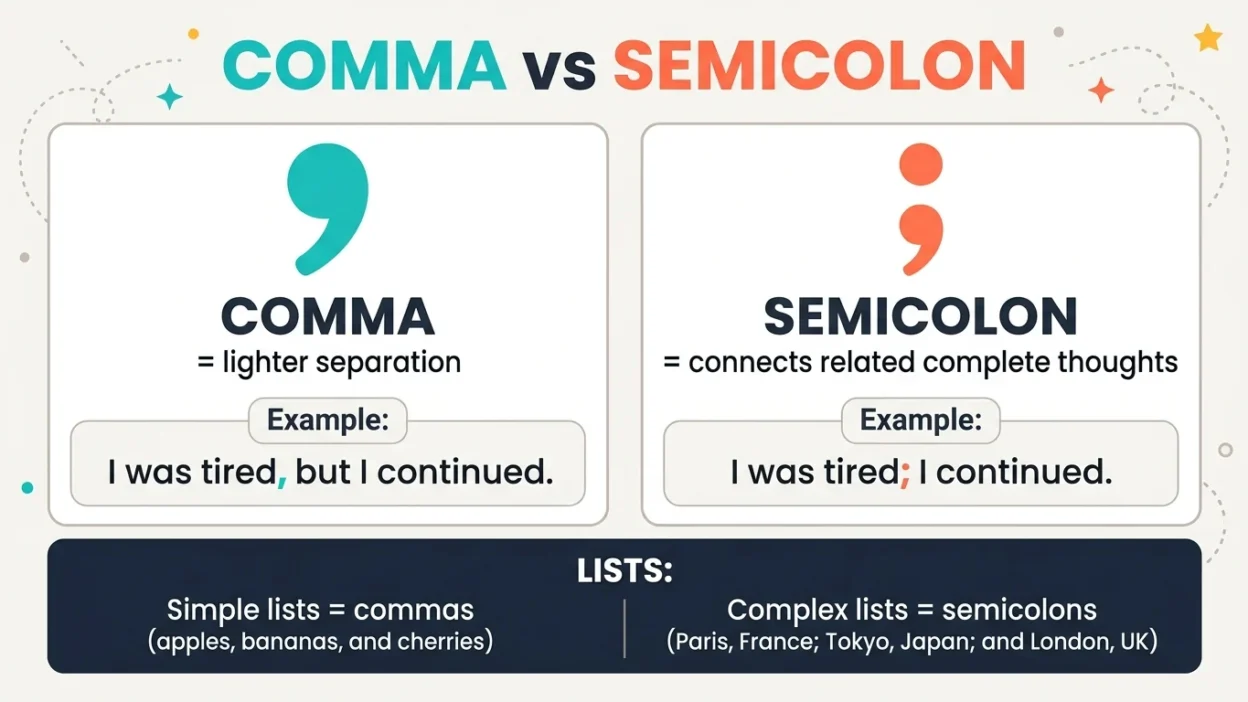
Choosing between a comma vs semicolon can be difficult because both punctuation marks create pauses and help organize ideas within sentences. However, they do not perform the same grammatical job. A comma (,) creates a relatively light separation and is used in lists, after introductory elements, around certain nonessential information, and with coordinating conjunctions that connect independent clauses. A semicolon (;) creates a stronger division and can connect closely related independent clauses without a coordinating conjunction.
Using the wrong punctuation can affect both clarity and grammar. A comma between two complete sentences can create a comma splice, while a semicolon placed where only a comma is needed may make writing awkward or incorrect. Fortunately, choosing between them becomes easier when you determine whether the material on both sides could stand as complete sentences. This guide explains comma vs semicolon rules, examples, common mistakes, lists, conjunctions, transitions, academic writing, and simple memory tricks.
Quick Answer
A comma (,) creates a lighter separation and has many uses, including lists and introductory phrases. A semicolon (;) can join two closely related independent clauses without a coordinating conjunction. Use a semicolon when both sides could stand as complete sentences; use a comma for lighter grammatical separation.
Comma vs Semicolon Definition and Meaning
A comma and a semicolon are punctuation marks used to organize sentences, but their grammatical functions differ.
A comma looks like this:
,
A semicolon looks like this:
;
A comma can separate items:
“I bought bread, milk, eggs, and cheese.”
It can also appear before a coordinating conjunction joining two independent clauses:
“I was tired, but I kept working.”
A semicolon can connect closely related independent clauses directly:
“I was tired; I kept working.”
A semicolon can also separate items in a complicated list when those items already contain commas.
The central difference is that a semicolon creates a stronger boundary than a comma but a less complete break than a period.
Why People Confuse Commas and Semicolons
People confuse commas and semicolons because both punctuation marks can appear in the middle of sentences and both create some degree of separation.
The difficulty increases because punctuation is not simply about where you “pause” while speaking. Grammar determines many punctuation choices.
For example:
❌ “I finished my work, I went home.”
Both parts are independent clauses, so this creates a comma splice in standard edited English.
You could write:
“I finished my work; I went home.”
Or:
“I finished my work, and I went home.”
The first uses a semicolon to connect two complete thoughts. The second uses a comma plus the coordinating conjunction and.
Understanding clause structure is therefore more reliable than judging punctuation by the length of a spoken pause.
What Is a Comma?
A comma (,) is one of the most frequently used punctuation marks in English.
It can perform several important jobs.
A comma can separate items in a series:
“We bought apples, oranges, bananas, and grapes.”
It can follow an introductory element:
“After dinner, we went for a walk.”
It can separate two independent clauses when they are connected by a coordinating conjunction:
“I wanted to go, but I was busy.”
Commas can also set off certain nonessential elements:
“My brother, who lives in Lahore, is visiting.”
Because commas have many uses, there is no single rule that covers every situation. However, commas generally create a lighter grammatical separation than semicolons or periods.
What Is a Semicolon?
A semicolon (;) is a punctuation mark that creates a stronger separation than a comma while maintaining a closer connection than two separate sentences often would.
Its most familiar use is joining two closely related independent clauses.
For example:
“The weather was terrible; we stayed inside.”
Both sides are complete sentences:
“The weather was terrible.”
“We stayed inside.”
Because the ideas are closely connected, a semicolon can join them.
Semicolons also appear before conjunctive adverbs or transitions connecting independent clauses:
“The weather was terrible; therefore, we stayed inside.”
Another important use is separating complicated list items:
“The offices are in Lahore, Pakistan; Dubai, UAE; and London, England.”
Here, semicolons make the list easier to understand.
Comma vs Semicolon Comparison Table
| Feature | Comma | Semicolon |
|---|---|---|
| Symbol | , | ; |
| Strength | Lighter separation | Stronger separation |
| Separates simple list items | Yes | Usually no |
| Joins related independent clauses alone | No | Yes |
| Used with coordinating conjunctions | Often | Usually not for this purpose |
| Used with conjunctive adverbs | Not alone between independent clauses | Yes |
| Separates complex list items | Sometimes insufficient | Yes |
| Example | I was tired, but I worked. | I was tired; I worked. |
The key question is often whether the material on both sides can function as complete sentences.
Comma vs Semicolon Pronunciation and Reading
Punctuation marks do not have ordinary spoken pronunciations within sentences, but they influence how readers process written language.
A comma often indicates a relatively light boundary:
“After the meeting, we had lunch.”
A semicolon signals a stronger structural break:
“The meeting ended early; we had time for lunch.”
You may hear people describe a semicolon as representing a longer pause than a comma. While this can sometimes be a useful reading cue, it should not be treated as the main grammatical rule.
Punctuation is primarily about sentence structure and meaning, not measuring pauses.
When deciding between a comma and semicolon, identify the clauses and their relationship rather than simply reading the sentence aloud and guessing based on rhythm.
Grammar Rules for Commas
Commas have many grammatical uses.
Use a comma to separate items in a series:
“She bought pens, pencils, notebooks, and folders.”
Use one after many introductory elements:
“Before leaving, check the door.”
Use a comma before a coordinating conjunction joining independent clauses:
“I called him, but he did not answer.”
Use commas to set off certain nonessential information:
“Sarah, my oldest friend, moved abroad.”
Commas can also appear with direct address:
“David, please sit down.”
One important rule is that a comma by itself should not normally join two independent clauses in standard edited prose. Doing so creates what is commonly called a comma splice.
Grammar Rules for Semicolons
The most important semicolon rule is simple:
A semicolon can join two closely related independent clauses without a coordinating conjunction.
Example:
“The deadline is tomorrow; we need to finish today.”
Both parts could stand independently:
“The deadline is tomorrow.”
“We need to finish today.”
A semicolon is therefore grammatically appropriate.
Semicolons can also connect independent clauses when the second begins with a conjunctive adverb or similar transitional expression:
“The deadline is tomorrow; therefore, we need to finish today.”
Finally, use semicolons to separate complex list items when those items contain internal commas.
Example:
“We visited Karachi, Pakistan; Istanbul, Türkiye; and Rome, Italy.”
These uses cover most situations where semicolons are needed.
When to Use a Comma
Use a comma when you need a relatively light grammatical separation.
Common situations include:
- separating simple list items
- following an introductory phrase or clause
- before a coordinating conjunction joining independent clauses
- setting off certain nonessential information
- separating direct address
- separating some coordinate adjectives
Examples:
“First, we need to review the report.”
“I wanted coffee, but the café was closed.”
“We bought bread, butter, milk, and eggs.”
“My teacher, who recently moved here, is very helpful.”
Do not assume every natural pause needs a comma. Instead, identify the grammatical structure and apply the relevant comma rule.
When to Use a Semicolon
Use a semicolon when two complete, closely related sentences would benefit from being presented as one connected sentence.
Example:
“The shop was closed; we returned home.”
Both halves are independent clauses.
You can also use a semicolon before transitions such as however, therefore, nevertheless, consequently, and moreover when they connect independent clauses:
“The shop was closed; therefore, we returned home.”
Another major use involves complicated lists:
“Participants came from Karachi, Pakistan; Doha, Qatar; and Muscat, Oman.”
The semicolons prevent the commas inside individual list items from creating confusion.
A semicolon should not normally separate a dependent clause from the independent clause it belongs to.
When to Use Each Punctuation Mark
A quick decision process can help you choose between a comma and semicolon.
Use a comma for:
- simple lists
- introductory elements
- certain nonessential information
- independent clauses joined by coordinating conjunctions
Use a semicolon for:
- two closely related independent clauses without a coordinating conjunction
- independent clauses connected by transitions such as however
- complex lists containing internal commas
Compare:
“I wanted to leave, but I stayed.”
“I wanted to leave; I stayed.”
Both are correct.
The first uses comma + but.
The second uses a semicolon without a coordinating conjunction.
The grammar of the connection determines which punctuation mark is appropriate.
Comma vs Semicolon Examples
Here are 15 examples showing correct usage:
- I was tired, but I continued working.
- I was tired; I continued working.
- We bought apples, bananas, oranges, and pears.
- The rain stopped; the sun appeared.
- After breakfast, we left the hotel.
- She studied hard; therefore, she felt prepared.
- John, my neighbor, works at the bank.
- I called him, but he did not answer.
- The deadline is tomorrow; we must work quickly.
- Before you leave, turn off the lights.
- We visited Paris, France; Rome, Italy; and Madrid, Spain.
- The road was blocked; however, we found another route.
- Yes, I understand the instructions.
- He wanted to attend, yet he had another appointment.
- The evidence was convincing; the committee approved the proposal.
These examples illustrate the different levels and types of separation.
Comma vs Semicolon Between Two Sentences
A semicolon can connect two independent clauses when their ideas are closely related.
For example:
“The storm became stronger; we decided to leave.”
Both parts are grammatically complete.
You could also write:
“The storm became stronger. We decided to leave.”
The period creates a stronger separation.
A comma alone is generally not enough:
❌ “The storm became stronger, we decided to leave.”
That construction is a comma splice.
To fix it, you could add a conjunction:
“The storm became stronger, so we decided to leave.”
Or use a semicolon:
“The storm became stronger; we decided to leave.”
This is one of the most important differences between commas and semicolons.
Comma Plus Conjunction vs Semicolon
When two independent clauses are connected by a coordinating conjunction, a comma is commonly used before the conjunction.
The coordinating conjunctions are often remembered as FANBOYS:
- for
- and
- nor
- but
- or
- yet
- so
Example:
“I wanted to buy the laptop, but it was too expensive.”
Without the conjunction, you can use a semicolon:
“I wanted to buy the laptop; it was too expensive.”
Usually, you do not need both a semicolon and a coordinating conjunction in a straightforward sentence.
The two common patterns are:
Independent clause + comma + coordinating conjunction + independent clause
or:
Independent clause + semicolon + independent clause
Semicolon Before However
One of the most common uses of a semicolon is before however when however connects two independent clauses.
Correct:
“I wanted to attend; however, I was unavailable.”
Notice the punctuation pattern:
semicolon + however + comma
Another example:
“The proposal was expensive; however, the committee approved it.”
A common mistake is:
❌ “The proposal was expensive, however, the committee approved it.”
When however functions as a conjunctive adverb connecting two independent clauses, a comma alone does not create the appropriate boundary.
You could instead use a period:
“The proposal was expensive. However, the committee approved it.”
Both the period and semicolon versions are correct.
Semicolon Before Therefore
Therefore often functions as a conjunctive adverb showing a result or conclusion.
When it connects two independent clauses within one sentence, use a semicolon before it and typically a comma after it.
Example:
“The road was closed; therefore, we took another route.”
The two independent clauses are:
“The road was closed.”
“We took another route.”
Another example:
“The evidence was incomplete; therefore, the investigation continued.”
You could also separate them with a period:
“The evidence was incomplete. Therefore, the investigation continued.”
Avoid using only a comma between the independent clauses:
❌ “The evidence was incomplete, therefore, the investigation continued.”
In formal edited English, the semicolon or period provides the necessary separation.
Comma vs Semicolon in a List
Commas normally separate items in a simple list.
Example:
“We need paper, pens, folders, and envelopes.”
However, semicolons are useful when the individual items already contain commas.
For example:
“The conference included speakers from Lahore, Pakistan; London, England; Toronto, Canada; and Sydney, Australia.”
If only commas were used, readers might struggle to determine where one item ends and another begins.
Think:
Simple list → commas
Complex list with internal commas → semicolons
This is sometimes called using semicolons as super commas because they create clearer divisions between complicated list items.
The goal is readability, not simply making a sentence look more formal.
Comma vs Semicolon Before And
Usually, when and joins two independent clauses, use a comma before it.
Example:
“Sarah finished the report, and John submitted it.”
Both clauses are complete, but and performs the connecting job.
A semicolon is normally used when no coordinating conjunction is needed:
“Sarah finished the report; John submitted it.”
If and merely joins words or short phrases rather than independent clauses, a comma may not be necessary:
“Sarah and John submitted the report.”
Therefore, do not automatically place a comma or semicolon before every and. First determine what and is connecting.
Sentence structure should guide your punctuation choice.
Comma vs Semicolon Before But
When but connects two independent clauses, a comma is normally appropriate.
Example:
“I called her, but she did not answer.”
Both sides can stand as sentences:
“I called her.”
“She did not answer.”
Because but connects them, a comma is enough.
You could remove but and use a semicolon:
“I called her; she did not answer.”
However, the relationship between the ideas may feel slightly different because but explicitly expresses contrast.
Avoid writing:
❌ “I called her; but she did not answer.”
In ordinary sentence structure, prefer either:
“I called her, but she did not answer.”
or:
“I called her; she did not answer.”
Comma Splice vs Semicolon
A comma splice occurs when two independent clauses are joined only by a comma without an appropriate conjunction.
Example:
❌ “The meeting ended, everyone went home.”
“The meeting ended” is a complete sentence.
“Everyone went home” is also a complete sentence.
A comma alone is not normally sufficient to connect them in standard edited prose.
You can correct the sentence several ways:
Semicolon:
“The meeting ended; everyone went home.”
Period:
“The meeting ended. Everyone went home.”
Comma + conjunction:
“The meeting ended, so everyone went home.”
Recognizing comma splices is one of the most useful reasons to understand the difference between commas and semicolons.
Semicolon vs Period
A semicolon and period can often both be grammatically correct between two independent clauses.
Compare:
“The sun was setting; we headed home.”
“The sun was setting. We headed home.”
The difference is largely rhetorical.
The semicolon emphasizes a close relationship between the two ideas and keeps them within one sentence.
The period gives each statement greater independence.
A semicolon is therefore useful when you want readers to recognize that two complete thoughts are strongly connected.
However, do not overuse semicolons. Sometimes two short sentences are clearer.
The best punctuation is the one that expresses the relationship naturally while keeping the sentence easy to understand.
Comma vs Semicolon in Real Life Writing
Imagine writing an email:
“I have reviewed the document, and I will send my comments tomorrow.”
The comma works because and connects two independent clauses.
Now consider:
“I have reviewed the document; several sections need revision.”
A semicolon works because both clauses are complete and closely related.
For a list:
“Please bring your laptop, charger, notebook, and identification.”
Commas are sufficient.
For a complex list:
“Meetings are scheduled in Lahore, Pakistan; Dubai, UAE; and London, England.”
Semicolons improve clarity.
These patterns appear regularly in emails, reports, essays, articles, presentations, and professional correspondence.
Comma vs Semicolon in Academic Writing
Both commas and semicolons are important in academic writing.
Commas help organize introductory phrases, lists, clauses, and nonessential information.
For example:
“After analyzing the results, researchers identified three major patterns.”
Semicolons can connect closely related independent clauses:
“The first experiment produced significant results; the second produced no measurable difference.”
They are also useful for complex lists containing internal punctuation.
However, semicolons should not be inserted merely to make writing appear sophisticated. Incorrect semicolon usage can make academic prose less clear rather than more professional.
Before using one, verify that both sides are independent clauses unless you are using the semicolon to separate complex list items.
Comma vs Semicolon in Business Writing
Clear punctuation is valuable in business emails, reports, proposals, and presentations.
Consider:
“The client approved the design, but several changes are still required.”
The comma works with but.
Compare:
“The client approved the design; implementation can begin tomorrow.”
A semicolon connects two related complete statements.
Semicolons can also improve complicated business lists:
“The project involves Ali Khan, marketing manager; Sarah Lee, financial analyst; and David Jones, project coordinator.”
Without semicolons, the commas separating names from job titles could make the list difficult to parse.
In professional writing, clarity should be the priority. Use semicolons when they make relationships or complex lists clearer, not simply because they look formal.
Formal vs Informal Use
Commas are essential in both formal and informal writing.
Semicolons are also grammatically appropriate in both, although they tend to appear more often in carefully edited, formal, literary, professional, or academic prose than in casual text messages.
Informal:
“I’m tired, but I’ll finish it.”
More structured:
“I’m tired; I still need to finish the report.”
Neither punctuation mark is inherently “too formal.” The question is whether it fits the sentence structure.
In very casual communication, writers may prefer shorter sentences instead of semicolons.
In essays, reports, and articles, semicolons can be valuable for showing a close relationship between complete thoughts while avoiding repetitive conjunctions or overly short sentences.
American vs British English
The fundamental grammatical rules for commas and semicolons are broadly similar in American and British English.
In both varieties, a semicolon can connect closely related independent clauses:
“The evidence was strong; the conclusion was clear.”
Both also use semicolons to organize complex lists.
Comma conventions can differ somewhat between styles. One familiar example involves the serial comma, also called the Oxford comma.
A sentence might be written:
“tea, coffee, and juice”
or:
“tea, coffee and juice.”
Style guides differ on whether the comma before the final conjunction should routinely be included.
This variation does not change the core distinction between a comma and semicolon.
Common Mistakes With Commas and Semicolons
A major mistake is using a comma alone between independent clauses:
❌ “I was hungry, I made dinner.”
Correct:
✅ “I was hungry; I made dinner.”
Or:
✅ “I was hungry, so I made dinner.”
Another mistake is using a semicolon before a dependent clause:
❌ “I stayed home; because it was raining.”
Correct:
✅ “I stayed home because it was raining.”
Another error is using a comma where a semicolon is needed before a conjunctive adverb:
❌ “It was raining, however, we continued.”
Better:
✅ “It was raining; however, we continued.”
The best safeguard is to identify whether the clauses on each side are grammatically complete.
Memory Trick for Comma vs Semicolon
Use this simple memory trick:
Comma = small connection
Semicolon = sentence connection
A semicolon can often connect:
complete sentence ; complete sentence
For example:
“The rain stopped; we went outside.”
Both sides work independently.
For a comma with a coordinating conjunction, remember:
sentence , FANBOYS sentence
Example:
“The rain stopped, so we went outside.”
For lists:
Simple list = commas
Complex list with commas inside items = semicolons
These three patterns cover many of the most common situations and make choosing the correct punctuation much easier.
Expert Tips for Choosing a Comma or Semicolon
When you are unsure, check both sides of the punctuation mark.
Ask:
Can the words before the mark form a complete sentence?
Then ask:
Can the words after it also form a complete sentence?
If both answers are yes and the ideas are closely related, a semicolon may work.
Example:
“She practiced every day; her performance improved.”
If the clauses are joined by and, but, or, yet, so, for, or nor, a comma is often appropriate:
“She practiced every day, so her performance improved.”
If you are writing a simple list, use commas.
If list items already contain commas, semicolons can make the structure much clearer.
Mistakes to Avoid
Do not use semicolons simply because you want a longer pause.
Avoid:
❌ “After finishing dinner; we went home.”
The introductory phrase is not an independent clause.
Correct:
✅ “After finishing dinner, we went home.”
Do not join complete sentences with only a comma in standard edited prose:
❌ “The car stopped, we called for help.”
Use:
✅ “The car stopped; we called for help.”
Also avoid unnecessary semicolons in simple lists:
❌ “I bought apples; oranges; bananas; and pears.”
Use:
✅ “I bought apples, oranges, bananas, and pears.”
Always choose punctuation based on grammatical structure and clarity rather than appearance.
Similar Punctuation Marks
Understanding comma vs semicolon becomes easier when you compare them with related punctuation.
Period (.)
Ends a sentence and creates a strong separation.
Colon (:)
Often introduces an explanation, list, quotation, or elaboration after an independent clause.
Semicolon (;)
Links closely related independent clauses or separates complex list items.
Comma (,)
Creates lighter grammatical divisions and performs many functions.
Dash (—)
Can create emphasis, interruption, or an explanatory break.
For example:
Comma:
“I was tired, but I continued.”
Semicolon:
“I was tired; I continued.”
Period:
“I was tired. I continued.”
Each choice affects the structure, rhythm, and relationship between ideas.
Related Confusing Grammar Topics
Writers who struggle with commas and semicolons often benefit from reviewing related punctuation topics, including:
- semicolon vs colon
- comma vs period
- colon vs dash
- comma before and
- comma before but
- comma before because
- comma splice rules
- Oxford comma
- independent vs dependent clauses
- conjunctive adverbs
- FANBOYS conjunctions
- run-on sentences
The most important underlying skill is recognizing an independent clause.
An independent clause contains a subject and predicate and expresses a complete thought.
Once you can identify complete clauses, choosing between commas, semicolons, periods, and conjunctions becomes much easier.
FAQs About Comma vs Semicolon
What is the main difference between a comma and semicolon?
A comma provides lighter grammatical separation and has many uses. A semicolon can join two closely related independent clauses without a coordinating conjunction and can separate complex list items.
When should I use a semicolon instead of a comma?
Use a semicolon when you want to connect two closely related independent clauses without a coordinating conjunction, as in: “It was late; we went home.”
Can a comma connect two complete sentences?
Not by itself in standard edited English. Use a semicolon, period, or an appropriate conjunction with the comma.
Do you use a semicolon before however?
When however connects two independent clauses within one sentence, a common pattern is semicolon + however + comma: “I wanted to go; however, I was busy.”
Should I use a comma or semicolon in a list?
Use commas for simple lists. Use semicolons when list items are complex or already contain commas.
Do you put a semicolon before and?
Usually, a comma is used before and when it joins two independent clauses. A semicolon is normally used without a coordinating conjunction when directly connecting closely related clauses.
Is a semicolon stronger than a comma?
Yes. A semicolon creates a stronger grammatical boundary than a comma but generally maintains a closer relationship than a period.
How can I remember comma vs semicolon?
Remember: comma = lighter separation; semicolon = complete sentence + complete sentence, or a separator for complex list items.
Final Verdict on Comma vs Semicolon
The difference between a comma vs semicolon becomes much easier once you focus on sentence structure. A comma is a versatile punctuation mark used for lists, introductory elements, nonessential information, and independent clauses connected by coordinating conjunctions. It creates a relatively light grammatical boundary.
A semicolon creates a stronger connection between two closely related independent clauses without requiring a coordinating conjunction. It is also useful for separating complicated list items that already contain commas. When uncertain, check whether both sides could stand as complete sentences. If they can and the ideas are closely connected, a semicolon may be appropriate. If you are creating a lighter separation or using a coordinating conjunction, a comma may be the better choice.
Remember This
Use these three quick patterns:
Comma + conjunction
“I was tired, but I continued.”
Semicolon between related complete sentences
“I was tired; I continued.”
Simple list = commas
“We bought bread, milk, eggs, and cheese.”
Complex list = semicolons
“We visited Lahore, Pakistan; Dubai, UAE; and London, England.”
The simplest memory trick is:
Comma = lighter separation
Semicolon = stronger connection between complete thoughts

Carol Amanda is a passionate writer and faith-driven author dedicated to sharing the wisdom of the Bible. At BiblyWord, she creates inspiring and meaningful content that encourages spiritual growth and daily reflection. Her work focuses on helping readers connect with God’s Word and find guidance, peace, and strength in their faith journey.