The difference between hung vs hanged can confuse even experienced English speakers because both words are past forms related to the verb hang. In most situations, hung is the correct past tense and past participle. You can say that someone hung a picture on the wall, hung their coat by the door, or that curtains were hung over the windows. Hanged, however, has a much narrower traditional use: it is generally used when referring to a person being put to death by hanging.
The distinction is largely based on meaning rather than ordinary tense rules. That is why “The picture was hanged on the wall” sounds unusual in standard modern English, while “The prisoner was hung” may be avoided when the intended meaning is execution. There are also historical, legal, figurative, and idiomatic contexts worth understanding. This guide explains hung vs hanged, grammar rules, pronunciation, examples, common mistakes, and an easy memory trick.
Quick Answer
Use hung as the past tense and past participle of hang in most situations: “She hung the picture.” Use hanged traditionally when hang means putting a person to death by suspension: “The condemned man was hanged.” Remember: objects are usually hung; people executed by hanging are hanged.
Hung vs Hanged Definition and Meaning
Both hung and hanged are legitimate past forms of hang, but modern standard usage generally assigns them different roles.
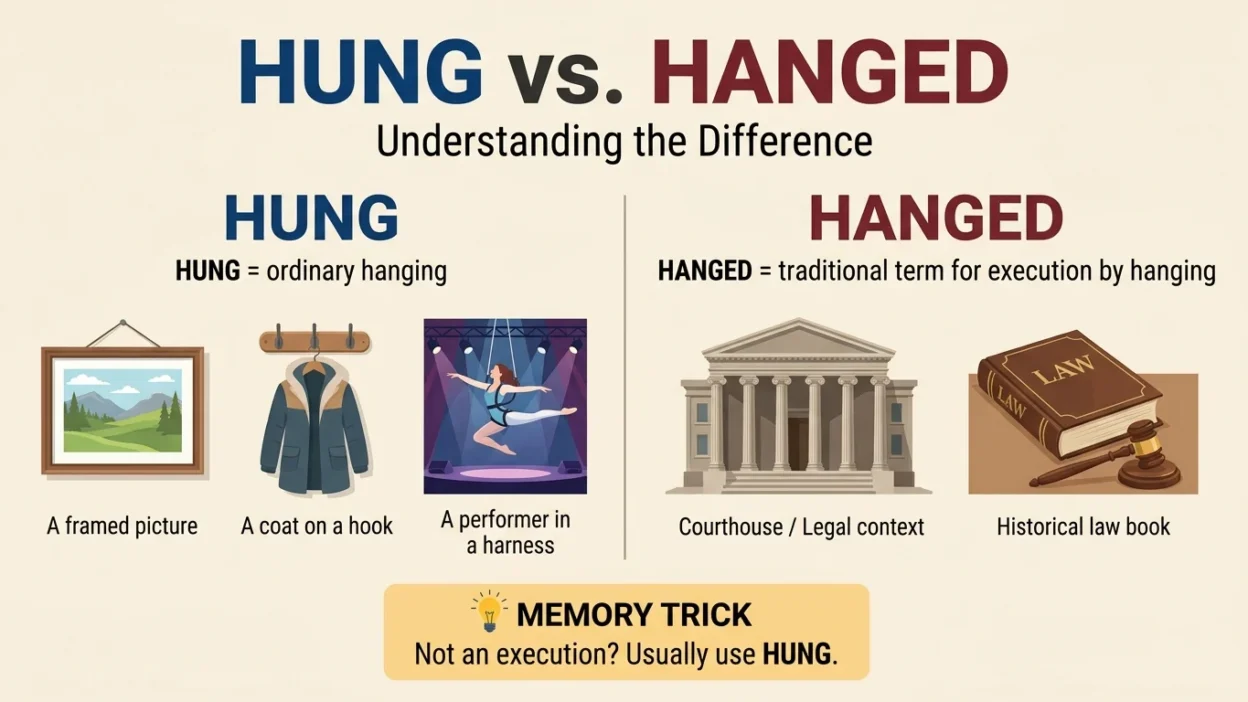
Use hung when something is suspended, attached, displayed, or placed so that it hangs.
Examples:
“She hung her coat on the hook.”
“The painting was hung above the fireplace.”
Use hanged when referring specifically to death by hanging:
“The condemned prisoner was hanged.”
This gives us the familiar rule:
Hung = ordinary suspension
Hanged = execution by hanging
The distinction is strong in edited English, although actual historical and regional usage can be more complicated. For most everyday and professional writing, following this rule will keep your sentences clear and conventional.
Why People Confuse Hung and Hanged
People confuse hung vs hanged because English normally uses one past-tense form of a verb regardless of what the verb means.
For example:
walk → walked
open → opened
jump → jumped
But hang developed two past forms that became associated with different meanings:
hang → hung
hang → hanged
The word hung is much more common because it covers most ordinary meanings of hang. The specialized hanged form is mainly preserved for execution.
This creates uncertainty when a sentence involves a person but not an execution.
For example:
“He hung from the tree branch.”
Here, hung is correct because the sentence merely describes suspension.
The distinction is therefore not simply person vs object. The key question is whether the context specifically means execution by hanging.
What Does Hung Mean?
Hung is the usual past tense and past participle of hang.
It can describe suspending something from above:
“She hung the lamp from the ceiling.”
It can describe displaying something:
“We hung the photographs on the wall.”
It can also describe something remaining suspended:
“The clouds hung low over the mountains.”
Other examples include:
- hung clothes to dry
- hung a mirror
- hung a curtain
- hung a sign
- hung decorations
- hung from a branch
Hung also appears in many idiomatic expressions and phrasal verbs, including hung up, hung around, and hung out.
Unless you are specifically describing death by hanging, hung is normally the form you need.
What Does Hanged Mean?
Hanged is traditionally used as the past tense and past participle of hang when the word refers to execution by hanging.
For example:
“The prisoner was hanged.”
Historically, hanging was used as a method of capital punishment in various societies. In descriptions of such executions, hanged is the conventional form.
Another example:
“He was sentenced to be hanged.”
This specialized use helps distinguish an execution from ordinary suspension.
Compare:
“He was hung from a harness during the performance.”
“He was hanged for the crime.”
The first person is suspended but not being described as executed. The second sentence explicitly refers to execution.
That difference is central to choosing the correct form.
Hung vs Hanged Comparison Table
| Feature | Hung | Hanged |
|---|---|---|
| Past form of “hang” | Yes | Yes |
| Used for ordinary objects | Yes | Usually no |
| Used for pictures | Yes | Usually no |
| Used for clothes | Yes | Usually no |
| Used for decorations | Yes | Usually no |
| Used for a person suspended but alive | Yes | Usually no |
| Traditional form for execution | Usually no | Yes |
| Example | She hung the picture. | The prisoner was hanged. |
| Memory clue | Ordinary hanging | Execution by hanging |
The most important distinction is ordinary suspension vs execution, not simply objects vs people.
Hung vs Hanged Pronunciation Guide
Hung and hanged are pronounced differently.
Hung rhymes with words such as:
- sung
- young
- lung
- rung
Example:
“She hung the picture.”
Hanged contains the regular -ed ending and sounds like hanged, rhyming approximately with banged.
Example:
“The prisoner was hanged.”
Because the pronunciations are clearly different, spoken English can make the distinction easier to notice than some other commonly confused word pairs.
However, pronunciation does not tell you which form belongs in your sentence. You still need to identify the intended meaning: ordinary hanging generally takes hung, while execution traditionally takes hanged.
Grammar Rules Explained
The verb hang has different forms depending on tense and meaning.
For most meanings:
Present: hang
Third-person singular: hangs
Present participle: hanging
Simple past: hung
Past participle: hung
Examples:
“I hang my coat here.”
“She hangs the pictures carefully.”
“He is hanging decorations.”
“They hung the curtains yesterday.”
“The paintings have been hung.”
For execution:
Present: hang
Present participle: hanging
Simple past: hanged
Past participle: hanged
Examples:
“The court ordered that he be hanged.”
“The condemned prisoner was hanged.”
The specialized distinction appears mainly in the past and past-participle forms.
When to Use Hung
Use hung for almost every ordinary meaning of hang.
For example:
“She hung the painting above her desk.”
Use it for clothing:
“He hung his jacket in the closet.”
Use it for decorations:
“We hung lights around the room.”
Use it when a person is physically suspended without the specific meaning of execution:
“The performer hung from the trapeze.”
Use it figuratively:
“A feeling of uncertainty hung over the meeting.”
You will also find hung in common phrasal verbs:
“She hung up the phone.”
“We hung out after work.”
“He hung around for another hour.”
The broad rule is simple: if execution is not the intended meaning, hung is usually correct.
When to Use Hanged
Use hanged when hang specifically refers to putting a person to death by hanging.
For example:
“The convicted man was hanged.”
Another example:
“Historical records state that several people were hanged after the trial.”
This usage is particularly common in:
- historical accounts
- legal discussions
- biographies
- crime history
- descriptions of capital punishment
Do not automatically use hanged merely because the subject is a human being.
For example:
“The climber hung from the rope.”
is correct because the climber is suspended, not being executed.
Ask:
Does hang specifically mean execution?
If yes, hanged is the conventional form.
Otherwise, use hung.
When to Use Each Word
Use hung for:
- pictures
- paintings
- clothes
- curtains
- decorations
- signs
- mirrors
- objects suspended from something
- people suspended without execution
- figurative expressions
- many phrasal verbs
Use hanged for:
- execution by hanging
- historical descriptions of such executions
- legal references to death by hanging
Compare:
“The painting was hung in the gallery.”
“The performer hung from a rope.”
“The condemned prisoner was hanged.”
These examples demonstrate why the oversimplified rule things are hung, people are hanged can be misleading. A person can absolutely be hung when the sentence is not describing execution.
Hung vs Hanged Examples
Here are 15 examples showing the distinction:
- She hung the picture on the wall.
- He hung his coat by the door.
- We hung decorations around the room.
- The curtains were hung yesterday.
- The mirror hung above the fireplace.
- The climber hung from the rope.
- The performer hung upside down during the show.
- She hung the clothes outside to dry.
- They hung a sign over the entrance.
- Dark clouds hung over the city.
- The prisoner was hanged after being sentenced to death.
- Historical accounts say the condemned men were hanged.
- He was sentenced to be hanged.
- The photograph was hung in the hallway.
- The decorations had been hung before the guests arrived.
The meaning of hang determines the past form.
Hung a Picture vs Hanged a Picture
The standard expression is:
hung a picture
For example:
“She hung a picture above the sofa.”
You would normally not write:
❌ “She hanged a picture above the sofa.”
Because the picture is simply being suspended or displayed, hung is the appropriate past tense.
The same rule applies to:
- hung a painting
- hung a photograph
- hung a mirror
- hung a poster
- hung a sign
A useful mental association is:
Picture on wall = hung
For example:
“The portrait has hung in the gallery for decades.”
Whether the object was recently placed there or has remained there for years, the ordinary past forms use hung.
Hung Clothes vs Hanged Clothes
When clothes are placed on a hanger, line, hook, or similar support, use hung.
Correct:
“She hung her dress in the closet.”
“He hung the wet clothes outside.”
“The jackets were hung near the entrance.”
Using hanged would be inappropriate in ordinary standard usage:
❌ “The clothes were hanged outside.”
The distinction remains the same because this is ordinary physical suspension.
The word hanger itself can help you remember the connection. You place clothes on a hanger, and once you have done so, the clothes have been hung.
So remember:
Clothes → hung
Pictures → hung
Decorations → hung
Execution → hanged
Can You Say a Person Was Hung?
Yes. A person can be described as hung when hang does not mean execution.
For example:
“The stunt performer was hung from a harness.”
Or more naturally in many contexts:
“The stunt performer hung from a harness.”
Another example:
“The climber hung from the ledge.”
The person is suspended, but no execution is taking place.
This is why the common memory rule “things are hung; people are hanged” is incomplete.
A more accurate rule is:
Ordinary suspension = hung
Execution by hanging = hanged
The subject can be a person in either case. What matters is the meaning of the verb.
Was He Hung or Hanged?
Both forms can be grammatically possible depending on what happened.
If the sentence describes execution:
“He was hanged.”
This traditionally means he was put to death by hanging.
If it describes ordinary suspension:
“He was hung from a safety harness.”
Here, he was physically suspended but not executed.
Therefore, the question is not simply whether the subject is male, female, human, or nonhuman.
Instead, ask:
Was this an execution?
If yes:
hanged
If no:
hung
Adding context is often helpful because a sentence such as “He was hung” can sound ambiguous or unnatural without explaining how and why the person was suspended.
Hang, Hung, and Hanged
Understanding all three forms together makes the distinction easier.
Hang is the base form:
“Please hang your coat here.”
For ordinary past actions, use hung:
“She hung her coat there.”
For the past participle:
“The coat has hung there all day.”
When referring specifically to execution, use hanged:
“The condemned prisoner was hanged.”
So the pattern is:
hang → hung → hung
for most meanings.
But:
hang → hanged → hanged
for the traditional execution meaning.
This is unusual because English often uses the same past form across different senses of a verb. The specialized hanged form has remained in standard usage because of its long association with execution.
Has Hung vs Has Hanged
The same distinction applies when using the present perfect.
For ordinary hanging:
“She has hung the curtains.”
“The gallery has hung the new paintings.”
“He has hung his jacket by the door.”
For execution:
“The state has hanged prisoners in the past.”
The auxiliary verb has does not change the basic rule.
Ask what hang means in the sentence.
If it means suspend, display, attach, or remain suspended, use hung.
If it specifically means put to death by hanging, traditional usage calls for hanged.
This rule also works with have and had:
“They had hung the decorations.”
“Several prisoners had been hanged.”
Hung Up Meaning and Usage
The phrasal verb hang up uses hung in the past tense.
For example:
“She hung up the phone.”
It can also mean placing clothing or another object on a hook or hanger:
“He hung up his coat.”
In informal English, hung up on can describe excessive concern or preoccupation:
“Don’t get hung up on one small mistake.”
The correct form is always hung up in these ordinary meanings, not hanged up.
Examples:
✅ “He hung up suddenly.”
✅ “She hung up her jacket.”
✅ “They are still hung up on the details.”
❌ “He hanged up the phone.”
Learning common expressions like hung up helps reinforce the broader rule that hung is used for ordinary meanings of hang.
Hung Out Meaning and Usage
Hung out is the past tense of hang out.
It commonly means spending time somewhere or socializing casually.
For example:
“We hung out at the café after class.”
Another example:
“She hung out with her friends all weekend.”
The correct expression is:
hung out
not:
hanged out
The phrase has nothing to do with execution, so the ordinary past tense hung applies.
Other related forms include:
“I like to hang out with friends.”
“They are hanging out downstairs.”
“We hung out yesterday.”
This is another useful reminder that hung appears in a wide range of common phrasal verbs and everyday expressions.
Hung Over vs Hungover
Hung over and hungover can have different grammatical uses.
Something can literally be hung over another object:
“The lamp was hung over the table.”
Here, hung is the past participle of hang.
Hungover, usually written as one word when functioning as an adjective, commonly describes feeling ill after drinking too much alcohol:
“He felt hungover the next morning.”
This meaning still uses hung, not hanged.
Another expression is:
“A sense of uncertainty hung over the project.”
Again, hung describes something figuratively remaining over or affecting a situation.
None of these uses involve execution, so hanged would be inappropriate.
Hung vs Hanged in Real Life Usage
Imagine decorating a room for an event.
You might say:
“We hung balloons, lights, and photographs around the room.”
Later, someone places a coat on a hook:
“She hung her coat by the door.”
A circus performer may also:
“hang from a rope.”
In the past:
“The performer hung from the rope.”
By contrast, a history book discussing capital punishment might say:
“The convicted prisoner was hanged.”
These examples demonstrate that hung is the normal everyday form, while hanged has a specialized and relatively narrow meaning.
In most ordinary conversations, you will therefore encounter hung far more frequently than hanged.
Hung vs Hanged in Historical Writing
The word hanged appears frequently in historical writing because hanging was once a common method of execution in many places.
For example:
“The condemned prisoner was hanged.”
Historical texts may discuss people who were hanged for crimes, sentenced to be hanged, or publicly hanged.
Meanwhile, hung remains appropriate for ordinary objects in historical descriptions:
“Portraits were hung throughout the hall.”
“The banners hung above the entrance.”
The distinction can be especially important in historical writing because using hung instead of hanged may reduce precision when the sentence specifically describes an execution.
Always identify what type of hanging the source or sentence describes.
Hung vs Hanged in Formal Writing
In formal writing, following the traditional distinction between hung and hanged helps maintain precision.
For ordinary suspension:
“The artwork was hung in the main gallery.”
For execution:
“The historical record states that the prisoner was hanged.”
The same principle applies to reports, essays, biographies, historical analysis, and carefully edited publications.
However, avoid using hanged simply because the subject is a person.
For example:
“The worker hung from the safety harness.”
This is still ordinary suspension.
Formal writing benefits from the more accurate rule:
Use hanged specifically for execution by hanging; use hung for other meanings.
This avoids both grammatical errors and misleading oversimplifications.
Hung vs Hanged in Academic Writing
Academic writing may use both forms depending on the field.
In art history:
“The painting was hung in the exhibition hall.”
In engineering or design:
“The equipment was hung from a reinforced support.”
In historical or legal scholarship:
“The prisoner was hanged following the sentence.”
Precision is particularly important when writing about historical punishment because hanged communicates the specialized meaning immediately.
Academic writers should also be careful when quoting older sources. Historical texts may contain usage that differs from modern conventions. When directly quoting a source, preserve its original wording as appropriate.
In your own modern prose, however, the standard distinction between hung and hanged generally provides the clearest wording.
Formal vs Informal Use
The distinction between hung and hanged is not mainly about formal versus informal English.
Hung appears naturally in both:
Informal:
“I hung my jacket by the door.”
Formal:
“The artwork was hung according to the curator’s instructions.”
Hanged can likewise appear in both, but its subject matter is usually more specialized:
“The prisoner was hanged.”
Because everyday conversation rarely involves discussions of execution, hung is naturally much more common.
Do not choose hanged simply because you want your sentence to sound formal. The correct choice depends on the meaning of hang.
If the sentence describes ordinary suspension, use hung, regardless of how formal the writing is.
American vs British English
The traditional distinction between hung and hanged is recognized in both American and British English.
In both varieties, hung is normally used for ordinary meanings:
“The picture was hung on the wall.”
And hanged is traditionally used for execution:
“The prisoner was hanged.”
As with many usage conventions, actual examples can vary, particularly in historical writing, journalism, dialect, and informal speech. However, learners writing standard edited English can safely follow the same core rule in both major varieties.
There is therefore no major American-versus-British spelling difference to memorize here.
Remember:
ordinary hanging → hung
execution → hanged
This distinction works well for both American and British audiences.
Synonyms and Alternatives
Synonyms for hung depend heavily on context.
For physical objects, alternatives may include:
- suspended
- displayed
- attached
- mounted
- draped
For example:
“The painting was hung on the wall.”
could sometimes become:
“The painting was displayed on the wall.”
For hanged in historical or legal contexts, alternatives might include carefully worded phrases such as:
- executed by hanging
- put to death by hanging
These alternatives can sometimes improve clarity, particularly when readers might misunderstand the specialized meaning of hanged.
However, no synonym works in every context.
For everyday writing, learning the direct distinction between hung and hanged is more useful than trying to replace the words.
Common Sentences With Hung and Hanged
Here are useful examples:
- She hung the picture on the wall.
- He hung his coat by the door.
- We hung the decorations yesterday.
- The curtains were hung carefully.
- The mirror hung above the sink.
- The climber hung from the rope.
- She hung up the phone.
- We hung out after work.
- Dark clouds hung over the city.
- The portrait has hung there for years.
- The condemned prisoner was hanged.
- Historical records say several prisoners were hanged.
- He was sentenced to be hanged.
- The paintings had already been hung.
- The performer hung from a safety harness.
Notice that hanged appears only when execution is specifically intended.
Common Mistakes With Hung and Hanged
One common mistake is using hanged for ordinary objects.
Incorrect:
❌ “She hanged the picture.”
Correct:
✅ “She hung the picture.”
Another mistake is using the simplified rule that objects are hung and people are hanged.
That rule fails in sentences such as:
“The climber hung from the rope.”
“The child hung from the monkey bars.”
“The performer hung upside down.”
These people are not being executed, so hung is correct.
For execution, traditional edited usage prefers:
“The prisoner was hanged.”
The most reliable rule is therefore:
Hanged = execution
Hung = almost every other meaning
This distinction is both simpler and more accurate.
Memory Trick for Hung vs Hanged
Use this short memory trick:
HANGED has an extra “-ed” for the specialized execution meaning.
For almost everything else, choose:
HUNG
Think of familiar everyday examples:
Picture → hung
Coat → hung
Curtains → hung
Phone → hung up
Friends → hung out
Execution → hanged
An even shorter rule is:
If it’s not an execution, it’s usually HUNG.
This is more accurate than saying “people are hanged and objects are hung,” because people can also hang from ropes, bars, ledges, harnesses, and other supports without being executed.
Expert Tips for Choosing Hung or Hanged
When you encounter hang in the past tense, ask one question:
Does this sentence specifically describe execution by hanging?
If the answer is yes, use hanged in conventional edited English.
If the answer is no, use hung.
For example:
“The painting was ___ in the gallery.”
No execution:
hung
“The climber ___ from the ledge.”
No execution:
hung
“The condemned prisoner was ___.”
Execution:
hanged
This one-question method handles nearly every everyday situation.
Also remember that common phrasal verbs always follow the ordinary pattern:
hung up
hung out
hung around
These do not become hanged up, hanged out, or hanged around.
Mistakes to Avoid
Avoid using hanged merely because a human being is involved.
Incorrect:
❌ “The gymnast hanged from the bar.”
Correct:
✅ “The gymnast hung from the bar.”
Avoid using hanged for objects:
❌ “The curtains were hanged.”
Correct:
✅ “The curtains were hung.”
For the specialized execution sense, prefer:
✅ “The prisoner was hanged.”
Also avoid applying the rule blindly to quotations or historical documents. If you are quoting older material, the original author may use forms differently.
For your own standard modern writing, however, the safest rule remains:
Hung for ordinary meanings; hanged for execution.
Related Confusing Words
If hung vs hanged causes difficulty, you may also want to review other irregular or commonly confused verb forms:
- lay vs lie
- laid vs layed
- drank vs drunk
- sang vs sung
- sank vs sunk
- rang vs rung
- began vs begun
- swam vs swum
- chose vs chosen
- rose vs risen
- saw vs seen
- went vs gone
English irregular verbs often have different forms for the simple past and past participle.
Hang is unusual because its past form can also change according to meaning.
Learning the words through complete examples—hung a picture and was hanged—makes the distinction easier to remember.
FAQs About Hung vs Hanged
What is the difference between hung and hanged?
Hung is the normal past tense and past participle of hang for most meanings. Hanged is traditionally used when referring specifically to execution by hanging.
Is it hung or hanged a picture?
Use hung: “She hung the picture on the wall.”
Is it hung or hanged for a person?
It depends on meaning. A person who is merely suspended hung from something. A person put to death by hanging was traditionally hanged.
Is it “he was hung” or “he was hanged”?
If you mean he was executed by hanging, standard traditional usage is “he was hanged.” If he was suspended without execution, hung may be correct.
Is it hung or hanged clothes?
Use hung: “She hung the clothes outside to dry.”
Is “hanged” grammatically correct?
Yes. Hanged is a correct word and is traditionally used for the execution meaning of hang.
Is it “hung up” or “hanged up”?
Hung up is correct. For example: “She hung up the phone.”
What is the easiest way to remember hung vs hanged?
Remember: hanged = execution; hung = almost everything else. This rule is more accurate than simply saying objects are hung and people are hanged.
Final Verdict on Hung vs Hanged
The difference between hung vs hanged depends primarily on the meaning of hang. Hung is the standard past tense and past participle for nearly all ordinary uses. Pictures are hung, clothes are hung, decorations are hung, and a person can hang from a rope, ledge, or harness. Common expressions also use forms such as hung up, hung out, and hung around.
Hanged has a much narrower traditional role. It is used when hang specifically refers to putting a person to death by hanging. Therefore, the most reliable rule is not “objects are hung and people are hanged.” Instead, remember: execution = hanged; almost every other meaning = hung. That distinction will help you choose the conventional form accurately in everyday, academic, historical, and professional writing.
Remember This
The easiest rule is:
HUNG = ordinary hanging
“She hung the picture.”
“The climber hung from the rope.”
“We hung the decorations.”
HANGED = execution by hanging
“The condemned prisoner was hanged.”
Remember:
A person does not automatically take “hanged.”
The meaning matters.
Not an execution? Usually use HUNG

Kevin Brian is a passionate author at BiblyWord, dedicated to sharing the message of the Bible through thoughtful and inspiring content. He focuses on creating clear and meaningful writings that help readers understand scripture, strengthen their faith, and find guidance in everyday life through God’s Word.