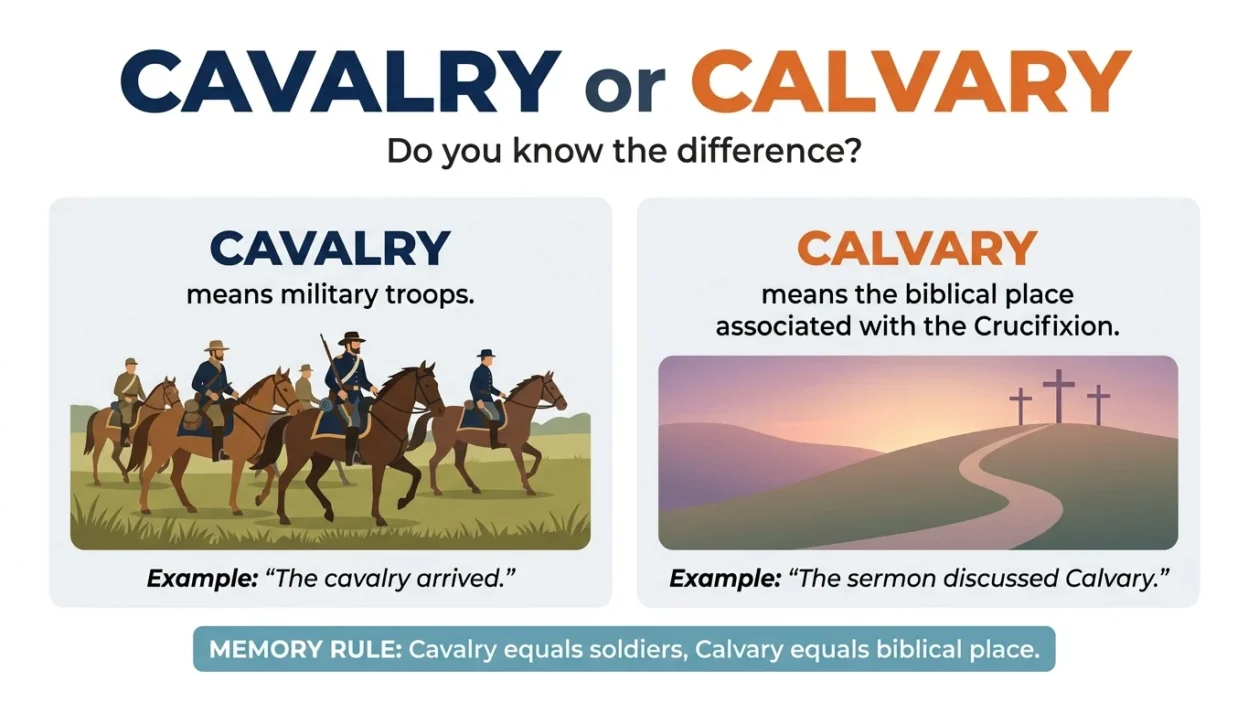
Choosing between cavalry or Calvary can be difficult because the words look very similar and are sometimes mispronounced or accidentally switched. However, they have completely different meanings.
Cavalry traditionally refers to soldiers who fight on horseback. In modern military contexts, the term can also appear in the names of certain mobile or armored units. For example, “The cavalry arrived to support the troops” uses cavalry correctly.
Calvary, usually written with a capital C when referring to the specific biblical place, is associated with the site where Jesus was crucified. The name is traditionally used for Golgotha. The word can also be used figuratively in some contexts to describe an experience of intense suffering. Therefore, cavalry and Calvary are not interchangeable. A simple way to remember the difference is that cavalry relates to soldiers, while Calvary relates to the biblical site of the Crucifixion.
Quick Answer
Cavalry refers traditionally to soldiers who fought on horseback and can also refer to certain modern military units. Calvary refers to the biblical place associated with the Crucifixion of Jesus and can sometimes be used figuratively for great suffering. Use cavalry for soldiers and Calvary for the biblical place.
Cavalry or Calvary Definition and Meaning
Cavalry and Calvary are both correct English words, but they have completely different meanings.
Cavalry is a military term.
Traditionally, it refers to troops who fought on horseback.
Example:
“The cavalry advanced across the field.”
Calvary is most commonly a religious and biblical term.
It refers to the place associated with the Crucifixion of Jesus.
Example:
“Calvary is associated with the Crucifixion.”
The basic distinction is:
CAVALRY means soldiers
CALVARY means the biblical place
Because only a few letters change position, the words are easy to confuse in both speech and writing.
Why People Confuse Cavalry and Calvary
The main reason people confuse cavalry and Calvary is their similar spelling.
Compare:
cavalry
Calvary
Both contain many of the same letters, but their order is different.
Pronunciation can also contribute to the confusion, especially in rapid speech. Some speakers may accidentally switch the middle sounds.
However, the meanings are unrelated.
Think of these two sentences:
“The cavalry arrived.”
“He spoke about Calvary.”
The first concerns soldiers.
The second concerns the biblical place.
Learning each word together with its meaning is much more effective than trying to remember the spelling alone.
What Does Cavalry Mean?
Cavalry traditionally refers to soldiers who fight or travel on horseback.
Historically, cavalry units were important because horses allowed troops to move quickly across battlefields.
For example:
“The cavalry charged across the field.”
“The army sent cavalry to support the infantry.”
“Cavalry units could move quickly.”
The word is strongly associated with military history, horses, mounted soldiers, and rapid movement.
In modern military terminology, cavalry can also survive in the names and traditions of units that use armored vehicles or other mobile equipment rather than horses.
The central idea remains military forces associated historically with mounted mobility.
What Does Calvary Mean?
Calvary most commonly refers to the place associated in Christian tradition with the Crucifixion of Jesus.
It is traditionally identified with Golgotha.
When referring to this specific biblical place, Calvary is normally capitalized.
For example:
“The sermon referred to Calvary.”
“Christian art frequently depicts scenes associated with Calvary.”
The word can also have extended or figurative uses relating to severe suffering or an ordeal.
However, its primary familiar meaning is religious rather than military.
This makes it very different from cavalry.
Remember:
Calvary relates to the Crucifixion
Cavalry relates to soldiers
Is Cavalry a Word?
Yes. Cavalry is a standard English word.
It is primarily a military noun.
Historically, it refers to mounted soldiers.
Examples:
“The cavalry approached.”
“The general ordered the cavalry forward.”
“The cavalry played an important role in the battle.”
The word can also appear in modern unit names even when horses are no longer involved.
A familiar figurative expression is:
“Here comes the cavalry.”
In everyday figurative use, this can refer to help or reinforcements arriving at an important moment.
The spelling remains:
cavalry
not:
Calvary
when soldiers or rescuing reinforcements are intended.
Is Calvary a Word?
Yes. Calvary is also a standard English word.
It is not a misspelling of cavalry.
Calvary is primarily associated with the biblical place where Jesus was crucified.
For example:
“The painting depicts a scene at Calvary.”
The word is usually capitalized when referring to the specific place.
It can also have figurative uses connected with intense suffering or an ordeal.
Therefore, both spellings are legitimate.
The question is not which spelling exists.
The question is which meaning you intend.
Use:
cavalry for military forces
Calvary for the biblical place
Cavalry vs Calvary Comparison
Cavalry
Meaning: Mounted soldiers or certain military units
Main context: Military
Example: “The cavalry arrived.”
Main association: Soldiers and horses
Calvary
Meaning: The biblical place associated with the Crucifixion
Main context: Religious and biblical
Example: “The sermon focused on Calvary.”
Main association: Crucifixion
The easiest distinction is:
Cavalry equals military
Calvary equals biblical place
Both words are correct, but replacing one with the other can completely change the meaning of a sentence.
Cavalry or Calvary Pronunciation Guide
Cavalry and Calvary have different standard pronunciations, although their similar sounds can cause confusion.
Cavalry is pronounced approximately:
“KAV ul ree”
The word has three syllables.
Calvary is pronounced approximately:
“KAL vuh ree”
It also commonly has three syllables.
The position of the v sound helps distinguish them.
Because the words can become blurred in quick speech, pronunciation alone may not always prevent mistakes.
It is better to connect each spelling with its meaning:
CAVALRY means soldiers
CALVARY means the biblical place
How to Spell Cavalry Correctly
The correct spelling for the military word is:
CAVALRY
A useful way to remember the letter order is to break it into sounds:
cav al ry
The v appears early in the word.
Correct:
“cavalry soldiers”
“cavalry unit”
“cavalry charge”
“cavalry regiment”
“cavalry officer”
Do not write Calvary when you mean mounted troops.
For example:
Incorrect:
“The Calvary charged across the battlefield.”
Correct:
“The cavalry charged across the battlefield.”
The military word is always cavalry.
How to Spell Calvary Correctly
The correct spelling for the biblical place is:
CALVARY
The letters l and v occur earlier in a different order than in cavalry.
Correct:
“Calvary”
“the scene at Calvary”
“the road to Calvary”
Do not use cavalry when referring to the biblical location.
Incorrect:
“The sermon described Cavalry.”
Correct:
“The sermon described Calvary.”
When the specific biblical place is intended, capitalize the word:
Calvary
Connecting the spelling with its religious meaning is the easiest way to avoid confusion.
When to Use Cavalry
Use cavalry when discussing soldiers, military units, mounted troops, or certain types of military reinforcement.
Examples:
“The cavalry arrived at dawn.”
“The army deployed its cavalry.”
“The cavalry moved rapidly.”
“The cavalry supported the infantry.”
“The commander led the cavalry.”
You can also encounter cavalry in names for modern military formations.
In figurative language, the word may describe rescuers or reinforcements.
For example:
“Here comes the cavalry.”
This means help has arrived.
Whenever your sentence concerns soldiers, military units, or figurative reinforcements, cavalry is likely the correct word.
When to Use Calvary
Use Calvary when referring to the biblical site associated with the Crucifixion of Jesus.
Examples:
“The sermon focused on Calvary.”
“The painting portrays Calvary.”
“The story leads toward Calvary.”
In such uses, the word is normally capitalized because it functions as a proper name.
The word can also be used figuratively in certain literary or religious contexts to describe great suffering.
However, it does not mean a group of soldiers.
Therefore:
Calvary is religious
cavalry is military
This simple distinction will work in most situations.
When to Use Each Word
Use cavalry when your sentence involves:
soldiers
horses
military units
battlefield mobility
reinforcements
Use Calvary when your sentence involves:
the Crucifixion
Golgotha
biblical history
Christian religious discussion
religious symbolism
Compare:
“The cavalry arrived on the battlefield.”
“The sermon described Calvary.”
The first sentence concerns troops.
The second concerns the biblical place.
These words should never be treated as alternative spellings of the same term.
Cavalry or Calvary Examples
Here are 15 examples showing the difference:
- The cavalry arrived before sunset.
- The cavalry advanced across the field.
- The commander called for the cavalry.
- The cavalry supported the infantry.
- The army relied heavily on its cavalry.
- The cavalry moved quickly toward the enemy.
- Reinforcements arrived with the cavalry.
- The soldiers served in a cavalry regiment.
- The sermon referred to Calvary.
- The painting depicts a scene at Calvary.
- The story of Calvary has deep religious significance.
- The speaker discussed the events associated with Calvary.
- The artwork portrays the journey to Calvary.
- Calvary is associated with the Crucifixion.
- The minister spoke about the meaning of Calvary.
Cavalry Soldiers or Calvary Soldiers?
The correct phrase is:
cavalry soldiers
This refers to soldiers serving in cavalry forces.
Historically, these soldiers commonly fought on horseback.
For example:
“The cavalry soldiers prepared for battle.”
Do not write:
“Calvary soldiers”
when referring to military troops.
Calvary is associated with the biblical place, not a military category.
Other correct military expressions include:
“cavalry troops”
“cavalry regiment”
“cavalry officer”
“cavalry unit”
“cavalry charge”
Remember:
Soldiers belong with CAVALRY
Cavalry Charge or Calvary Charge?
The correct military expression is:
cavalry charge
A cavalry charge traditionally refers to mounted troops advancing rapidly toward an enemy.
For example:
“The cavalry charge broke through the opposing line.”
Do not write:
“Calvary charge”
for this military meaning.
Calvary is a biblical place and has no ordinary meaning referring to mounted soldiers charging in battle.
The word charge provides a useful clue.
If the context involves horses, soldiers, battle, or military movement, choose:
cavalry
Therefore:
cavalry charge
is the correct expression.
Cavalry Unit or Calvary Unit?
The correct military phrase is:
cavalry unit
For example:
“The cavalry unit moved into position.”
Historically, a cavalry unit might have consisted of mounted soldiers.
Modern military organizations may retain the term cavalry even when their equipment and operational roles have changed.
Do not write:
“Calvary unit”
when describing a military formation.
The easiest test is to ask:
Is this a military unit?
If yes, use:
cavalry
The biblical word Calvary does not name this type of military unit.
Cavalry Regiment or Calvary Regiment?
Use:
cavalry regiment
A cavalry regiment is a military formation historically associated with mounted troops.
Example:
“He served in a cavalry regiment.”
Other natural combinations include:
“cavalry division”
“cavalry brigade”
“cavalry squadron”
“cavalry officer”
“cavalry commander”
The spelling Calvary regiment would normally be incorrect if the intended meaning is a military cavalry formation.
Remember that cavalry belongs to military vocabulary.
Here Comes the Cavalry Meaning
The expression:
Here comes the cavalry
can be used literally or figuratively.
Literally, it could refer to mounted troops arriving.
Figuratively, it means that help, support, rescuers, or reinforcements have arrived.
For example:
“We were struggling with the project, but then the technical team arrived. Here comes the cavalry.”
The phrase draws on the image of military reinforcements arriving at an important moment.
The correct spelling is:
cavalry
not:
Calvary
This is one of the most common places where the two words are accidentally confused.
Call in the Cavalry or Calvary?
The correct expression is:
call in the cavalry
This can literally mean requesting military reinforcement.
It can also be used figuratively to mean bringing in additional help.
For example:
“We cannot solve this alone, so it is time to call in the cavalry.”
This means more assistance or expertise is needed.
Do not write:
“call in the Calvary”
for this meaning.
The expression is based on soldiers arriving as reinforcements.
Therefore, it requires the military word:
cavalry
Cavalry and Horses
Historically, cavalry is closely associated with horses.
Cavalry soldiers used horses for speed, mobility, reconnaissance, and combat.
Common historical expressions include:
“mounted cavalry”
“cavalry horse”
“cavalry charge”
“cavalry officer”
“cavalry regiment”
This connection gives you a strong memory clue.
When you picture soldiers riding horses into battle, think:
CAVALRY
The word Calvary has no ordinary connection with mounted military troops.
Associating cavalry with horses is one of the easiest ways to remember its meaning.
Cavalry and Infantry Difference
Cavalry and infantry are both military terms, but historically they describe different types of troops.
Cavalry traditionally consisted of mounted soldiers.
Infantry refers to soldiers who fight primarily on foot.
For example:
“The cavalry supported the infantry during the battle.”
Historically, their battlefield roles could differ significantly because mounted troops had greater mobility.
In modern military terminology, the exact roles and equipment associated with cavalry can vary.
The important spelling point is that the military term is:
cavalry
not:
Calvary
Calvary and Golgotha
Calvary and Golgotha are names associated with the place of the Crucifixion of Jesus in Christian tradition.
The English word Calvary comes through Latin tradition, while Golgotha reflects the biblical place name.
In ordinary Christian usage, the two terms are closely associated with the same crucifixion site.
For example:
“The sermon discussed the events at Calvary.”
“The biblical account refers to Golgotha.”
This religious context makes the difference from cavalry very clear.
Calvary belongs to biblical and religious vocabulary.
Cavalry belongs primarily to military vocabulary.
Why Is Calvary Capitalized?
Calvary is normally capitalized when it refers to the specific biblical place because it functions as a proper name.
For example:
“The sermon focused on Calvary.”
“The painting depicts Calvary.”
This is similar to capitalizing other specific place names.
However, words derived from proper names or figurative uses can sometimes follow different capitalization conventions depending on context and style.
For the main biblical meaning, the safest standard form is:
Calvary
By contrast, the general military noun cavalry is normally lowercase unless it appears at the beginning of a sentence or as part of an official proper name.
Calvary in Christianity
In Christian tradition, Calvary has strong religious significance because it is associated with the Crucifixion of Jesus.
The word frequently appears in:
sermons
hymns
religious books
Christian art
theological discussions
historical discussions of the Crucifixion
For example:
“The preacher spoke about Calvary.”
This context is entirely different from the military meaning of cavalry.
If the surrounding words involve Jesus, the Crucifixion, Golgotha, or Christian theology, Calvary is probably the intended word.
Can Calvary Mean Suffering?
Calvary can sometimes be used figuratively for an experience of severe suffering, anguish, or ordeal.
This figurative meaning develops from the religious associations of the biblical Calvary.
Such usage is more literary or formal than everyday.
Context is important because the specific proper name Calvary and broader figurative uses may be treated differently stylistically.
The key point is that this meaning still relates conceptually to suffering rather than soldiers.
Therefore:
cavalry means military forces
while:
Calvary can carry religious or figurative associations with suffering
Cavalry in Modern Military Usage
Although cavalry historically referred to mounted soldiers, the word did not disappear when horses became less central to warfare.
Modern armed forces may use cavalry in the names of units associated with reconnaissance, armored mobility, or historical traditions.
The exact organization and role depend on the military involved.
Therefore, it would be too narrow to say that cavalry can only mean soldiers currently fighting on horseback.
Its historical foundation is mounted warfare, but its modern military usage can be broader.
The spelling remains:
cavalry
Cavalry in Real Life Usage
Imagine reading a historical novel about a battle.
You might encounter:
“The cavalry arrived just before sunset.”
This refers to military troops.
Now imagine reading a religious text.
You might encounter:
“The passage reflects on Calvary.”
This refers to the biblical place and its religious significance.
These contexts are very different.
A useful mental picture is:
Cavalry equals soldiers riding into battle
Calvary equals the place associated with the Crucifixion
Connecting each word with a strong image makes the spelling easier to remember.
Cavalry in Historical Writing
Cavalry frequently appears in historical writing about warfare.
Examples include:
“The cavalry advanced along the flank.”
“The commander deployed the cavalry.”
“Mounted cavalry provided mobility.”
“The cavalry pursued the retreating forces.”
When writing about military history, cavalry is the standard term.
Writers should be particularly careful because spell checking software may not identify Calvary as an error. Since both are valid English words, a spelling checker may accept the wrong one.
Meaning must determine the choice.
Cavalry and Calvary in Formal Writing
Both words can appear in formal writing, but in completely different subject areas.
Military or historical writing may use:
cavalry
Religious, theological, or biblical writing may use:
Calvary
For example:
“The cavalry was deployed before the battle.”
“The author discusses the symbolism of Calvary.”
Because both words are legitimate, proofreading is important.
A spelling checker may not detect accidental substitution.
Always check whether the context concerns:
military forces
or:
the biblical place
That distinction determines the correct spelling.
American vs British English
The basic distinction between cavalry and Calvary is the same in American and British English.
Both varieties use cavalry for the military term.
Both use Calvary for the biblical place associated with the Crucifixion.
There is no major American versus British spelling difference that changes the basic rule.
Pronunciation may vary somewhat by accent, but the meanings remain distinct.
Therefore, the same memory rule works for both audiences:
Cavalry equals soldiers
Calvary equals the biblical place
Common Mistakes With Cavalry and Calvary
One common mistake is:
Incorrect:
“The Calvary arrived to help the soldiers.”
Correct:
“The cavalry arrived to help the soldiers.”
Another mistake is:
Incorrect:
“The sermon focused on Cavalry.”
Correct:
“The sermon focused on Calvary.”
Also avoid:
“Call in the Calvary.”
For reinforcements, write:
“Call in the cavalry.”
The problem often occurs because both spellings are real words, so automatic spell checking may not catch the mistake.
Always check the intended meaning.
Military equals cavalry.
Biblical place equals Calvary.
Memory Trick for Cavalry or Calvary
Use this simple memory trick:
CAVALRY equals CAVALRY SOLDIERS
Picture soldiers riding horses into battle.
Think:
Cavalry comes charging.
For Calvary, connect the word with its religious context:
CALVARY equals CRUCIFIXION
You can remember the letter C in both:
Calvary
Crucifixion
The simplest memory rule is:
CAVALRY means soldiers
CALVARY means the biblical place
A vivid image of horses for cavalry and the Crucifixion for Calvary can make the distinction easy to retain.
Expert Tips for Choosing Cavalry or Calvary
First, identify the subject of the sentence.
If the sentence involves soldiers, troops, horses, battle, military units, or reinforcements, use:
cavalry
If it involves Jesus, the Crucifixion, Golgotha, Christian theology, or the biblical place, use:
Calvary
Second, pay attention to capitalization.
The specific biblical place is normally:
Calvary
The general military noun is normally:
cavalry
Finally, do not rely entirely on spell checking because both words are valid.
Meaning is the most reliable guide.
Mistakes to Avoid
Do not use Calvary for military troops.
Incorrect:
“The Calvary charged.”
Correct:
“The cavalry charged.”
Do not use cavalry for the biblical place.
Incorrect:
“The events at Cavalry.”
Correct:
“The events at Calvary.”
Also be careful with the common figurative phrase:
Incorrect:
“Here comes the Calvary.”
Correct:
“Here comes the cavalry.”
When help or reinforcements are arriving, the phrase refers metaphorically to military forces.
Therefore, use:
cavalry
Similar Words
Several English word pairs can be confused because their spellings are similar even though their meanings differ.
Examples include:
cavalry and Calvary
casual and causal
personal and personnel
later and latter
principal and principle
stationary and stationery
complement and compliment
affect and effect
With pairs like these, memorizing spelling alone may not be enough.
Learn each word together with its meaning and a short example.
For this pair:
“The cavalry arrived.”
“The sermon discussed Calvary.”
These examples immediately reveal the distinction.
Related Confusing Words
If cavalry or Calvary is confusing, these related topics may also be useful:
casual vs causal
personal vs personnel
principal vs principle
stationary vs stationery
complement vs compliment
affect vs effect
later vs latter
title vs tittle
peeked vs peaked
capital vs capitol
desert vs dessert
accept vs except
The key rule for the current pair remains simple:
Cavalry belongs to military vocabulary.
Calvary belongs primarily to biblical and religious vocabulary.
FAQs About Cavalry or Calvary
What is the difference between cavalry and Calvary?
Cavalry traditionally refers to mounted soldiers and can also refer to certain modern military units. Calvary refers to the biblical place associated with the Crucifixion of Jesus.
Is it cavalry or Calvary soldiers?
Use cavalry soldiers when referring to military troops.
Is it cavalry charge or Calvary charge?
The correct military expression is cavalry charge.
Is it call in the cavalry or call in the Calvary?
Use call in the cavalry. The expression refers to bringing in reinforcements or additional help.
What does Calvary mean?
Calvary primarily refers to the biblical place associated with the Crucifixion of Jesus. It can also have figurative associations with severe suffering.
What does cavalry mean?
Cavalry traditionally means mounted military troops. The term also survives in certain modern military formations.
Are cavalry and Calvary pronounced the same?
No. Their standard pronunciations differ, although their similar sounds and spellings can cause confusion.
Should Calvary be capitalized?
Yes, Calvary is normally capitalized when referring to the specific biblical place.
Final Verdict on Cavalry or Calvary
The difference between cavalry and Calvary is based entirely on meaning. Cavalry is primarily a military word. Historically, it refers to soldiers who fought on horseback, although the term continues in certain modern military formations and traditions. It also appears figuratively in expressions such as here comes the cavalry and call in the cavalry, where it represents arriving help or reinforcements.
Calvary, normally capitalized when referring to the specific place, is associated with the biblical site of the Crucifixion of Jesus. It can also have figurative associations with intense suffering. The two words are therefore not interchangeable. The easiest rule to remember is simple: cavalry means soldiers or military forces, while Calvary means the biblical place associated with the Crucifixion.
Remember This
Memorize these two meanings:
CAVALRY
Military forces
Mounted soldiers
Military units
Reinforcements
Example:
“The cavalry arrived.”
CALVARY
Biblical place
Associated with the Crucifixion
Example:
“The sermon discussed Calvary.”
The quickest rule is:
CAVALRY equals SOLDIERS
CALVARY equals CRUCIFIXION
If horses, troops, battles, or reinforcements are involved, think cavalry.
If the biblical Crucifixion is involved, think Calvary.

Donald Andrew is a dedicated author at BiblyWord, passionate about sharing biblical teachings in a clear and inspiring way. He creates meaningful content that helps readers understand scripture, reflect on their faith, and apply God’s Word in daily life. His work supports spiritual growth, guidance, and a deeper connection with biblical wisdom.