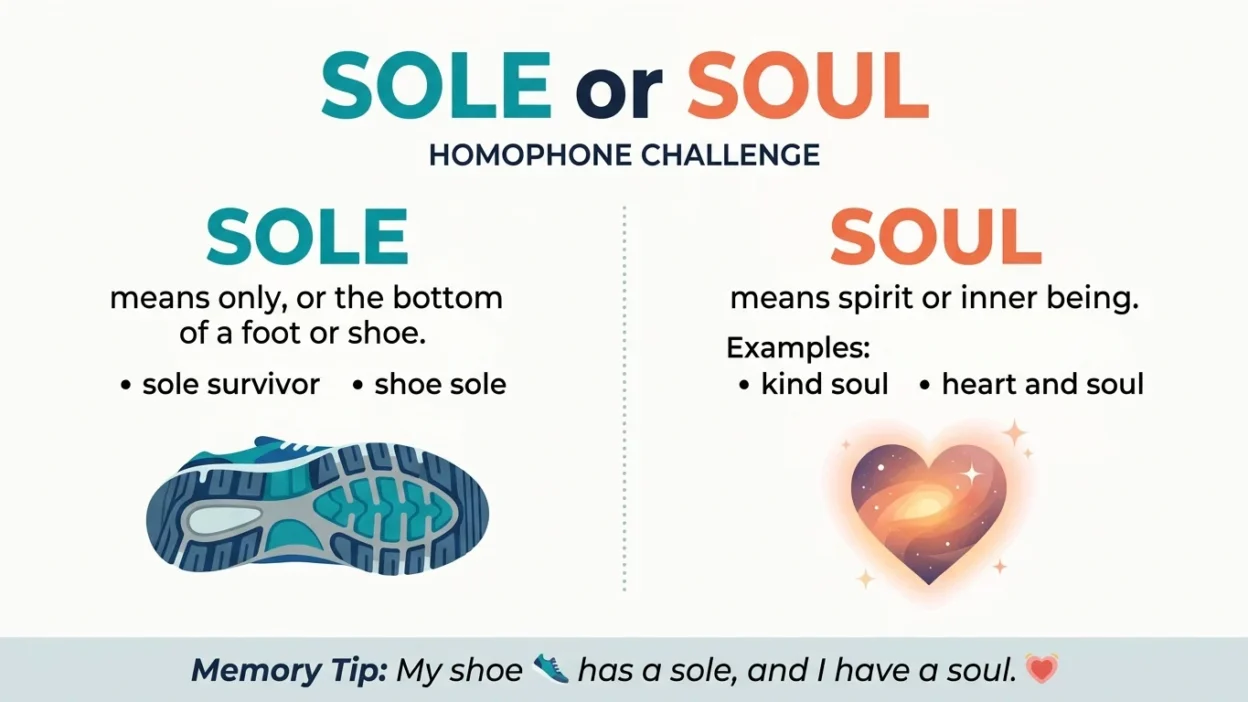
Choosing between sole or soul can be confusing because the two words sound the same but have very different meanings. Sole can mean only or single, as in “She was the sole survivor.” It can also refer to the bottom of a foot or shoe, and sole is also the name used for certain flatfish. Soul, on the other hand, commonly refers to the spiritual or nonphysical part of a person and can also describe a person’s deepest feelings, character, or emotional essence.
Because sole and soul are homophones, pronunciation usually cannot help you decide which spelling belongs in a sentence. Instead, you need to look at the meaning. If you mean only, single, the bottom of a foot or shoe, or the fish, use sole. If you mean spirit, inner being, deep feeling, or emotional essence, use soul. Learning these meanings makes the distinction much easier.
Quick Answer
Sole means only or single and can also mean the bottom of a foot or shoe or a type of flatfish. Soul refers to a person’s spiritual or inner being and can also mean deep feeling or emotional essence. They sound alike but are not interchangeable.
Sole or Soul Definition and Meaning
Sole and soul are both correct English words.
Sole has several meanings.
It can mean:
only
single
the bottom of a foot
the bottom of a shoe
certain types of flatfish
For example:
“He was the sole owner.”
Soul usually refers to the spiritual, emotional, or inner aspect of a person.
For example:
“Music touched her soul.”
It can also refer more broadly to a person, especially in certain expressions.
The simplest distinction is:
SOLE means ONLY or BOTTOM
SOUL means SPIRIT or INNER BEING
Why People Confuse Sole and Soul
People confuse sole and soul because they are homophones.
Homophones are words that sound the same but have different spellings and meanings.
For example:
“He is the sole owner.”
“She has a kind soul.”
The words sole and soul sound alike, but exchanging them would change the meaning.
The confusion becomes greater because both words are common and can appear in figurative expressions.
Spell checking software may not always identify the mistake because both spellings are legitimate words.
The best solution is to focus on meaning.
If you mean only, think sole.
If you mean spirit or inner self, think soul.
What Does Sole Mean?
Sole has several meanings in English.
As an adjective, it can mean only or single.
Example:
“She was the sole winner.”
As a noun, it can mean the bottom surface of a person’s foot.
Example:
“The sole of my foot hurts.”
It can also mean the bottom part of a shoe:
“The sole of the shoe is damaged.”
Additionally, sole is a name used for certain flatfish.
Although these meanings are different, they all use the spelling:
sole
Do not use soul when you mean only, a foot, a shoe bottom, or the fish.
What Does Soul Mean?
Soul commonly refers to the spiritual or nonphysical part of a person in religious, philosophical, and everyday language.
For example:
“Many traditions discuss the nature of the soul.”
The word can also refer to a person’s deepest feelings, character, or emotional nature.
For example:
“She has a gentle soul.”
“This music touches my soul.”
Soul also appears in many expressions:
“heart and soul”
“body and soul”
“lost soul”
“old soul”
“soul searching”
The word can also refer to soul music, a major musical genre.
The key idea is usually connected with spirit, identity, emotion, or inner character.
Sole vs Soul Comparison
Sole
Meaning: Only or single
Example: “She was the sole applicant.”
Meaning: Bottom of a foot
Example: “The sole of his foot was sore.”
Meaning: Bottom of a shoe
Example: “The shoe needs a new sole.”
Meaning: A type of flatfish
Example: “They served sole for dinner.”
Soul
Meaning: Spiritual or inner being
Example: “She has a kind soul.”
Meaning: Emotional essence
Example: “The song touched his soul.”
Main memory rule:
SOLE equals ONLY or BOTTOM
SOUL equals SPIRIT or INNER SELF
Sole or Soul Pronunciation Guide
Sole and soul are pronounced the same in standard English.
Both sound like:
“sohl”
This makes them homophones.
Because their pronunciation does not normally reveal the spelling, context is essential.
Compare:
“He was the sole survivor.”
“She has a beautiful soul.”
The words sound alike, but the first means only, while the second refers to someone’s inner or spiritual being.
Do not choose the spelling according to sound.
Instead, identify the intended meaning.
Only means sole.
Spirit means soul.
Grammar Rules for Sole and Soul
Sole can function as an adjective or noun.
As an adjective:
“He is the sole owner.”
Here, sole modifies owner and means only.
As a noun:
“The sole of my shoe is worn.”
Here, sole names the bottom part of the shoe.
Soul normally functions as a noun.
For example:
“She has a generous soul.”
Its regular plural is:
souls
Example:
“There were hundreds of souls aboard.”
The plural of sole depends on its noun meaning:
“shoe soles”
“the soles of his feet”
Grammar and meaning together determine the correct word.
When to Use Sole
Use sole when you mean only or single.
Examples:
“She was the sole applicant.”
“He is the sole owner.”
“That was the sole reason.”
Use sole when referring to the bottom of a foot:
“The sole of my foot hurts.”
Use it for the bottom of a shoe:
“The sole needs replacing.”
You can also use sole for the fish:
“We ordered sole for dinner.”
A useful test is to ask:
Does the sentence mean only, bottom, or the fish?
If yes, choose sole.
When to Use Soul
Use soul when referring to someone’s spiritual or inner being.
Examples:
“She has a kind soul.”
“He believes in the soul.”
“The experience affected his soul.”
Use soul for emotional depth:
“The performance had soul.”
“The song touched my soul.”
The word also appears in religious, philosophical, literary, and musical contexts.
For example:
“soul music”
“body and soul”
“heart and soul”
“old soul”
If your sentence concerns spirit, deep emotion, or inner character, soul is normally the correct choice.
When to Use Each Word
Use sole for:
only
single
bottom of a foot
bottom of a shoe
certain flatfish
Use soul for:
spirit
inner being
deep emotional character
a person in certain expressions
soul music
Compare:
“He was the sole survivor.”
Only survivor
“He is a gentle soul.”
Kind person
“The sole of my shoe is damaged.”
Bottom of shoe
“The music touched my soul.”
Inner emotions
Remembering these examples makes the distinction easy.
Sole or Soul Examples
Here are 15 examples showing correct usage:
- She was the sole survivor.
- He is the sole owner of the company.
- Money was not the sole reason for his decision.
- She became the sole winner.
- The sole of my foot is sore.
- The sole of his shoe is damaged.
- These shoes have thick soles.
- They ordered sole for dinner.
- She has a beautiful soul.
- He is a kind soul.
- The song touched my soul.
- She put her heart and soul into the project.
- He is often described as an old soul.
- The performance was full of soul.
- The novel explores questions about the human soul.
Sole Survivor or Soul Survivor?
The standard expression meaning the only survivor is:
sole survivor
For example:
“He was the sole survivor of the accident.”
Here, sole means only.
Therefore:
sole survivor equals only survivor
The phrase soul survivor may occasionally appear as a deliberate name, title, pun, or creative expression, but it does not normally mean the only surviving person.
If you are writing ordinary English and mean that only one person survived, use:
sole survivor
This is one of the most common situations where sole and soul are confused.
Sole Owner or Soul Owner?
The correct expression is:
sole owner
For example:
“She is the sole owner of the business.”
Here, sole means the only one.
A sole owner is the only owner.
Similarly, you can say:
“sole responsibility”
“sole purpose”
“sole reason”
“sole authority”
“sole provider”
Soul owner does not have this ordinary meaning.
Whenever you can replace sole with only, the spelling sole is usually correct.
For example:
“She is the only owner.”
“She is the sole owner.”
Both communicate the same basic idea.
Sole Purpose or Soul Purpose?
The usual expression meaning the only purpose is:
sole purpose
Example:
“The sole purpose of the meeting was to discuss the budget.”
Here, sole means only.
However, soul purpose can appear intentionally in spiritual, motivational, or creative contexts to refer to a purpose connected with the soul.
Therefore, context matters.
For ordinary English meaning only purpose, use:
sole purpose
For example:
“My sole purpose was to help.”
This means:
“My only purpose was to help.”
The replacement with only confirms that sole is correct.
Sole Reason or Soul Reason?
The standard expression meaning the only reason is:
sole reason
For example:
“That was the sole reason I left.”
This means:
“That was the only reason I left.”
Because sole can be replaced by only, the spelling is easy to confirm.
Other examples include:
“The sole reason for the delay was bad weather.”
“Cost was not the sole reason for the decision.”
Soul reason would not normally have this meaning.
Remember:
sole equals only
Therefore:
sole reason
sole purpose
sole owner
sole survivor
all use the same spelling.
Sole of the Foot or Soul of the Foot?
The correct expression is:
sole of the foot
The sole is the underside or bottom surface of the foot.
For example:
“The sole of my foot hurts.”
“She had a small cut on the sole of her foot.”
The plural is:
soles
Example:
“The soles of his feet were dirty.”
Do not use soul for this anatomical meaning.
Soul refers to a person’s inner or spiritual being, not the physical bottom of the foot.
A simple memory clue is:
Your sole touches the ground.
Sole of a Shoe or Soul of a Shoe?
The correct expression is:
sole of a shoe
The sole is the bottom part of the shoe that contacts the ground.
For example:
“The sole of my shoe is worn out.”
“The shoe has a thick rubber sole.”
“The soles need replacing.”
Do not normally write:
“soul of a shoe”
when referring to the physical bottom.
Think:
FOOT equals SOLE
SHOE equals SOLE
SPIRIT equals SOUL
This simple three part distinction helps prevent confusion.
Sole Proprietor Meaning
A sole proprietor is a person who owns and operates a business as an individual under a sole proprietorship structure.
The important spelling for this topic is:
sole proprietor
Here, sole carries the idea of being single or individual.
Related expressions include:
“sole proprietorship”
“sole owner”
“sole trader”
The exact legal and tax implications of these business structures can vary by jurisdiction.
However, the spelling does not change:
sole
Do not write:
“soul proprietor”
for the ordinary business term.
The business expression is:
sole proprietor
Sole Responsibility Meaning
Sole responsibility means that responsibility belongs entirely to one person, organization, or party.
For example:
“She had sole responsibility for the project.”
This means she alone was responsible.
Another example:
“The final decision is his sole responsibility.”
Here, sole can be understood as:
only
or:
exclusive
The phrase has nothing to do with the spiritual meaning of soul.
Therefore:
sole responsibility
is correct.
This follows the same pattern as:
“sole owner”
“sole purpose”
“sole reason”
“sole authority”
Heart and Soul Meaning
The correct expression is:
heart and soul
For example:
“She put her heart and soul into her work.”
This expression means she gave the work great energy, emotion, commitment, and dedication.
Another example:
“Music is the heart and soul of the festival.”
Here, the expression can refer to the central emotional essence of something.
Do not write:
“heart and sole”
unless you are deliberately creating a joke or wordplay.
In the standard idiom, use:
soul
because the expression concerns emotional and inner essence.
Body and Soul Meaning
Body and soul is another established expression using soul.
It can refer to the whole person, including physical and spiritual aspects.
For example:
“He devoted himself body and soul to the cause.”
This means he committed himself completely.
The correct spelling is:
body and soul
not:
“body and sole”
The word sole would refer to something completely different, such as the bottom of a foot.
When expressions involve spirit, inner being, or complete personal commitment, soul is the correct word.
Kind Soul Meaning
A kind soul is a kind, caring, or compassionate person.
For example:
“She is a kind soul who always helps others.”
Another example:
“Some kind soul returned my lost wallet.”
In this expression, soul can stand for a person and emphasize character or humanity.
Do not write:
“kind sole”
for this meaning.
A sole could be the bottom of a shoe or foot, so the phrase would communicate something entirely different.
Remember:
Person’s inner character equals soul
Therefore:
kind soul
gentle soul
poor soul
old soul
all use soul.
Old Soul Meaning
An old soul is a person who seems unusually mature, thoughtful, wise, or connected with interests associated with an earlier time.
For example:
“She has always been an old soul.”
The expression does not literally refer to someone’s physical age.
It is a figurative description of personality, temperament, or perceived maturity.
The correct spelling is:
old soul
not:
“old sole”
Again, sole relates to being the only one, the bottom of a foot or shoe, or the fish.
Personality and inner character belong with:
soul
Lost Soul Meaning
A lost soul can describe a person who seems confused, lonely, directionless, troubled, or spiritually lost.
For example:
“He wandered around like a lost soul.”
The exact meaning depends on context.
In religious writing, it can carry a spiritual meaning.
In everyday figurative language, it can describe someone who appears uncertain or without direction.
The correct spelling is:
lost soul
not:
“lost sole”
The expression concerns a person or inner being, so soul is the appropriate word.
Soul Searching Meaning
Soul searching refers to serious reflection about your feelings, beliefs, decisions, motives, or values.
For example:
“After some soul searching, she decided to change careers.”
It describes deep personal reflection.
The correct expression is:
soul searching
because it involves examining one’s inner thoughts and feelings.
Do not use sole searching for this meaning.
A useful connection is:
Soul equals inner self
Therefore:
soul searching equals examining your inner self
This expression is common in both everyday and formal writing.
Soul Music Meaning
Soul is also the name of an influential genre of popular music that developed in the United States, drawing strongly from African American musical traditions including gospel and rhythm and blues.
The correct expression is:
soul music
For example:
“She enjoys listening to soul music.”
The word can also describe emotional depth in a performance:
“The singer performs with soul.”
Do not use sole music for this meaning.
This is another important use showing that soul can extend beyond explicitly spiritual contexts and refer to emotional expression, character, and musical style.
Sole as a Fish
Sole is also a name used for certain flatfish.
For example:
“They ordered grilled sole for dinner.”
“The restaurant serves fresh sole.”
This meaning is completely separate from:
sole meaning only
and:
sole meaning the bottom of a foot or shoe
English words can have several meanings while keeping the same spelling.
Do not confuse the fish sole with soul.
If the context involves seafood, fishing, cooking, or a restaurant menu, sole may refer to the fish.
Sole and Soul in Real Life Usage
Imagine someone is the only person who knows a password.
You could say:
“She is the sole person who knows it.”
Here, sole means only.
Now imagine describing someone’s character:
“She has a gentle soul.”
Here, soul refers to inner character.
Another example:
“The sole of my shoe is damaged.”
Physical bottom
“The music touched my soul.”
Deep emotion
These examples show why context is essential.
Although sole and soul sound identical, their meanings are clearly different once you examine the sentence.
Sole and Soul in Business English
Sole is much more common than soul in ordinary business terminology.
Examples include:
“sole owner”
“sole proprietor”
“sole responsibility”
“sole authority”
“sole supplier”
“sole purpose”
For example:
“She is the sole owner of the company.”
Soul may appear in creative business language, branding, marketing, or descriptions of organizational identity.
For example:
“Creativity is the soul of the brand.”
Here, soul is figurative and refers to essential character.
In precise business writing, choose according to meaning.
Only or exclusive equals sole.
Inner essence or character equals soul.
Sole and Soul in Formal Writing
Both words can appear in formal writing.
Sole is appropriate when meaning only or exclusive:
“The committee was the sole authority responsible for the decision.”
Soul may appear in philosophical, religious, literary, cultural, or psychological discussion:
“The text explores traditional concepts of the soul.”
Because the words are homophones, proofreading is important.
A spelling checker may accept either word even when one is wrong for the context.
Always check meaning rather than relying only on spelling software.
Sole and Soul in Literature
Both sole and soul can appear frequently in literary writing.
Sole may emphasize uniqueness:
“He was the sole witness.”
It can also refer literally to feet or footwear.
Soul has a much broader range of figurative and emotional possibilities.
Writers may use soul to discuss:
identity
spirit
emotion
humanity
character
morality
inner conflict
For example:
“The experience changed his soul.”
Because literary language can be highly figurative, context remains especially important.
Formal vs Informal Use
Both sole and soul are standard in formal and informal English.
Formal use of sole:
“She has sole responsibility for the decision.”
Informal use:
“He was the sole person there.”
Formal use of soul:
“The philosopher examined the concept of the soul.”
Informal use:
“She is such a kind soul.”
Neither word is inherently more formal than the other.
They simply perform different jobs.
Use sole for meanings such as only and bottom.
Use soul for spirit, inner being, emotional character, and related meanings.
American vs British English
The basic meanings and spellings of sole and soul are the same in American and British English.
Both varieties use:
sole for only
sole for the bottom of a foot or shoe
soul for spirit or inner being
Both also pronounce sole and soul alike in standard speech.
Therefore, there is no major American versus British distinction to memorize for this word pair.
The same rule works in both:
SOLE equals ONLY or BOTTOM
SOUL equals SPIRIT or INNER SELF
Common Mistakes With Sole and Soul
A common mistake is:
Incorrect:
“He was the soul survivor.”
Correct:
“He was the sole survivor.”
Another error is:
Incorrect:
“The soul of my shoe is damaged.”
Correct:
“The sole of my shoe is damaged.”
Another mistake is:
Incorrect:
“She has a beautiful sole.”
Correct when referring to character:
“She has a beautiful soul.”
Also remember:
sole purpose
not:
“soul purpose”
when you mean only purpose.
The correct spelling always depends on the intended meaning.
Memory Trick for Sole or Soul
Use this simple memory trick:
SOLE equals ONLY
Think:
“She is the sole winner.”
That means:
“She is the only winner.”
Also remember:
SOLE equals SHOE
Both contain the idea of something physical associated with your foot.
For soul, think:
SOUL equals SPIRIT
You can memorize:
My shoe has a sole.
I have a soul.
This short pair makes the difference easy to remember.
Another useful rule is:
Sole touches the ground.
Soul describes the inner person.
Expert Tips for Choosing Sole or Soul
First, try replacing the word with only.
If the sentence still makes sense, use sole.
Example:
“He was the sole survivor.”
“He was the only survivor.”
Correct.
Second, ask whether the sentence concerns a foot or shoe.
If yes, use sole.
Third, ask whether the sentence concerns spirit, emotion, inner character, or a person in a figurative sense.
If yes, use soul.
Finally, remember that pronunciation cannot normally help because the words are homophones.
Meaning is the most reliable guide.
Mistakes to Avoid
Avoid using soul simply because the sentence refers to a person.
For example:
“He was the sole survivor.”
Although the sentence concerns a person, sole means only.
Also avoid using sole when discussing emotional or spiritual matters.
Correct:
“She has a kind soul.”
Correct:
“The music touched my soul.”
Correct:
“The sole of my shoe is worn.”
Correct:
“He is the sole owner.”
A simple question solves most problems:
Do I mean only or bottom, or do I mean spirit and inner character?
Similar Words
Sole and soul belong to a large group of English homophones.
Other examples include:
sea and see
pair and pear
right and write
hear and here
whole and hole
flour and flower
peace and piece
week and weak
These words sound alike but differ in spelling and meaning.
Because spell checking software may recognize both forms as legitimate, writers must use context to choose correctly.
For sole and soul, remember:
Sole equals only or bottom.
Soul equals spirit or inner self.
Related Confusing Words
If sole or soul is confusing, these related topics may also be useful:
whole vs hole
sea vs see
peace vs piece
pair vs pear
right vs write
hear vs here
flour vs flower
week vs weak
peeked vs peaked
cavalry vs Calvary
title vs tittle
principal vs principle
These pairs show why pronunciation alone cannot always determine spelling.
For the current pair, remember:
Sole belongs with only, feet, shoes, and fish.
Soul belongs with spirit, emotion, character, and inner being.
FAQs About Sole or Soul
What is the difference between sole and soul?
Sole can mean only, the bottom of a foot or shoe, or a type of flatfish. Soul commonly refers to the spiritual or inner part of a person.
Is it sole survivor or soul survivor?
The standard expression meaning the only survivor is sole survivor.
Is it sole purpose or soul purpose?
Use sole purpose when you mean only purpose. Soul purpose may appear intentionally in spiritual or creative contexts with a different meaning.
Is it sole of the shoe or soul of the shoe?
Use sole of the shoe for the physical bottom part of a shoe.
Is it sole owner or soul owner?
Sole owner is correct when you mean the only owner.
Is it heart and sole or heart and soul?
The standard expression is heart and soul.
Do sole and soul sound the same?
Yes. Sole and soul are homophones in standard English.
Can sole mean only?
Yes. Sole commonly means only or single, as in “the sole reason” or “the sole survivor.”
Final Verdict on Sole or Soul
When choosing between sole or soul, focus on meaning because the two words sound the same. Sole can mean only or single, as in sole survivor, sole owner, sole reason, and sole purpose. It can also refer to the bottom of a foot or shoe and is used as the name of certain flatfish.
Soul commonly refers to a person’s spiritual or inner being, emotional character, or deepest feelings. It appears in expressions such as heart and soul, kind soul, old soul, lost soul, and soul searching. It is also used in soul music. The easiest distinction is simple: sole means only or bottom, while soul means spirit or inner self. If you remember “My shoe has a sole, and I have a soul,” you are unlikely to confuse them.
Remember This
SOLE
Means only:
“sole survivor”
“sole owner”
“sole reason”
Means bottom:
“sole of the foot”
“sole of the shoe”
Can also mean a fish.
SOUL
Means spirit or inner being:
“kind soul”
“beautiful soul”
“heart and soul”
“old soul”
The easiest memory sentence is:
My shoe has a SOLE, and I have a SOUL.

Kevin Brian is a passionate author at BiblyWord, dedicated to sharing the message of the Bible through thoughtful and inspiring content. He focuses on creating clear and meaningful writings that help readers understand scripture, strengthen their faith, and find guidance in everyday life through God’s Word.