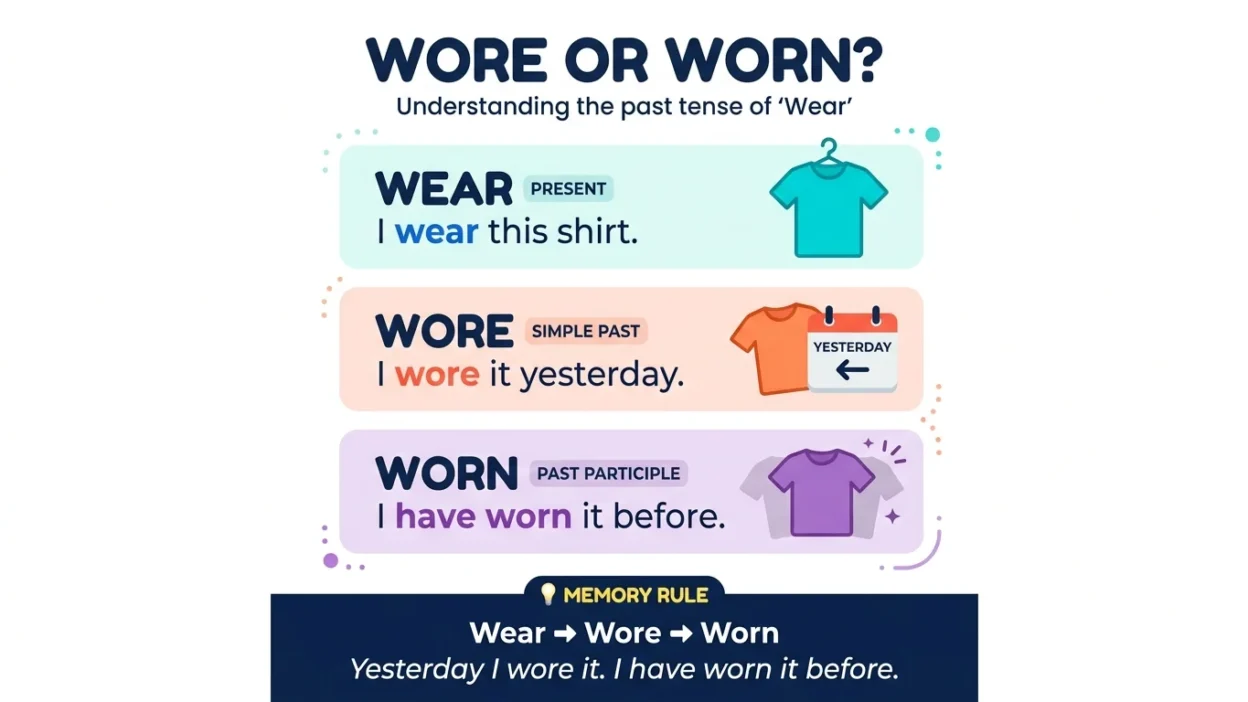
Choosing between wore or worn can be confusing because both words come from the verb wear, but they perform different grammatical jobs. Wore is the simple past tense of wear. For example, “She wore a blue dress yesterday” is correct because the action happened at a specific time in the past. Worn is the past participle of wear and commonly appears with helping verbs such as have, has, and had. For example, “She has worn that dress before” is correct.
The word worn also works as an adjective meaning damaged, old, tired, or affected by repeated use. For example, “These shoes are worn” means the shoes show signs of use. The easiest way to remember the difference is to learn the verb pattern wear, wore, worn. Use wore for a simple completed past action and worn with helping verbs or when describing something affected by wear.
Quick Answer
Wore is the simple past tense of wear, as in “I wore a jacket yesterday.” Worn is the past participle, as in “I have worn that jacket before.” Worn can also be an adjective meaning damaged or affected by repeated use. Remember: wear, wore, worn.
Wore or Worn Definition and Meaning
Both wore and worn are forms of the irregular verb wear.
The basic verb pattern is:
wear
Present form
wore
Simple past form
worn
Past participle form
For example:
“I wear glasses.”
“I wore glasses yesterday.”
“I have worn glasses for years.”
The difference is mainly grammatical.
Use wore when talking directly about a completed past action.
Use worn with helping verbs such as have, has, and had.
Worn can also describe something showing damage or deterioration caused by use.
Why People Confuse Wore and Worn
People often confuse wore and worn because both describe situations connected with the past and both come from wear.
For example:
“She wore the dress.”
“She has worn the dress.”
Both sentences concern wearing a dress in the past, but their grammar differs.
Another source of confusion is that worn can function as an adjective.
For example:
“The carpet looks worn.”
Here, worn describes the condition of the carpet rather than simply reporting an action.
The easiest solution is to memorize:
wear, wore, worn
Then connect wore with simple past tense and worn with participle constructions.
What Does Wore Mean?
Wore is the simple past tense of wear.
Use it for an action or state located in the past.
Examples:
“She wore a red dress yesterday.”
“He wore glasses as a child.”
“I wore my new shoes to the party.”
“They wore matching shirts.”
“She wore a hat during the ceremony.”
Because wore already expresses past tense, it does not normally need have, has, or had.
Correct:
“I wore that shirt yesterday.”
Incorrect:
“I have wore that shirt.”
The correct present perfect form is:
“I have worn that shirt.”
What Does Worn Mean?
Worn is the past participle of wear.
It commonly appears after:
have
has
had
Examples:
“I have worn this jacket before.”
“She has worn glasses for years.”
“They had worn similar clothes previously.”
Worn can also appear in passive constructions:
“The uniform was worn by the actor.”
It can also function as an adjective:
“The shoes are worn.”
Here, worn means that the shoes show signs of repeated use.
Therefore, worn has broader grammatical uses than wore.
Wear, Wore, Worn Verb Forms
The most important pattern to memorize is:
wear
wore
worn
Use wear for the present or base form:
“I wear glasses.”
Use wore for the simple past:
“I wore glasses yesterday.”
Use worn as the past participle:
“I have worn glasses for years.”
Another example:
“She wears a uniform every day.”
“She wore a uniform yesterday.”
“She has worn a uniform many times.”
Because wear is an irregular verb, its past forms are not created simply by adding ed.
Memorizing all three forms together prevents most mistakes.
Wore vs Worn Comparison
Wore
Grammar: Simple past tense
Example: “She wore a dress yesterday.”
Common helping verb needed: No
Main use: Completed past action
Worn
Grammar: Past participle
Example: “She has worn that dress before.”
Common helping verbs: Have, has, had
Other use: Adjective
Example: “The shoes are worn.”
The easiest distinction is:
WORE equals SIMPLE PAST
WORN equals PAST PARTICIPLE
Remember:
Yesterday I wore it.
I have worn it before.
Wore or Worn Pronunciation Guide
Wore and worn are pronounced differently.
Wore sounds like:
“war”
depending on accent.
Worn sounds approximately like:
“worn”
with a final n sound.
The pronunciation difference can help distinguish them in speech.
However, grammar is still the most reliable guide in writing.
Compare:
“She wore the dress.”
“She has worn the dress.”
The presence of has in the second sentence signals that the past participle worn is needed.
Learning the words as part of complete sentence patterns is especially useful.
Grammar Rules for Wore and Worn
The central grammar rule is simple.
Use wore as the simple past tense.
Example:
“She wore a jacket yesterday.”
Use worn as the past participle.
Example:
“She has worn that jacket before.”
Past participles commonly appear with forms of have:
“have worn”
“has worn”
“had worn”
They can also appear in passive constructions with forms of be:
“The costume was worn by the performer.”
Worn can additionally function as an adjective:
“The carpet is worn.”
Do not use wore after have, has, or had in standard English.
When to Use Wore
Use wore when describing a completed past action without forming a perfect tense.
Examples:
“I wore a suit yesterday.”
“She wore a beautiful dress.”
“He wore glasses at school.”
“They wore uniforms during the event.”
“We wore warm clothes because it was cold.”
Time expressions commonly associated with simple past can provide clues:
“yesterday”
“last night”
“last week”
“in 2020”
“when I was young”
For example:
“When I was young, I wore glasses.”
Because the sentence describes a past situation directly, wore is correct.
When to Use Worn
Use worn when you need the past participle of wear.
Examples:
“I have worn this shirt before.”
“She has worn that necklace many times.”
“They had worn uniforms before.”
Use worn in passive constructions:
“The dress was worn by a famous actress.”
Use it as an adjective:
“The carpet is worn.”
“The shoes look worn.”
“The old book has worn pages.”
The key clue is often a helping verb such as:
have
has
had
If one of these appears before the word, worn is normally required.
When to Use Each Word
Use wore for a simple action in the past:
“She wore the dress yesterday.”
Use worn after have, has, or had:
“She has worn the dress before.”
Use worn in passive constructions:
“The dress was worn by the actress.”
Use worn as an adjective:
“The dress looks worn.”
The basic rule is:
Simple past equals wore
Past participle equals worn
A quick memory pair is:
I wore it yesterday.
I have worn it before.
If you remember these two sentences, choosing the correct form becomes much easier.
Wore or Worn Examples
Here are 15 examples showing the correct usage:
- I wore a blue shirt yesterday.
- She wore a beautiful dress to the party.
- He wore glasses when he was younger.
- They wore uniforms at school.
- We wore warm coats last night.
- She wore her favorite necklace.
- He wore black shoes to the meeting.
- I have worn this jacket before.
- She has worn that dress several times.
- They had worn uniforms before.
- He has worn glasses for many years.
- The costume was worn by the actor.
- These shoes are badly worn.
- The carpet looks worn.
- I have never worn that color before.
I Wore or I Worn?
In standard English, use:
I wore
when forming the simple past tense.
Correct:
“I wore a jacket yesterday.”
Incorrect in standard grammar:
“I worn a jacket yesterday.”
Worn is the past participle and normally needs an appropriate helping verb when functioning as part of a verb phrase.
Correct:
“I have worn that jacket before.”
Therefore:
I wore it yesterday.
I have worn it before.
This contrast provides one of the easiest ways to remember the difference.
Without have, simple past usually requires wore.
With have, use worn.
Have Wore or Have Worn?
The correct standard expression is:
have worn
For example:
“I have worn this shirt before.”
Do not write:
“I have wore this shirt before.”
The reason is that have requires the past participle in this construction.
The past participle of wear is:
worn
Therefore:
have worn
has worn
had worn
are all correct.
Examples:
“We have worn these uniforms before.”
“She has worn that dress many times.”
“They had worn similar outfits previously.”
Remember:
Have, has, had plus WORN
Has Wore or Has Worn?
Use:
has worn
For example:
“She has worn that jacket several times.”
Incorrect:
“She has wore that jacket several times.”
Has is used to form the present perfect tense, which requires a past participle.
The past participle of wear is worn.
Compare:
“She wore the jacket yesterday.”
Simple past
“She has worn the jacket before.”
Present perfect
The first sentence uses wore because there is no perfect tense helping verb.
The second uses worn because has requires the past participle.
Had Wore or Had Worn?
The correct expression is:
had worn
For example:
“She had worn the dress before the event.”
Do not use:
“had wore”
in standard English.
The structure is:
had plus past participle
Since worn is the past participle of wear, use:
“had worn”
Another example:
“He had worn glasses for years before getting new lenses.”
Remember:
wore equals simple past
had worn equals past perfect
This distinction applies regardless of whether the subject is I, you, he, she, we, or they.
Have Never Wore or Have Never Worn?
The correct standard expression is:
have never worn
For example:
“I have never worn a suit.”
Incorrect:
“I have never wore a suit.”
The word never does not change the underlying grammar.
The structure remains:
have plus past participle
Therefore:
“I have worn it.”
“I have never worn it.”
“She has worn it.”
“She has never worn it.”
The same rule applies with other adverbs such as already and ever:
“I have already worn it.”
“Have you ever worn it?”
Use worn whenever the perfect tense requires the past participle.
Wore Yesterday or Worn Yesterday?
If you are making an ordinary simple past sentence about yesterday, use wore.
Correct:
“I wore this shirt yesterday.”
“She wore a red dress yesterday.”
“He wore his new shoes yesterday.”
However, worn yesterday can appear in a different grammatical construction.
For example:
“The dress worn yesterday is now being cleaned.”
Here, worn is a participle modifying dress.
Therefore, do not assume that the word yesterday automatically makes worn impossible.
For a normal simple past sentence, though, use:
I wore it yesterday.
Wore Before or Worn Before?
Both can be correct depending on sentence structure.
Use wore in simple past contexts:
“I wore this jacket before I bought the new one.”
Use worn with a perfect tense:
“I have worn this jacket before.”
The phrase:
“I have worn this before.”
is particularly common.
The helping verb have tells you to use worn.
Therefore, examine the complete sentence rather than choosing based on the word before alone.
Simple past requires wore.
Perfect constructions require worn.
Was Wore or Was Worn?
In a passive construction, use:
was worn
For example:
“The dress was worn by the actress.”
Here, was combines with the past participle worn to form the passive voice.
Do not write:
“The dress was wore by the actress.”
However, was wearing can also be correct with a different grammatical structure:
“She was wearing a dress.”
Compare:
“The actress wore the dress.”
Active voice
“The dress was worn by the actress.”
Passive voice
“She was wearing the dress.”
Past continuous
Understanding these structures helps prevent confusion.
Is Wore or Is Worn?
Use is worn when forming a passive construction or describing a condition.
For example:
“This uniform is worn by all employees.”
Passive meaning
“The carpet is worn.”
Adjective describing condition
Do not normally write:
“The uniform is wore.”
The word wore is simple past and cannot perform the past participle role required after is in a passive construction.
Compare:
“He wore the uniform yesterday.”
“The uniform is worn every day.”
The first sentence uses simple past.
The second uses the past participle.
Worn Out Meaning
Worn out is a common expression with several related meanings.
For objects, it means damaged or no longer in good condition because of repeated use.
Example:
“My shoes are worn out.”
For people, worn out means extremely tired or exhausted.
Example:
“I am completely worn out after working all day.”
The expression always uses:
worn out
not:
“wore out”
when functioning as an adjective after a form of be.
However, the simple past verb can be:
“The long journey wore me out.”
Here, wore is correct because it is the simple past of the phrasal verb wear out.
Wore Out or Worn Out?
Both can be correct, but their grammatical roles differ.
Use wore out as simple past:
“The long walk wore me out.”
“The children wore out their shoes.”
Use worn out as a past participle or adjective:
“The long walk has worn me out.”
“My shoes are worn out.”
“I feel worn out.”
Therefore:
wore out equals simple past action
worn out equals past participle or condition
Compare:
“The work wore him out.”
“He was worn out after work.”
Both sentences are correct but use different grammatical structures.
Worn Clothes Meaning
Worn clothes can describe clothing that shows signs of use.
For example:
“He arrived wearing old, worn clothes.”
Here, worn functions as an adjective.
Depending on context, worn can suggest that something is:
used
faded
damaged
old looking
affected by repeated wear
You may also encounter:
“worn shoes”
“worn carpet”
“worn fabric”
“worn furniture”
The word describes the condition created by repeated use.
Do not replace it with wore.
Correct:
“worn shoes”
Incorrect:
“wore shoes”
when wore is intended as an adjective.
Worn Shoes Meaning
Worn shoes are shoes that show signs of use, age, or deterioration.
For example:
“His worn shoes needed replacing.”
Another example:
“The soles of her shoes were badly worn.”
Here, worn functions as an adjective or participial form describing condition.
Compare:
“He wore the shoes yesterday.”
Action in the past
“The shoes are worn.”
Condition of the shoes
This comparison clearly demonstrates the difference.
Wore reports what someone did.
Worn can describe what repeated use has done to an object.
Wear, Wore, Worn in Real Life Usage
Imagine getting ready for work every day.
You might say:
“I wear a uniform to work.”
That is present tense.
Talking about yesterday:
“I wore my uniform yesterday.”
That is simple past.
Talking about your experience:
“I have worn this uniform many times.”
That uses the past participle.
Now imagine the uniform is old:
“My uniform looks worn.”
Here, worn is descriptive.
These examples show the complete pattern:
wear for present
wore for simple past
worn for past participle or descriptive use
Wore and Worn in Business English
Both forms can appear naturally in professional contexts.
For example:
“The employees wore formal clothing at the event.”
This is simple past.
“The employees have worn uniforms since the policy was introduced.”
This uses the past participle.
You may also see worn when discussing equipment or materials:
“The flooring appears worn.”
“The protective clothing has become worn.”
The same grammar rules apply regardless of whether the context is casual or professional.
Use wore for simple past actions.
Use worn for perfect constructions, passive structures, and certain descriptive uses.
Wore and Worn in Academic Writing
In academic or formal writing, the distinction remains the same.
Simple past:
“Participants wore protective clothing during the experiment.”
Present perfect:
“Participants have worn similar equipment in previous studies.”
Passive:
“The equipment was worn by each participant.”
Descriptive use:
“The material showed signs of being worn.”
Because wore and worn are different forms of an irregular verb, formal writing requires careful attention to tense and sentence structure.
A useful proofreading check is to look immediately before the word.
If you see have, has, or had, choose worn.
Formal vs Informal Use
Both wore and worn are standard English forms and can appear in formal or informal writing.
Informal:
“I wore my new shoes yesterday.”
Formal:
“Participants wore protective equipment.”
Informal:
“I have worn this shirt before.”
Formal:
“The equipment had been worn during earlier trials.”
The distinction does not depend on formality.
It depends on grammar.
Use:
wore for simple past
worn for past participle
worn for certain adjective uses
Following these rules will produce correct English in both casual conversation and professional writing.
American vs British English
The basic distinction between wore and worn is the same in American and British English.
Both use the irregular verb pattern:
wear
wore
worn
American English:
“I wore the jacket yesterday.”
“I have worn the jacket before.”
British English:
“I wore the jacket yesterday.”
“I have worn the jacket before.”
There is no major spelling difference between the varieties for these forms.
Pronunciation may vary somewhat by accent, but the grammatical rule remains the same.
Therefore, the same memory pattern works for both:
wear, wore, worn
Common Mistakes With Wore and Worn
One common mistake is:
Incorrect:
“I have wore this before.”
Correct:
“I have worn this before.”
Another mistake is:
Incorrect:
“She worn a dress yesterday.”
Correct:
“She wore a dress yesterday.”
Another error is:
Incorrect:
“The dress was wore by the actress.”
Correct:
“The dress was worn by the actress.”
Remember:
Wore stands as simple past.
Worn is the past participle.
If have, has, or had appears before the word, worn is normally required.
Memory Trick for Wore or Worn
The easiest memory trick is to memorize all three forms together:
WEAR
Present
“I wear it.”
WORE
Past
“I wore it yesterday.”
WORN
Past participle
“I have worn it before.”
You can also remember:
HAVE needs WORN
“have worn”
“has worn”
“had worn”
Not:
“have wore”
“has wore”
“had wore”
A short memory sentence is:
Yesterday I WORE it. I have WORN it before.
Expert Tips for Choosing Wore or Worn
First, look for have, has, or had.
If one appears as the helping verb, use:
worn
Example:
“She has worn it.”
Second, if you are simply reporting a completed past action, use:
wore
Example:
“She wore it yesterday.”
Third, check whether the word describes the condition of an object or person.
If so, worn may be functioning as an adjective.
Example:
“The carpet looks worn.”
Finally, memorize the irregular verb sequence:
wear, wore, worn
This is the fastest way to choose correctly.
Mistakes to Avoid
Avoid using wore after have, has, or had.
Incorrect:
“has wore”
Correct:
“has worn”
Avoid using worn alone as an ordinary simple past verb.
Incorrect in standard English:
“She worn the dress yesterday.”
Correct:
“She wore the dress yesterday.”
Also remember that worn can describe condition:
“The shoes are worn.”
And it can appear in passive voice:
“The shoes were worn by the actor.”
Always examine the grammatical structure rather than relying only on whether the sentence refers to the past.
Similar Words
The wear, wore, worn pattern is similar to other irregular verb patterns.
Examples include:
tear, tore, torn
swear, swore, sworn
break, broke, broken
speak, spoke, spoken
choose, chose, chosen
write, wrote, written
These patterns show an important distinction between simple past and past participle forms.
For example:
“I broke it.”
“I have broken it.”
Similarly:
“I wore it.”
“I have worn it.”
Learning irregular verbs in groups can make their forms easier to remember.
Related Confusing Words
If wore or worn is confusing, these related topics may also be useful:
wear vs wore
wore vs worn
wear vs worn
tear vs tore
tore vs torn
swore vs sworn
broke vs broken
spoke vs spoken
wrote vs written
saw vs seen
lay vs laid
went vs gone
These pairs follow the broader distinction between simple past and past participle forms.
For the current pair, remember:
WORE equals simple past
WORN equals past participle
FAQs About Wore or Worn
What is the difference between wore and worn?
Wore is the simple past tense of wear. Worn is the past participle and is commonly used with have, has, and had. Worn can also function as an adjective.
Is it I wore or I worn?
For simple past tense, use I wore. For example, “I wore a jacket yesterday.” Use worn with a suitable helping verb, as in “I have worn that jacket before.”
Is it have wore or have worn?
The correct standard form is have worn.
Is it has wore or has worn?
Use has worn because worn is the past participle of wear.
Is it had wore or had worn?
The correct form is had worn.
Is it was wore or was worn?
In passive voice, use was worn, as in “The dress was worn by the actress.”
What does worn out mean?
Worn out can mean damaged through repeated use or extremely tired. For example, “My shoes are worn out” and “I feel worn out.”
What are the three forms of wear?
The key forms are wear, wore, worn. Wear is the base form, wore is the simple past, and worn is the past participle.
Final Verdict on Wore or Worn
Choosing between wore or worn becomes easy once you understand their grammatical roles. Wore is the simple past tense of wear and is used for completed past actions. For example, “She wore a red dress yesterday” and “He wore glasses as a child” are correct. You do not normally use have, has, or had before wore.
Worn is the past participle of wear, so it appears in constructions such as have worn, has worn, and had worn. It can also appear in passive sentences such as “The costume was worn by the actor” and as an adjective in sentences such as “The carpet looks worn.” The easiest rule is to memorize the sequence wear, wore, worn. Think: Yesterday I wore it, but I have worn it before.
Remember This
Memorize the complete pattern:
WEAR
Present
“I wear this shirt.”
WORE
Simple past
“I wore this shirt yesterday.”
WORN
Past participle
“I have worn this shirt before.”
Also remember:
have worn
has worn
had worn
The easiest memory sentence is:
Yesterday I WORE it. I have WORN it before.

Kevin Brian is a passionate author at BiblyWord, dedicated to sharing the message of the Bible through thoughtful and inspiring content. He focuses on creating clear and meaningful writings that help readers understand scripture, strengthen their faith, and find guidance in everyday life through God’s Word.