Difference,
Choosing between peeked or peaked can be confusing because the two words sound the same in standard English but have different meanings. Peeked is the past tense and past participle of peek, which means to look quickly, secretly, or briefly at something. For example, “She peeked through the window” means she took a quick or secret look through it.
Peaked is the past tense and past participle of peak. As a verb, peak means to reach the highest point, greatest level, or maximum amount. For example, “Sales peaked in December” means sales reached their highest level during that month. Peaked also has an adjective use meaning pale, tired, or unwell, and in that meaning its pronunciation is different.
Understanding peeked vs peaked becomes easy when you remember that peeked relates to looking, while peaked usually relates to reaching a maximum or, as an adjective, looking unwell.
Quick Answer
Use peeked when someone looked quickly or secretly: “He peeked through the door.” Use peaked when something reached its highest point: “Prices peaked in July.” Peaked can also describe someone who looks pale or unwell. Peeked and the verb peaked sound alike but have different meanings.
Peeked or Peaked Definition and Meaning
Peeked and peaked are both correct English words.
Peeked comes from the verb peek.
It means looked quickly, briefly, or secretly.
Example:
“She peeked inside the box.”
Peaked comes from the verb peak.
It means reached the highest point or maximum level.
Example:
“Demand peaked during the summer.”
There is also an adjective peaked, meaning pale, tired, or unhealthy looking.
Example:
“You look a little peaked today.”
The basic distinction is:
Peeked means looked
Peaked means reached a maximum
Peaked as an adjective can mean pale or unwell
Why People Confuse Peeked and Peaked
People confuse peeked and peaked mainly because they are homophones when peaked is being used as the past form of the verb peak.
For example:
“He peeked inside.”
“Sales peaked yesterday.”
The key words sound alike, but their spellings and meanings differ.
Another source of confusion is the related word piqued, which also sounds like peeked and peaked.
This creates three commonly confused words:
peek
peak
pique
Each has a different meaning.
The best way to avoid mistakes is to focus on meaning rather than sound.
If someone looked, use peeked.
If something reached its maximum, use peaked.
What Does Peeked Mean?
Peeked is the simple past tense and past participle of peek.
To peek means to look quickly, briefly, or sometimes secretly.
Examples:
“She peeked through the curtains.”
“He peeked inside the room.”
“The child peeked into the box.”
“I peeked at the answer.”
“She peeked over his shoulder.”
The complete verb pattern is:
peek
peeks
peeked
peeking
The word is connected with sight and looking.
A useful question is:
Did someone take a quick look?
If yes, peeked is probably the word you need.
What Does Peaked Mean?
Peaked is commonly the past tense or past participle of the verb peak.
To peak means to reach the highest point, greatest level, or maximum value.
Examples:
“Sales peaked in December.”
“Temperatures peaked in the afternoon.”
“His popularity peaked during the 1990s.”
“The audience peaked at one million viewers.”
“The athlete’s performance peaked at the right time.”
The verb pattern is:
peak
peaks
peaked
peaking
Think of the peak of a mountain, which is its highest point.
That image can help you remember that peaked often means reached the top.
What Does Peaked Mean When Describing a Person?
Peaked can also be an adjective describing someone who looks pale, tired, weak, or unwell.
For example:
“You look peaked today.”
“She appeared rather peaked after being sick.”
This adjective is traditionally pronounced differently from the past tense of peak.
The adjective is commonly pronounced with two syllables, approximately:
“PEE kid”
By contrast, the verb form in:
“Sales peaked yesterday”
has one syllable.
This adjective use is less common than the verb peaked, but it is important because context and pronunciation can change the interpretation.
Peeked vs Peaked Comparison
Peeked
Meaning: Looked quickly or secretly
Example: “She peeked through the window.”
Main idea: Looking
Base word: Peek
Peaked
Meaning: Reached the highest point
Example: “Sales peaked in June.”
Main idea: Maximum level
Base word: Peak
Peaked as an adjective
Meaning: Pale, tired, or unwell looking
Example: “He looks peaked.”
Main idea: Unhealthy appearance
The easiest distinction is:
PEEKED equals LOOKED
PEAKED equals REACHED THE TOP
Peeked or Peaked Pronunciation Guide
When peeked and peaked are verb forms, they are generally pronounced alike.
Peeked sounds like:
“peekt”
Peaked, meaning reached a maximum, also sounds like:
“peekt”
This similarity explains much of the confusion.
However, the adjective peaked, meaning pale or unwell, is traditionally pronounced with two syllables:
“PEE kid”
Therefore:
“She peeked through the door.”
and:
“Sales peaked yesterday.”
contain words that sound alike.
But:
“She looks peaked.”
can have a different pronunciation.
Since pronunciation does not always distinguish the verb forms, use context and meaning to choose the spelling.
Grammar Rules for Peeked and Peaked
Both peeked and peaked can function as regular past tense and past participle verb forms.
For peek:
Present:
“I peek through the window.”
Past:
“I peeked through the window.”
Present perfect:
“I have peeked through the window.”
For peak:
Present:
“Sales peak in December.”
Past:
“Sales peaked in December.”
Present perfect:
“Sales have peaked.”
Both verbs form their past tense by adding ed.
The important difference is semantic rather than grammatical.
Peek concerns looking.
Peak concerns reaching a maximum.
When to Use Peeked
Use peeked when someone looked quickly, briefly, or secretly.
Examples:
“He peeked around the corner.”
“She peeked through the window.”
“I peeked inside the bag.”
“The child peeked behind the curtain.”
“He peeked at his phone.”
The word normally involves a person or animal using their eyes to look at something.
A useful replacement test is:
looked quickly
For example:
“She peeked through the window.”
becomes:
“She looked quickly through the window.”
If this meaning works, peeked is probably correct.
When to Use Peaked
Use peaked when something reached its highest level or maximum point.
Examples:
“Sales peaked last month.”
“Temperatures peaked at noon.”
“Demand peaked during the holiday season.”
“His career peaked in the 1990s.”
“Website traffic peaked in the evening.”
A useful replacement test is:
reached its highest point
For example:
“Sales peaked in December.”
means:
“Sales reached their highest point in December.”
If this replacement makes sense, use peaked.
When to Use Each Word
Use peeked for looking.
Example:
“She peeked through the curtains.”
Use peaked for reaching a maximum.
Example:
“Demand peaked in December.”
Use adjective peaked when describing someone as looking pale or unwell.
Example:
“He looked peaked after his illness.”
The easiest way to choose is to identify the idea:
Looking means peeked
Maximum means peaked
Pale or unwell appearance can mean peaked
Do not choose based only on pronunciation because the two verb forms sound the same.
Peeked or Peaked Examples
Here are 15 examples showing the difference:
- She peeked through the window.
- He peeked inside the box.
- The child peeked behind the curtain.
- I peeked at the answer.
- She peeked around the corner.
- He peeked over my shoulder.
- The dog peeked through the doorway.
- Sales peaked in December.
- Temperatures peaked during the afternoon.
- Demand peaked last year.
- His popularity peaked during the 1990s.
- Website traffic peaked at noon.
- The athlete’s performance peaked before the competition.
- Oil prices peaked earlier in the year.
- She looked peaked after being ill.
Peeked Through or Peaked Through?
The correct expression for looking is:
peeked through
Example:
“She peeked through the window.”
This means she looked through the window quickly or secretly.
Do not normally write:
“She peaked through the window.”
Peaked relates to reaching a maximum, so it does not express the intended idea of looking.
Another example:
“He peeked through the curtains.”
Correct.
“He peaked through the curtains.”
Incorrect if you mean he looked through them.
Remember:
Eyes peek
Levels peak
This simple distinction makes the correct spelling easy to identify.
Peeked Inside or Peaked Inside?
If you mean someone looked inside something, use:
peeked inside
For example:
“She peeked inside the room.”
“He peeked inside the box.”
“The child peeked inside the bag.”
Using peaked inside would normally be incorrect for this meaning because peak does not mean to look.
A simple test is to replace the word with:
looked quickly
“She looked quickly inside the box.”
Since that meaning works, peeked is correct.
Remember:
Peek means look
Therefore:
peeked inside
is the standard expression when describing a quick look.
Peeked Through the Window or Peaked Through the Window?
The correct sentence is:
“She peeked through the window.”
Here, peeked means looked quickly or secretly.
The sentence:
“She peaked through the window.”
would not normally communicate the intended meaning because peaked does not mean looked.
Other correct examples include:
“He peeked through the door.”
“She peeked through the curtains.”
“The child peeked through the opening.”
Whenever the action involves taking a quick look through something, choose peeked.
The memory rule is simple:
Looking through something means PEEKED
Peeked Around the Corner or Peaked Around the Corner?
Use:
peeked around the corner
For example:
“He peeked around the corner to see who was there.”
This means he briefly looked around the corner.
Do not use:
“peaked around the corner”
when you mean looked.
Peaked belongs to contexts involving maximum levels or highest points.
For example:
“Demand peaked during the holiday season.”
Compare the ideas:
He peeked around the corner.
Looking
Sales peaked in December.
Maximum
The meanings are unrelated even though the words sound alike.
Peeked at Me or Peaked at Me?
If someone took a quick look at you, use:
peeked at me
For example:
“She peeked at me from behind the curtain.”
This means she looked at you briefly or secretly.
Peaked at me is not correct for this meaning.
However, peaked at can be correct when discussing a maximum value.
For example:
“Sales peaked at 10,000 units.”
Here, peaked at means reached a maximum of 10,000 units.
Compare:
“She peeked at me.”
Looking
“Sales peaked at 10,000.”
Maximum value
Context determines the correct spelling.
Peaked at or Peeked at?
Both expressions can be correct, but they mean different things.
Peeked at means looked briefly at something.
Example:
“I peeked at the answer.”
Peaked at means reached a maximum value.
Example:
“The temperature peaked at 40 degrees.”
Another example:
“Website traffic peaked at 50,000 visitors.”
Therefore, the noun and context matter.
A person can:
peek at something
A number, level, rate, or measurement can:
peak at a particular value
Remember:
Peeked at equals looked at
Peaked at equals reached a maximum of
Sales Peeked or Sales Peaked?
The correct expression is:
sales peaked
For example:
“Sales peaked in December.”
This means sales reached their highest level in December.
Do not write:
“Sales peeked in December.”
unless you are intentionally giving sales the human ability to look, which would be unusual.
Other common examples include:
“profits peaked”
“prices peaked”
“demand peaked”
“traffic peaked”
“inflation peaked”
“temperatures peaked”
When discussing numbers, rates, levels, or performance reaching their maximum, peaked is usually the correct choice.
Prices Peeked or Prices Peaked?
The correct expression is:
prices peaked
For example:
“Prices peaked in July.”
This means prices reached their highest point in July.
Other examples include:
“Oil prices peaked last year.”
“House prices peaked before demand fell.”
“Prices peaked at 500 dollars.”
The word peeked would be incorrect because prices cannot literally take a quick look.
A useful test is:
Can you replace the word with reached their highest point?
“Prices reached their highest point in July.”
Yes.
Therefore:
Prices peaked in July
is correct.
Interest Peeked or Interest Peaked?
This phrase requires special attention because two different words may be intended.
If interest reached its highest level, use:
interest peaked
Example:
“Interest in the product peaked after the announcement.”
However, if something caused someone to become interested, the correct word is usually:
piqued
Example:
“The unusual headline piqued my interest.”
Therefore:
interest peaked
means interest reached its maximum.
piqued my interest
means caused or stimulated my interest.
peeked my interest is not standard for either meaning.
This is an important distinction among peeked, peaked, and piqued.
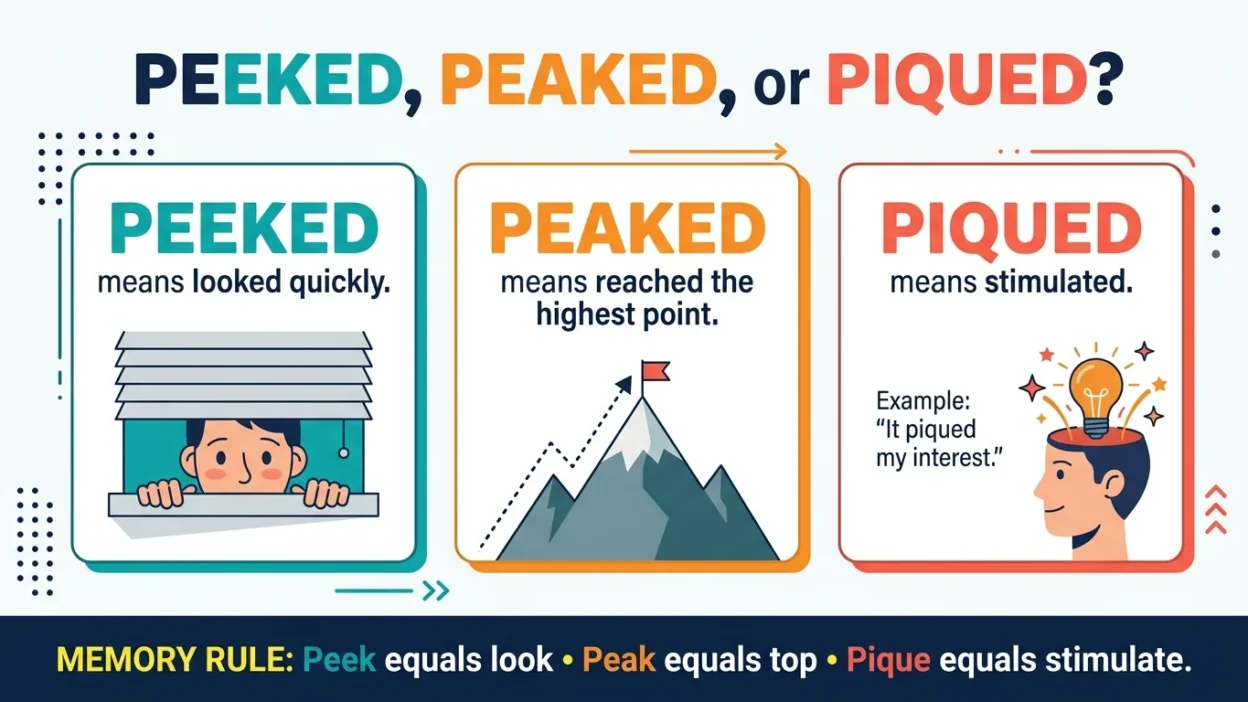
Peeked vs Peaked vs Piqued
These three words are commonly confused because they sound alike.
Peeked comes from peek and means looked quickly.
Example:
“She peeked through the window.”
Peaked comes from peak and means reached the highest point.
Example:
“Sales peaked in June.”
Piqued comes from pique and can mean stimulated or aroused, especially in the expression:
“piqued my interest”
Example:
“The headline piqued my interest.”
The easiest memory rule is:
PEEK means LOOK
PEAK means TOP
PIQUE means STIMULATE
Learning all three together can prevent one of the most common homophone mistakes in English.
Piqued My Interest or Peaked My Interest?
The standard expression for causing curiosity or interest is:
piqued my interest
Example:
“The documentary piqued my interest in astronomy.”
This means the documentary stimulated or aroused your interest.
Peaked my interest is commonly written by mistake because peaked and piqued sound alike.
However, peak means to reach a maximum.
You could correctly say:
“My interest peaked during the final chapter.”
This means your interest reached its highest level at that point.
Compare:
“The headline piqued my interest.”
It created or stimulated interest.
“My interest peaked later.”
The interest reached its maximum.
Peeked Over or Peaked Over?
If someone looked over an object, use:
peeked over
Example:
“The child peeked over the fence.”
This means the child looked over the fence briefly.
If you write peaked over, the meaning would normally be incorrect for an act of looking.
Compare:
“She peeked over his shoulder.”
Correct for looking.
“Demand peaked during the summer.”
Correct for reaching a maximum.
Whenever eyes, looking, watching, or seeing are involved, peeked is usually the word to consider.
Peak as a Noun
Peak is also a noun meaning the highest point or top.
For example:
“The climbers reached the mountain peak.”
“The company experienced a peak in demand.”
“Traffic reaches its peak in the evening.”
This noun meaning helps explain the verb peaked.
If something peaked, it reached its metaphorical or literal highest level.
Think of a mountain:
The peak is the top.
Therefore:
“Sales peaked”
means:
“Sales reached the top level.”
This visual connection is one of the easiest ways to remember the spelling of peaked.
Peek as a Noun
Peek can also function as a noun meaning a quick or secret look.
For example:
“Take a peek inside.”
“She had a quick peek at the present.”
“He took a peek through the window.”
This noun meaning reinforces the connection between peek and looking.
As a verb:
“She peeked inside.”
As a noun:
“She took a peek inside.”
Both involve looking briefly.
Therefore, if you can replace the idea with a quick look, the spelling peek or peeked is probably correct.
Peaked Meaning Highest Point
One of the most common meanings of peaked is reached the highest point.
Examples:
“Sales peaked in December.”
“Demand peaked during the holidays.”
“Temperatures peaked in the afternoon.”
“His career peaked in his thirties.”
“Website visits peaked after the announcement.”
This usage can describe numbers, performance, popularity, demand, prices, temperatures, and many other measurable or figurative levels.
After something peaks, it may remain stable or begin to decline.
The essential idea is that it has reached a maximum point.
Think:
PEAK equals TOP
Therefore:
PEAKED equals REACHED THE TOP
Peeked and Peaked in Real Life Usage
Imagine someone hears a noise outside and looks through the curtains.
You could say:
“She peeked through the curtains.”
Here, peeked refers to looking.
Now imagine a very hot day.
You could say:
“The temperature peaked at 3 p.m.”
Here, peaked means reached its highest level.
Another example:
“He peeked at the screen.”
“Website traffic peaked later that evening.”
These everyday examples reveal the basic distinction:
People peek when they look.
Numbers, levels, and performance peak when they reach a maximum.
Context makes the correct spelling much easier to identify.
Peeked and Peaked in Business English
Peaked is particularly common in business and financial writing.
Examples:
“Sales peaked in December.”
“Demand peaked during the holiday season.”
“Revenue peaked in the third quarter.”
“Prices peaked before declining.”
“Website traffic peaked after the campaign launched.”
Peeked is less common in formal business reporting because it refers to the physical act of looking.
However, it can still appear in ordinary workplace communication:
“She peeked into the meeting room.”
When discussing trends, statistics, or maximum levels, peaked is usually the relevant word.
Peeked and Peaked in Academic Writing
Both words can appear in academic writing, but peaked is especially common when discussing measured values and trends.
Examples:
“The response rate peaked during the second week.”
“Temperatures peaked in the afternoon.”
“Participation peaked near the end of the study.”
Peeked may appear in descriptive research contexts:
“The participant peeked through the opening.”
The correct choice depends entirely on meaning.
Academic writers should be particularly careful because spelling a homophone incorrectly may not be detected by basic spell checking software if both words are valid.
Always check whether the sentence concerns looking or reaching a maximum.
Formal vs Informal Use
Both peeked and peaked are standard English words.
Peeked can appear in both casual and formal contexts.
Informal:
“I peeked inside the bag.”
More formal descriptive writing:
“The participant peeked through the opening.”
Peaked is also appropriate across different levels of formality.
Informal:
“The temperature peaked around noon.”
Formal:
“Demand peaked during the final quarter.”
Neither word is inherently more formal than the other.
The distinction is based on meaning.
Choose peeked for looking and peaked for reaching a maximum.
American vs British English
The basic distinction between peeked and peaked is the same in American and British English.
Both varieties use:
peeked for looking quickly or secretly
peaked for reaching the highest point
Examples:
“She peeked through the window.”
“Sales peaked in December.”
Both varieties also recognize peaked as an adjective meaning pale or unwell, although frequency and pronunciation can vary by speaker and context.
There is no major American versus British spelling difference for the ordinary verb forms.
Therefore, the same memory rule works for both:
Peeked means looked
Peaked means reached the top
Common Mistakes With Peeked and Peaked
A common mistake is:
Incorrect:
“She peaked through the window.”
Correct:
“She peeked through the window.”
Another common error is:
Incorrect:
“Sales peeked in December.”
Correct:
“Sales peaked in December.”
A third common mistake involves piqued:
Incorrect:
“The article peeked my interest.”
Incorrect for the usual intended meaning:
“The article peaked my interest.”
Correct:
“The article piqued my interest.”
Remember the three meanings:
peek equals look
peak equals top
pique equals stimulate
Focusing on meaning rather than pronunciation prevents these mistakes.
Memory Trick for Peeked or Peaked
Use this simple memory trick:
PEEKED equals EYES
Both peek and see contain the letter e, which can help remind you of looking.
Think:
“She peeked with her eyes.”
For peaked, picture a mountain:
PEAK equals TOP
Therefore:
“Sales peaked”
means sales reached the top.
You can memorize these two sentences:
“She peeked through the window.”
“Sales peaked in December.”
And for the third homophone:
“The story piqued my interest.”
These three examples cover the most common confusion.
Expert Tips for Choosing Peeked or Peaked
First ask whether someone looked at something.
If yes, choose:
peeked
Example:
“She peeked inside.”
Next ask whether something reached its highest level.
If yes, choose:
peaked
Example:
“Demand peaked in July.”
If the phrase involves interest, be especially careful.
“Interest peaked”
can be correct when interest reached its maximum.
But:
“piqued my interest”
means stimulated my curiosity.
Do not rely on sound because all three words can sound alike.
Instead, identify the intended meaning before choosing the spelling.
Mistakes to Avoid
Do not use peaked when you mean someone looked quickly.
Use:
“peeked through”
“peeked inside”
“peeked at”
“peeked over”
Do not use peeked when discussing maximum levels.
Use:
“sales peaked”
“prices peaked”
“demand peaked”
“temperatures peaked”
“traffic peaked”
Also remember the third word:
piqued
Use it in:
“piqued my interest”
Each spelling has its own meaning.
Keeping look, top, and stimulate separate will help you choose correctly.
Similar Words
Several words sound like peeked and peaked.
The most important is:
piqued
Compare:
peeked
looked quickly
peaked
reached a maximum
piqued
stimulated or aroused
The base words also appear as:
peek
peak
pique
Examples:
“Take a peek.”
“Reach the peak.”
“Pique someone’s curiosity.”
Because these words sound alike, context is essential.
Learning them as a group is often more effective than studying peeked and peaked alone.
Related Confusing Words
If peeked or peaked is confusing, these related word pairs may also be useful:
peek vs peak
peak vs pique
peek vs pique
piqued vs peaked
site vs sight
see vs sea
stare vs stair
there vs their
passed vs past
stationary vs stationery
principal vs principle
complement vs compliment
These words demonstrate how identical or similar pronunciation can create spelling confusion.
For the current pair, remember:
Peeked is about looking.
Peaked is about reaching a maximum.
FAQs About Peeked or Peaked
Is it peeked or peaked?
Both are correct words. Use peeked for looking quickly or secretly and peaked for reaching the highest point.
What does peeked mean?
Peeked means looked quickly, briefly, or secretly.
What does peaked mean?
As a verb, peaked means reached the highest point or maximum level. As an adjective, it can mean pale, tired, or unwell looking.
Is it peeked through the window or peaked through the window?
Use peeked through the window because the action involves looking.
Is it sales peeked or sales peaked?
Use sales peaked because the phrase means sales reached their highest level.
Is it peeked at or peaked at?
Both can be correct. Peeked at means looked briefly at something. Peaked at means reached a particular maximum value.
Is it peaked my interest or piqued my interest?
The standard expression meaning stimulated my curiosity is piqued my interest. My interest peaked is also possible when you mean that your interest reached its highest level.
Do peeked and peaked sound the same?
Yes, the verb forms are generally homophones. However, adjective peaked, meaning pale or unwell, is traditionally pronounced with two syllables.
Final Verdict on Peeked or Peaked
The difference between peeked and peaked becomes simple when you focus on meaning. Peeked is the past tense and past participle of peek, meaning to look quickly, briefly, or secretly. Therefore, expressions such as peeked through the window, peeked inside the box, peeked around the corner, and peeked at the answer all use peeked.
Peaked is the past tense and past participle of peak, meaning to reach the highest point or maximum level. Therefore, sales peaked, prices peaked, demand peaked, and temperatures peaked are correct. Peaked can also function as an adjective meaning pale or unwell looking. Remember the simple distinction: peeked means looked, while peaked means reached the top. Also watch for piqued, especially in the expression piqued my interest.
Remember This
Memorize these three meanings:
PEEKED
Looked quickly
“She peeked through the window.”
PEAKED
Reached the highest point
“Sales peaked in December.”
PIQUED
Stimulated or aroused
“The article piqued my interest.”
The easiest memory rule is:
PEEK equals LOOK
PEAK equals TOP
PIQUE equals STIMULATE
If eyes are looking, think peeked.
If a level reaches the top, think peaked.

Carol Amanda is a passionate writer and faith-driven author dedicated to sharing the wisdom of the Bible. At BiblyWord, she creates inspiring and meaningful content that encourages spiritual growth and daily reflection. Her work focuses on helping readers connect with God’s Word and find guidance, peace, and strength in their faith journey.