Understanding plural or possessive forms is essential for writing clear and correct English. A plural noun usually tells us that there is more than one person, place, thing, or idea. For example, dogs means more than one dog, while students means more than one student. In most cases, regular plurals are formed by adding s or es without using an apostrophe.
A possessive noun shows ownership, association, relationship, or connection. For example, the dog’s collar refers to the collar associated with one dog, while the dogs’ collars refers to collars associated with multiple dogs. The position of the apostrophe is therefore extremely important.
It can tell readers whether the possessor is singular or plural. Once you understand how plural vs possessive forms work, common questions about students, student’s, students’, boys, boy’s, boys’, and similar words become much easier to answer.
Quick Answer
A plural means more than one and usually does not need an apostrophe: dogs, teachers, cars. A possessive shows ownership or association and normally uses an apostrophe: dog’s, teacher’s, students’. Remember: s often makes a plural, while an apostrophe usually helps show possession.
What Is the Difference Between Plural and Possessive?
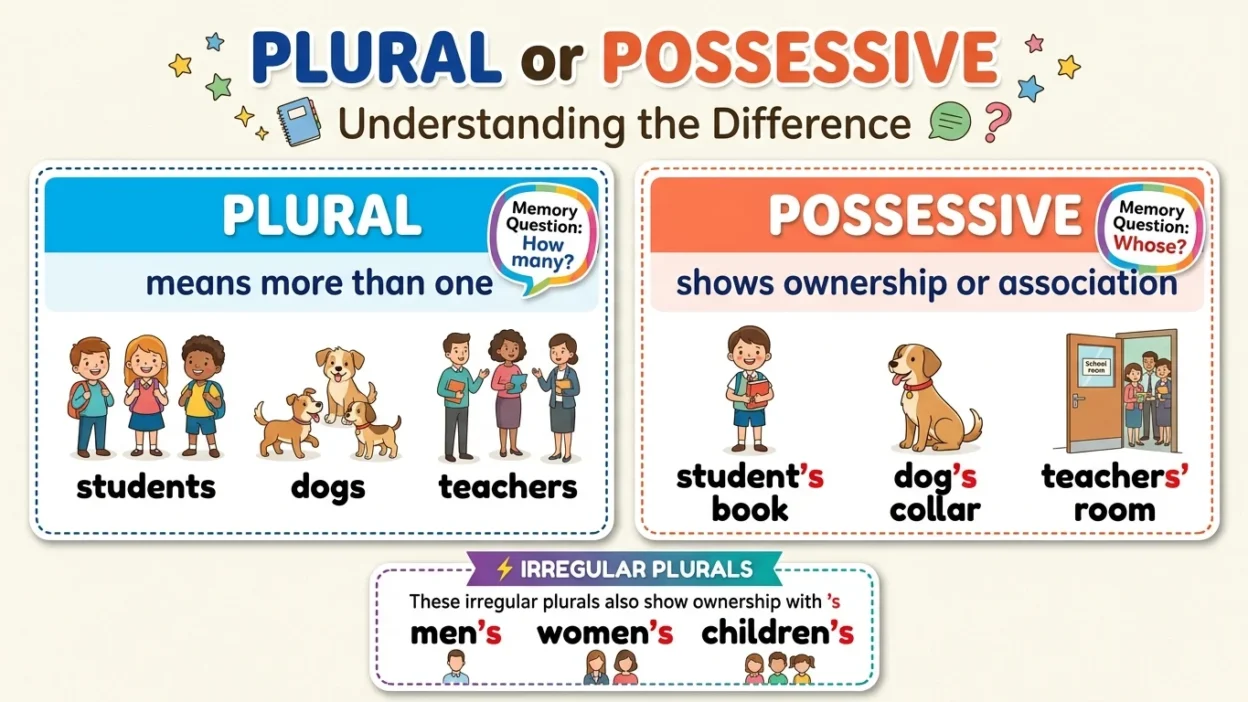
The main difference between a plural and a possessive is meaning.
A plural answers questions such as:
How many?
For example:
“Three students entered the classroom.”
Here, students simply means more than one student.
A possessive answers a question such as:
Whose?
For example:
“The student’s book is open.”
Here, student’s tells us whose book it is.
Another example is:
“The students’ books are open.”
Here, the books are associated with multiple students.
The easiest rule is:
Plural means more than one
Possessive shows ownership, association, or relationship
Do not add an apostrophe merely because a noun is plural.
Why People Confuse Plural and Possessive Forms
Plural and possessive forms are confusing because both frequently involve the letter s.
Compare:
student
students
student’s
students’
These forms look very similar, but their meanings are different.
Students is simply plural.
Student’s is singular possessive.
Students’ is plural possessive.
Another reason for confusion is that apostrophes are often difficult to hear in spoken English. For example, students and students’ can sound identical.
As a result, writers cannot depend on pronunciation alone.
Instead, determine the meaning of the sentence.
Ask:
Am I simply talking about more than one?
Use a plural.
Am I showing whose something is?
Use a possessive.
What Is a Plural?
A plural noun refers to more than one person, animal, object, place, or idea.
Examples include:
dog becomes dogs
book becomes books
teacher becomes teachers
car becomes cars
For example:
“One dog is outside.”
“Three dogs are outside.”
The second sentence uses the plural dogs.
Most regular English nouns form their plurals by adding s or es.
Examples:
“two books”
“five houses”
“several teachers”
“three boxes”
A normal plural does not require an apostrophe.
Correct:
“Four students arrived.”
Incorrect:
“Four student’s arrived.”
If you are simply counting multiple things, an apostrophe is normally unnecessary.
What Is a Possessive?
A possessive noun expresses ownership, association, relationship, or another close connection.
For example:
“The girl’s bicycle is outside.”
Here, girl’s tells us that the bicycle belongs to or is associated with one girl.
Another example:
“The teacher’s desk is near the window.”
Possessives do not always indicate literal ownership.
For example:
“the company’s policy”
“the country’s history”
“the day’s events”
“the student’s name”
A day does not literally own events, but the possessive form expresses a relationship.
Therefore, it is more accurate to think of possessives as showing possession or association, rather than ownership alone.
Plural vs Possessive Comparison Table
| Form | Meaning | Example |
|---|---|---|
| student | One student | The student is here. |
| students | More than one student | The students are here. |
| student’s | Associated with one student | The student’s book is open. |
| students’ | Associated with multiple students | The students’ books are open. |
| child | One child | The child is playing. |
| children | More than one child | The children are playing. |
| child’s | Associated with one child | The child’s toy is broken. |
| children’s | Associated with multiple children | The children’s toys are here. |
The table shows that plural and possessive forms are separate grammatical ideas.
How to Form Regular Plurals
Most regular nouns form their plurals by adding s.
Examples:
cat becomes cats
boy becomes boys
teacher becomes teachers
student becomes students
Some nouns take es.
Examples:
box becomes boxes
bus becomes buses
class becomes classes
watch becomes watches
Some words ending in consonant plus y change y to ies.
Example:
city becomes cities
The most important punctuation rule is that ordinary plurals normally do not require apostrophes.
Write:
“five books”
not:
“five book’s”
Write:
“three cars”
not:
“three car’s”
An apostrophe is not a general plural marker.
How to Form Singular Possessives
For most singular nouns, create the possessive by adding an apostrophe followed by s.
Examples:
dog becomes dog’s
student becomes student’s
teacher becomes teacher’s
boy becomes boy’s
Examples in sentences:
“The dog’s collar is red.”
“The student’s book is missing.”
“The teacher’s desk is clean.”
“The boy’s bicycle is outside.”
This rule normally applies even when the noun already ends in s, although specific editorial style guides can differ in some cases involving names.
For ordinary singular nouns, the easiest rule is:
Singular noun plus apostrophe s equals singular possessive
How to Form Plural Possessives
If a regular plural already ends in s, form the possessive by adding an apostrophe after that s.
Examples:
students becomes students’
teachers becomes teachers’
boys becomes boys’
dogs becomes dogs’
Example:
“The students’ books are on the table.”
This means the books are associated with multiple students.
Compare:
“The student’s book is on the table.”
This refers to one student.
The difference is:
student’s means one possessor
students’ means multiple possessors
The position of the apostrophe tells the reader how many possessors are involved.
Singular Possessive vs Plural Possessive
A singular possessive usually has the apostrophe before the final s.
Example:
girl’s
“The girl’s bag is blue.”
A regular plural possessive normally has the apostrophe after the s.
Example:
girls’
“The girls’ bags are blue.”
Compare:
boy’s bicycle
One boy is associated with the bicycle.
boys’ bicycle
Multiple boys are associated with the bicycle.
Do not decide based on whether the object itself is singular or plural.
The important question is:
How many possessors are there?
One regular singular possessor usually takes ‘s.
Multiple regular possessors ending in s normally take only an apostrophe.
Plural or Possessive Examples
Here are 15 examples:
- The dogs are barking.
- The dog’s collar is red.
- The dogs’ collars are red.
- The students entered the room.
- The student’s book is missing.
- The students’ books are missing.
- The teachers attended the meeting.
- The teacher’s office is upstairs.
- The teachers’ offices are upstairs.
- The boys are playing outside.
- The boy’s shoes are muddy.
- The boys’ shoes are muddy.
- The girls joined the team.
- The girl’s bicycle is new.
- The girls’ bicycles are new.
These patterns can be applied to thousands of regular English nouns.
Apostrophe Before S
An apostrophe before s commonly indicates singular possession.
Examples:
student’s
teacher’s
boy’s
girl’s
dog’s
For example:
“The student’s answer was correct.”
There is one student.
“The teacher’s computer is new.”
There is one teacher associated with the computer.
A useful memory rule is:
One possessor often means apostrophe s
Examples:
“the cat’s food”
“the company’s office”
“the child’s toy”
However, irregular plural possessives such as children’s also use apostrophe s, so always consider whether the underlying noun is singular or an irregular plural.
Apostrophe After S
An apostrophe after s commonly shows possession for a regular plural noun that already ends in s.
Examples:
students’
teachers’
boys’
girls’
dogs’
For example:
“The students’ classroom is upstairs.”
The classroom is associated with multiple students.
“The teachers’ meeting begins at noon.”
The meeting involves multiple teachers.
The basic pattern is:
student becomes students becomes students’
boy becomes boys becomes boys’
First create the regular plural.
Then add the apostrophe to make it possessive.
This two step method makes apostrophe placement easier to understand.
Do Plurals Need Apostrophes?
Ordinary plurals generally do not need apostrophes.
Correct:
“three dogs”
“five books”
“several teachers”
“many students”
Incorrect:
“three dog’s”
“five book’s”
“several teacher’s”
“many student’s”
The apostrophe should not normally be inserted just because a word ends in s.
Compare:
“The dogs are outside.”
Here, dogs is plural.
“The dog’s bowl is outside.”
Here, dog’s is singular possessive.
“The dogs’ bowls are outside.”
Here, dogs’ is plural possessive.
Always determine whether you are expressing number or possession before adding an apostrophe.
Irregular Plurals and Possessives
Not every English plural ends in s.
Some nouns have irregular plural forms.
Examples:
man becomes men
woman becomes women
child becomes children
person becomes people
mouse becomes mice
When an irregular plural does not end in s, its possessive form normally takes apostrophe s.
Examples:
men’s clothing
women’s shoes
children’s books
people’s opinions
mice’s nests
This is why men’s has an apostrophe before s, even though it refers to multiple men.
The important rule is:
Irregular plural not ending in s plus apostrophe s
Boys vs Boy’s vs Boys’
This example clearly demonstrates the difference.
Boys means more than one boy.
“The boys are playing.”
Boy’s means something belongs to or is associated with one boy.
“The boy’s ball is red.”
Boys’ means something belongs to or is associated with multiple boys.
“The boys’ ball is red.”
The object can be singular in both possessive examples.
What matters is the number of possessors.
Remember:
boys means many
boy’s means one possessor
boys’ means multiple possessors
This same pattern applies to regular nouns such as students, teachers, girls, dogs, and players.
Students vs Student’s vs Students’
Students is a plural noun.
“The students are studying.”
Student’s is singular possessive.
“The student’s notebook is open.”
Students’ is plural possessive.
“The students’ notebooks are open.”
The difference can be summarized as:
students means multiple students
student’s means belonging to one student
students’ means belonging to multiple students
This distinction is particularly important in school and academic writing.
Compare:
“The students completed the assignment.”
“The student’s assignment was excellent.”
“The students’ assignments were excellent.”
Each sentence uses a different grammatical form and communicates a different meaning.
Teachers vs Teacher’s vs Teachers’
Teachers means more than one teacher.
“The teachers are meeting today.”
Teacher’s shows possession or association with one teacher.
“The teacher’s desk is near the window.”
Teachers’ shows possession or association with multiple teachers.
“The teachers’ meeting starts at noon.”
Again, the pattern is:
teacher
teachers
teacher’s
teachers’
You can use the same pattern with many regular nouns.
Whenever you are uncertain, first determine whether the noun is singular or plural. Then ask whether you need to show possession.
That two question process prevents most apostrophe mistakes.
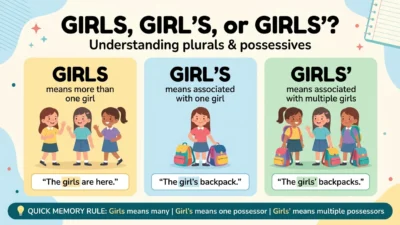
Girls vs Girl’s vs Girls’
Girls is simply plural.
“The girls are playing.”
Girl’s is singular possessive.
“The girl’s backpack is pink.”
Girls’ is plural possessive.
“The girls’ backpacks are in the classroom.”
These forms may sound very similar in normal speech, but their written meanings differ.
Ask:
How many girls?
Then:
Is there possession or association?
If you simply mean several girls:
girls
If one girl is the possessor:
girl’s
If multiple girls are the possessors:
girls’
The same logic works with most regular English nouns.
Men’s vs Mens
Men is already the plural of man.
Correct:
“The men are waiting.”
Do not write mens simply to mean multiple men.
For possession or association, use:
men’s
Examples:
“men’s clothing”
“men’s shoes”
“men’s health”
“men’s room”
Because men is an irregular plural that does not end in s, its possessive form takes apostrophe s.
Compare:
boys becomes boys’
but:
men becomes men’s
This difference exists because boys already ends in s, while men does not.
Women’s vs Womens
Women is the plural of woman.
For example:
“The women attended the event.”
The possessive form is:
women’s
Examples:
“women’s clothing”
“women’s shoes”
“women’s health”
“women’s team”
The form womens without an apostrophe is generally incorrect in ordinary standard writing.
The pattern is the same as men’s:
woman becomes women becomes women’s
Because women is an irregular plural that does not end in s, add apostrophe s to create the possessive.
Remember:
men’s
women’s
children’s
people’s
All follow the same basic possessive rule.
Children’s vs Childrens
Children is already the plural of child.
Correct:
“The children are playing.”
Incorrect:
“The childrens are playing.”
To form the possessive, add apostrophe s:
children’s
For example:
“The children’s toys are on the floor.”
Other common expressions include:
“children’s books”
“children’s clothing”
“children’s hospital”
“children’s activities”
Do not write childrens in ordinary standard English.
The pattern is:
child
children
child’s
children’s
This is an important example because it shows that a plural possessive does not always end with an apostrophe alone.
Irregular plurals that do not end in s normally take apostrophe s.
Plural or Possessive in Real Life Usage
Imagine several students entering a classroom.
You would write:
“The students entered the classroom.”
Here, students is plural.
One student leaves a phone behind:
“The student’s phone is on the desk.”
Here, student’s is singular possessive.
Several students leave their phones:
“The students’ phones are on the desks.”
Here, students’ is plural possessive.
These three sentences demonstrate the essential distinction.
First determine whether you are simply referring to multiple people or things.
Then determine whether you need to express possession or association.
That simple process works in everyday messages, school assignments, emails, reports, and professional writing.
Plural or Possessive in Business English
Correct apostrophe use is important in professional communication.
Plural:
“The managers attended the meeting.”
Singular possessive:
“The manager’s report was approved.”
Plural possessive:
“The managers’ reports were approved.”
Another example:
“The customers entered the store.”
“The customer’s complaint was resolved.”
“The customers’ feedback was reviewed.”
A misplaced apostrophe can change meaning and make polished business writing look careless.
When proofreading, identify every noun ending in s and ask whether it is simply plural or whether it shows possession.
Do not add apostrophes automatically.
Use them only when the grammatical structure requires them.
Plural or Possessive in Academic Writing
Academic writing requires precise distinctions between plurals and possessives.
Compare:
“The researchers analyzed the data.”
“The researcher’s conclusion was questioned.”
“The researchers’ conclusions were compared.”
The first refers to multiple researchers.
The second refers to one researcher’s conclusion.
The third refers to conclusions associated with multiple researchers.
Similar patterns appear frequently with words such as:
students
participants
authors
teachers
researchers
Apostrophe placement can therefore affect the meaning of academic sentences.
A useful proofreading strategy is to expand the meaning mentally.
Ask:
Does this simply mean several people or things?
Or:
Does this mean something associated with them?
Formal vs Informal Use
Plural and possessive rules apply in both formal and informal standard writing.
Formal:
“The employees attended the meeting.”
“The employees’ concerns were discussed.”
Informal:
“The dogs are outside.”
“The dogs’ bowls are outside.”
Casual messages sometimes omit apostrophes, but that can create ambiguity.
For example:
“my brothers car”
is understandable but not standard punctuation.
The standard form is:
“my brother’s car”
if there is one brother.
If multiple brothers share the car:
“my brothers’ car”
Correct apostrophe placement makes the intended relationship immediately clear, regardless of how formal the writing is.
American vs British English
The core rules for plurals and possessives are broadly the same in American and British English.
Both varieties normally use:
students for the plural
student’s for singular possession
students’ for plural possession
Both also use irregular possessives such as:
men’s
women’s
children’s
people’s
Individual editorial style guides may differ on certain special cases, particularly possessive forms of singular names ending in s.
However, the fundamental distinction between ordinary plurals and possessives remains the same.
For most everyday writing, the standard rules explained here work in both American and British English.
Plural Possessive With Names
Proper names can also form possessives.
For many singular names, apostrophe s is commonly used:
“Maria’s book”
“David’s car”
“James’s office”
However, style guides can differ on some singular names ending in s. Some styles may prefer forms such as James’, while others prefer James’s.
The important point is that this is a style issue involving certain names, not the basic rule for ordinary plurals.
For regular plural family names, the possessive can look different.
For example, first form the plural family name, then make it possessive according to the appropriate rule.
When writing professionally, consistency with the chosen style guide is important.
Plural Possessive With Shared Ownership
When two people share ownership of the same thing, the possessive is usually marked on the final name.
For example:
“Emma and Liam’s house”
This indicates that Emma and Liam share the house.
If they own separate things, each name can be possessive:
“Emma’s and Liam’s cars”
This suggests that Emma and Liam have separate cars.
The distinction is useful because possessive punctuation can communicate whether ownership is shared or separate.
This principle goes beyond basic plural formation, but it demonstrates why apostrophes carry important grammatical information.
Use context to make the relationship as clear as possible.
Common Mistakes With Plurals and Possessives
One of the most common mistakes is using an apostrophe to create an ordinary plural.
Incorrect:
“Three dog’s are outside.”
Correct:
“Three dogs are outside.”
Another error is omitting an apostrophe from a possessive.
Incorrect:
“The teachers desk.”
Correct:
“The teacher’s desk.”
For multiple teachers:
“The teachers’ desks.”
Another common error involves irregular plurals.
Incorrect:
“mens clothing”
Correct:
“men’s clothing”
Incorrect:
“childrens books”
Correct:
“children’s books”
The best way to avoid these errors is to separate the two questions:
Is the noun plural?
Is the noun possessive?
A noun can be plural, possessive, or both.
Memory Trick for Plural or Possessive
Use this simple memory trick:
Plural answers HOW MANY?
“Three dogs.”
“Five students.”
“Several teachers.”
Possessive answers WHOSE?
“The dog’s bowl.”
“The student’s book.”
“The teacher’s desk.”
For plural possession, combine both ideas:
HOW MANY possessors?
“The students’ books.”
There are multiple students, and the books are associated with them.
Remember:
Plural means more than one
Possessive means whose
This quick question method is more reliable than looking only at the final s.
Expert Tips for Choosing Plural or Possessive
First, ask whether you are simply counting people or things.
If yes, use the appropriate plural.
Example:
“Four teachers arrived.”
Next, ask whether you are expressing a relationship that answers whose.
If one teacher is involved:
“The teacher’s office.”
If multiple teachers are involved:
“The teachers’ office.”
For irregular plurals that do not end in s, add apostrophe s:
“The children’s room.”
“The men’s clothing.”
“The women’s team.”
The best strategy is to determine meaning before punctuation.
Do not add or remove an apostrophe until you know whether the noun is plural, possessive, or both.
Mistakes to Avoid
Do not use apostrophes merely to make regular nouns plural.
Avoid:
“apple’s” when you mean several apples
“car’s” when you mean several cars
“student’s” when you mean several students
Instead write:
“apples”
“cars”
“students”
Also do not assume every plural possessive ends with only an apostrophe.
Regular plural:
boys’
Irregular plural:
men’s
women’s
children’s
The difference depends on whether the plural form already ends in s.
Always identify the plural form first. Then create the possessive form from it.
Similar Grammar Forms
These examples are useful for comparison:
dog
dogs
dog’s
dogs’
Another pattern:
teacher
teachers
teacher’s
teachers’
Irregular pattern:
man
men
man’s
men’s
Another irregular pattern:
child
children
child’s
children’s
The main lesson is that plural formation and possessive formation are separate processes.
First determine the correct singular or plural noun.
Then decide whether possession needs to be shown.
Following the steps in that order prevents many common punctuation errors.
Related Confusing Grammar Topics
Other useful topics related to plural or possessive include:
boys or boy’s
mens or men’s
women or women’s
girls or girl’s
students or student’s
teachers or teacher’s
parents or parent’s
dogs or dog’s
its or it’s
whose or who’s
your or you’re
their vs they’re
The first group mainly involves plural and possessive forms.
The second group includes possessives and contractions.
Learning these differences together can improve both grammar and punctuation because they all require writers to pay attention to the function of apostrophes.
FAQs About Plural or Possessive
What is the difference between plural and possessive?
A plural indicates more than one person or thing. A possessive indicates ownership, association, or relationship.
Does a plural need an apostrophe?
Ordinary plurals normally do not require an apostrophe. Write dogs, books, students, and teachers.
What is a singular possessive?
A singular possessive usually adds apostrophe s to a singular noun, as in dog’s collar or student’s book.
What is a plural possessive?
A plural possessive shows possession by multiple people or things. A regular plural ending in s normally adds an apostrophe, as in students’ books.
Is student’s plural or possessive?
Student’s is singular possessive. The plural is students, while the plural possessive is students’.
Is students plural or possessive?
Students without an apostrophe is plural. Students’ with an apostrophe is plural possessive.
Why is men’s possessive if the apostrophe comes before s?
Because men is an irregular plural that does not end in s. Such plurals normally add apostrophe s to form the possessive.
How can I tell if a word is plural or possessive?
Ask what the sentence means. If the word answers how many, it is probably plural. If it answers whose, it is probably possessive.
Final Verdict on Plural or Possessive
The difference between plural or possessive forms becomes much easier when you focus on meaning before punctuation. A plural tells you that there is more than one person, place, object, or idea. Regular plurals such as dogs, students, teachers, and boys normally do not use apostrophes. A possessive, however, shows ownership, association, or relationship and usually requires an apostrophe.
For singular possession, forms such as student’s and boy’s are common. For regular plural possession, the apostrophe normally follows the existing s, as in students’ and boys’. Irregular plurals that do not end in s usually add apostrophe s, giving forms such as men’s, women’s, children’s, and people’s. Remembering the questions how many and whose provides a quick way to choose the correct form.
Remember This
Use these two questions:
HOW MANY?
You probably need a plural.
“The students are here.”
WHOSE?
You probably need a possessive.
“The student’s book.”
For multiple possessors:
“The students’ books.”
Remember these patterns:
student
students
student’s
students’
For irregular plurals:
man
men
man’s
men’s
The easiest rule is:
Plural means more than one
Possessive shows ownership or association
Do not use an apostrophe simply to make an ordinary noun plural

Kevin Brian is a passionate author at BiblyWord, dedicated to sharing the message of the Bible through thoughtful and inspiring content. He focuses on creating clear and meaningful writings that help readers understand scripture, strengthen their faith, and find guidance in everyday life through God’s Word.