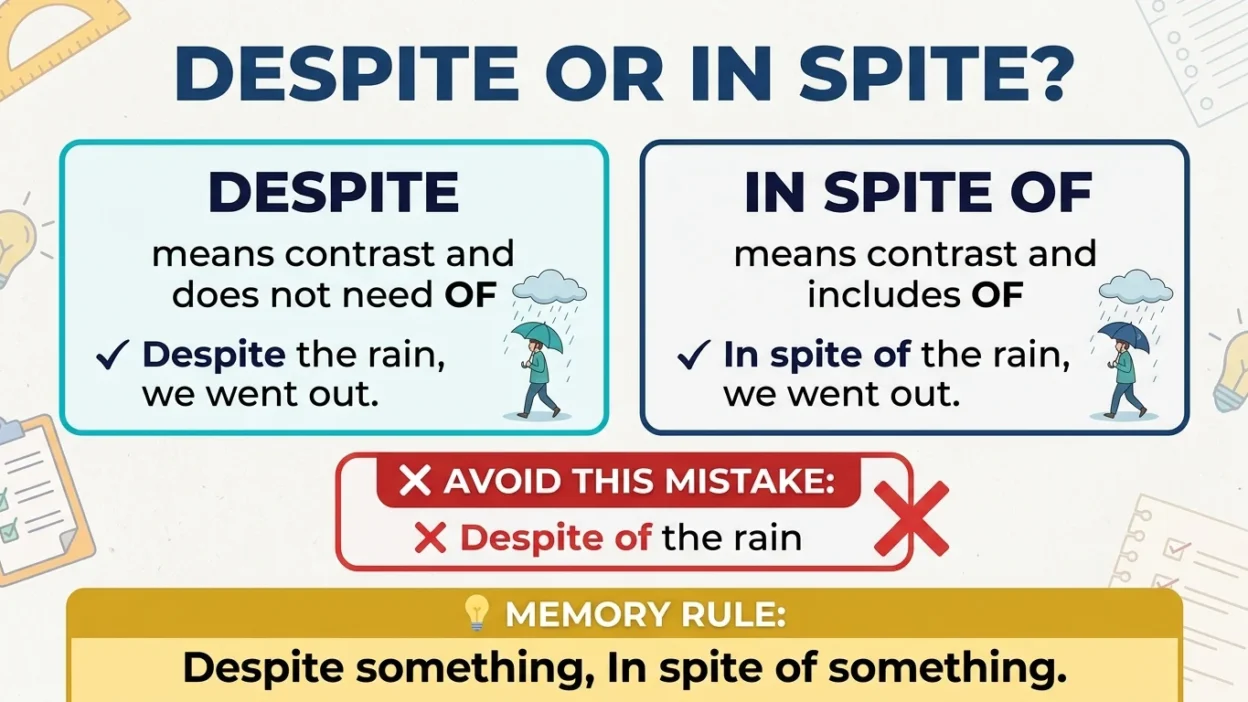
Choosing between despite or in spite can be confusing because both expressions communicate almost the same idea. They are used to introduce a contrast between two facts or situations, especially when something happens even though another circumstance might have prevented it. For example, both “Despite the rain, we went outside” and “In spite of the rain, we went outside” are correct and have essentially the same meaning.
The main difference is grammatical structure. Despite is used directly before a noun, pronoun, or gerund, while the fixed expression in spite of includes of. Therefore, “despite the rain” and “in spite of the rain” are correct, but “despite of the rain” is incorrect in standard English. Both expressions are common in formal and everyday writing, although despite is shorter and often more concise. Understanding these simple patterns will help you choose between despite and in spite of confidently.
Quick Answer
Despite and in spite of have essentially the same meaning and express contrast. Use despite without of, as in “despite the rain.” Use in spite of with of, as in “in spite of the rain.” Never normally write despite of in standard English.
Despite or In Spite Definition and Meaning
Despite and in spite of both mean that something happens even though another fact or condition might suggest a different result.
For example:
“Despite the rain, we went outside.”
“In spite of the rain, we went outside.”
Both sentences mean that it was raining, but the rain did not prevent us from going outside.
The basic structures are:
despite plus noun
“despite the weather”
in spite of plus noun
“in spite of the weather”
Their meanings are essentially the same.
The most important difference is that despite does not normally take of, while in spite needs of before a noun or similar complement.
Why People Confuse Despite and In Spite
People often confuse despite and in spite because they have nearly identical meanings.
The confusion usually comes from their different structures.
We say:
“in spite of”
Because of is required in this expression, learners sometimes incorrectly transfer it to despite and write:
“despite of”
However, standard English normally uses:
despite
or:
in spite of
Compare:
“Despite the traffic, we arrived on time.”
“In spite of the traffic, we arrived on time.”
Both are correct.
Incorrect:
“Despite of the traffic, we arrived on time.”
Remembering that despite already does the job of in spite of can help prevent this common mistake.
What Does Despite Mean?
Despite is a preposition used to show contrast.
It means that something happened or was true even though another circumstance might have been expected to prevent it.
For example:
“Despite the rain, they continued playing.”
The expected result might have been that the rain would stop them, but it did not.
Other examples include:
“Despite his age, he remains very active.”
“Despite the difficulties, she succeeded.”
“Despite feeling tired, I finished the work.”
“Despite our concerns, the event went well.”
The key grammatical rule is:
Do not normally put of after despite.
Correct:
“despite the problem”
Incorrect:
“despite of the problem”
What Does In Spite Of Mean?
In spite of is a fixed prepositional expression that also introduces contrast.
For example:
“In spite of the rain, they continued playing.”
This has essentially the same meaning as:
“Despite the rain, they continued playing.”
Other examples include:
“In spite of his age, he remains active.”
“In spite of the difficulties, she succeeded.”
“In spite of feeling tired, I continued working.”
Unlike despite, the expression requires of:
in spite of
Do not normally write:
“in spite the rain”
Instead:
“in spite of the rain”
The easiest pattern is:
despite something
in spite of something
Despite vs In Spite Comparison Table
| Feature | Despite | In Spite Of |
|---|---|---|
| Meaning | Even though a difficulty or contrast exists | Even though a difficulty or contrast exists |
| Basic structure | despite plus noun | in spite of plus noun |
| Requires of | No | Yes |
| Example | Despite the rain, we left. | In spite of the rain, we left. |
| Before gerund | Yes | Yes |
| Formal writing | Common | Common |
| Everyday English | Common | Common |
| Conciseness | Shorter | Longer |
| Main mistake | despite of | in spite without of |
The easiest distinction is:
Despite the rain
In spite of the rain
Despite or In Spite Pronunciation Guide
Despite is pronounced approximately:
“di SPITE”
The stress falls on the second syllable.
In spite of is pronounced as three separate words, although they may blend together naturally in fast speech.
The important issue is not pronunciation but grammar.
Despite contains the sound and spelling spite, which can make learners associate it with in spite of.
However, their structures remain different.
Say:
“despite the problem”
or:
“in spite of the problem”
Do not combine the two structures into:
“despite of the problem”
Learning each expression as a complete grammatical pattern is more useful than relying on pronunciation.
Grammar Rules for Despite and In Spite
The basic grammar rules are straightforward.
Use:
despite plus noun
Example:
“Despite the rain, we went out.”
Use:
in spite of plus noun
Example:
“In spite of the rain, we went out.”
Both can also be followed by a pronoun:
“Despite this, we continued.”
“In spite of this, we continued.”
Both can be followed by a gerund:
“Despite feeling tired, she worked.”
“In spite of feeling tired, she worked.”
When introducing a full clause, additional structures are normally needed, such as:
despite the fact that
in spite of the fact that
This distinction is especially important for avoiding grammatical errors.
When to Use Despite
Use despite when you want a concise way to introduce contrast.
For example:
“Despite the cold weather, we went swimming.”
“Despite his experience, he made a mistake.”
“Despite her fear, she continued.”
“Despite working hard, he did not succeed.”
Because despite is only one word, it is often convenient in formal, academic, professional, and everyday writing.
A useful formula is:
Despite plus noun
Despite plus pronoun
Despite plus gerund
Examples:
“despite the delay”
“despite this”
“despite waiting”
Do not normally add of after despite.
When to Use In Spite Of
Use in spite of when you want to express the same contrast as despite.
For example:
“In spite of the bad weather, we traveled.”
“In spite of his experience, he made a mistake.”
“In spite of her fear, she continued.”
“In spite of working hard, he did not succeed.”
The important structural rule is that of belongs to the expression.
Correct:
“in spite of the rain”
Incorrect:
“in spite the rain”
Think of in spite of as one complete unit.
If you can use despite in a sentence, you can often replace it with in spite of without significantly changing the meaning.
When to Use Each Expression
In most contexts, despite and in spite of are interchangeable in meaning.
Use despite when you prefer a shorter expression:
“Despite the rain, we continued.”
Use in spite of when you prefer the longer phrase:
“In spite of the rain, we continued.”
Both are standard.
The important difference is structure:
Despite plus noun
In spite of plus noun
For example:
“Despite the problem, she remained calm.”
“In spite of the problem, she remained calm.”
Neither expression is automatically more correct than the other.
Choose according to sentence flow, style, and personal preference while keeping the grammar correct.
Despite or In Spite Examples
Here are 15 examples showing correct usage:
- Despite the rain, we went outside.
- In spite of the rain, we went outside.
- Despite his age, he is very active.
- In spite of his age, he is very active.
- Despite the traffic, we arrived on time.
- In spite of the traffic, we arrived on time.
- Despite feeling tired, she continued working.
- In spite of feeling tired, she continued working.
- Despite the difficulties, they succeeded.
- In spite of the difficulties, they succeeded.
- Despite her fear, she remained calm.
- In spite of her fear, she remained calm.
- Despite everything, he remained optimistic.
- In spite of everything, he remained optimistic.
- Despite the delay, the project was completed successfully.
Despite the Rain or In Spite of the Rain?
Both expressions are correct:
despite the rain
in spite of the rain
For example:
“Despite the rain, we played football.”
“In spite of the rain, we played football.”
The meaning is essentially the same.
The only important structural difference is of.
Despite does not need of.
In spite does need of.
Incorrect:
“Despite of the rain, we played football.”
Correct:
“Despite the rain, we played football.”
Also correct:
“In spite of the rain, we played football.”
This simple comparison is one of the easiest ways to memorize the rule.
Despite Of or Despite?
The correct standard form is normally:
despite
not:
despite of
Correct:
“Despite the bad weather, we left.”
Incorrect:
“Despite of the bad weather, we left.”
The confusion occurs because learners mix:
despite
with:
in spite of
These are two separate constructions.
Remember:
DESPITE
No of
IN SPITE OF
Includes of
If you find yourself writing despite of, remove of:
“Despite the problem”
Or replace the entire expression:
“In spite of the problem”
Both corrected versions are grammatical.
In Spite or In Spite Of?
When the expression is followed by a noun, pronoun, or gerund, use:
in spite of
For example:
“In spite of the weather, we went out.”
“In spite of this, we continued.”
“In spite of feeling tired, she worked.”
Do not normally omit of:
“In spite the weather”
is not the standard construction for this meaning.
The complete expression should be memorized as:
IN SPITE OF
This is different from despite, which stands alone as a preposition.
Compare:
“despite the weather”
“in spite of the weather”
Keeping these two patterns separate will prevent most errors.
Despite Plus Noun
Despite can be followed directly by a noun or noun phrase.
Examples:
“Despite the rain, we continued.”
“Despite the delay, she arrived before noon.”
“Despite his experience, he made an error.”
“Despite the difficult conditions, they succeeded.”
The pattern is:
despite plus noun phrase
You do not need another preposition between despite and the noun.
Therefore:
“despite the weather”
is correct.
But:
“despite of the weather”
is not the normal standard form.
This structure is one reason despite is often convenient in concise writing.
In Spite Of Plus Noun
In spite of can also be followed by a noun or noun phrase.
Examples:
“In spite of the rain, we continued.”
“In spite of the delay, she arrived before noon.”
“In spite of his experience, he made an error.”
“In spite of the difficult conditions, they succeeded.”
The structure is:
in spite of plus noun phrase
Notice that of must remain.
Compare:
despite the rain
in spite of the rain
The meaning is essentially identical.
Only the grammatical construction changes.
Despite Plus Gerund
Despite can be followed by a gerund, which is the ing form of a verb functioning in a noun like way.
Examples:
“Despite feeling tired, she continued working.”
“Despite studying hard, he found the test difficult.”
“Despite arriving late, she was allowed inside.”
“Despite knowing the truth, he remained silent.”
The pattern is:
despite plus gerund
Do not write:
“despite of feeling tired”
Instead:
“despite feeling tired”
Or:
“in spite of feeling tired”
Both corrected constructions are standard.
This pattern is especially useful when you want to contrast an action or circumstance with an unexpected result.
In Spite Of Plus Gerund
In spite of can also be followed by a gerund.
Examples:
“In spite of feeling tired, she continued.”
“In spite of studying hard, he found the exam difficult.”
“In spite of arriving late, she was admitted.”
“In spite of knowing the truth, he said nothing.”
The structure is:
in spite of plus gerund
Compare:
“Despite feeling tired, she worked.”
“In spite of feeling tired, she worked.”
Both are correct.
The main difference remains:
despite has no of
in spite of includes of
Once this pattern is memorized, choosing between the expressions becomes much easier.
Despite the Fact That
Use despite the fact that when you want to introduce a complete clause containing a subject and verb.
For example:
“Despite the fact that it was raining, we went outside.”
Here:
it is the subject
was raining is the verb phrase
Another example:
“Despite the fact that he was tired, he continued working.”
This structure is grammatical, although it can sometimes be shortened:
“Despite being tired, he continued working.”
or:
“Although he was tired, he continued working.”
The longer construction can be useful when the full clause is important for clarity.
In Spite of the Fact That
In spite of the fact that can also introduce a complete clause.
For example:
“In spite of the fact that it was raining, we went outside.”
This has essentially the same meaning as:
“Despite the fact that it was raining, we went outside.”
Other examples include:
“In spite of the fact that she was nervous, she gave an excellent presentation.”
“In spite of the fact that they had little time, they finished the work.”
This construction is correct but relatively wordy.
Depending on the context, you may be able to write more concisely:
“Although she was nervous, she gave an excellent presentation.”
Despite That or Despite the Fact That?
Standard English usually does not use despite that directly before an ordinary clause in the same way as although.
For example, instead of:
“Despite that it was raining, we went out.”
Prefer:
“Despite the fact that it was raining, we went out.”
Or:
“Although it was raining, we went out.”
However, despite that can occur when that refers back to an earlier statement.
For example:
“The weather forecast was terrible. Despite that, we decided to travel.”
Here, that functions as a pronoun referring to the previous information.
Therefore, the structure depends on the role of that in the sentence.
Despite vs Although
Despite and although both express contrast, but their grammatical structures differ.
Use despite before a noun, pronoun, or gerund:
“Despite the rain, we left.”
“Despite feeling tired, she worked.”
Use although before a full clause:
“Although it was raining, we left.”
“Although she was tired, she worked.”
Compare:
Despite the rain
Although it was raining
Both communicate a similar contrast, but the grammar after each expression is different.
A common mistake is:
“Despite it was raining”
Instead, write:
“Although it was raining”
or:
“Despite the fact that it was raining”
In Spite Of vs Although
In spite of and although can express similar ideas, but they require different structures.
Use in spite of before a noun or gerund:
“In spite of the rain, we left.”
“In spite of feeling tired, she worked.”
Use although before a clause:
“Although it was raining, we left.”
“Although she was tired, she worked.”
Therefore:
in spite of plus noun
although plus subject and verb
Incorrect:
“In spite of it was raining, we left.”
Correct:
“In spite of the rain, we left.”
Or:
“Although it was raining, we left.”
Understanding the structure is more important than memorizing the meaning alone.
Despite vs Even Though
Despite and even though both introduce contrast, but their grammatical patterns differ.
Use despite with a noun, pronoun, or gerund:
“Despite the rain, we continued.”
Use even though with a complete clause:
“Even though it was raining, we continued.”
Another comparison:
“Despite being tired, he worked.”
“Even though he was tired, he worked.”
Even though can sometimes emphasize the contrast more strongly than although, while despite remains a concise prepositional choice.
Do not write:
“Despite he was tired.”
Instead:
“Despite being tired”
or:
“Even though he was tired”
Despite This Meaning
Despite this is a common and correct expression.
It means that something happened even though the previously mentioned situation might have suggested otherwise.
For example:
“The weather was terrible. Despite this, we went outside.”
Here, this refers to the bad weather described in the previous sentence.
Other examples include:
“The task was difficult. Despite this, she completed it.”
“He had very little experience. Despite this, he performed well.”
The expression is especially useful in formal and academic writing because it creates a clear connection between ideas.
You can often use in spite of this with the same basic meaning.
In Spite of This Meaning
In spite of this is also correct.
For example:
“The weather was terrible. In spite of this, we went outside.”
This has essentially the same meaning as:
“The weather was terrible. Despite this, we went outside.”
Both expressions refer back to a previously mentioned fact and introduce an unexpected contrast.
Other examples include:
“The project was difficult. In spite of this, the team succeeded.”
“She had little experience. In spite of this, she performed confidently.”
The choice between the two is largely stylistic.
Despite this is shorter.
In spite of this is slightly longer but equally grammatical.
Despite and In Spite in Real Life Usage
Imagine that heavy rain begins before a football match.
You could say:
“Despite the rain, the match continued.”
Or:
“In spite of the rain, the match continued.”
Now imagine that a student is very tired but continues studying:
“Despite feeling tired, she continued studying.”
“In spite of feeling tired, she continued studying.”
In each example, there is an obstacle or circumstance that might normally produce a different result.
The key idea is unexpected contrast.
Rain might stop the match, but it does not.
Tiredness might stop the student, but it does not.
Both expressions communicate this relationship effectively.
Despite and In Spite in Business English
Both expressions are useful in professional communication.
Examples:
“Despite rising costs, the company increased its profits.”
“In spite of rising costs, the company increased its profits.”
“Despite the delay, the project was completed successfully.”
“In spite of the delay, the project was completed successfully.”
Despite is particularly useful when concise writing is preferred because it communicates the same basic meaning in fewer words.
However, in spite of is also perfectly acceptable.
The most important consideration is grammatical accuracy.
Use:
despite the challenge
or:
in spite of the challenge
Avoid:
“despite of the challenge”
in standard professional writing.
Despite and In Spite in Academic Writing
Both despite and in spite of can appear in academic writing.
Examples:
“Despite the limitations, the study produced significant findings.”
“In spite of the limitations, the study produced significant findings.”
Academic writers often value concise expression, so despite can be especially convenient.
For example:
“Despite limited evidence, the hypothesis remains influential.”
If a full clause is necessary, you can use:
“Despite the fact that the evidence was limited, the hypothesis remained influential.”
However, although may sometimes produce a more concise sentence:
“Although the evidence was limited, the hypothesis remained influential.”
Choose the construction that communicates the relationship clearly and efficiently.
Formal vs Informal Use
Both despite and in spite of are standard in formal and informal English.
Formal:
“Despite the economic challenges, the company expanded.”
“In spite of the economic challenges, the company expanded.”
Informal:
“Despite the rain, we went out.”
“In spite of the rain, we went out.”
Neither expression should automatically be considered incorrect or too informal.
Despite is shorter and can sound particularly concise.
In spite of is slightly longer and may sometimes feel more conversational, but it is also entirely appropriate in formal writing.
The correct choice depends mainly on sentence structure and style.
American vs British English
Both despite and in spite of are standard in American and British English.
The grammatical rules are essentially the same.
American English:
“Despite the rain, we went outside.”
British English:
“Despite the rain, we went outside.”
Both also use:
“In spite of the rain, we went outside.”
There is no major spelling difference between the varieties for these expressions.
The important rule remains:
despite plus noun
in spite of plus noun
Do not add of after despite simply because in spite of contains it.
Common Mistakes With Despite and In Spite
One of the most common mistakes is:
Incorrect:
“Despite of the rain, we went out.”
Correct:
“Despite the rain, we went out.”
Also correct:
“In spite of the rain, we went out.”
Another common mistake is:
“In spite the rain, we went out.”
Correct:
“In spite of the rain, we went out.”
Another problem occurs with full clauses:
Incorrect:
“Despite he was tired, he worked.”
Correct:
“Although he was tired, he worked.”
Or:
“Despite being tired, he worked.”
Or:
“Despite the fact that he was tired, he worked.”
Memory Trick for Despite or In Spite
Use this simple memory trick:
DESPITE has NO OF
“Despite the rain”
IN SPITE needs OF
“In spite of the rain”
You can memorize these two complete patterns:
DESPITE SOMETHING
IN SPITE OF SOMETHING
Never mix them into:
“despite of something”
Another useful memory sentence is:
“Despite the rain, we went out.”
“In spite of the rain, we went out.”
If you remember these two examples, you can reproduce the correct structure in many other situations.
Expert Tips for Choosing Despite or In Spite
First, remember that their meanings are essentially the same.
Second, check the structure.
If using despite, do not normally add of:
“despite the problem”
If using in spite, include of:
“in spite of the problem”
Third, check what follows.
A noun works naturally:
“despite the weather”
A gerund also works:
“despite feeling tired”
For a complete clause, consider:
“although she was tired”
“even though she was tired”
“despite the fact that she was tired”
Choosing based on structure will prevent most errors.
Mistakes to Avoid
Avoid combining the two expressions.
Incorrect:
“despite of”
Correct:
“despite”
Correct:
“in spite of”
Also avoid putting an ordinary complete clause directly after despite.
Incorrect:
“Despite she was tired, she continued.”
Correct:
“Despite being tired, she continued.”
Correct:
“Despite the fact that she was tired, she continued.”
Correct:
“Although she was tired, she continued.”
Finally, remember that in spite of is three words.
Do not normally write it as one word.
Learning each construction as a complete phrase makes correct usage much easier.
Similar Words and Expressions
Several expressions can communicate contrast.
Despite
“Despite the rain, we left.”
In spite of
“In spite of the rain, we left.”
Although
“Although it was raining, we left.”
Though
“Though it was raining, we left.”
Even though
“Even though it was raining, we left.”
Nevertheless
“It was raining. Nevertheless, we left.”
However
“It was raining. However, we left.”
These expressions are related in meaning, but their grammatical structures differ.
Do not assume that one can always replace another without changing the sentence structure.
Related Confusing Words
If despite or in spite is confusing, these related topics are useful:
although vs though
although vs even though
despite vs although
in spite of vs despite
however vs although
even though vs even if
because vs because of
due to vs because of
regardless vs irrespective
nevertheless vs nonetheless
while vs whereas
The key distinction in the current topic is particularly simple:
Despite does not need of
In spite requires of before its complement
Both normally communicate essentially the same contrast.
FAQs About Despite or In Spite
What is the difference between despite and in spite of?
They have essentially the same meaning. The main difference is grammatical structure. Use despite the rain but in spite of the rain.
Is despite of correct?
Despite of is not the normal standard English construction. Use despite or in spite of.
Is it in spite or in spite of?
Before a noun, pronoun, or gerund, the standard expression is in spite of.
Can despite and in spite of be used interchangeably?
They can often replace each other when the sentence structure is adjusted correctly. For example, “despite the rain” and “in spite of the rain” have essentially the same meaning.
Can I use despite before a verb?
Despite can be followed by a gerund, as in “Despite feeling tired, she continued.” It does not normally take an ordinary finite clause directly.
Is despite more formal than in spite of?
Both are standard in formal and informal English. Despite is shorter and can be especially useful when concise writing is preferred.
Is it despite the fact that or despite that?
Use despite the fact that before a full clause. Despite that can be correct when that refers back to a previously mentioned situation.
What comes after in spite of?
A noun, pronoun, or gerund can follow in spite of, as in “in spite of the rain,” “in spite of this,” and “in spite of feeling tired.”
Final Verdict on Despite or In Spite
When choosing between despite or in spite, remember that despite and in spite of have essentially the same meaning. Both introduce a contrast and show that something happened even though another circumstance might have been expected to prevent it. For example, “Despite the rain, we went outside” and “In spite of the rain, we went outside” communicate the same basic idea.
The main difference is grammatical structure. Despite is used without of, while in spite normally requires of before a noun, pronoun, or gerund. Therefore, use despite the rain or in spite of the rain, not despite of the rain. For complete clauses, constructions such as although, even though, despite the fact that, and in spite of the fact that may be appropriate. Remembering these patterns will make the distinction easy.
Remember This
The easiest rule is:
DESPITE
No of
“Despite the rain”
“Despite being tired”
“Despite the difficulty”
IN SPITE OF
Always remember of before the complement
“In spite of the rain”
“In spite of being tired”
“In spite of the difficulty”
Both express essentially the same idea.
The key memory rule is:
Despite something
In spite of something
Avoid:
Despite of something

Kevin Brian is a passionate author at BiblyWord, dedicated to sharing the message of the Bible through thoughtful and inspiring content. He focuses on creating clear and meaningful writings that help readers understand scripture, strengthen their faith, and find guidance in everyday life through God’s Word.