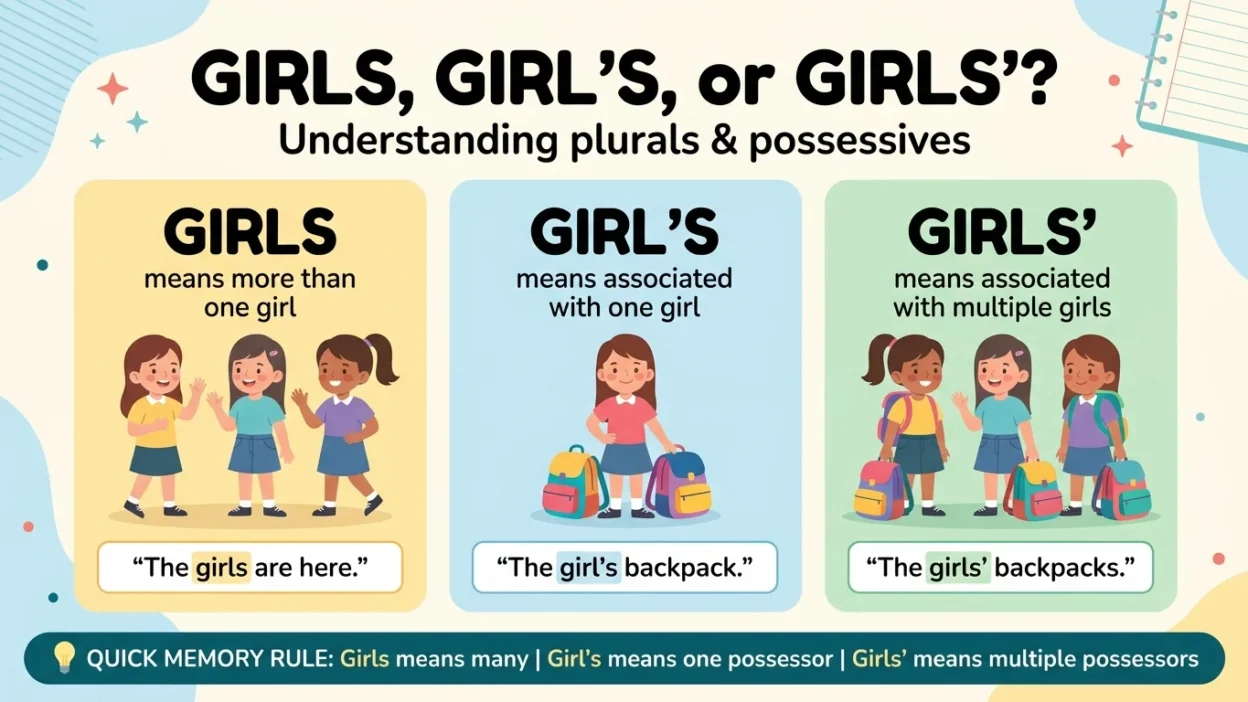
The difference between girls and girl’s depends on if you are talking about more than one girl or showing possession. Girls is the regular plural of girl, so it means two or more girls. For example, “The girls are playing outside” simply refers to multiple girls. No apostrophe is needed when you are only making the noun plural.
Girl’s, with an apostrophe before the s, is normally the singular possessive form. It means something belongs to or is associated with one girl. For example, “The girl’s backpack is on the chair” refers to the backpack associated with one girl.
There is also a third important form, girls’, which is the plural possessive. It refers to something belonging to or associated with multiple girls, as in “The girls’ backpacks are on the chairs.” Understanding girls or girl’s therefore requires knowing the difference between a regular plural, singular possessive, and plural possessive.
Quick Answer
Use girls when you mean more than one girl: “The girls are here.” Use girl’s when something belongs to one girl: “The girl’s bag is here.” Use girls’ when something belongs to multiple girls: “The girls’ bags are here.”
Girls or Girl’s Definition and Meaning
The words girls and girl’s have different grammatical functions.
Girls is the plural of girl.
Example:
“The girls are studying.”
This sentence refers to more than one girl.
Girl’s is usually the singular possessive form.
Example:
“The girl’s notebook is open.”
This means the notebook belongs to or is associated with one girl.
There is also:
Girls’
This is the plural possessive form.
Example:
“The girls’ notebooks are open.”
The basic pattern is:
girl means one girl
girls means more than one girl
girl’s means belonging to one girl
girls’ means belonging to or associated with multiple girls
Why People Confuse Girls and Girl’s
People often confuse girls and girl’s because both forms contain the same letters and sound very similar when spoken.
English also uses s for different grammatical purposes.
Adding s can create a regular plural:
girl becomes girls
Adding apostrophe s can create a singular possessive:
girl becomes girl’s
A regular plural possessive places the apostrophe after the existing s:
girls becomes girls’
These small punctuation differences can completely change the grammatical meaning.
One common mistake is:
“The girl’s are playing.”
This is incorrect if you simply mean several girls.
Correct:
“The girls are playing.”
An apostrophe does not normally create an ordinary plural.
What Does Girls Mean?
Girls is the plural form of girl.
It refers to two or more girls.
Examples:
“The girls are waiting.”
“Three girls entered the classroom.”
“Those girls are friends.”
“Several girls joined the team.”
“The girls finished their homework.”
Because girls is plural, it normally takes a plural verb.
Correct:
“The girls are ready.”
Incorrect:
“The girls is ready.”
If you are simply talking about multiple girls, no apostrophe is required.
Think:
one girl
two girls
five girls
The simple rule is:
More than one girl equals girls
What Does Girl’s Mean?
Girl’s is normally the singular possessive form of girl.
It indicates that something belongs to or is associated with one girl.
Example:
“The girl’s bicycle is outside.”
This means the bicycle belongs to one girl.
Other examples include:
“The girl’s shoes are wet.”
“The girl’s mother arrived.”
“The girl’s name is Emma.”
“The girl’s room is clean.”
“The girl’s teacher called.”
Possession does not always mean literal ownership.
For example, a girl does not own her name or mother in the same way she might own a bicycle. The possessive can also express relationships and associations.
The basic rule is:
one girl plus possession equals girl’s
What Does Girls’ Mean?
Girls’ is the plural possessive form of girls.
It shows that something belongs to or is associated with multiple girls.
Example:
“The girls’ bicycles are outside.”
This means the bicycles are associated with more than one girl.
Other examples include:
“The girls’ classroom is upstairs.”
“The girls’ uniforms are ready.”
“The girls’ parents attended the meeting.”
“The girls’ team won.”
Because girls is already a regular plural ending in s, you add only an apostrophe to create the possessive.
The pattern is:
girl becomes girls
Then:
girls becomes girls’
Remember:
girls means multiple girls
girls’ means possession involving multiple girls
Girls vs Girl’s vs Girls’ Comparison Table
| Form | Meaning | Example |
|---|---|---|
| girl | One girl | The girl is here. |
| girls | More than one girl | The girls are here. |
| girl’s | Associated with one girl | The girl’s bag is here. |
| girls’ | Associated with multiple girls | The girls’ bags are here. |
The easiest pattern to remember is:
Girl means one
Girls means many
Girl’s means one possessor
Girls’ means multiple possessors
The apostrophe changes possession, while the ordinary s creates the regular plural.
Girls or Girl’s Pronunciation Guide
Girls, girl’s, and girls’ are generally pronounced the same way in ordinary speech.
This is one reason they can be difficult to distinguish when writing.
Compare:
“The girls are here.”
“The girl’s coat is here.”
“The girls’ coats are here.”
The pronunciation does not clearly reveal where an apostrophe belongs.
Therefore, you need to examine the meaning and grammar.
Ask:
Do I simply mean multiple girls?
Use girls.
Does something relate to one girl?
Use girl’s.
Does something relate to multiple girls?
Use girls’.
Meaning is more reliable than pronunciation.
Grammar Rules for Girls and Girl’s
Girl is a regular countable noun.
Its plural is formed by adding s:
girl becomes girls
The singular possessive is formed by adding apostrophe s:
girl becomes girl’s
The plural possessive starts with the plural girls and then adds an apostrophe:
girls becomes girls’
The complete pattern is:
girl
girls
girl’s
girls’
Compare:
“The girl is studying.”
“The girls are studying.”
“The girl’s book is open.”
“The girls’ books are open.”
Once you understand these four forms, choosing the correct spelling becomes much easier.
When to Use Girls
Use girls when you simply mean more than one girl.
Examples:
“Two girls are waiting.”
“The girls went to school.”
“Several girls joined the club.”
“Those girls are classmates.”
“The girls played outside.”
Numbers can provide an easy clue:
“three girls”
“ten girls”
“twenty girls”
Do not write:
“three girl’s”
when you simply mean three girls.
The apostrophe is unnecessary because there is no possessive relationship.
Remember:
Plural only means girls
No apostrophe is needed.
When to Use Girl’s
Use girl’s when something belongs to or is associated with one girl.
Examples:
“The girl’s bag is heavy.”
“The girl’s shoes are new.”
“The girl’s bicycle is red.”
“The girl’s mother called.”
“The girl’s answer was correct.”
A useful test is to ask:
Whose?
Whose bag?
“The girl’s bag.”
Whose bicycle?
“The girl’s bicycle.”
If your answer involves one girl, girl’s is usually the correct possessive form.
The apostrophe comes before s because the possessor is singular.
When to Use Girls’
Use girls’ when something belongs to or is associated with more than one girl.
Examples:
“The girls’ bags are outside.”
“The girls’ bicycles are new.”
“The girls’ classroom is upstairs.”
“The girls’ parents arrived.”
“The girls’ team won.”
Ask:
How many girls are associated with the thing?
If there are multiple girls, first form the plural:
girls
Then add an apostrophe:
girls’
This gives you the plural possessive.
Remember:
one girl’s bag
several girls’ bags
The location of the apostrophe communicates whether there is one possessor or more than one.
When to Use Each Form
Use girls when referring to multiple girls without possession.
Example:
“The girls are talking.”
Use girl’s when something relates to one girl.
Example:
“The girl’s phone is ringing.”
Use girls’ when something relates to multiple girls.
Example:
“The girls’ phones are ringing.”
Another comparison is:
“The girls entered the classroom.”
“The girl’s classroom is upstairs.”
“The girls’ classroom is upstairs.”
The first sentence is simply plural.
The second associates the classroom with one girl.
The third associates the classroom with multiple girls.
Always identify number and possession before choosing the form.
Girls or Girl’s Examples
Here are 15 examples showing the difference:
- The girls are playing outside.
- Three girls joined the team.
- Those girls are classmates.
- The girls finished their homework.
- Several girls attended the event.
- The girl’s backpack is heavy.
- The girl’s bicycle is new.
- The girl’s shoes are wet.
- The girl’s mother is waiting.
- The girl’s name is Sarah.
- The girls’ uniforms are ready.
- The girls’ bicycles are outside.
- The girls’ parents attended the meeting.
- The girls’ classroom is upstairs.
- The girls’ team won the competition.
Girls Clothes or Girl’s Clothes or Girls’ Clothes?
The correct form depends on the intended meaning.
Girl’s clothes means clothes belonging to one girl.
Example:
“The girl’s clothes are in the closet.”
Girls’ clothes can refer to clothes associated with multiple girls.
Example:
“The girls’ clothes were packed in separate bags.”
When referring generally to clothing designed or marketed for girls, girls’ clothing is a conventional form.
For example:
“The store sells girls’ clothing.”
The form:
girls clothes
without an apostrophe is generally not the standard possessive form in ordinary prose.
Always determine whether you are expressing simple plurality, possession, or a product category.
Girls Shoes or Girl’s Shoes or Girls’ Shoes?
Use girl’s shoes when the shoes belong to one girl.
Example:
“The girl’s shoes are by the door.”
Use girls’ shoes when the shoes belong to multiple girls or when referring to shoes intended for girls as a category.
Examples:
“The girls’ shoes were muddy.”
“The store sells girls’ shoes.”
Do not confuse the number of shoes with the number of possessors.
One girl can own several shoes:
“The girl’s shoes.”
Multiple girls can also have multiple pairs:
“The girls’ shoes.”
The apostrophe position depends on how many girls are involved.
Girls Room or Girl’s Room or Girls’ Room?
Use girl’s room when referring to a room belonging to or associated with one girl.
Example:
“The girl’s room is upstairs.”
Use girls’ room when the room is associated with multiple girls.
Example:
“The girls’ room is at the end of the hallway.”
The form girls room without an apostrophe may sometimes appear in labels, names, or informal signage, but standard possessive grammar normally requires the apostrophe when possession or association is intended.
Remember:
one girl means girl’s
multiple girls means girls’
Girls School or Girls’ School?
When referring to a school intended for girls, the traditional possessive form is:
girls’ school
Example:
“She attended a girls’ school.”
The apostrophe comes after s because girls is already plural.
By contrast, girl’s school would normally suggest a school associated with one particular girl, which is rarely the intended meaning.
You may also encounter official institutional names that use different punctuation conventions. When writing the official name of a particular organization, preserve its official spelling.
For ordinary grammar:
school for girls means girls’ school
Girl’s Name or Girls’ Names?
Use girl’s name when talking about one girl.
Example:
“What is the girl’s name?”
Use girls’ names when talking about multiple girls.
Example:
“The girls’ names are written on the list.”
Compare:
“The girl’s name is Maria.”
“The girls’ names are Maria and Sofia.”
The apostrophe placement depends on the number of girls, not on whether name or names follows.
One girl:
girl’s
Multiple girls:
girls’
This is an important principle because the number of possessions does not determine the form of the possessive noun.
Girl’s Bag vs Girls’ Bags
Consider these examples:
“The girl’s bag is blue.”
One girl is associated with the bag.
“The girl’s bags are blue.”
One girl has multiple bags.
“The girls’ bag is blue.”
Multiple girls share or are associated with one bag.
“The girls’ bags are blue.”
Multiple girls have multiple bags.
These examples demonstrate an important rule:
The number of possessions does not determine apostrophe placement.
Instead, determine the number of possessors.
One girl means:
girl’s
Multiple girls means:
girls’
This rule helps prevent many common apostrophe errors.
Girl’s Team or Girls’ Team?
Both forms can be grammatical, but they communicate different meanings.
Girl’s team would normally suggest a team associated with one particular girl.
Girls’ team refers to a team for or composed of girls.
For example:
“The girls’ team won the tournament.”
When discussing sports categories involving multiple girls, girls’ team is generally the intended form.
Related expressions include:
“girls’ basketball team”
“girls’ soccer team”
“girls’ sports”
The apostrophe follows the s because girls is plural.
If an official team or organization uses a particular capitalization or punctuation style, follow its official name.
Girls Bathroom or Girls’ Bathroom?
In ordinary possessive grammar, girls’ bathroom is appropriate when referring to a bathroom intended for multiple girls.
Example:
“The girls’ bathroom is downstairs.”
The apostrophe follows s because girls is plural.
Compare:
girl’s bathroom
This would normally refer to a bathroom associated with one particular girl.
girls’ bathroom
This refers to a bathroom for multiple girls.
Signs and labels may sometimes omit punctuation, but in standard prose the possessive form clearly expresses the relationship.
Remember:
bathroom for one girl means girl’s bathroom
bathroom for girls means girls’ bathroom
Girl’s vs Girls’ With One Object
Do not decide between girl’s and girls’ by looking at the number of objects.
One girl can possess one object:
“The girl’s bicycle.”
One girl can possess several objects:
“The girl’s bicycles.”
Multiple girls can share one object:
“The girls’ bicycle.”
Multiple girls can possess several objects:
“The girls’ bicycles.”
The key question is:
How many girls are the possessors?
If one:
girl’s
If more than one:
girls’
This rule is extremely useful because many learners mistakenly look at the noun after the possessive rather than the noun doing the possessing.
Why Girls’ Has an Apostrophe After S
The plural girls already ends in s.
To make a regular plural noun possessive, standard English normally adds an apostrophe after the existing s.
Therefore:
girl becomes girls
Then:
girls becomes girls’
The same pattern applies to:
boys becomes boys’
teachers becomes teachers’
students becomes students’
parents becomes parents’
Examples:
“The boys’ room.”
“The teachers’ meeting.”
“The students’ books.”
“The girls’ uniforms.”
This differs from irregular plurals such as women and children, which do not end in s and therefore normally take apostrophe s:
women’s
children’s
Can Girl’s Mean Girl Is?
Yes. Girl’s can sometimes be a contraction of girl is or girl has, depending on context.
For example:
“The girl’s waiting outside.”
Here:
girl’s means girl is
Another example:
“The girl’s finished her homework.”
Here:
girl’s means girl has
Compare that with possession:
“The girl’s homework is finished.”
Here, girl’s is possessive.
A useful test is to expand the contraction.
If girl is or girl has fits grammatically, girl’s may be functioning as a contraction.
If it answers the question whose, it is probably possessive.
Context determines the meaning.
Girls and Girl’s in Real Life Usage
Imagine several girls arriving at school.
You could say:
“The girls arrived early.”
Here, girls is simply plural.
One girl leaves her backpack behind:
“The girl’s backpack is in the classroom.”
Here, girl’s shows singular possession.
Several girls leave their books behind:
“The girls’ books are in the classroom.”
Here, girls’ shows plural possession.
This real life example demonstrates the three main forms clearly:
girls means multiple girls
girl’s means associated with one girl
girls’ means associated with multiple girls
Once you identify the number of girls and whether possession exists, choosing the correct form becomes much easier.
Girls and Girl’s in Business English
Correct apostrophe placement matters in professional and commercial writing.
For example:
“The girls attended the event.”
Here, girls is plural.
“The girl’s registration was confirmed.”
Here, girl’s refers to one girl’s registration.
“The girls’ registrations were confirmed.”
Here, girls’ refers to registrations associated with multiple girls.
Retail writing may also use expressions such as:
“girls’ clothing”
“girls’ shoes”
“girls’ accessories”
“girls’ sportswear”
Correct punctuation is particularly important on product pages, advertisements, reports, and professional websites because misplaced apostrophes can make polished writing look careless.
Girls and Girl’s in Academic Writing
Academic writing follows the same plural and possessive rules.
Plural:
“The girls participated in the study.”
Singular possessive:
“The girl’s response was recorded.”
Plural possessive:
“The girls’ responses were compared.”
The difference can change the meaning significantly.
“The girl’s results”
refers to results associated with one girl.
“The girls’ results”
refers to results associated with multiple girls.
When proofreading academic work, ask whether each noun is simply plural or whether it expresses possession or association.
Apostrophe placement should reflect the intended meaning precisely.
Formal vs Informal Use
The distinction between girls, girl’s, and girls’ remains the same in formal and informal standard English.
Informal:
“The girls are here.”
Formal:
“The girls participated in the program.”
Singular possession:
“The girl’s phone is missing.”
Plural possession:
“The girls’ phones are missing.”
Casual digital communication may sometimes omit apostrophes, but standard written English maintains the distinction.
Using apostrophes correctly makes your meaning clearer and helps readers immediately understand whether you mean multiple girls, something associated with one girl, or something associated with several girls.
American vs British English
The fundamental rules for girls, girl’s, and girls’ are the same in American and British English.
Both use:
girls for the regular plural
girl’s for singular possession
girls’ for plural possession
Examples:
“The girls are outside.”
“The girl’s coat is outside.”
“The girls’ coats are outside.”
Specific institutional names or style conventions can sometimes use punctuation differently, but the basic grammatical distinction remains the same.
Therefore, the same memory rule works for both American and British English:
girls means many
girl’s means one possessor
girls’ means multiple possessors
Common Mistakes With Girls and Girl’s
A very common error is using an apostrophe to make the ordinary plural.
Incorrect:
“The girl’s are playing.”
Correct:
“The girls are playing.”
Another mistake is forgetting the apostrophe when possession is intended.
Incorrect:
“The girls bicycle is red.”
If one girl owns it:
“The girl’s bicycle is red.”
If several girls share it:
“The girls’ bicycle is red.”
Another common error is placing the apostrophe on the wrong side of s.
Remember:
girl’s means one girl
girls’ means multiple girls
Always determine the number of possessors before placing the apostrophe.
Memory Trick for Girls or Girl’s
Use this simple four part pattern:
GIRL means ONE
“The girl is here.”
GIRLS means MANY
“The girls are here.”
GIRL’S means ONE POSSESSOR
“The girl’s bag.”
GIRLS’ means MULTIPLE POSSESSORS
“The girls’ bags.”
You can also ask two questions:
How many girls?
Then:
Is there possession or association?
If you simply mean multiple girls, use girls.
If one girl is the possessor, use girl’s.
If multiple girls are the possessors, use girls’.
Expert Tips for Choosing Girls or Girl’s
First ask whether you simply mean more than one girl.
If yes:
girls
Example:
“Five girls arrived.”
Next ask whether something belongs to or is associated with one girl.
If yes:
girl’s
Example:
“The girl’s jacket.”
Finally, ask whether something belongs to or is associated with multiple girls.
If yes:
girls’
Example:
“The girls’ jackets.”
A useful test for possessives is the question:
Whose?
Whose jacket?
One girl:
“The girl’s jacket.”
Whose jackets?
Multiple girls:
“The girls’ jackets.”
This simple test works in most everyday situations.
Mistakes to Avoid
Do not use an apostrophe simply because girls ends in s.
Incorrect:
“Four girl’s entered the room.”
Correct:
“Four girls entered the room.”
Do not confuse singular and plural possession.
One girl:
girl’s
Multiple girls:
girls’
Also remember that the noun following the possessive does not determine apostrophe placement.
“The girl’s books”
can refer to several books owned by one girl.
“The girls’ book”
can refer to one book shared by several girls.
Always focus on the number of possessors.
Similar Words
Many regular nouns follow the same pattern.
Boy
boy
boys
boy’s
boys’
Student
student
students
student’s
students’
Teacher
teacher
teachers
teacher’s
teachers’
Parent
parent
parents
parent’s
parents’
Compare:
“The teachers are here.”
“The teacher’s office is upstairs.”
“The teachers’ offices are upstairs.”
The same grammatical pattern applies to girl, girls, girl’s, and girls’.
Learning one pattern helps you understand thousands of regular English nouns.
Related Confusing Words
If girls or girl’s causes confusion, these related grammar topics are useful:
boys or boy’s
men or men’s
women or women’s
students or student’s
teachers or teacher’s
parents or parent’s
dogs or dog’s
children or children’s
its or it’s
whose or who’s
your or you’re
plural or possessive
The most important distinction is between a simple plural and a possessive form.
Remember:
girls means more than one
girl’s means associated with one girl
girls’ means associated with multiple girls
FAQs About Girls or Girl’s
Is it girls or girl’s?
Use girls when referring to more than one girl. Use girl’s when something belongs to or is associated with one girl.
What does girls mean?
Girls is the regular plural of girl and means more than one girl.
What does girl’s mean?
Girl’s normally indicates possession involving one girl. It can also sometimes contract girl is or girl has.
What does girls’ mean?
Girls’ is the plural possessive form. It indicates something belongs to or is associated with multiple girls.
Is it girls clothes or girl’s clothes?
Girl’s clothes means clothes belonging to one girl. Girls’ clothes can mean clothes associated with multiple girls or clothing intended for girls as a category.
Is it girl’s school or girls’ school?
If you mean a school intended for girls, girls’ school is the traditional possessive form.
Is it girls shoes or girls’ shoes?
For shoes intended for girls as a category, girls’ shoes is the conventional possessive form. Girl’s shoes means shoes belonging to one girl.
Does girls need an apostrophe?
Not when girls is simply the plural of girl. Add an apostrophe only when the grammatical construction requires possession.
Final Verdict on Girls or Girl’s
The difference between girls and girl’s depends on number and possession. Girls is the regular plural of girl, so it means more than one girl. For example, “The girls are playing outside” requires no apostrophe because the word is simply plural. Girl’s, with the apostrophe before s, normally indicates something belonging to or associated with one girl, as in “The girl’s bicycle is outside.”
The third form, girls’, is equally important. It is the plural possessive and indicates something associated with multiple girls, as in “The girls’ bicycles are outside.” The easiest way to choose correctly is to determine the number of girls first and then ask whether possession or association is involved. Remember: girl means one, girls means many, girl’s means one possessor, and girls’ means multiple possessors.
Remember This
Memorize these four forms:
GIRL
One girl
GIRLS
More than one girl
GIRL’S
Belonging to or associated with one girl
GIRLS’
Belonging to or associated with multiple girls
Examples:
“The girls are here.”
“The girl’s bag is here.”
“The girls’ bags are here.”
The quickest rule is:
More than one girl means GIRLS
One girl possesses something means GIRL’S
Multiple girls possess something means GIRLS’

Donald Andrew is a dedicated author at BiblyWord, passionate about sharing biblical teachings in a clear and inspiring way. He creates meaningful content that helps readers understand scripture, reflect on their faith, and apply God’s Word in daily life. His work supports spiritual growth, guidance, and a deeper connection with biblical wisdom.