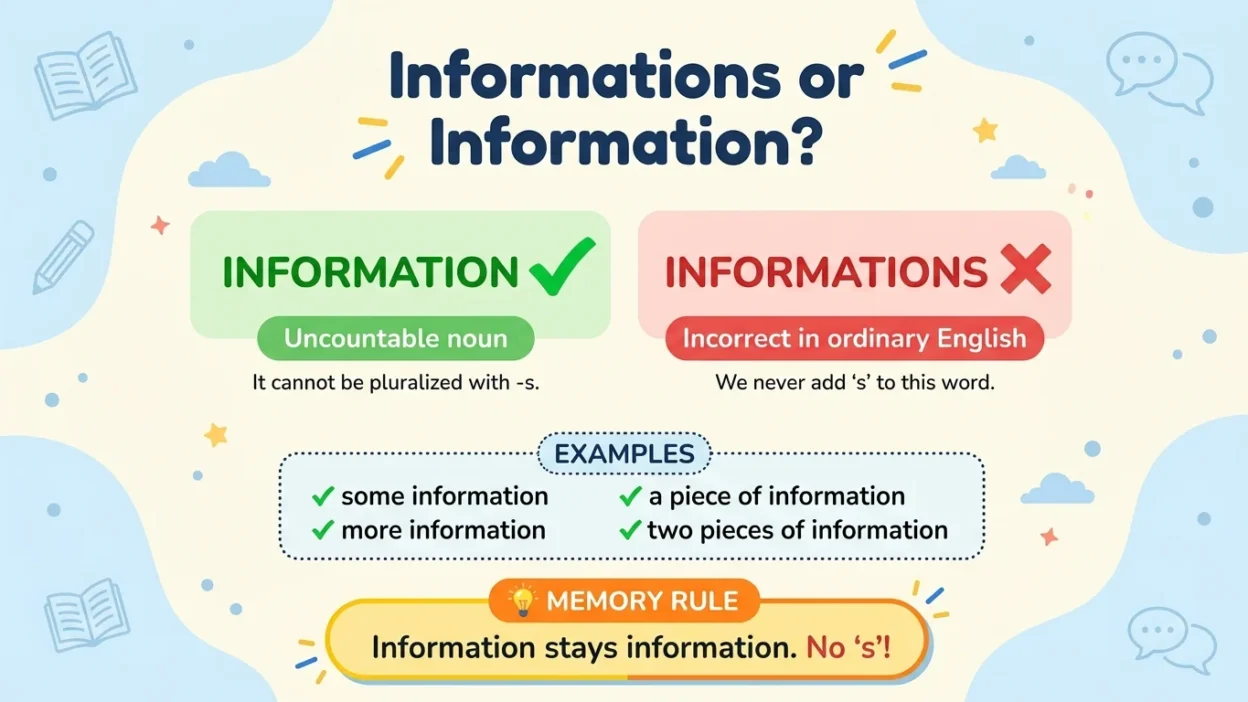
Choosing between informations or information can be confusing, especially for English learners whose first language allows the equivalent of information to have a regular plural form. In standard English, however, information is normally an uncountable noun. This means we generally do not add s to make it plural. If you have one fact or many facts to communicate, the usual word remains information.
For example, “I need some information about the course” is correct, while “I need some informations about the course” is not standard English. If you need to count separate facts or details, you can use expressions such as a piece of information, two pieces of information, several facts, or some details. Understanding whether informations or information is correct becomes much easier once you recognize that information behaves like other uncountable nouns such as advice, knowledge, furniture, and equipment.
Quick Answer
Information is correct in standard English. Informations is generally incorrect because information is normally an uncountable noun. Say “some information” or “a piece of information,” not “an information” or “informations.” To count separate items, use pieces of information, facts, or details.
Informations or Information Definition and Meaning
Information refers to facts, details, knowledge, or material communicated or learned about a person, subject, situation, or event.
For example:
“I need more information.”
“She gave me useful information.”
“We received information about the event.”
In standard English, information is normally an uncountable noun.
Therefore, we do not normally say:
“an information”
or:
“informations”
Instead, we use expressions such as:
“some information”
“more information”
“a piece of information”
“three pieces of information”
The central rule is simple:
Information is normally uncountable, so information remains information regardless of quantity.
Why People Confuse Informations and Information
The confusion often comes from the fact that information can refer to many individual facts.
Logically, a learner may think:
one fact equals information
many facts equal informations
However, English grammar does not work that way with this noun.
Information is treated as a mass or uncountable noun in ordinary English.
Compare:
“I received some information.”
“I received a lot of information.”
“I received several pieces of information.”
In all these examples, information itself does not become plural.
Another reason for confusion is that equivalent words in other languages may be countable. English learners sometimes transfer that grammatical pattern into English.
The safest rule is:
Do not add s to information in ordinary English.
What Does Information Mean?
Information means facts, knowledge, details, or material that tells someone about something.
Examples:
“Can you give me more information?”
“The website contains useful information.”
“We need information about the applicant.”
“She provided important information.”
“The police received new information.”
The noun can describe a small amount or a large amount.
For example:
“some information”
“a little information”
“a lot of information”
“more information”
“enough information”
Because the word is normally uncountable, its form does not change according to quantity.
You can have a large amount of information, but you do not normally have many informations.
Is Informations a Word?
In ordinary modern English, informations is generally not used as the normal plural of information.
If you mean multiple facts or details, simply use information:
Correct:
“We received useful information.”
Incorrect in ordinary English:
“We received useful informations.”
If you need to emphasize separate countable items, use:
“pieces of information”
“facts”
“details”
“reports”
“messages”
In rare historical, legal, or specialized contexts, informations can occur with technical meanings. For example, information has specialized legal uses in some jurisdictions that can be countable.
However, those specialized cases do not change the everyday rule.
For normal English communication, information is the correct form.
Informations vs Information Comparison Table
| Form | Standard Everyday Use | Meaning | Example |
|---|---|---|---|
| information | Correct | Facts or knowledge | I need more information. |
| informations | Generally incorrect for ordinary meaning | Intended plural of information | Avoid in everyday English. |
| an information | Generally incorrect | Intended single item | Use a piece of information. |
| some information | Correct | An unspecified amount | She gave me some information. |
| a piece of information | Correct | One countable item | I learned a useful piece of information. |
| pieces of information | Correct | Multiple countable items | We received three pieces of information. |
The most important rule is:
Use information, not informations, for the ordinary meaning.
Is Information Countable or Uncountable?
Information is normally an uncountable noun in standard English.
Countable nouns can usually be counted directly:
“one book”
“two books”
“three books”
Uncountable nouns are not normally counted directly in this way.
Therefore, we do not normally say:
“one information”
“two informations”
Instead, say:
“one piece of information”
“two pieces of information”
“three pieces of information”
Other common uncountable nouns include:
advice
furniture
equipment
knowledge
research
Recognizing information as uncountable explains most of the grammar rules surrounding the word.
Why Information Has No Regular Plural
English nouns do not all form plurals simply by adding s.
Countable nouns commonly do:
book becomes books
car becomes cars
student becomes students
But mass nouns such as information normally do not have an ordinary plural form because they represent something as an uncounted quantity.
For example:
“The document contains information.”
It could contain one fact or hundreds of facts. The noun information remains unchanged.
Similarly:
“The office has new equipment.”
You would not normally say:
“new equipments”
The same principle applies to information.
When individual units matter, English uses another countable noun, such as piece, fact, or detail.
Can We Say an Information?
In ordinary standard English, you should not normally say:
“an information”
The article an is used with singular countable nouns, but information is normally uncountable.
Incorrect:
“Can you give me an information?”
Correct:
“Can you give me some information?”
If you mean one specific item, say:
“Can you give me a piece of information?”
Another natural alternative is:
“Can you give me a detail?”
The same principle applies to advice.
We normally say:
“a piece of advice”
rather than:
“an advice”
Remember that information does not become countable simply because you are referring to one fact.
Can We Say Some Information?
Yes. Some information is completely correct and very common.
Examples:
“I need some information about the job.”
“She gave me some useful information.”
“We found some information online.”
“Could you send me some information?”
The determiner some works naturally with uncountable nouns.
Other useful expressions include:
“more information”
“less information”
“enough information”
“a lot of information”
“useful information”
“additional information”
“further information”
These expressions allow you to discuss different quantities without making information plural.
Therefore, when you are unsure, some information is often a safe and natural choice.
A Piece of Information Meaning
A piece of information means one individual fact, detail, or item of information.
For example:
“I have an important piece of information for you.”
Because information itself is uncountable, piece provides the countable unit.
One:
“a piece of information”
More than one:
“two pieces of information”
“several pieces of information”
“many pieces of information”
For example:
“The report contains three important pieces of information.”
This construction is grammatically correct, although in everyday writing three important facts or three important details may sometimes sound simpler.
Use the expression that best matches your context.
Pieces of Information or Informations?
The standard expression is:
pieces of information
not:
informations
For example:
“We received several pieces of information.”
This allows you to count individual items while keeping information uncountable.
Compare:
“One piece of information was missing.”
“Three pieces of information were missing.”
Notice that piece changes to pieces, while information remains unchanged.
This pattern also appears with other uncountable nouns:
“a piece of advice”
“two pieces of advice”
“a piece of equipment”
“several pieces of equipment”
The countable unit changes, while the uncountable noun remains in its usual form.
Information or Informations Examples
Here are 15 examples showing the correct usage:
- I need more information.
- She gave me useful information.
- We received some information yesterday.
- The website provides detailed information.
- Please send me the required information.
- He shared important information with us.
- We do not have enough information.
- I found a useful piece of information.
- She provided two pieces of information.
- This information is confidential.
- The information was accurate.
- Could you provide additional information?
- We need further information before deciding.
- The report contains a lot of information.
- Please check the information carefully.
In ordinary English, none of these examples requires informations.
Information Is or Information Are?
Because information is an uncountable singular mass noun, it normally takes a singular verb.
Correct:
“The information is correct.”
Incorrect:
“The information are correct.”
Another example:
“This information was helpful.”
Not:
“This information were helpful.”
Even when information refers to many facts, the noun itself is grammatically singular in ordinary usage.
Compare:
“The information is useful.”
“The facts are useful.”
Information takes is.
Facts takes are.
This is an important rule because learners sometimes assume that information containing many details should take a plural verb.
Grammatically, however:
information is
is the standard construction.
This Information or These Informations?
The correct expression is:
this information
Because information is normally uncountable, we use this rather than treating it as a regular plural noun.
Correct:
“This information is useful.”
Incorrect in ordinary English:
“These informations are useful.”
If you want a plural construction, use a countable noun:
“These facts are useful.”
“These details are useful.”
“These pieces of information are useful.”
Notice the difference:
this information
but:
these pieces of information
The demonstrative agrees with the countable noun pieces, not with information.
Much Information or Many Informations?
Use much information, not many informations.
Much can be used with uncountable nouns:
“much information”
“much advice”
“much knowledge”
Many is used with plural countable nouns:
“many facts”
“many details”
“many books”
In everyday affirmative sentences, a lot of information often sounds more natural than much information.
For example:
“The report contains a lot of information.”
In questions and negative sentences, much information is very natural:
“Do you have much information?”
“We don’t have much information.”
Avoid:
“many informations”
Instead, say:
“many facts”
“many details”
or:
“many pieces of information”
More Information or More Informations?
The correct standard expression is:
more information
For example:
“I need more information.”
“Please contact us for more information.”
“The website provides more information about the program.”
Do not normally write:
“more informations”
The word more can modify both countable and uncountable nouns, so there is no need to make information plural.
Compare:
“more books”
“more students”
“more information”
With countable nouns, the noun may be plural.
With information, the noun remains uncountable.
This is why for more information is one of the most common expressions used on websites, brochures, advertisements, and official documents.
Additional Information or Additional Informations?
The standard phrase is:
additional information
For example:
“Please provide additional information.”
“We need additional information before processing your application.”
“The document contains additional information.”
Do not normally write:
“additional informations”
If you need to identify multiple separate items, you can say:
“additional pieces of information”
“additional details”
“additional facts”
In most professional contexts, however, additional information is the most natural and concise expression.
The adjective additional does not make the uncountable noun information countable.
Therefore:
additional information
is the standard form.
Further Information or Further Informations?
The correct phrase is:
further information.
For example:
“For further information, contact the office.”
“Please visit our website for further information.”
“We require further information before making a decision.”
The phrase is especially common in formal, professional, academic, and business writing.
Avoid:
“further informations”
because information remains uncountable.
You may also use:
“more information”
“additional information”
“further details”
Which expression is best depends on context, but all of these are standard.
A useful phrase to memorize is:
For further information
This is widely used in notices, applications, reports, websites, and official communication.
Information About or Information On?
Both information about and information on can be correct.
For example:
“I need information about the course.”
“I found information on the new policy.”
Information about is extremely common and works in a wide range of situations.
Information on is also common, particularly when referring to information concerning a particular topic or subject.
Examples:
“information about the company”
“information on workplace safety”
“information about the application process”
“information on current regulations”
The exact choice depends on context and natural phrasing.
The important point for this topic is that the noun remains:
information
not:
informations
Information vs Data
Information and data are related, but they are not always interchangeable.
Data generally refers to facts, measurements, observations, or values collected for analysis.
Information is a broader term for facts or knowledge that are communicated, understood, or used.
For example:
“The researchers collected data.”
“The report provides information about the results.”
In everyday English, data and information can overlap, especially in technology and business contexts, but their precise meanings can differ.
When choosing between information and informations, however, the rule remains straightforward:
Use information for the ordinary uncountable noun.
Information vs Details
Information is a broad uncountable noun.
Details is a plural countable noun referring to specific facts or particulars.
Compare:
“Please send me more information.”
“Please send me the details.”
Both can be correct, but their emphasis is slightly different.
Information may include general or detailed knowledge.
Details often emphasizes specific points.
Because details is countable, you can say:
“one detail”
“three details”
“many details”
With information, use:
“some information”
“a piece of information”
“a lot of information”
Choosing details is often a natural alternative when you want to discuss several separate pieces of information.
Information vs Advice
Both information and advice are normally uncountable nouns.
Correct:
“some information”
“some advice”
Incorrect in ordinary English:
“informations”
“advices”
For one item, you can say:
“a piece of information”
“a piece of advice”
For multiple items:
“pieces of information”
“pieces of advice”
However, their meanings differ.
Information provides facts or knowledge.
Advice provides recommendations or suggestions about what someone should do.
Example:
“She gave me information about the job.”
“She gave me advice about the interview.”
Learning these nouns together can help you remember their uncountable grammar.
Information in Real Life Usage
Imagine you are applying for a job and need to know more about the position.
You would say:
“I need more information about the job.”
You would not normally say:
“I need more informations about the job.”
If the employer asks you to provide certain facts, they might say:
“Please provide the required information.”
If three specific details are missing, they could say:
“We need three additional pieces of information.”
In everyday English, information appears constantly in applications, websites, emails, forms, instructions, customer service conversations, and workplace communication.
Remembering that it is normally uncountable will help you avoid a very common learner error.
Information in Business English
Information is extremely common in business communication.
Examples include:
“Please provide the requested information.”
“We need additional information.”
“The information is confidential.”
“Contact our office for more information.”
“Please verify the information before submitting the form.”
Because information is uncountable, professional writing should not normally use informations for multiple facts.
If separate items need to be counted, business writers may use:
“details”
“records”
“documents”
“facts”
“pieces of information”
Choosing a more specific countable noun can sometimes make business communication clearer and more precise.
Information in Academic Writing
Academic writing frequently uses information as an uncountable noun.
Examples:
“The study provides useful information.”
“The researchers collected information from participants.”
“Additional information is presented in the appendix.”
“The available information was insufficient.”
Do not normally write:
“The researchers collected many informations.”
Instead:
“The researchers collected a great deal of information.”
or:
“The researchers collected many pieces of information.”
Depending on the context, more precise academic nouns may be preferable, such as:
data
evidence
findings
results
observations
Still, when information is appropriate, it normally remains uncountable.
Information in Technology
The word information is widely used in computing and technology.
Examples include:
“personal information”
“login information”
“account information”
“system information”
“contact information”
“security information”
“user information”
Even when a system stores many individual fields or records, information normally remains uncountable.
For example:
“Your account information is secure.”
Notice that information takes is, not are.
If you need to discuss separate countable objects, more specific terms may be appropriate:
“records”
“files”
“entries”
“data points”
“messages”
The grammatical rule for information itself remains unchanged.
Formal vs Informal Use
Information is standard in both formal and informal English.
Informal:
“Can you give me some information?”
Formal:
“Please provide the requested information.”
Informal:
“I need more information.”
Formal:
“Further information is required before the application can be processed.”
The form informations is not a more formal version of information.
In ordinary English, it is generally inappropriate regardless of formality.
Therefore, whether you are writing a text message, email, academic paper, business report, application, or official document, use information for the normal meaning.
American vs British English
The ordinary grammatical treatment of information is the same in American and British English.
In both varieties, information is normally uncountable.
American English:
“Please provide more information.”
British English:
“Please provide more information.”
Neither standard variety normally uses informations as the everyday plural.
Expressions such as:
“some information”
“further information”
“additional information”
“a piece of information”
are standard in both.
Therefore, you do not need to learn separate American and British rules for this particular distinction.
The main rule remains:
Use information, not informations, in ordinary English.
Common Mistakes With Informations and Information
A common mistake is:
Incorrect:
“I need some informations.”
Correct:
“I need some information.”
Another error is:
Incorrect:
“She gave me an information.”
Correct:
“She gave me some information.”
Or:
“She gave me a piece of information.”
Another mistake is:
Incorrect:
“These informations are useful.”
Correct:
“This information is useful.”
If referring to separate items:
“These pieces of information are useful.”
Also avoid:
“many informations”
Use:
“much information”
“a lot of information”
“many facts”
“many details”
or:
“many pieces of information”
Recognizing information as uncountable prevents all of these common errors.
Memory Trick for Informations or Information
Use this simple memory trick:
INFORMATION STAYS INFORMATION
One fact:
“a piece of information”
Many facts:
“a lot of information”
The noun itself does not normally change.
You can also connect information with advice.
We say:
“some advice”
not:
“advices”
Likewise:
“some information”
not:
“informations”
Remember:
One piece of information
Two pieces of information
Lots of information
The quantity can change, but the word information stays the same.
Expert Tips for Using Information Correctly
First, avoid putting a or an directly before information in its ordinary meaning.
Instead of:
“an information”
write:
“some information”
or:
“a piece of information”
Second, do not add s when you mean multiple facts.
Instead of:
“informations”
use:
“information”
Third, choose a countable noun when counting is important.
Use:
“three facts”
“four details”
“five pieces of information”
Finally, remember the correct verb agreement:
“The information is correct.”
These four rules will help you use information naturally in most everyday, professional, and academic situations.
Mistakes to Avoid
Avoid treating information like an ordinary countable noun.
Do not normally write:
“an information”
“two informations”
“many informations”
“these informations”
Instead use:
“some information”
“a piece of information”
“two pieces of information”
“a lot of information”
“this information”
Also remember:
“The information is useful.”
not:
“The information are useful.”
The easiest approach is to treat information as a quantity of knowledge rather than as individual countable objects.
When you need individual objects, use words such as facts, details, records, or pieces of information.
Similar Uncountable Words
Several common English nouns behave similarly to information.
Advice
“some advice”
“a piece of advice”
Equipment
“some equipment”
“a piece of equipment”
Furniture
“some furniture”
“a piece of furniture”
Knowledge
“some knowledge”
“a great deal of knowledge”
Research
“some research”
“a research study”
These nouns should not normally receive a simple s merely because you mean more than one item.
Learning them together can help you understand how uncountable nouns work in English.
Related Confusing Words
If informations or information is confusing, these related grammar topics are useful:
advice or advices
equipment or equipments
furniture or furnitures
knowledge or knowledges
research or researches
feedback or feedbacks
evidence or evidences
work or works
data or information
detail or details
plural or possessive
mens or men’s
girls or girl’s
These topics involve questions about countable nouns, uncountable nouns, plurals, or possessive forms.
The key rule for the current topic is especially simple:
Information is normally uncountable and does not take a regular plural s.
FAQs About Informations or Information
Is it informations or information?
Use information in ordinary standard English. Informations is generally incorrect when you simply mean multiple facts or details.
Is information singular or plural?
Information is normally an uncountable mass noun and takes singular verb agreement, as in “The information is correct.”
Can we say informations?
Not normally for the everyday meaning of facts or knowledge. Rare specialized uses exist, but ordinary English uses information.
Can we say an information?
Not normally. Say some information or a piece of information.
What is the plural of information?
In ordinary English, information does not have a regular plural. To count individual items, use pieces of information, facts, or details.
Is it some information or some informations?
Some information is correct.
Is it much information or many informations?
Use much information or, more naturally in many affirmative sentences, a lot of information. Do not normally use many informations.
Is information is or information are correct?
Use information is because information normally takes singular verb agreement.
Final Verdict
When choosing between or information, information is the correct form for ordinary standard English. The noun is normally uncountable, which means it does not form a regular plural by adding s. You can say some information, more information, additional information, useful information, or a lot of information regardless of how many individual facts are involved.
When you need to count separate items, use a countable expression such as a piece of information, two pieces of information, several facts, or some details. Also remember that information normally takes singular verb agreement, so “The information is correct” is standard. The easiest rule to remember is simple: information stays information, whether you have a little or a lot of it.
Remember This
The easiest rule is:
INFORMATION stays INFORMATION
Correct:
some information
more information
useful information
additional information
further information
a lot of information
To count it:
one piece of information
two pieces of information
several pieces of information
Avoid in ordinary English:
an information
informations
many informations
Remember:
Information is normally uncountable.

Donald Andrew is a dedicated author at BiblyWord, passionate about sharing biblical teachings in a clear and inspiring way. He creates meaningful content that helps readers understand scripture, reflect on their faith, and apply God’s Word in daily life. His work supports spiritual growth, guidance, and a deeper connection with biblical wisdom.