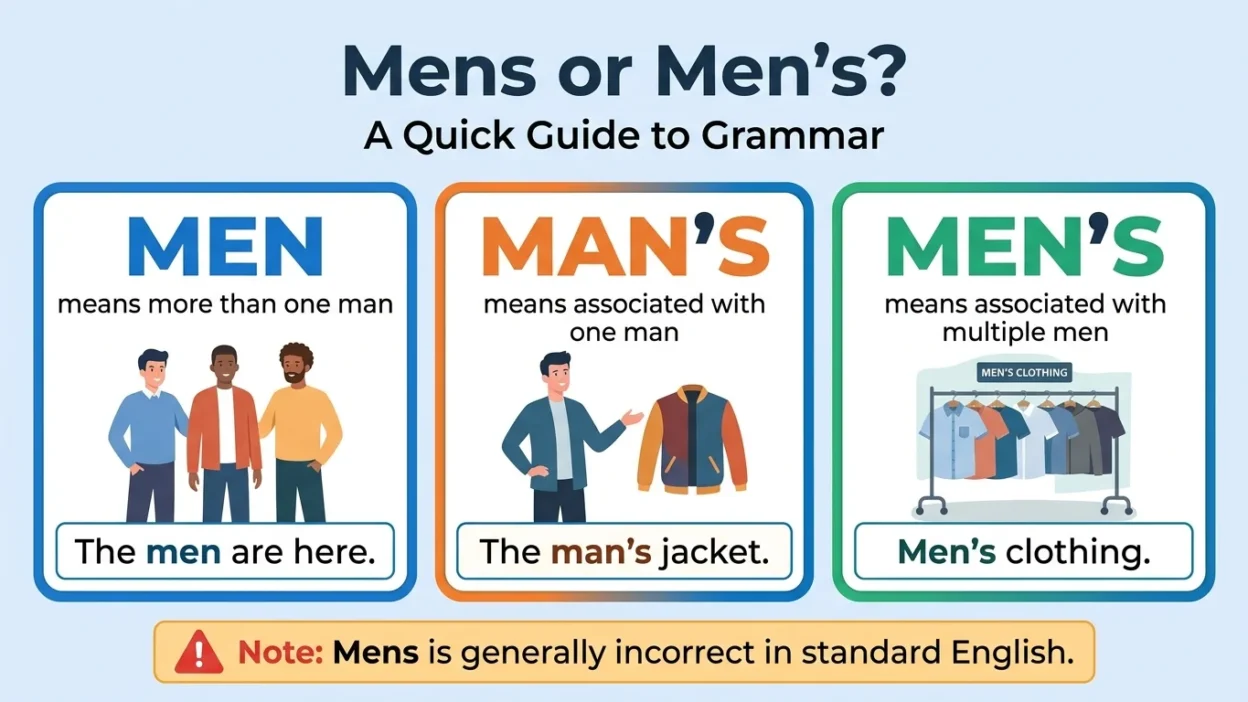
The difference between mens and men’s is an important English grammar and punctuation question. In standard English, men is already the plural form of man, so you do not add an s to make it plural. For example, “The men are waiting outside” is correct. The form mens is generally incorrect when you simply mean more than one man.
Men’s, with an apostrophe followed by s, is the possessive form of men. It means something belongs to, is intended for, or is associated with men. For example, “The men’s locker room is downstairs” and “The store sells men’s clothing” are correct. Because men is an irregular plural that does not end in s, its possessive form is created by adding ‘s. Understanding mens or men’s becomes much easier once you remember that men means more than one man, while men’s shows possession or association.
Quick Answer
Men is the correct plural of man. Men’s is the possessive form and means belonging to or associated with men. Mens without an apostrophe is generally incorrect in standard English. Write “three men” but “men’s clothing,” “men’s shoes,” and “men’s room.”
Mens or Men’s Definition and Meaning
The correct choice depends on whether you mean a simple plural or possession.
Men is the plural of man.
Example:
“The men are working.”
Men’s is the possessive form of men.
Example:
“The men’s jackets are hanging by the door.”
Here, men’s indicates that the jackets belong to or are associated with men.
Mens without an apostrophe is generally not the standard form for either meaning.
The basic pattern is:
man means one man
men means more than one man
man’s means belonging to one man
men’s means belonging to or associated with multiple men
Learning these four forms makes the distinction much easier.
Why People Confuse Mens and Men’s
People often confuse mens and men’s because most English nouns form their plurals by adding s.
For example:
boy becomes boys
girl becomes girls
student becomes students
Because of this familiar pattern, someone might assume that the plural of man should be mans or mens.
However, man is an irregular noun.
Its plural is:
man becomes men
No additional s is necessary.
Another source of confusion is possessive punctuation. Since men is already plural but does not end in s, its possessive form takes ‘s:
men becomes men’s
This gives us two important forms:
“The men arrived.”
“The men’s bags are here.”
What Does Men Mean?
Men is the plural form of man.
It refers to more than one man.
Examples:
“Two men entered the building.”
“The men are waiting outside.”
“Several men joined the team.”
“The men finished their work.”
Because men is plural, it normally takes a plural verb.
Correct:
“The men are ready.”
Incorrect:
“The men is ready.”
You do not need an apostrophe when simply referring to multiple men.
The plural is not:
“mens”
It is:
men
This irregular plural must be memorized because it does not follow the usual rule of adding s to the singular noun.
What Does Men’s Mean?
Men’s is the possessive form of men.
It can indicate ownership:
“The men’s bags are on the table.”
It can also indicate association or intended use:
“men’s clothing”
“men’s shoes”
“men’s health”
“men’s fashion”
“men’s room”
In expressions such as men’s clothing, the clothes do not literally belong to a particular group of men. Instead, the phrase means clothing intended for or associated with men.
Because men is an irregular plural that does not end in s, add ‘s to form the possessive:
men becomes men’s
This follows the same pattern as children’s, women’s, and people’s.
Is Mens a Word?
In ordinary standard English grammar, mens is generally not the correct plural or possessive form of man.
If you mean more than one man, write:
men
If you mean something belonging to or associated with men, write:
men’s
For example:
Incorrect:
“Mens clothing is upstairs.”
Correct:
“Men’s clothing is upstairs.”
Incorrect:
“Three mens entered the store.”
Correct:
“Three men entered the store.”
You might occasionally encounter Mens in names, abbreviations, specialized terminology, or stylized branding. Those special cases do not change the ordinary grammar rule.
For normal English writing, choose between men and men’s according to meaning.
Men vs Men’s Comparison Table
| Form | Meaning | Example |
|---|---|---|
| man | One man | The man is here. |
| men | More than one man | The men are here. |
| man’s | Belonging to one man | The man’s coat is wet. |
| men’s | Belonging to or associated with multiple men | The men’s coats are wet. |
| mens | Generally incorrect in ordinary standard usage | Avoid in normal writing. |
The most important distinction is:
men means plural
men’s means possessive
Mens or Men’s Pronunciation Guide
Men and men’s do not have exactly the same pronunciation.
Men ends with the sound in the ordinary plural word:
“men”
Men’s adds a final z sound.
It sounds roughly like:
“menz”
For example:
“The men are here.”
“The men’s shoes are here.”
The pronunciation can help, but spelling should still be based on grammar.
If you simply mean several men, use:
men
If the word modifies something belonging to or associated with men, use:
men’s
The apostrophe itself is not pronounced, but the added possessive s contributes the final sound.
Grammar Rules for Men and Men’s
The noun man has an irregular plural.
Singular:
man
Plural:
men
To make the singular possessive, add ‘s:
man’s
Example:
“The man’s car.”
To make the irregular plural possessive, also add ‘s because men does not end in s:
men’s
Example:
“The men’s cars.”
The complete pattern is:
man
men
man’s
men’s
Compare this with a regular noun such as boy:
boy
boys
boy’s
boys’
The difference exists because boys already ends in s, while men does not.
When to Use Men
Use men when referring to more than one man without making the noun possessive.
Examples:
“Three men were waiting.”
“The men entered the room.”
“Those men work together.”
“Several men volunteered.”
“Both men agreed.”
A number greater than one is often an easy clue:
“two men”
“five men”
“twenty men”
Do not write:
“five mens”
The plural is already complete with men.
Think:
one man
two men
This irregular pattern is similar to other irregular plurals such as woman and women or child and children.
When to Use Men’s
Use men’s when something belongs to, relates to, or is intended for men.
Examples:
“The men’s coats are hanging outside.”
“The men’s team won the competition.”
“The store has a men’s clothing section.”
“He bought men’s running shoes.”
“The men’s room is on the first floor.”
The word can indicate actual possession, category, association, or intended audience.
A useful test is to ask whether for men or associated with men makes sense.
“men’s clothing”
means:
“clothing for men”
“men’s health”
means:
“health issues relating to men”
If this relationship exists, men’s is usually appropriate.
When to Use Each Form
Use men when you simply mean multiple men.
Example:
“The men are talking.”
Use men’s when another noun is connected with those men.
Example:
“The men’s conversation continued.”
Compare:
“The men entered the building.”
“The men’s bags were searched.”
In the first sentence, men is simply plural.
In the second sentence, men’s shows that the bags are associated with the men.
Another example:
“Several men bought new shoes.”
“The store sells men’s shoes.”
The distinction is straightforward:
Multiple men themselves means men
Something belonging to or associated with men means men’s
Mens or Men’s Examples
Here are 15 examples showing the correct forms:
- The men are waiting outside.
- Three men entered the office.
- Those men work together.
- Several men volunteered for the event.
- The men finished their work early.
- The men’s jackets are in the closet.
- The men’s team won the match.
- This store sells men’s clothing.
- He bought men’s shoes.
- The men’s room is downstairs.
- The men’s bags were placed on the table.
- She works in the men’s fashion department.
- The program focuses on men’s health.
- The men attended the meeting.
- The men’s uniforms were ready.
These examples show the difference between a simple plural and a possessive form.
Mens Clothing or Men’s Clothing?
The correct standard expression is:
men’s clothing
For example:
“This store specializes in men’s clothing.”
The word men’s indicates that the clothing is intended for or associated with men.
Do not write:
“mens clothing”
in normal standard prose.
You may occasionally see Mens on signs, websites, menus, or product category labels where punctuation has been omitted for stylistic reasons. That does not make it the standard grammatical form.
In ordinary writing, use:
men’s clothing
The same pattern applies to:
men’s fashion
men’s accessories
men’s jackets
men’s trousers
men’s sportswear
Mens Shoes or Men’s Shoes?
The standard expression is:
men’s shoes
For example:
“The men’s shoes are on the second floor.”
When referring to shoes designed or marketed for men, men’s indicates association or intended use.
Correct:
“men’s running shoes”
“men’s dress shoes”
“men’s casual shoes”
“men’s sports shoes”
Avoid:
“mens shoes”
in standard edited writing.
A simple replacement test can help:
shoes for men
If that is the intended meaning, men’s shoes is the conventional form.
The same rule applies to clothing and accessories intended for men.
Mens Wear or Men’s Wear?
The conventional possessive expression is:
men’s wear
However, the compound noun menswear is also standard and extremely common.
For example:
“The store has a large menswear department.”
You can therefore encounter:
men’s wear
and:
menswear
Both can be correct depending on the construction.
What you should generally avoid in ordinary prose is:
“mens wear”
with neither an apostrophe nor the established compound spelling.
Examples:
“He designs menswear.”
“The men’s wear section has moved upstairs.”
When referring to the established fashion category as a single compound noun, menswear is often the most natural choice.
Mens Fashion or Men’s Fashion?
The standard phrase is:
men’s fashion
For example:
“He writes about men’s fashion.”
The phrase refers to fashion associated with or intended for men.
Correct examples include:
“men’s fashion trends”
“men’s fashion brands”
“men’s fashion magazine”
“men’s fashion industry”
Do not normally write:
“mens fashion”
without an apostrophe.
The same principle applies to women’s fashion.
Because individuals are irregular plurals that do not end in s, their possessive forms add ‘s:
men becomes men’s
women becomes women’s
Mens Room or Men’s Room?
The standard expression is:
men’s room
For example:
“Where is the men’s room?”
The phrase refers to a restroom intended for men.
The apostrophe is required in ordinary standard writing because men’s indicates association or intended use.
Correct:
“men’s room”
Incorrect in ordinary prose:
“mens room”
Signs may sometimes omit punctuation for visual simplicity, but that does not change the standard grammatical spelling.
Compare:
“women’s room”
“men’s room”
Both use ‘s because individuals are irregular plurals that do not already end in s.
Mens Health or Men’s Health?
The standard grammatical phrase is:
men’s health
For example:
“The organization promotes men’s health.”
This refers to health matters affecting or relating to men.
Other examples include:
“men’s health services”
“men’s health awareness”
“men’s health issues”
“men’s health research”
The phrase uses men’s because the following noun is associated with men.
Remember that possession in grammar is broader than literal ownership.
Health does not physically belong to a group in the way a bag might, but English still uses the possessive form to express the relationship.
Therefore:
men’s health is correct.
Mens Hair or Men’s Hair?
The standard possessive form is:
men’s hair
For example:
“The salon specializes in men’s hair.”
However, depending on what you mean, more specific phrases may sound more natural:
“men’s hairstyles”
“men’s haircuts”
“men’s hair products”
“men’s hair care”
In each case, men’s describes something associated with or intended for men.
Avoid writing:
“mens hair products”
in standard edited English.
Correct:
“men’s hair products”
The rule remains the same regardless of the noun that follows:
If it relates to multiple men as a category, men’s is the standard possessive form.
Mens Watches or Men’s Watches?
The standard phrase is:
men’s watches
For example:
“The store sells men’s watches.”
This means watches designed, marketed, or categorized for men.
Other examples include:
“men’s accessories”
“men’s wallets”
“men’s belts”
“men’s watches”
“men’s jewelry”
In all of these phrases, men’s functions possessively or attributively to show association.
Do not write:
“mens watches”
in ordinary standard prose.
The same grammar applies regardless of whether the product is owned by particular men or simply marketed as a category for men.
Man’s vs Men’s
Man’s and men’s are both correct, but they refer to different numbers of people.
Man’s is singular possessive.
Example:
“The man’s coat is wet.”
This means the coat belongs to one man.
Men’s is plural possessive.
Example:
“The men’s coats are wet.”
This means the coats belong to or are associated with multiple men.
Remember:
man means one
men means many
Therefore:
man’s means one possessor
men’s means multiple possessors
This distinction is similar to:
woman’s and women’s
child’s and children’s
The number of possessors determines which form you need.
Men vs Men’s With One Object
The number of objects does not determine whether you use man’s or men’s.
One man can own several objects:
“The man’s shoes.”
Several men can share one object:
“The men’s office.”
Several men can also have several objects:
“The men’s jackets.”
The possessive form depends on the person or people associated with the object.
One man:
man’s
Multiple men:
men’s
This means that men’s can be followed by either a singular or plural noun.
Examples:
“The men’s room.”
“The men’s rooms.”
Both can be grammatically correct.
Focus on the number of possessors rather than the number of things being discussed.
Why Men’s Has an Apostrophe S
Normally, regular plural nouns ending in s form the possessive by adding only an apostrophe.
For example:
boys becomes boys’
teachers becomes teachers’
But men is different because it is an irregular plural and does not end in s.
Therefore, its possessive form takes ‘s:
men becomes men’s
The same happens with:
children becomes children’s
women becomes women’s
people becomes people’s
Examples:
“children’s books”
“women’s clothing”
“people’s opinions”
“men’s shoes”
This is one of the most important apostrophe rules for irregular plural nouns.
Men and Men’s in Real Life Usage
Imagine several men entering a store.
You could say:
“The men entered the store.”
Here, men is simply plural.
They walk toward a clothing section:
“The men’s clothing section is upstairs.”
Here, men’s describes clothing intended for men.
Later:
“The men’s jackets were on sale.”
Again, men’s shows association.
Compare:
“Several men bought jackets.”
“The store sells men’s jackets.”
The first sentence refers directly to multiple men.
The second refers to a product category associated with men.
This simple real life comparison demonstrates the difference clearly:
men means people
men’s means belonging to or associated with those people
Men and Men’s in Business English
Both forms appear frequently in professional and commercial writing.
Use men when referring directly to people:
“Ten men participated in the survey.”
Use men’s for categories, markets, products, and services associated with men:
“The company expanded its men’s clothing range.”
“The brand launched a men’s fragrance collection.”
“The report examines men’s purchasing habits.”
“The organization provides men’s support services.”
Retail businesses commonly use men’s in product categories such as clothing, footwear, accessories, and grooming.
Correct apostrophe placement is especially important on professional websites, advertisements, reports, and product descriptions because punctuation errors can reduce the credibility of the writing.
Men and Men’s in Academic Writing
Academic writing follows the same grammar rules.
Use men as the plural noun:
“The study included 100 men.”
Use men’s when showing possession or association:
“The researchers examined men’s responses.”
“The study investigated men’s attitudes toward the policy.”
“The report discusses men’s participation in the program.”
Because academic writing values clarity, distinguishing between plural and possessive forms is important.
Compare:
“The men completed the survey.”
“The men’s responses were analyzed.”
In the first sentence, men is the subject.
In the second, men’s identifies whose responses were analyzed.
The apostrophe changes the grammatical relationship rather than simply changing the number.
Formal vs Informal Use
The basic distinction between men and men’s remains the same in formal and informal standard English.
Informal:
“The men are here.”
Formal:
“The men participated in the study.”
Informal:
“Where’s the men’s room?”
Formal:
“The research focuses on men’s health.”
You may encounter mens without an apostrophe on signs, social media, online category labels, or stylized branding. However, this omission should not be copied into ordinary standard writing.
For polished writing, use:
men for the plural
men’s for the possessive or associated category
The rule applies whether you are writing an essay, email, product description, report, or social media post.
American vs British English
The fundamental distinction between men and men’s is the same in American and British English.
Both use:
man for one man
men for multiple men
man’s for singular possession
men’s for plural possession or association
Examples:
“The men arrived.”
“The men’s shoes were outside.”
Both American and British writers follow the same basic apostrophe rule for the irregular plural men.
Vocabulary surrounding specific products or facilities may vary between regions, but the possessive grammar does not.
Therefore, whether your audience is American or British, men’s clothing, men’s shoes, and men’s health use the apostrophe.
Common Mistakes With Mens and Men’s
One common error is:
Incorrect:
“Three mens entered the building.”
Correct:
“Three men entered the building.”
Another common mistake is:
Incorrect:
“mens clothing”
Correct:
“men’s clothing”
Also avoid:
“mens shoes”
Use:
“men’s shoes”
And:
“mens room”
Use:
“men’s room”
The underlying problem is usually confusion between plural and possessive forms.
Remember that men is already plural.
You do not need another s to make it plural.
You add ‘s only when creating the possessive form:
men becomes men’s
That one rule prevents most mistakes.
Memory Trick for Mens or Men’s
Use this simple memory trick:
MAN becomes MEN
There is no s in the plural.
Then remember:
MEN plus possession becomes MEN’S
Examples:
“Three men”
“Men’s clothing”
“Men’s shoes”
“Men’s room”
You can also remember this pair:
The MEN are shopping.
The MEN’S clothes are on sale.
If you are talking directly about multiple people, use men.
If another noun belongs to or is associated with those people, use men’s.
The apostrophe tells the reader that a possessive or associative relationship exists.
Expert Tips for Choosing Men or Men’s
First ask whether you simply mean more than one man.
If yes, use:
men
Example:
“Five men arrived.”
Next ask whether another noun is connected to men.
If yes, men’s may be required.
Example:
“men’s clothing”
“men’s shoes”
“men’s health”
“men’s team”
A useful replacement test is:
for men
If the phrase can naturally mean something intended for men, men’s is often appropriate.
“clothing for men”
becomes:
“men’s clothing”
“shoes for men”
becomes:
“men’s shoes”
This simple test works particularly well for product and retail categories.
Mistakes to Avoid
Do not add s to men simply to make it plural.
Incorrect:
“mens”
Correct:
“men”
Do not remove the apostrophe when standard grammar requires the possessive.
Incorrect:
“mens clothing”
Correct:
“men’s clothing”
Also remember the difference between:
man’s
and:
men’s
Man’s relates to one man.
Men’s relates to multiple men.
Examples:
“The man’s jacket.”
“The men’s jackets.”
Finally, do not assume that punctuation on store signs or website navigation always reflects standard prose conventions. Branding and category labels sometimes omit punctuation intentionally.
Similar Words
Several irregular plurals follow a similar possessive pattern.
Woman
woman
women
woman’s
women’s
Child
child
children
child’s
children’s
Person
person
people
person’s
people’s
Compare:
“women’s clothing”
“children’s books”
“people’s opinions”
“men’s shoes”
These plural nouns do not end in s, so their possessive forms normally add ‘s.
This differs from regular plurals such as:
boys’
girls’
students’
Learning the difference between regular and irregular plurals makes apostrophe rules much easier to understand.
Related Confusing Words
If mens or men’s causes confusion, these related topics are useful:
boys or boy’s
women or women’s
girls or girl’s
children or children’s
parents or parent’s
students or student’s
teachers or teacher’s
its or it’s
whose or who’s
your or you’re
theirs or there’s
The most closely related comparison is women vs women’s because women, like men, is an irregular plural.
Remember:
men becomes men’s
women becomes women’s
children becomes children’s
Irregular plurals that do not end in s generally take ‘s to form the possessive.
FAQs About Mens or Men’s
Is it mens or men’s?
In standard English, use men’s when showing possession or association. Mens without an apostrophe is generally incorrect in ordinary writing.
What is the plural of man?
The plural of man is men, not mans or mens.
Is it mens clothing or men’s clothing?
The correct standard phrase is men’s clothing.
Is it mens shoes or men’s shoes?
Use men’s shoes when referring to shoes designed, marketed, or intended for men.
Is it mens room or men’s room?
The standard expression is men’s room.
Is it mens health or men’s health?
Use men’s health when referring to health matters relating to men.
What is the difference between man’s and men’s?
Man’s is the possessive form of singular man. Men’s is the possessive form of plural men.
Why does men’s have an apostrophe before the s?
Because men is an irregular plural that does not end in s. Such plurals normally form the possessive by adding ‘s.
Final Verdict on Mens or Men’s
The difference between mens and men’s becomes simple once you remember that men is already the plural of man. If you are referring directly to more than one man, use men without an apostrophe. For example, “The men are waiting outside.” The form mens is generally incorrect in ordinary standard English when used as a plural.
Use men’s when showing possession, association, or intended use. Examples include men’s clothing, men’s shoes, men’s health, men’s fashion, and men’s room. Because men is an irregular plural that does not end in s, its possessive form is created by adding ‘s. Remember the simple pattern: man means one, men means many, man’s relates to one man, and men’s relates to multiple men.
Remember This
Memorize these four forms:
MAN
One man
MEN
More than one man
MAN’S
Belonging to or associated with one man
MEN’S
Belonging to or associated with multiple men
Examples:
“The men are here.”
“The men’s jackets are here.”
“The man’s jacket is here.”
The quickest rule is:
More than one man means MEN
Something for or associated with men means MEN’S
And remember:
MEN’S clothing
MEN’S shoes
MEN’S room
MEN’S health

Carol Amanda is a passionate writer and faith-driven author dedicated to sharing the wisdom of the Bible. At BiblyWord, she creates inspiring and meaningful content that encourages spiritual growth and daily reflection. Her work focuses on helping readers connect with God’s Word and find guidance, peace, and strength in their faith journey.