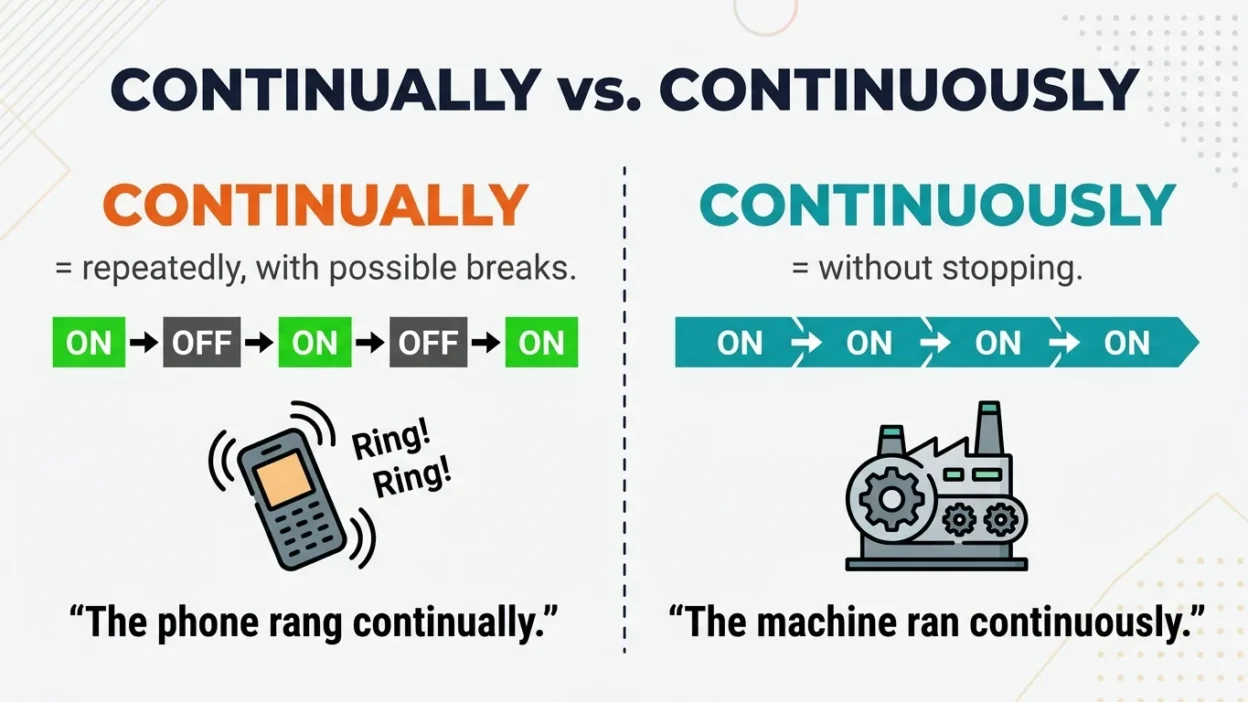
The difference between continually vs continuously is subtle because both adverbs describe something that continues or happens repeatedly. Traditionally, however, they emphasize different patterns. Continually usually means something happens repeatedly over a period of time, often with interruptions or breaks. For example, if your phone continually rings throughout the morning, it may ring many times with quiet periods between calls. Continuously generally means something happens without interruption or stopping.
This distinction is useful when precision matters. A machine that operates continuously for 24 hours does not stop during that period, while a machine that continually develops problems may experience problems again and again at separate times. In modern English, the two words sometimes overlap, so the traditional distinction is not absolute in every context. Still, understanding it can make your writing clearer. This guide explains their meanings, grammar, pronunciation, examples, common mistakes, and easy memory tricks.
Quick Answer
Continually usually means repeatedly, with possible breaks, while continuously means without interruption or stopping. For example, “The baby continually woke up” suggests repeated waking, while “The machine ran continuously for eight hours” means it operated without stopping.
Continually vs Continuously Definition and Meaning
Both words are adverbs related to the idea of continuation, but they traditionally emphasize different patterns.
Continually means repeatedly or frequently over a period of time.
Example:
“He continually checks his phone.”
This suggests he checks it again and again, not that he literally checks it every second.
Continuously means without interruption.
Example:
“The engine ran continuously all night.”
This means the engine did not stop.
The simplest distinction is:
Continually = again and again
Continuously = without stopping
Modern usage sometimes blurs this difference, and dictionaries may recognize overlapping senses. Therefore, using one where the other might also work is not automatically an error. However, maintaining the traditional distinction can make your intended meaning more precise.
Why People Confuse Continually and Continuously
People confuse continually and continuously because both words come from closely related adjectives: continual and continuous.
Both suggest continuation, repetition, or persistence.
Compare:
“The noise occurred continually.”
“The noise continued continuously.”
Without additional context, both sentences suggest something lasting over time.
The traditional distinction lies in whether there are interruptions.
Imagine a dog barking every few minutes:
“The dog barked continually.”
There may be pauses between barks.
Now imagine a machine producing a steady sound without any pause:
“The machine hummed continuously.”
The sound never stops during the stated period.
Because everyday speakers do not always maintain this distinction strictly, the words frequently overlap. Nevertheless, the breaks vs no breaks test remains a useful writing guideline.
What Does Continually Mean?
Continually is an adverb that commonly means repeatedly, frequently, or regularly over a period of time.
It often allows for interruptions.
For example:
“She continually asks questions.”
This does not mean she is speaking every second without stopping. Instead, she asks questions repeatedly.
Other examples include:
- continually changing plans
- continually making mistakes
- continually checking messages
- continually interrupting someone
- continually improving a process
- continually returning to a topic
The word often emphasizes repetition.
For example:
“The alarm continually went off during the night.”
This may suggest the alarm sounded several times, with periods of silence between occurrences.
Think of continually as something that keeps happening again and again.
What Does Continuously Mean?
Continuously is an adverb that commonly means without stopping, interruption, or a break.
For example:
“The machine operated continuously for twelve hours.”
This indicates uninterrupted operation throughout the entire twelve-hour period.
Other examples include:
- continuously running
- continuously flowing
- continuously operating
- continuously monitoring
- continuously recording
- continuously updating
Consider:
“Water flowed continuously from the pipe.”
The natural interpretation is that the flow did not stop during the relevant period.
Continuously is therefore especially useful when emphasizing an unbroken process, state, movement, or action.
Think:
Continuous = no interruption
That idea provides the clearest distinction from continually.
Continually vs Continuously Comparison Table
| Feature | Continually | Continuously |
|---|---|---|
| Basic meaning | Repeatedly | Without interruption |
| Breaks possible? | Yes | Normally no |
| Emphasizes repetition? | Yes | Less strongly |
| Emphasizes unbroken duration? | Usually no | Yes |
| Example | He continually checks his phone. | The camera records continuously. |
| Similar to | Again and again | Nonstop |
| Common context | Repeated actions | Uninterrupted processes |
| Memory clue | Repeated with breaks | Constant without breaks |
Remember that modern usage sometimes overlaps, but this traditional distinction remains helpful for precise writing.
Continually vs Continuously Pronunciation Guide
Continually and continuously are pronounced differently because they come from different adjective forms.
Continually comes from continual.
It is pronounced approximately:
kuhn-TIN-yoo-uh-lee
Continuously comes from continuous.
It is pronounced approximately:
kuhn-TIN-yoo-us-lee
The additional sound in continuously reflects the -ous ending of continuous.
Although pronunciation helps distinguish the words in speech, meaning is still the most important factor when choosing between them in writing.
Ask whether the action occurs repeatedly with possible interruptions or remains uninterrupted throughout the entire period.
That question is more reliable than simply remembering how each word sounds.
Grammar Rules Explained
Both continually and continuously are adverbs.
They modify verbs, adjectives, or sometimes larger ideas by explaining how an action or process occurs.
Example with continually:
“The company continually improves its services.”
Here, continually modifies improves.
Example with continuously:
“The system continuously monitors network activity.”
Here, continuously modifies monitors.
Their adjective forms are:
continual → continually
continuous → continuously
Because they are adverbs, they often appear before the main verb:
“She continually complains.”
“The software continuously monitors performance.”
They can also appear after a verb:
“The machine runs continuously.”
The choice depends mainly on meaning, not sentence position.
Continual vs Continuous
Understanding the adjectives makes the adverbs easier to remember.
Continual traditionally describes something that occurs repeatedly, often with interruptions.
Example:
“We experienced continual delays.”
This may mean multiple delays occurred.
Continuous describes something unbroken.
Example:
“There was continuous rain for three hours.”
This emphasizes that the rain did not stop.
The same distinction carries into the adverbs:
continual → continually
continuous → continuously
So:
“continual interruptions” → interruptions keep happening.
“continuous operation” → operation does not stop.
This relationship provides one of the easiest ways to understand the difference.
When to Use Continually
Use continually when an action happens repeatedly over time, especially when breaks can occur between individual instances.
For example:
“He continually changes his mind.”
The person changes his mind again and again. He is not literally performing the action without interruption.
Other natural examples include:
“She continually checks her email.”
“They continually revise the plan.”
“He continually interrupts meetings.”
“The company continually improves its products.”
In each example, the action occurs repeatedly.
A useful test is to replace continually with:
again and again
If the sentence still makes sense, continually is probably a good choice.
For example:
“She checks her phone again and again.”
Therefore:
“She continually checks her phone.”
When to Use Continuously
Use continuously when something continues without stopping during the relevant period.
For example:
“The generator operated continuously for six hours.”
The generator did not stop.
Other examples include:
“The camera records continuously.”
“Water flowed continuously from the pipe.”
“The system operates continuously.”
“The patient’s heart rate was monitored continuously.”
A useful replacement test is:
without stopping
If this phrase preserves your intended meaning, continuously is probably appropriate.
For example:
“The machine ran without stopping.”
Therefore:
“The machine ran continuously.”
This test makes the distinction particularly easy when discussing machines, measurements, flows, monitoring systems, or other processes with clearly defined periods of operation.
When to Use Each Word
Use continually when you mean:
- repeatedly
- frequently
- again and again
- recurring over time
- happening with possible breaks
Use continuously when you mean:
- without stopping
- uninterruptedly
- nonstop
- in an unbroken manner
- throughout an entire period
Compare:
“The child continually asked questions.”
This means the child repeatedly asked questions.
“The fan ran continuously all night.”
This means the fan never stopped.
Another comparison:
“It continually rained throughout the week.”
This can suggest repeated periods of rain.
“It rained continuously for five hours.”
This emphasizes five uninterrupted hours of rain.
Continually vs Continuously Examples
Here are 15 examples showing the traditional distinction:
- She continually checks her phone.
- The machine ran continuously for ten hours.
- He continually changes his plans.
- The camera records continuously.
- They continually ask the same questions.
- Water flowed continuously from the damaged pipe.
- The company continually improves its services.
- The system operates continuously throughout the day.
- My neighbor continually complains about the noise.
- The heart monitor recorded data continuously.
- She continually interrupted the conversation.
- The light remained on continuously for three days.
- Prices continually changed throughout the season.
- The motor ran continuously until midnight.
- He continually returned to the same argument.
The central question is whether interruptions are possible.
Continually Changing vs Continuously Changing
Both expressions can be correct, but they can emphasize different things.
Continually changing often suggests repeated changes:
“The company is continually changing its policies.”
This may mean one policy change occurs, then another, and then another.
Continuously changing emphasizes an ongoing process of change:
“The digital display is continuously changing.”
This suggests the change is happening as an uninterrupted process.
However, change itself often involves an ongoing process, so the distinction can become less sharp in real-world usage.
If you mean repeatedly making separate changes, continually changing is especially natural.
If you mean changing all the time as an ongoing process, continuously changing may better express your meaning.
Continually Improving vs Continuously Improving
Both continually improving and continuously improving can be grammatical.
Their emphasis may differ.
“The company is continually improving its products.”
This suggests the company makes improvements repeatedly over time.
“The technology is continuously improving.”
This can present improvement as an ongoing, relatively unbroken process.
In business contexts, continuous improvement is also an established concept referring to an ongoing effort to improve products, services, or processes.
Because improvement normally occurs through multiple actions and stages, continually improving can be appropriate when emphasizing repeated improvements.
Use continuously improving when you want to present improvement as an ongoing process.
Context ultimately determines which nuance is more useful.
Continually Working vs Continuously Working
Consider these sentences:
“She continually works on improving her skills.”
This suggests she repeatedly dedicates time to improvement.
Now consider:
“The machine worked continuously for twelve hours.”
This clearly means the machine did not stop during those twelve hours.
For a human being, worked continuously for eight hours means the person worked for that period without a meaningful interruption.
By contrast:
“He continually worked on the project throughout the year.”
This may describe repeated periods of work across the year rather than one year of nonstop activity.
The difference becomes clear when you ask:
Are there separate periods of activity?
Choose continually.
Is the activity unbroken for the specified period?
Choose continuously.
Continually Interrupting vs Continuously Interrupting
Continually interrupting is usually the more logical expression when someone interrupts repeatedly.
For example:
“He continually interrupted the speaker.”
An interruption is normally an individual event. A person interrupts, stops, and then may interrupt again.
Therefore, continually effectively expresses repeated interruptions.
Saying:
“He continuously interrupted the speaker”
may occur in everyday usage, but if interpreted strictly, it suggests an almost unbroken process of interruption.
When describing repeated behaviors such as:
- interrupting
- calling
- asking
- complaining
- checking
- knocking
continually often expresses the intended meaning more precisely because these actions naturally occur as separate repeated events.
Continually Running vs Continuously Running
The best word depends on what running means.
For a machine:
“The engine ran continuously for eight hours.”
This means it did not stop.
For repeated operation:
“The engine continually started and stopped throughout the day.”
Here, continually fits because separate events recur.
For a person:
“She continually runs into problems.”
This is figurative and means problems repeatedly occur.
But:
“She ran continuously for an hour.”
means she did not stop running during that hour.
So remember:
Repeated occurrences → continually
Uninterrupted activity → continuously
The same verb can work with either adverb when the intended pattern changes.
Continually vs Continuously in Real Life Usage
Imagine receiving several phone calls throughout the morning.
You could say:
“My phone rang continually all morning.”
This suggests repeated ringing with breaks between calls.
Now imagine an alarm producing one unbroken sound for ten minutes:
“The alarm sounded continuously for ten minutes.”
There was no interruption.
Another example involves rain:
“It rained continually throughout the week.”
This may suggest recurring rain.
“It rained continuously from noon until midnight.”
This emphasizes that the rain never stopped during that period.
These examples show why the distinction can add precision even though everyday usage sometimes allows the words to overlap.
Continually vs Continuously in Business English
Both words are common in professional contexts.
Use continually for repeated efforts:
“We continually review customer feedback.”
This suggests reviews happen regularly.
“The company continually updates its policies.”
Updates happen repeatedly over time.
Use continuously for uninterrupted processes:
“The system continuously monitors network traffic.”
“The equipment operates continuously during production.”
Business writers should consider whether they mean regular repeated action or uninterrupted operation.
This distinction is particularly useful in:
- technical documentation
- process descriptions
- performance reports
- operational procedures
- quality management
- monitoring systems
Precise adverb choice can prevent readers from misunderstanding how frequently or for how long a process occurs.
Continually vs Continuously in Academic Writing
Precision makes the distinction particularly valuable in academic and scientific writing.
Consider:
“Researchers continually reviewed the findings.”
This suggests repeated reviews at different times.
Now compare:
“Temperature was continuously monitored for 24 hours.”
This indicates uninterrupted monitoring throughout the full period.
In scientific research, continuously can communicate an important methodological detail. Continuous monitoring may differ significantly from measurements taken periodically.
Therefore, avoid using the two words casually when the distinction affects how a study or process is interpreted.
If measurements occurred every hour, they were collected repeatedly or periodically, not necessarily continuously.
Accurate word choice helps readers understand the actual procedure.
Formal vs Informal Use
Both continually and continuously are standard in formal and informal English.
Informal:
“He continually changes his mind.”
Formal:
“The organization continually reviews its policies.”
Informal:
“The fan runs continuously.”
Formal:
“Data were continuously recorded throughout the experiment.”
The difference is therefore not one of formality.
Instead, it concerns the pattern of an action:
Continually = repeated
Continuously = uninterrupted
In casual conversation, speakers may not always maintain this distinction strictly, and context often prevents misunderstanding.
In formal, technical, scientific, or academic writing, however, maintaining the distinction can improve precision and reduce ambiguity.
American vs British English
The traditional distinction between continually and continuously is broadly the same in American and British English.
In both varieties:
continually can emphasize repeated occurrences.
continuously can emphasize uninterrupted duration.
For example:
“She continually checks her messages.”
“The machine runs continuously.”
Modern usage in both varieties may show overlap, so you should not assume every use that ignores the traditional distinction is grammatically wrong.
When writing for a broad English-speaking audience, the safest approach is to preserve the distinction whenever it matters:
repeated with possible breaks → continually
without interruption → continuously
This provides clear meaning regardless of whether your readers use American or British English.
Continually vs Constantly
Continually and constantly can overlap.
For example:
“He continually complains.”
“He constantly complains.”
Both can mean that the person complains very frequently.
However, constantly can sometimes sound stronger, suggesting extremely frequent or persistent behavior.
It may also be used loosely to mean all the time.
Continually traditionally allows repeated interruptions and recurrence.
Compare:
“She continually checks her email.”
“She constantly checks her email.”
The second may imply greater frequency or annoyance, depending on context.
Neither word automatically means mathematically uninterrupted activity.
If you specifically need to emphasize without any break, continuously is often the clearest choice.
Continuously vs Constantly
Continuously emphasizes an uninterrupted process.
For example:
“The machine operated continuously for 24 hours.”
This clearly communicates that it did not stop.
Constantly may mean all the time, but in ordinary speech it often means very frequently rather than literally without interruption.
For example:
“He is constantly checking his phone.”
A person obviously cannot check a phone every instant, so constantly here means very frequently.
Compare:
“The sensor continuously records temperature.”
“The technician constantly checks the readings.”
The first emphasizes uninterrupted recording.
The second may simply indicate very frequent checking.
When technical precision matters, continuously is preferable for genuinely uninterrupted activity.
Synonyms and Alternatives
Possible synonyms for continually include:
- repeatedly
- frequently
- regularly
- persistently
- again and again
- recurrently
Possible alternatives for continuously include:
- nonstop
- without interruption
- uninterruptedly
- steadily
- constantly, in some contexts
A synonym test can help you choose.
If again and again works:
“She continually asks questions.”
“She asks questions again and again.”
Use continually.
If without stopping works:
“The machine runs continuously.”
“The machine runs without stopping.”
Use continuously.
These substitution tests are especially helpful when the difference feels unclear.
Common Sentences With Continually and Continuously
Here are useful examples:
- She continually checks her email.
- He continually changes his mind.
- They continually improve their products.
- The problem continually returns.
- She continually asks for updates.
- The machine runs continuously.
- The camera records continuously.
- Water flows continuously through the pipe.
- The system continuously monitors traffic.
- The engine operated continuously overnight.
- Prices continually change.
- The software is continuously updated during the process.
- He continually interrupts meetings.
- The sensor continuously measures temperature.
- The organization continually reviews its procedures.
Pay attention to whether each action is repeated or uninterrupted.
Common Mistakes With Continually and Continuously
A common mistake is treating the words as if they must always be completely interchangeable.
For maximum precision:
“The phone rang continually.”
suggests repeated ringing.
“The tone sounded continuously.”
suggests an unbroken sound.
Another mistake is assuming continually means only “sometimes.” It can describe something that happens very frequently; the important point is that interruptions are possible.
Similarly, continuously does not merely mean “often.” It emphasizes continuation without interruption.
However, avoid correcting every overlapping use as though it were unquestionably wrong. Modern English does not always maintain a rigid boundary between these words.
Treat the distinction as a powerful precision tool rather than an absolute rule governing every possible sentence.
Memory Trick for Continually vs Continuously
Use this simple memory trick:
Continually = repeats
Continuously = continues without stopping
Think of continually as:
ON → OFF → ON → OFF → ON
The action keeps returning.
Think of continuously as:
ON → ON → ON → ON → ON
The action never stops during the period.
For example:
“A phone rings continually.”
Ring → pause → ring → pause → ring.
“A machine runs continuously.”
Run → run → run → no stop.
This visual distinction makes the meanings much easier to remember.
Expert Tips for Choosing Continually or Continuously
When you are unsure, perform one of two substitution tests.
First try:
again and again
“The customer ___ called the office.”
“The customer called again and again.”
Choose:
continually
Now try:
without stopping
“The motor operated ___ for six hours.”
“The motor operated without stopping for six hours.”
Choose:
continuously
Also consider whether the action naturally occurs as separate events.
Actions such as asking, interrupting, checking, calling, and complaining are often repeated, making continually natural.
Processes such as flowing, recording, monitoring, and operating can be uninterrupted, making continuously a natural choice when that is what you mean.
Mistakes to Avoid
Do not assume continuously simply means “very often.”
If a worker checks a machine once every hour, the worker is not necessarily monitoring it continuously.
Instead, you might say:
“The worker checks the machine continually throughout the shift.”
or, more precisely:
“The worker checks the machine regularly.”
Likewise, do not assume continually means rarely or occasionally. It can describe highly frequent repetition.
Avoid forcing the traditional distinction when context clearly supports overlapping modern usage, but preserve it whenever precision matters.
The safest guide is:
Repeated events with possible gaps → continually
One unbroken process → continuously
Similar Words
Several related words are worth distinguishing:
Continue
To keep going.
Continual
Repeated or recurring, traditionally with possible breaks.
Continually
Repeatedly or again and again.
Continuous
Uninterrupted or unbroken.
Continuously
Without interruption.
Constant
Unchanging, persistent, or occurring very frequently depending on context.
Constantly
All the time or very frequently.
Repeatedly
Again and again.
Understanding these related forms makes it easier to choose the exact word your sentence needs.
The central contrast remains:
continual/continually → recurrence
continuous/continuously → unbroken duration
Related Confusing Words
Writers interested in continually vs continuously may also encounter:
- continual vs continuous
- constantly vs continuously
- repeatedly vs continually
- everyday vs every day
- sometime vs sometimes
- awhile vs a while
- farther vs further
- among vs between
- fewer vs less
- historic vs historical
- alternate vs alternative
- later vs latter
Many of these pairs overlap in meaning but differ in grammatical function or nuance.
The best strategy is not simply memorizing definitions. Instead, learn each word through a short contrast.
For this pair:
continually = repeatedly
continuously = nonstop
That distinction handles most everyday situations.
FAQs About Continually vs Continuously
What is the difference between continually and continuously?
Continually traditionally means repeatedly, often with breaks between occurrences. Continuously means without interruption or stopping.
Does continually mean nonstop?
Not necessarily. Continually often describes something that happens repeatedly over time with possible interruptions.
Does continuously mean without stopping?
Yes. Continuously commonly emphasizes that an action or process continues without interruption during a specified period.
Is it continually improving or continuously improving?
Both can be correct. Continually improving emphasizes repeated improvements, while continuously improving presents improvement as an ongoing process.
Is it continually changing or continuously changing?
Both are possible. Continually changing can emphasize repeated separate changes, while continuously changing emphasizes an ongoing process of change.
What is the difference between continual and continuous?
Continual traditionally describes repeated occurrences with possible breaks. Continuous describes something uninterrupted.
Are continually and continuously interchangeable?
They sometimes overlap in modern usage, but maintaining the traditional distinction can improve precision.
How can I remember continually vs continuously?
Remember: continually = again and again; continuously = without stopping.
Final Verdict on Continually vs Continuously
The traditional difference between continually vs continuously comes down to repetition versus uninterrupted duration. Continually usually describes something that happens repeatedly over time, with possible pauses or interruptions. Someone can continually check a phone, continually ask questions, or continually change plans because these are separate actions that happen again and again.
Continuously, by contrast, generally describes something that continues without stopping during the relevant period. A machine can run continuously, a camera can record continuously, and water can flow continuously. Modern English sometimes allows overlap between the two words, so the distinction is not rigid in every context. Still, when precise wording matters, remember: continually = repeatedly with possible breaks; continuously = without interruption.
Remember This
Use this simple pattern:
CONTINUALLY = AGAIN AND AGAIN
“The phone rang continually.”
Ring → pause → ring → pause → ring
CONTINUOUSLY = WITHOUT STOPPING
“The machine ran continuously.”
Run → run → run → run → run
The easiest memory rule is:
Continually = repeated
Continuously = nonstop
When precision matters, ask:
Are there possible breaks? → Continually
No breaks? → Continuously

Donald Andrew is a dedicated author at BiblyWord, passionate about sharing biblical teachings in a clear and inspiring way. He creates meaningful content that helps readers understand scripture, reflect on their faith, and apply God’s Word in daily life. His work supports spiritual growth, guidance, and a deeper connection with biblical wisdom.