The words draws and drawers are easy to confuse, especially in spoken English. They look similar, and in some accents or fast speech, drawers may sound surprisingly close to draws. However, these words have different meanings and grammatical roles. Draws is most commonly the third-person singular form of the verb draw, as in “She draws beautiful pictures.” It can also be the plural of the noun draw, such as several tied games or lottery drawings.
Drawers, on the other hand, is the plural of drawer, meaning sliding storage compartments in furniture such as desks, cabinets, and dressers. For example, “The documents are in the desk drawers.” Drawers also has an older use referring to underwear, although that meaning is much less common in everyday modern usage. Understanding draws vs drawers requires paying attention to meaning, spelling, grammar, and pronunciation. This guide covers each difference with clear rules, examples, common mistakes, and an easy memory trick.
Quick Answer
Draws usually means creates pictures or pulls/attracts something, as in “She draws well.” Drawers are sliding storage compartments in furniture: “Put the clothes in the drawers.” In some accents, drawers may sound close to draws, but their spellings and meanings are different.
Draws vs Drawers Definition and Meaning
The difference between draws and drawers begins with their base words.
Draws comes from draw.
As a verb:
“He draws portraits.”
It can mean creates pictures, pulls, attracts, takes something out, or produces a conclusion, among other meanings.
As a plural noun, draws can also refer to tied contests or certain selections:
“The team recorded three draws.”
Drawers comes from the noun drawer.
A drawer is a sliding storage compartment:
“The spoons are in the kitchen drawer.”
Plural:
“The spoons are in the kitchen drawers.”
So the basic distinction is:
Draws → form of draw
Drawers → storage compartments
Why People Confuse Draws and Drawers
The main reason people confuse draws vs drawers is pronunciation.
In writing, the difference is noticeable:
draws
drawers
But spoken English can be more complicated. Depending on accent, drawer may be pronounced with one syllable or two, and the plural drawers can sound similar to draws.
This can lead to spelling errors such as:
❌ “Put your clothes in the draws.”
When the intended meaning is storage compartments, standard spelling requires:
✅ “Put your clothes in the drawers.”
Another source of confusion is that draw itself has many meanings.
It can refer to creating a picture, pulling something, attracting attention, selecting something, or ending a competition without a winner.
Context therefore plays an important role.
What Does Draws Mean?
Draws is commonly the third-person singular present-tense form of draw.
For example:
“She draws every day.”
“He draws cartoons for a newspaper.”
The verb draw has many meanings.
It can mean to create a picture:
“She draws landscapes.”
It can mean to pull:
“The horse draws the carriage.”
It can mean to attract:
“The festival draws thousands of visitors.”
It can mean to reach a conclusion:
“The researcher draws a different conclusion.”
It can also refer to taking something from a source:
“The pump draws water from the well.”
Therefore, the exact meaning of draws depends heavily on context.
What Does Drawers Mean?
Drawers is the plural form of drawer.
A drawer is a storage compartment that normally slides horizontally into and out of a piece of furniture.
For example:
“The desk has three drawers.”
Other examples include:
- kitchen drawers
- desk drawers
- dresser drawers
- cabinet drawers
- filing drawers
- bedside-table drawers
You might say:
“Put the socks in the top drawer.”
With more than one:
“The dresser has six drawers.”
Historically, drawers can also refer to an undergarment covering the lower body. That meaning still appears in historical writing and some particular contexts, but when people discuss modern furniture, drawers almost always means storage compartments.
Draws vs Drawers Comparison Table
| Feature | Draws | Drawers |
|---|---|---|
| Base word | Draw | Drawer |
| Common role | Verb / plural noun | Plural noun |
| Can mean creates pictures | Yes | No |
| Can mean attracts | Yes | No |
| Can mean tied games | Yes | No |
| Means storage compartments | No | Yes |
| Furniture-related | Usually no | Yes |
| Example | She draws pictures. | The clothes are in the drawers. |
| Memory clue | Draw = action/result | Drawer = storage |
The easiest distinction is to look for furniture or storage. If that is the meaning, you almost certainly need drawer or drawers.
Draws vs Drawers Pronunciation Guide
Pronunciation is one of the most interesting parts of draws vs drawers.
Draws is generally pronounced as one syllable.
It sounds like:
drawz
Drawers varies more by accent.
Some speakers pronounce drawer with two clearer syllables, roughly:
DRAW-er
Others pronounce it more like one syllable. In some accents, particularly in rapid speech, drawers may sound close to draws.
This is why someone may hear:
“Put it in the draws.”
even though the intended written word is:
“Put it in the drawers.”
Do not rely entirely on pronunciation when spelling these words. Instead, use meaning:
Furniture storage = drawers
Form of draw = draws
Grammar Rules for Draws
As a verb, draws is used with a third-person singular subject in the simple present.
Examples:
“She draws.”
“He draws.”
“The artist draws.”
“My daughter draws.”
But:
“I draw.”
“You draw.”
“We draw.”
“They draw.”
So:
he/she/it + draws
I/you/we/they + draw
The verb forms include:
draw → draws → drew → drawn → drawing
For example:
“She draws portraits.”
“She drew a portrait yesterday.”
“She has drawn several portraits.”
“She is drawing a portrait.”
As a noun, draws can simply be the plural of draw, depending on the meaning.
Grammar Rules for Drawers
Drawer is a countable noun.
Singular:
drawer
Plural:
drawers
Examples:
“There is a key in the drawer.”
“There are several keys in the drawers.”
You can use numbers with it:
“three drawers”
“six drawers”
“ten drawers”
It can also appear in compound expressions:
- desk drawer
- kitchen drawer
- dresser drawer
- filing drawer
- drawer handle
- drawer organizer
When several storage compartments are involved, use drawers.
Because drawers is a plural noun, it often takes a plural verb:
“The drawers are empty.”
Not:
❌ “The drawers is empty.”
When to Use Draws
Use draws when you need the third-person singular form of the verb draw.
For creating pictures:
“She draws cartoons.”
For attracting:
“The event draws large crowds.”
For pulling:
“The tractor draws the equipment.”
For obtaining from a source:
“The system draws power from the battery.”
For reaching conclusions:
“The author draws an important distinction.”
You can also use draws as the plural noun form of draw:
“The tournament ended with several draws.”
Ask yourself:
Am I using a form of the word “draw”?
If yes, draws may be correct.
If you are talking about storage compartments, however, you need drawers.
When to Use Drawers
Use drawers when referring to more than one drawer, especially sliding compartments used for storage.
For example:
“The clothes are in the drawers.”
“The desk has four drawers.”
“She cleaned the kitchen drawers.”
Other examples:
“Open the drawers carefully.”
“The bottom drawers are empty.”
“He installed new handles on the drawers.”
A useful question is:
Can I put something inside these?
If you mean sliding storage compartments, use drawers.
Think of:
- socks in drawers
- spoons in drawers
- documents in drawers
- clothes in drawers
- tools in drawers
This association makes the correct spelling easier to remember.
When to Use Each Word
Use draws for:
- making pictures
- attracting people or attention
- pulling something
- taking something from a source
- reaching a conclusion
- tied games or other noun senses of draw
Use drawers for:
- furniture compartments
- storage compartments
- desk storage
- dresser storage
- cabinet storage
Compare:
“She draws pictures at her desk.”
“She keeps her pencils in the desk drawers.”
Another example:
“The exhibition draws large crowds.”
“The documents are stored in filing drawers.”
If you associate drawers with things you open and store items inside, the difference becomes straightforward.
Draws vs Drawers Examples
Here are 15 examples showing correct usage:
- She draws beautiful portraits.
- He draws cartoons after school.
- The festival draws thousands of visitors.
- This machine draws very little power.
- The researcher draws an interesting conclusion.
- The team had three draws this season.
- The desk has four drawers.
- Put the documents in the drawers.
- She organized her kitchen drawers.
- My socks are in the top two drawers.
- The cabinet drawers are locked.
- The artist draws while sitting beside the window.
- The event draws visitors from across the country.
- These drawers need new handles.
- He keeps his tools in the bottom drawers.
Context makes the intended word clear.
Draws Pictures vs Drawers
When someone creates pictures, use draws.
Correct:
“She draws pictures.”
“He draws animals.”
“My son draws cartoons.”
Do not write:
❌ “She drawers pictures.”
Drawers is a noun, not the third-person singular form of draw.
Now compare:
“She keeps her drawings in the drawers.”
This sentence can contain related-looking words with completely different jobs:
drawings = pictures that have been drawn
drawers = storage compartments
A useful sentence to memorize is:
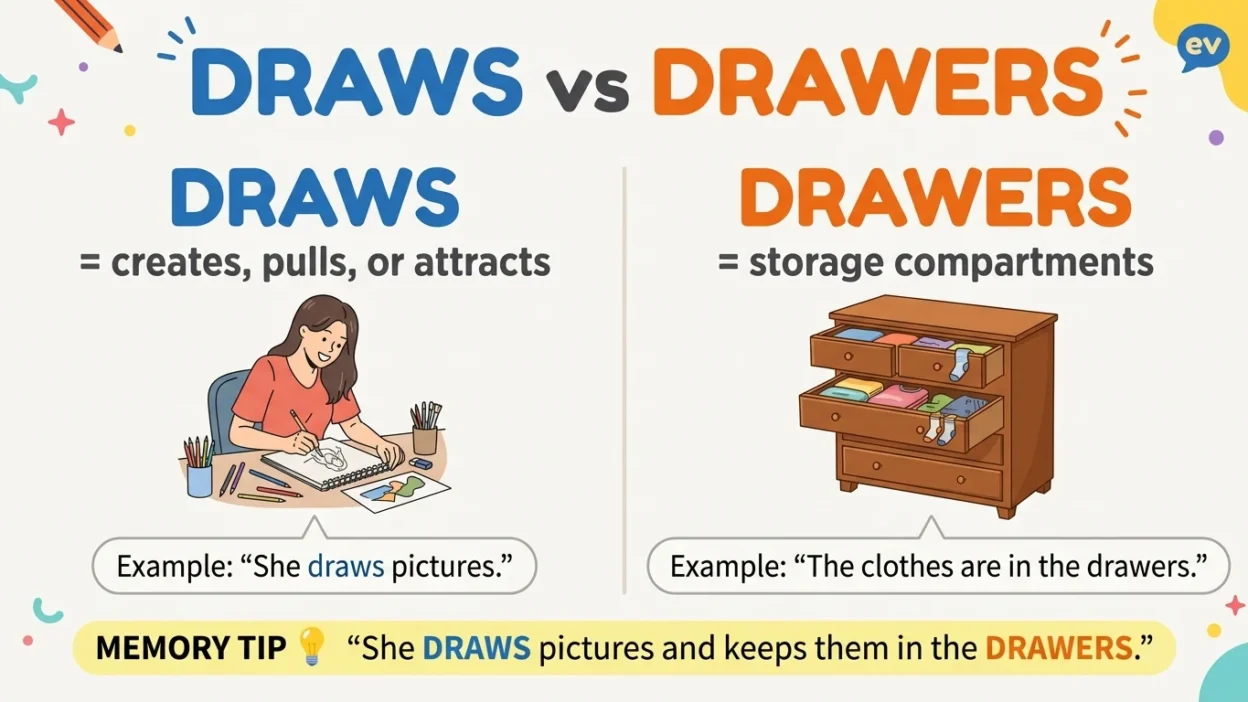
“She draws pictures and keeps them in the drawers.”
It contains both words and makes the distinction immediately visible.
Draws Attention Meaning
The phrase draws attention means attracts attention or causes someone to notice something.
For example:
“The bright sign draws attention.”
Another example:
“Her unusual design draws attention immediately.”
Related expressions include:
- draws attention to
- draws interest
- draws criticism
- draws praise
- draws a crowd
- draws visitors
For example:
“The report draws attention to an important problem.”
Here, draws is a form of the verb draw. It has nothing to do with furniture.
If you can replace draws with attracts without greatly changing the meaning, draws is probably the word you need.
Draws a Conclusion Meaning
The expression draws a conclusion means reaches or forms a conclusion based on information, evidence, or reasoning.
For example:
“The researcher draws a conclusion from the evidence.”
Another example:
“The author draws several conclusions from the data.”
A related common phrase is:
draw a conclusion
Example:
“We should not draw a conclusion before reviewing all the evidence.”
In the simple present with a singular third-person subject:
“He draws a conclusion.”
This use is completely unrelated to drawers.
Remember:
draws a conclusion = reaches a conclusion
drawers = storage compartments
Understanding common phrases helps prevent spelling mistakes.
Chest of Drawers Meaning
A chest of drawers is a piece of furniture containing several stacked drawers, commonly used for storing clothes and personal items.
For example:
“She keeps her clothes in a chest of drawers.”
This phrase is sometimes misspelled as:
❌ “chest of draws”
The standard expression is:
✅ chest of drawers
Why?
Because the furniture contains several drawers—sliding storage compartments.
A chest of drawers may contain:
- shirts
- socks
- underwear
- accessories
- folded clothes
- personal belongings
This is one of the most important phrases to remember when learning draws vs drawers.
Think:
A chest contains DRAWERS, not DRAWS.
Desk Draws or Desk Drawers?
The correct standard expression is:
desk drawers
For example:
“The documents are in the desk drawers.”
Not:
❌ “desk draws”
A desk may have one drawer:
“The key is in the desk drawer.”
Or several drawers:
“The files are stored in the desk drawers.”
Because some pronunciations of drawers sound close to draws, people may spell the phrase according to what they hear.
However, the spelling comes from:
drawer → drawers
A useful memory trick is to imagine physically opening the drawer. If you can open it and place something inside, you need drawer or drawers, not draws.
Kitchen Draws or Kitchen Drawers?
The correct expression is:
kitchen drawers
For example:
“The spoons are in the kitchen drawers.”
A kitchen may contain:
- cutlery drawers
- utensil drawers
- storage drawers
- cabinet drawers
Incorrect:
❌ “I cleaned the kitchen draws.”
Correct:
✅ “I cleaned the kitchen drawers.”
The confusion usually comes from pronunciation rather than meaning.
Remember that the singular form is:
drawer
If you would say:
“Put it in the drawer,”
then the plural must be:
“Put them in the drawers.”
Adding -s to drawer produces drawers, not draws.
Dresser Draws or Dresser Drawers?
The correct phrase is:
dresser drawers
A dresser is a piece of furniture used primarily for storing clothes and other personal items.
Example:
“She organized the dresser drawers.”
Another example:
“The bottom dresser drawer is broken.”
Incorrect:
❌ “The dresser draws are full.”
Correct:
✅ “The dresser drawers are full.”
You can remember the relationship:
dresser → contains drawers
The same rule applies to:
desk drawers
cabinet drawers
kitchen drawers
filing drawers
Whenever you mean sliding storage compartments, drawers is the standard spelling.
Draws vs Drawers in Real Life Usage
Imagine an artist sitting at a desk.
You might say:
“She draws pictures every evening.”
Now imagine where she stores her pencils:
“She keeps them in the desk drawers.”
At a sporting event:
“The team recorded two draws.”
At home:
“The bedroom dresser has six drawers.”
At a popular attraction:
“The museum draws thousands of visitors.”
These examples show that draws has several meanings because draw is a versatile word, whereas drawers usually has a much more specific storage-related meaning in everyday contexts.
Checking the surrounding words often makes the correct choice obvious.
Draws vs Drawers in Business English
Draws appears in business writing in several useful expressions.
For example:
“The campaign draws new customers.”
“The report draws attention to declining sales.”
“The analyst draws a distinction between the two markets.”
“The company draws revenue from several sources.”
Drawers may appear when discussing office furniture or storage:
“The contracts are stored in locked filing drawers.”
“The new desks include three drawers.”
The two words therefore belong to completely different business contexts.
If the sentence involves attracting, obtaining, concluding, or highlighting, draws may be appropriate.
If it involves physical office storage, drawers is the likely choice.
Draws vs Drawers in Academic Writing
In academic writing, draws often appears in analytical expressions.
For example:
“The researcher draws a distinction between correlation and causation.”
“The study draws on data from several sources.”
“The author draws attention to an important limitation.”
“The paper draws a different conclusion.”
These are standard academic uses of draw.
Drawers is much less common unless the subject involves furniture, storage, archaeology, design, history, or material objects.
For example:
“The specimens were stored in labeled museum drawers.”
Because academic writing values precision, spelling drawers as draws when referring to storage can look especially careless.
Always determine the underlying base word:
draw → draws
drawer → drawers
Formal vs Informal Use
Both draws and drawers are standard words and can appear in formal or informal English.
Informal:
“She draws really well.”
“My clothes are in the drawers.”
Formal:
“The study draws attention to several methodological limitations.”
“The documents are stored in secured filing drawers.”
The distinction does not depend on formality.
Instead, it depends on meaning and grammar.
Draws is connected to draw.
Drawers is the plural of drawer.
In casual speech, pronunciation may blur the difference, but formal writing requires the correct spelling.
Whenever you are unsure, identify the singular or base form. If you mean one storage compartment, you would write drawer; therefore, several are drawers.
American vs British English
The spellings draws and drawers are the same in standard American and British English.
The main variation involves pronunciation.
Depending on regional accent, drawer and especially drawers may be pronounced with different numbers or qualities of syllables. For some speakers, drawers sounds quite distinct from draws. For others, the difference can be much less noticeable.
This pronunciation variation helps explain why spelling errors occur.
However, the written distinction remains:
draws = form of draw
drawers = plural of drawer
Whether you write for American or British readers, use drawers when referring to sliding furniture compartments.
Draws as a Noun
Although draws is commonly a verb, it can also be a plural noun.
In sports, a draw can mean a game or competition that ends without a winner.
For example:
“The team recorded four draws this season.”
A draw can also refer to a selection process, such as a prize draw.
For example:
“The organization held several prize draws.”
The exact meaning depends on context.
This is important because saying draws = verb is incomplete.
It can be:
Verb: “She draws pictures.”
Plural noun: “The team had two draws.”
Neither use should be confused with drawers, which is the plural of drawer.
Drawers as an Older Clothing Term
Drawers also has a historical clothing meaning.
Traditionally, drawers could refer to an undergarment worn on the lower part of the body.
You may encounter this meaning in:
- historical novels
- older literature
- descriptions of historical clothing
- museum collections
- period dramas
For example:
“He wore a shirt and drawers.”
In modern everyday English, other terms for underwear are generally more common, depending on the garment and region.
This older meaning should not be confused with furniture drawers.
Context usually makes the intended sense obvious.
The existence of this additional meaning also shows why dictionaries may list more than one definition for drawers.
Synonyms and Alternatives
The best alternative for draws depends on its meaning.
If draws means attracts:
attracts
“The event attracts large crowds.”
If it means creates a picture:
sketches
“She sketches portraits.”
If it means reaches a conclusion:
concludes
“The researcher concludes that the evidence is insufficient.”
For drawers, alternatives may include:
- compartments
- storage compartments
- sliding compartments
However, drawer is usually the most natural everyday word.
A useful substitution test is:
If attracts, sketches, pulls, or concludes fits, you may need draws.
If storage compartments fits, use drawers.
Common Sentences With Draws and Drawers
Here are useful sentence patterns:
- She draws every day.
- He draws cartoons.
- The artist draws portraits.
- The festival draws large crowds.
- The report draws attention to the issue.
- The author draws an important conclusion.
- The team recorded two draws.
- The desk has three drawers.
- Open the top drawer.
- Put your clothes in the drawers.
- The kitchen drawers need cleaning.
- The dresser drawers are full.
- The filing drawers are locked.
- She draws pictures and stores them in the drawers.
- The exhibition draws visitors from around the world.
These examples reinforce both the spelling and meaning difference.
Common Mistakes With Draws and Drawers
The most common error occurs when draws is used instead of drawers for furniture.
Incorrect:
❌ “Put your clothes in the draws.”
Correct:
✅ “Put your clothes in the drawers.”
Another common mistake is:
❌ “chest of draws”
Correct:
✅ “chest of drawers”
Likewise:
❌ “kitchen draws”
Correct:
✅ “kitchen drawers”
However, do not assume draws is always a verb.
This sentence is correct:
“The team had three draws.”
Here, draws is a plural noun.
The safest approach is to identify the base word:
draw → draws
drawer → drawers
That simple test prevents most spelling errors.
Memory Trick for Draws vs Drawers
Use this easy memory trick:
DRAWERS have room to store things.
Notice that drawer contains extra letters after draw:
DRAW + ER
Think of those extra letters as the extra room inside a drawer.
You can also remember:
She DRAWS a picture.
She puts it in the DRAWER.
For plural:
She draws pictures and stores them in drawers.
This one sentence contains both words correctly.
Another quick rule is:
Action of drawing → DRAWS
Furniture storage → DRAWERS
If you can open it, close it, and put socks, tools, papers, or utensils inside it, you need drawer or drawers.
Expert Tips for Choosing Draws or Drawers
First, determine whether you are talking about furniture or storage.
If yes:
drawer / drawers
Example:
“The keys are in the desk drawers.”
Next, determine whether draw is functioning as an action.
“She ___ cartoons.”
Correct:
“She draws cartoons.”
Try replacing the word with attracts:
“The event ___ visitors.”
“The event attracts visitors.”
Therefore:
“The event draws visitors.”
Finally, check the singular form.
If one item would be:
“a drawer”
then several must be:
“drawers.”
This singular-to-plural test is especially useful because pronunciation may not clearly distinguish the words in every accent.
Mistakes to Avoid
Do not spell storage compartments according to how drawers sounds in casual speech.
Avoid:
❌ “desk draws”
❌ “kitchen draws”
❌ “dresser draws”
❌ “chest of draws”
Use:
✅ “desk drawers”
✅ “kitchen drawers”
✅ “dresser drawers”
✅ “chest of drawers”
Also avoid adding -er when you mean the verb:
❌ “She drawers beautiful pictures.”
Correct:
✅ “She draws beautiful pictures.”
Remember that pronunciation can vary significantly by accent, but spelling remains tied to meaning.
Always ask whether the base word is draw or drawer.
Similar Words
Several related words are useful to learn together:
Draw
To make a picture, pull, attract, or perform various related actions.
Draws
Third-person singular of draw or plural noun of draw.
Drew
Simple past of draw.
Drawn
Past participle of draw.
Drawing
The act of drawing or a picture produced by drawing.
Drawer
A sliding storage compartment.
Drawers
Plural of drawer.
Examples:
“She draws every day.”
“She drew yesterday.”
“She has drawn a portrait.”
“The drawing is beautiful.”
“She put it in a drawer.”
“The cabinet has six drawers.”
Related Confusing Words
If draws vs drawers causes difficulty, you may also want to review:
- ladder vs latter
- farther vs further
- lose vs loose
- passed vs past
- than vs then
- clothes vs cloths
- breath vs breathe
- accept vs except
- cord vs chord
- cue vs queue
- principal vs principle
- stationary vs stationery
These pairs often cause confusion because their spellings or pronunciations are similar.
For draws vs drawers, the easiest distinction is particularly concrete:
Draws = does the action of draw / plural of draw
Drawers = storage compartments
Imagine an artist drawing at a desk and then placing the pencils inside the desk drawer.
FAQs About Draws vs Drawers
What is the difference between draws and drawers?
Draws is usually a form of the verb draw, as in “She draws pictures,” though it can also be a plural noun. Drawers is the plural of drawer, meaning sliding storage compartments.
Is it chest of draws or chest of drawers?
The correct standard phrase is chest of drawers because the furniture contains multiple sliding storage compartments called drawers.
Is it desk draws or desk drawers?
Desk drawers is correct. For example: “The documents are in the desk drawers.”
Is it kitchen draws or kitchen drawers?
Use kitchen drawers when referring to storage compartments in a kitchen.
Is it dresser draws or dresser drawers?
The correct expression is dresser drawers.
Why do people say draws instead of drawers?
In some accents and in rapid speech, drawers may sound similar to draws. This pronunciation can sometimes lead to spelling confusion.
Can draws be a noun?
Yes. Draws can be the plural of draw, such as tied sporting contests: “The team recorded three draws.”
How can I remember draws vs drawers?
Remember: She draws a picture and puts it in a drawer. For more than one storage compartment, use drawers.
Final Verdict on Draws vs Drawers
The difference between draws vs drawers becomes simple once you identify the base word. Draws comes from draw and is commonly the third-person singular verb form, as in “She draws pictures,” “The event draws crowds,” or “The report draws attention to a problem.” It can also be the plural noun form of draw, as in “The team recorded two draws.”
Drawers is the plural of drawer and most commonly refers to sliding storage compartments in desks, cabinets, dressers, and other furniture. Therefore, the correct phrases are desk drawers, kitchen drawers, dresser drawers, and chest of drawers. Pronunciation can make the words sound similar in some accents, but their written meanings remain distinct. Remember: draws = form of draw; drawers = storage compartments.
Remember This
Use this simple sentence:
“She DRAWS pictures and keeps them in the DRAWERS.”
Then remember:
DRAWS = action/result connected with DRAW
“She draws pictures.”
“The event draws crowds.”
DRAWERS = STORAGE
“Put the clothes in the drawers.”
“The desk has three drawers.”
And never forget:
Chest of DRAWERS ✅
Chest of draws ❌
If you can open it and store something inside it, the word you need is drawer or drawers.

Kevin Brian is a passionate author at BiblyWord, dedicated to sharing the message of the Bible through thoughtful and inspiring content. He focuses on creating clear and meaningful writings that help readers understand scripture, strengthen their faith, and find guidance in everyday life through God’s Word.