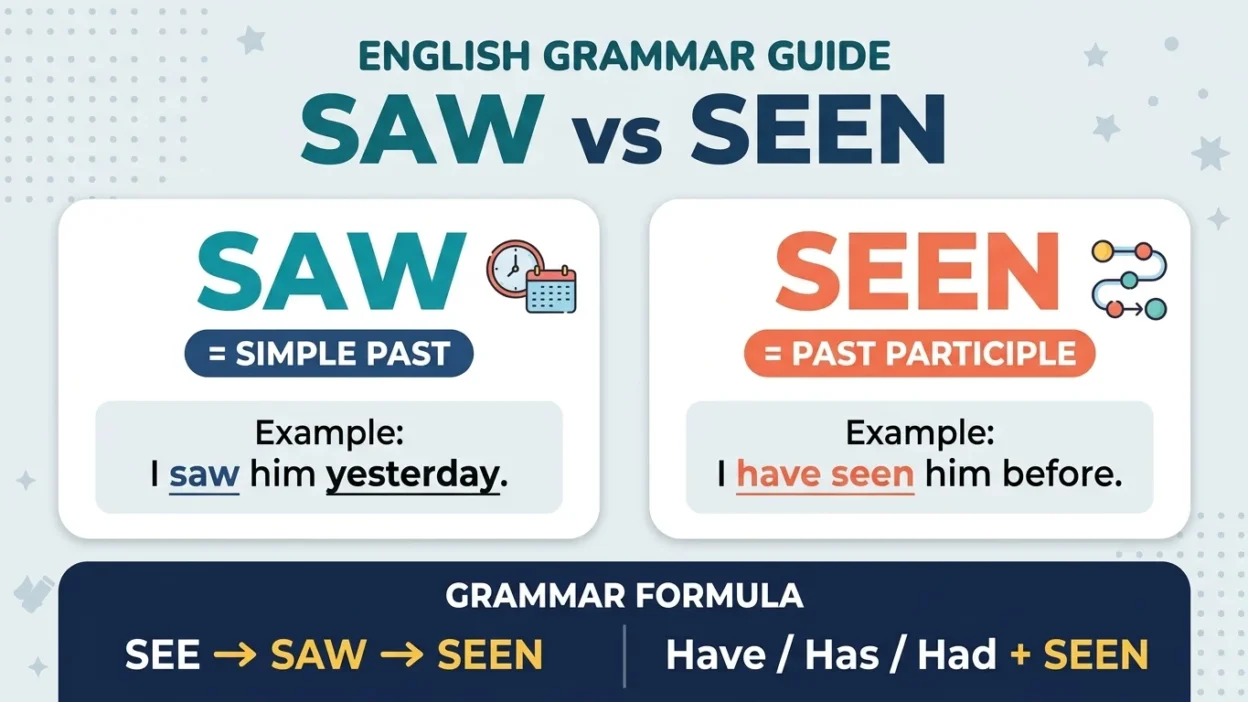
The difference between saw vs seen is one of the most common English grammar questions because both words are forms of the verb see. The basic rule is simple: saw is the simple past tense of see, while seen is the past participle. This means you can say, “I saw her yesterday,” but when you use seen, you normally need a helping verb such as have, has, or had: “I have seen her before.”
Confusion often appears in sentences such as “I seen it” and “I have saw it.” Although forms like these occur in some dialects, they are not the forms generally expected in standard edited English. The standard patterns are I saw it and I have seen it. Once you understand the difference between the simple past and past participle, choosing the right word becomes much easier. This guide explains saw vs seen, tense rules, examples, common mistakes, pronunciation, and memory tricks.
Quick Answer
Saw is the simple past tense of see: “I saw the movie yesterday.” Seen is the past participle and normally appears with a helping verb such as have, has, or had: “I have seen that movie.” Remember: saw usually stands alone; seen normally needs a helper.
Saw vs Seen Definition and Meaning
Both saw and seen come from the irregular verb see, but they perform different grammatical jobs.
The main verb forms are:
see → saw → seen
See is the base form:
“I see the mountains.”
Saw is the simple past:
“I saw the mountains yesterday.”
Seen is the past participle:
“I have seen those mountains before.”
The most important difference is therefore grammatical rather than one of basic meaning.
Both forms relate to seeing, noticing, observing, experiencing, or understanding something. However, saw is used for simple past events, while seen participates in perfect tenses and passive constructions.
Learning the three-part pattern see, saw, seen is the foundation for using these words correctly.
Why People Confuse Saw and Seen
People confuse saw and seen because both refer to past experiences involving the verb see.
Compare:
“I saw that movie.”
“I have seen that movie.”
Both sentences refer to viewing the movie in the past, but their grammar differs.
Another reason is that some regional and nonstandard dialects use constructions such as:
“I seen him yesterday.”
In standard edited English, however, the expected form is:
“I saw him yesterday.”
Likewise, learners sometimes incorrectly combine have with saw:
❌ “I have saw him.”
Standard:
✅ “I have seen him.”
The easiest solution is to stop thinking of saw and seen as interchangeable past-tense words. Instead, memorize their grammatical roles:
Saw = simple past
Seen = past participle
What Does Saw Mean?
Saw is the simple past tense of the verb see.
Use it when describing something that happened at a particular time in the past.
For example:
“I saw John yesterday.”
“She saw a beautiful bird this morning.”
“We saw the accident.”
“They saw the movie last weekend.”
The word can describe more than physical sight.
For example:
“I saw an opportunity and took it.”
Here, saw means recognized or noticed.
Another example:
“She saw what he meant.”
Here, it can mean understood.
Regardless of the exact sense, saw functions as the simple past form when it comes from the verb see.
What Does Seen Mean?
Seen is the past participle of see.
It commonly appears with forms of have:
- have seen
- has seen
- had seen
Examples:
“I have seen that movie.”
“She has seen the report.”
“They had seen him before.”
Seen can also appear in passive constructions with forms of be:
“He was seen leaving the building.”
“The bird has been seen in this area.”
Unlike saw, seen generally does not function as the simple past by itself in standard English.
Therefore:
❌ “I seen him yesterday.”
should normally be:
✅ “I saw him yesterday.”
But:
✅ “I have seen him before.”
is correct because have supports the past participle.
Saw vs Seen Comparison Table
| Feature | Saw | Seen |
|---|---|---|
| Base verb | See | See |
| Verb form | Simple past | Past participle |
| Can follow “have”? | No | Yes |
| Can follow “has”? | No | Yes |
| Can follow “had”? | No | Yes |
| Common with yesterday | Yes | Not alone |
| Example | I saw him. | I have seen him. |
| Standard “I ___ it yesterday” | Saw | Not seen alone |
| Standard “I have ___ it” | Not saw | Seen |
| Memory clue | Simple past | Needs a helper in common uses |
The basic pattern is:
see → saw → seen
Saw vs Seen Pronunciation Guide
Saw and seen are pronounced differently.
Saw sounds like the word saw in:
“I saw the movie.”
Its vowel sound may vary somewhat by accent.
Seen rhymes with:
- green
- mean
- clean
- screen
For example:
“I have seen the movie.”
Because the two words sound quite different, pronunciation is generally not the main source of confusion. The real difficulty is deciding which grammatical form the sentence requires.
Instead of relying on sound, look for tense markers and helping verbs.
If the sentence contains have, has, or had, you will normally need seen, not saw.
See, Saw, Seen Grammar Rules
The verb see is irregular.
Its three principal forms are:
Present/base form: see
Simple past: saw
Past participle: seen
Examples:
“I see him every day.”
“I saw him yesterday.”
“I have seen him before.”
Other forms include:
sees
“She sees him regularly.”
seeing
“I am seeing him tomorrow.”
Because see is irregular, you cannot create its past forms by simply adding -ed.
Incorrect:
❌ seed
❌ seeed
Correct:
✅ saw
✅ seen
Memorizing see → saw → seen is therefore essential.
When to Use Saw
Use saw when describing a completed act of seeing in the simple past.
For example:
“I saw Sarah at the store yesterday.”
Use it with finished past-time expressions such as:
- yesterday
- last night
- last week
- two days ago
- in 2025
- this morning, when the period is treated as finished
Examples:
“We saw the match last night.”
“He saw his doctor yesterday.”
“She saw a shooting star.”
No have, has, or had is needed for this simple past construction.
Think:
Finished past event → saw
That rule handles many everyday situations.
When to Use Seen
Use seen when the sentence requires the past participle of see.
It commonly follows:
have
“I have seen this before.”
has
“She has seen the message.”
had
“They had seen the building before.”
It can also appear in passive structures:
“He was seen near the entrance.”
“The animal has been seen several times.”
You should not normally use seen by itself as a simple past verb in standard edited English.
Incorrect:
❌ “We seen them yesterday.”
Correct:
✅ “We saw them yesterday.”
Or:
✅ “We have seen them before.”
Think:
Seen usually needs a helping verb.
When to Use Each Word
Use saw for a simple past event:
“I saw him yesterday.”
Use seen with perfect tenses:
“I have seen him before.”
Compare:
“She saw the email this morning.”
“She has seen the email.”
Another comparison:
“They saw the building last year.”
“They had seen the building before.”
A useful question is:
Am I simply describing what happened in the past?
Use saw.
Do I have have, has, or had before the verb?
Use seen.
These two questions solve most saw vs seen problems encountered in everyday English.
Saw vs Seen Examples
Here are 15 examples showing correct usage:
- I saw him yesterday.
- I have seen him before.
- She saw the movie last night.
- She has seen that movie three times.
- We saw a rainbow yesterday.
- We have seen many beautiful places.
- He saw the message this morning.
- He had seen the message before the meeting.
- They saw us at the restaurant.
- They have seen the new office.
- I saw what happened.
- I have never seen anything like it.
- The suspect was seen near the building.
- She saw her teacher at the store.
- Have you seen my keys?
Notice that seen appears with a helping verb in these standard constructions.
I Saw vs I Seen
In standard English, the correct simple past form is:
✅ I saw
For example:
“I saw him yesterday.”
“I saw the movie last night.”
“I saw your message.”
The construction:
❌ “I seen him yesterday.”
is not standard edited English, although it occurs in some regional and social dialects.
If you want to use seen in standard English, add the appropriate helping verb:
✅ “I have seen him before.”
The difference is:
I saw = simple past
I have seen = present perfect
For school, academic, business, and other standard formal writing, use I saw for the simple past.
I Have Saw vs I Have Seen
The correct expression is:
✅ I have seen
Not:
❌ I have saw
Why?
Because have requires the past participle in the present perfect construction.
The past participle of see is seen.
Therefore:
have + seen
Examples:
“I have seen this movie before.”
“I have seen your email.”
“I have seen better results.”
The same rule applies with has:
“She has seen him.”
And had:
“They had seen the problem earlier.”
Remember the sequence:
see → saw → seen
The second form, saw, is the simple past.
The third form, seen, is the past participle used after have, has, and had.
Did You See vs Did You Saw
The correct question is:
✅ Did you see it?
Not:
❌ “Did you saw it?”
When did is used as an auxiliary verb, the main verb returns to its base form.
Therefore:
did + see
not:
did + saw
Examples:
“Did you see Sarah yesterday?”
“Did you see the match?”
“Did he see your message?”
The same principle applies to negative sentences:
Correct:
“I did not see him.”
Incorrect:
❌ “I did not saw him.”
Even though the sentence refers to the past, did already carries the past tense. The main verb therefore remains see.
Have You Saw vs Have You Seen
The correct question is:
✅ Have you seen it?
Not:
❌ “Have you saw it?”
The reason is that have requires the past participle.
The past participle of see is:
seen
Examples:
“Have you seen my phone?”
“Have you seen this movie?”
“Have you seen John today?”
With has:
“Has she seen the report?”
With had:
“Had they seen him before?”
The pattern is consistent:
have/has/had + seen
A useful memory formula is:
HAVE + SEEN
If you see have, has, or had, seen is normally the form you need.
Saw It vs Seen It
Both saw it and seen it can appear in correct sentences, but they need different grammar.
Correct:
“I saw it yesterday.”
Here, saw is the simple past.
Correct:
“I have seen it before.”
Here, seen is the past participle.
Incorrect in standard edited English:
❌ “I seen it yesterday.”
Also incorrect:
❌ “I have saw it.”
The correct patterns are:
I saw it.
I have seen it.
You can memorize these two short sentences as models for many other situations.
Replace it with any object:
“I saw the car.”
“I have seen the car.”
“I saw that show.”
“I have seen that show.”
Never Saw vs Never Seen
Both never saw and never seen can be correct depending on sentence structure and intended tense.
Example:
“I never saw him again.”
Here, saw is simple past and refers to a completed past period.
Example:
“I have never seen snow.”
Here, seen appears in the present perfect and describes experience up to the present.
Another example:
“She had never seen the ocean before that trip.”
Here, had seen is past perfect.
Therefore:
never saw can be correct.
have never seen can also be correct.
The choice depends on whether you need the simple past or a perfect tense, not on the presence of never alone.
Saw Yesterday vs Seen Yesterday
If you are simply describing a completed event yesterday, use saw:
“I saw him yesterday.”
“She saw the doctor yesterday.”
“We saw the movie yesterday.”
Do not normally say in standard English:
❌ “I seen him yesterday.”
However, seen can occur in a sentence containing yesterday if the grammar supplies an appropriate auxiliary and context:
“He was seen near the station yesterday.”
Here, was seen is passive.
So the rule is not that yesterday can never appear near seen.
The important distinction is grammatical:
Simple active past → saw
Past participle in an appropriate construction → seen
Saw Before vs Seen Before
Both expressions can be possible, but seen before commonly appears with a perfect construction.
For example:
“I have seen this before.”
“She had seen him before.”
You can also use saw in an appropriate simple-past context:
“I saw him once before he moved away.”
The phrase have seen before is especially common when discussing previous experience without focusing on one specific finished time.
Compare:
“I saw that film in 2024.”
Specific past time.
“I have seen that film before.”
Previous experience.
This distinction also illustrates the broader difference between the simple past and present perfect.
Saw vs Seen With Have, Has, and Had
After have, has, or had in perfect constructions, use seen.
Correct:
“I have seen it.”
“She has seen it.”
“They had seen it.”
Incorrect:
❌ “I have saw it.”
❌ “She has saw it.”
❌ “They had saw it.”
The reason is straightforward:
Saw = simple past
Seen = past participle
Perfect tenses require the past participle.
You can memorize this formula:
HAVE / HAS / HAD + SEEN
Examples:
“We have seen enough.”
“He has seen the results.”
“I had seen her once before.”
This is one of the most important grammar rules for mastering saw vs seen.
Saw vs Seen in the Passive Voice
The passive voice uses a form of be plus a past participle.
Because seen is the past participle of see, passive constructions use seen, not saw.
Correct:
“He was seen entering the building.”
“The animal was seen near the river.”
“They were seen together.”
“The problem has been seen before.”
Incorrect:
❌ “He was saw entering the building.”
The formula is:
form of BE + SEEN
Examples include:
- is seen
- was seen
- were seen
- has been seen
- had been seen
This is another important situation where seen appears even though have, has, or had may not immediately precede it.
Saw vs Seen in Real Life Usage
Imagine meeting a friend yesterday.
You would say:
“I saw Ahmed yesterday.”
Now imagine discussing whether you have ever met him:
“I have seen Ahmed before.”
At the cinema:
“We saw that movie last weekend.”
Later:
“We have seen that movie already.”
Looking for your keys:
“Have you seen my keys?”
Reporting an observation:
“The missing dog was seen near the park.”
These examples demonstrate that the choice depends on grammatical structure rather than the basic act of seeing.
Once you identify whether you need a simple past form or past participle, the decision becomes straightforward.
Saw vs Seen in Business English
Correct use of saw and seen matters in emails, reports, presentations, and professional conversations.
For a completed past event:
“We saw a significant increase in sales last quarter.”
For experience or results connected with a broader period:
“We have seen substantial growth this year.”
Another example:
“The company saw demand decline in June.”
Versus:
“The company has seen demand increase recently.”
Both constructions can be useful in business writing, but their tense meanings differ.
Avoid forms such as:
❌ “We have saw an increase.”
Use:
✅ “We have seen an increase.”
Professional writing generally follows standard verb forms closely, making see → saw → seen an important pattern to master.
Saw vs Seen in Academic Writing
In academic writing, saw can describe a completed historical event or period:
“The nineteenth century saw major industrial changes.”
Researchers may also write:
“The experiment saw a significant increase in temperature.”
However, depending on style and context, more precise verbs such as showed, demonstrated, experienced, or produced may sometimes be preferable.
Seen frequently appears in perfect and passive constructions:
“Similar results have been seen in previous studies.”
“This pattern was seen in both groups.”
Academic writers should ensure that seen has the grammatical support required by the sentence.
Avoid:
❌ “Researchers have saw similar results.”
Use:
✅ “Researchers have seen similar results.”
Formal vs Informal Use
Both saw and seen are standard English forms.
The difference is grammatical, not formal versus informal.
Formal:
“We saw a decline in demand.”
“We have seen an improvement in performance.”
Informal:
“I saw him yesterday.”
“I’ve seen that show.”
In some dialects and informal speech, you may hear:
“I seen him yesterday.”
This form has a place within those dialect systems, but it is not the form generally expected in standard edited English.
For school assignments, examinations, business communication, academic writing, and other contexts requiring standard grammar, use:
I saw
or:
I have seen
depending on the tense you need.
American vs British English
The basic grammatical distinction between saw and seen is the same in standard American and British English.
Both use:
see → saw → seen
American English:
“I saw him yesterday.”
“I have seen him before.”
British English:
“I saw him yesterday.”
“I have seen him before.”
Regional and social dialects in different English-speaking communities may use these forms differently in everyday speech. However, the standard written pattern remains consistent.
Therefore, learners do not need separate American and British rules for this pair.
Remember:
Simple past → saw
Past participle → seen
This works in standard English on both sides of the Atlantic.
Saw vs Seen in Present Perfect
The present perfect uses:
have/has + past participle
Because the past participle of see is seen, we write:
“I have seen it.”
“She has seen it.”
“We have seen this before.”
The present perfect often describes experiences, recent developments, or past actions connected to the present.
Example:
“I have seen that movie three times.”
This discusses experience without specifying one finished past time.
Compare:
“I saw that movie last Friday.”
The phrase last Friday places the event at a specific finished past time, so the simple past saw is appropriate.
Understanding this tense distinction makes saw vs seen much easier.
Saw vs Seen in Past Perfect
The past perfect uses:
had + past participle
Therefore, with see, the correct form is:
had seen
Example:
“I had seen the movie before we discussed it.”
Another example:
“She had seen him once before.”
Do not write:
❌ “She had saw him.”
The correct pattern is:
✅ “She had seen him.”
The past perfect describes something that occurred before another point or event in the past.
For example:
“By the time I arrived, they had already seen the results.”
The presence of had is a strong clue that you need seen, because perfect constructions require the past participle.
Common Mistakes With Saw and Seen
One of the most common mistakes is:
❌ “I seen him yesterday.”
In standard English:
✅ “I saw him yesterday.”
Another common mistake is:
❌ “I have saw him.”
Correct:
✅ “I have seen him.”
Also avoid:
❌ “Did you saw it?”
Correct:
✅ “Did you see it?”
And:
❌ “He was saw near the building.”
Correct:
✅ “He was seen near the building.”
These errors come from mixing the simple past, base form, and past participle.
Remember the three forms:
SEE → SAW → SEEN
Then identify which form your grammatical construction requires.
Memory Trick for Saw vs Seen
Use this simple memory trick:
SAW = SIMPLE PAST
Both begin with an S.
Think:
SAW = yesterday
“I saw him yesterday.”
For seen, remember:
SEEN NEEDS SUPPORT
In many common constructions, that support comes from:
- have
- has
- had
- forms of be in passive constructions
Examples:
“I have seen it.”
“She has seen it.”
“He was seen there.”
Your quickest formula is:
Yesterday? → SAW
Have/has/had? → SEEN
And always remember:
SEE → SAW → SEEN
Expert Tips for Choosing Saw or Seen
First, look for have, has, or had.
If one appears as the perfect auxiliary for see, choose:
seen
Example:
“She has ___ the movie.”
Correct:
“She has seen the movie.”
Next, look for did.
After did, use the base form:
“Did you see it?”
Not saw or seen.
For a straightforward completed past event without a perfect auxiliary:
“I saw him yesterday.”
Finally, check for passive voice:
“He was seen near the entrance.”
These four patterns solve most problems:
simple past → saw
perfect tense → seen
after did → see
passive → seen
Mistakes to Avoid
Do not use seen alone as the standard simple past:
❌ “She seen the movie yesterday.”
Use:
✅ “She saw the movie yesterday.”
Do not place saw after have, has, or had:
❌ “She has saw it.”
Use:
✅ “She has seen it.”
Do not place saw after did:
❌ “Did she saw it?”
Use:
✅ “Did she see it?”
And do not forget passive constructions:
❌ “He was saw by the guard.”
Use:
✅ “He was seen by the guard.”
The easiest protection against these mistakes is memorizing the complete irregular verb pattern rather than learning saw and seen separately.
Similar Words and Verb Forms
The pattern see → saw → seen is similar to several other irregular English verbs.
Compare:
see → saw → seen
go → went → gone
do → did → done
write → wrote → written
take → took → taken
speak → spoke → spoken
break → broke → broken
choose → chose → chosen
In each case, the simple past and past participle may be different.
For example:
“I wrote the letter.”
“I have written the letter.”
Similarly:
“I saw the movie.”
“I have seen the movie.”
Recognizing this broader irregular-verb pattern can help learners understand why saw cannot simply replace seen after have.
Related Confusing Words
If saw vs seen is difficult, these related grammar topics are also useful:
- went vs gone
- did vs done
- drank vs drunk
- sang vs sung
- began vs begun
- chose vs chosen
- wrote vs written
- spoke vs spoken
- broke vs broken
- took vs taken
- lay vs lain
- swam vs swum
Many of these pairs involve the same basic issue:
simple past vs past participle
For example:
“I went.”
“I have gone.”
Compare:
“I saw.”
“I have seen.”
Learning irregular verbs as groups of three—base form, simple past, past participle—is one of the most effective ways to avoid these errors.
FAQs About Saw vs Seen
What is the difference between saw and seen?
Saw is the simple past tense of see. Seen is its past participle and commonly appears with have, has, or had, or in passive constructions.
Is it “I saw” or “I seen”?
In standard English, use “I saw” for the simple past: “I saw him yesterday.” Use seen with an appropriate helper: “I have seen him before.”
Is it “I have saw” or “I have seen”?
I have seen is correct. Perfect tenses require the past participle, and the past participle of see is seen.
Is it “did you see” or “did you saw”?
Did you see is correct. After the auxiliary did, use the base form of the main verb.
Is it “have you saw” or “have you seen”?
Have you seen is correct because seen is the past participle required after have.
Can seen be used without have?
Yes. Seen can appear with other auxiliaries, particularly in passive constructions: “He was seen outside.” It is therefore more accurate to say that seen needs an appropriate grammatical construction rather than that it must always follow have.
Is “I never saw it” correct?
Yes. I never saw it can be correct when using the simple past. I have never seen it is also correct but uses the present perfect and may convey a different time perspective.
How can I remember saw vs seen?
Remember: see → saw → seen. Use saw for simple past events and seen as the past participle, especially after have, has, or had.
Final Verdict on Saw vs Seen
The difference between saw vs seen is primarily a grammar distinction. Saw is the simple past tense of see and is appropriate for completed past actions: “I saw him yesterday.” Seen is the past participle and appears in perfect constructions such as “I have seen him before” and passive constructions such as “He was seen outside.”
The easiest way to master the difference is to memorize the three principal forms: see → saw → seen. Avoid common standard-English errors such as “I seen,” “I have saw,” and “Did you saw?” Instead, remember the basic patterns: I saw, I have seen, and Did you see? Once these three constructions become familiar, choosing the correct form becomes much easier.
Remember This
Memorize these three forms:
SEE → SAW → SEEN
Then remember:
SAW = simple past
“I saw him yesterday.”
SEEN = past participle
“I have seen him before.”
And:
DID + SEE
“Did you see him?”
The quickest memory trick is:
Yesterday → SAW
Have / has / had → SEEN
Did → SEE

Donald Andrew is a dedicated author at BiblyWord, passionate about sharing biblical teachings in a clear and inspiring way. He creates meaningful content that helps readers understand scripture, reflect on their faith, and apply God’s Word in daily life. His work supports spiritual growth, guidance, and a deeper connection with biblical wisdom.