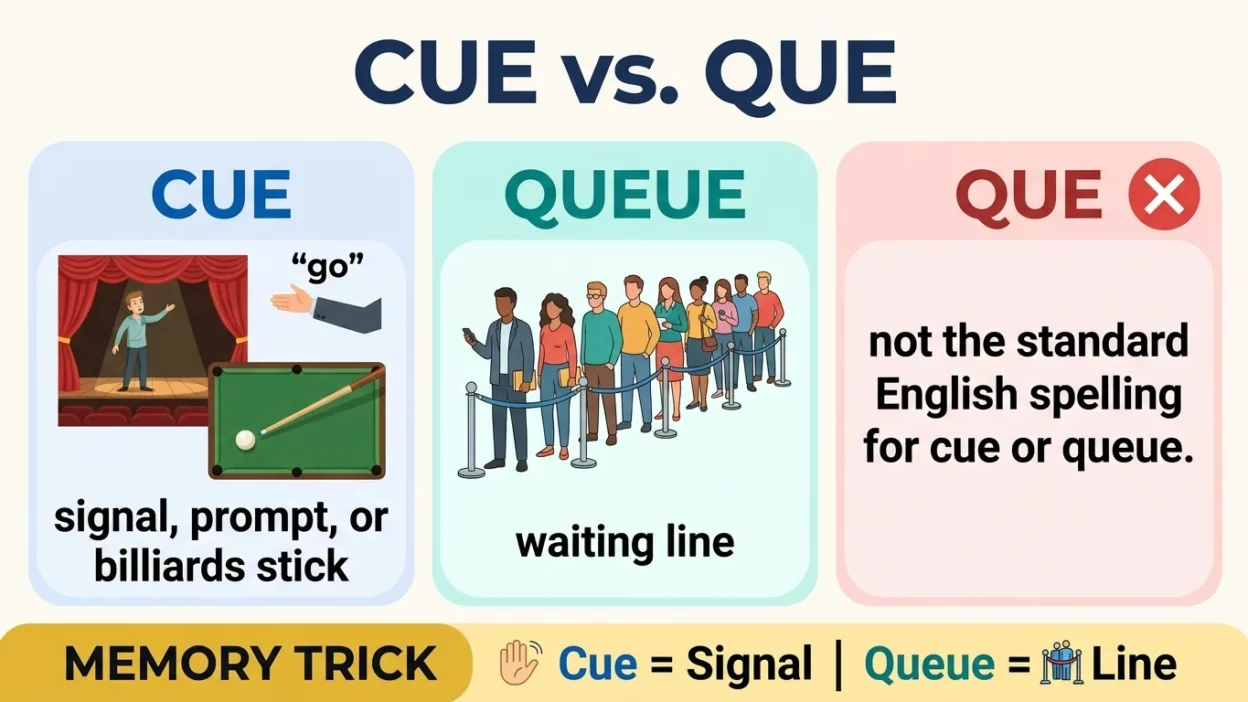
The difference between cue vs que can be confusing because cue is a standard English word, while que appears in other languages and specialized contexts but is generally not the correct English spelling when people mean a signal, prompt, or billiards stick. If someone gives you a signal to begin speaking, for example, that signal is your cue. The same spelling is used for a pool cue.
Confusion also happens because cue, queue, and que look similar. Queue is another standard English word meaning a line of people or things waiting their turn. Meanwhile, que is common in languages such as Spanish, French, and Portuguese, but it does not replace cue or queue in standard English. Understanding the grammatical role and meaning of each spelling makes the distinction much easier. This guide explains cue vs que, pronunciation, definitions, examples, common mistakes, and simple memory tricks.
Quick Answer
Cue is a correct English word meaning a signal or prompt, and it can also refer to the stick used in games such as pool. Que is generally not the correct English spelling for these meanings. If you mean a waiting line, the correct word is queue, not cue or que.
Cue vs Que Definition and Meaning
The key difference between cue and que is that cue has several established meanings in English, while que is not normally an English alternative spelling of cue.
A cue can be a signal that tells someone when to act.
For example:
“That was my cue to leave.”
A cue can also be the long stick used to strike balls in pool, billiards, and snooker.
For example:
“He picked up the pool cue.”
Que, meanwhile, appears as a word in several other languages and in some names or specialized abbreviations. However, if you are writing ordinary English and mean a signal, prompt, or billiards stick, cue is the correct spelling.
Do not confuse either with queue, which means a waiting line.
Why People Confuse Cue and Que
People often confuse cue vs que because English spelling does not always match pronunciation in an obvious way.
The word cue is pronounced like the letter Q, which may make writers uncertain about how many letters are actually needed.
The situation becomes even more confusing because queue has the same pronunciation in standard English. Despite containing five letters, queue is also pronounced like “Q.”
As a result, writers may encounter three forms:
- cue
- que
- queue
and wonder which one is correct.
The solution is to focus on meaning rather than sound.
Cue = signal, prompt, or billiards stick.
Queue = waiting line.
Que = generally not the standard English spelling for either of those meanings.
What Does Cue Mean?
Cue is a standard English word that can function as both a noun and a verb.
As a noun, it commonly means a signal or prompt telling someone to do something.
For example:
“The director gave the actor a cue.”
In theater, television, broadcasting, and live performances, cues tell performers or technical staff when something should happen.
The word can also refer to a hint or indication:
“She took his silence as a cue to change the subject.”
Another meaning is the stick used in billiard games:
“He bought a new pool cue.”
As a verb, cue means to signal, prompt, or prepare something to begin.
For example:
“Cue the music.”
These meanings make cue useful in many everyday and professional situations.
What Does Que Mean?
Que is not normally used as a standard English word meaning signal, prompt, billiards stick, or waiting line.
However, this does not mean that the letter sequence que never appears legitimately.
For example, que is an important word in several languages. Its exact meaning depends on the language and context. In Spanish, for instance, que can perform several grammatical functions and is often translated in ways such as “that,” “which,” or “than,” depending on usage. The accented qué is used differently.
In French and Portuguese, que also has legitimate grammatical uses.
Therefore, it is more accurate to say that que is generally incorrect when used as a replacement for English cue or queue, rather than saying that que is never a word.
Cue vs Que Comparison Table
| Feature | Cue | Que |
|---|---|---|
| Standard English word? | Yes | Not usually as an ordinary standalone English word |
| Can mean a signal? | Yes | No |
| Can mean a prompt? | Yes | No |
| Used in pool/billiards? | Yes | No |
| Used as a verb? | Yes | Not as an alternative to cue |
| Common in other languages? | Not in the same sense | Yes |
| Example | That was my cue. | Not a replacement for “cue” |
| Waiting line? | No | No — use “queue” |
For everyday English, if you mean signal or prompt, choose cue.
Cue vs Queue vs Que
Understanding all three spellings helps eliminate most confusion.
Cue means a signal or prompt:
“That’s your cue to start.”
Queue means a line of people or things waiting:
“We joined the queue for tickets.”
Que is generally not a standard English replacement for either word.
So:
❌ Give me a que when you’re ready.
✅ Give me a cue when you’re ready.
And:
❌ We waited in a que.
✅ We waited in a queue.
A useful summary is:
Cue = signal
Queue = line
Que = usually another language or specialized usage
Because cue and queue sound alike, checking the intended meaning is essential when writing.
Cue vs Que Pronunciation Guide
Cue is pronounced like the name of the English letter Q.
Queue has the same pronunciation.
That creates a particularly unusual situation:
cue → sounds like Q
queue → sounds like Q
Although these two words sound identical, their meanings and spellings are different.
The pronunciation of que depends on the language or context in which it appears. It should not simply be treated as another English spelling of cue.
Because pronunciation alone cannot distinguish cue from queue, you need to think about meaning.
If you mean a signal, write cue.
If you mean a waiting line, write queue.
This simple distinction solves most spelling problems.
Cue Grammar Rules Explained
Cue can function as a noun or a verb.
As a noun:
“That was our cue.”
Here, cue refers to a signal.
Its plural is cues:
“The actors memorized their cues.”
As a verb:
“The producer cued the music.”
The verb means to signal or prepare something to happen.
Useful forms include:
- cue
- cues
- cued
- cueing
For example:
“She is cueing the next video.”
Do not replace these forms with que.
The word queue has its own noun and verb uses. For example, people can queue for tickets, and digital tasks can be placed in a queue.
Understanding the grammatical role helps you select the correct spelling.
When to Use Cue
Use cue when talking about a signal, hint, prompt, or indication that something should happen.
For example:
“When the lights go down, that’s your cue to enter.”
You can also use cue when someone takes another person’s behavior as a signal:
“I took that as my cue to leave.”
Use cue for the stick used in pool, billiards, and snooker:
“He leaned his cue against the wall.”
As a verb, cue can mean to signal or prepare:
“Cue the applause.”
“Cue the next song.”
Whenever the intended meaning involves a signal, prompt, indication, or billiards stick, cue is usually the correct spelling.
When to Use Que
In ordinary standard English, you generally should not use que when you mean cue or queue.
For example:
❌ That is my que to start.
Correct:
✅ That is my cue to start.
Likewise:
❌ There was a long que outside.
Correct:
✅ There was a long queue outside.
However, que may appear correctly when you are writing in or quoting another language, or when it forms part of a proper name, abbreviation, or specialized expression.
Therefore, context is essential.
For English learners, the safest rule is:
Signal = cue
Waiting line = queue
Do not use que as a shortened spelling of either word in standard English.
When to Use Queue
Because que is frequently written when people actually mean queue, understanding queue is important.
A queue is a line of people, vehicles, tasks, or other things waiting to be served or processed.
For example:
“We stood in a queue for an hour.”
The word is particularly common in British English for a physical waiting line.
It is also widely used in computing:
“The document was added to the print queue.”
Queue can function as a verb:
“People queued outside the theater.”
Therefore:
cue = signal
queue = waiting line
This distinction is much more useful than treating cue and que as interchangeable spellings.
When to Use Each Word
Use cue when you mean:
- a signal
- a prompt
- a hint
- a billiards stick
- to signal something to begin
Use queue when you mean:
- a waiting line
- a sequence of tasks waiting to be processed
- the act of joining or forming a line
Use que only when it is genuinely required by another language, name, abbreviation, or specialized context.
Examples:
“That was my cue to speak.”
“We joined the queue.”
“The director cued the music.”
“The file entered the print queue.”
This meaning-based approach is the fastest way to avoid mistakes.
Cue vs Que Examples
Here are examples demonstrating the correct use of cue:
- That was my cue to leave.
- The actor missed his cue.
- She gave me a cue to begin.
- The director cued the music.
- He picked up his pool cue.
- Take this as your cue to start.
- The performer waited for her cue.
- His smile was my cue to continue.
- Please cue the next video.
- The lighting cue came too early.
- She bought a new billiards cue.
- The host cued the audience to applaud.
And compare:
“We waited in a queue.”
“The documents are in the print queue.”
In these standard English meanings, que would not be the correct replacement.
Cue in Theater and Acting
The word cue is particularly important in theater.
A cue tells an actor, technician, musician, or other participant when to perform a particular action.
For example:
“The actor entered on cue.”
The cue might be another actor’s line, a sound, a lighting change, a gesture, or an instruction from backstage.
Theater professionals may work with:
- lighting cues
- sound cues
- entrance cues
- music cues
An actor who misses a cue may enter late or fail to deliver a line at the expected moment.
This theatrical meaning also influenced the broader everyday use of cue as a signal telling someone that it is time to act.
Cue in Movies and Television
Cue is also common in filmmaking, television, broadcasting, and video production.
A director might say:
“Cue the music.”
This means that the music should begin at a particular moment.
A production may have cues for:
- cameras
- sound effects
- music
- lighting
- presenters
- video clips
For example:
“The producer cued the presenter to begin speaking.”
You may also encounter the phrase on cue, meaning at exactly the expected or appropriate moment:
“As if on cue, the phone started ringing.”
In all of these examples, cue is the correct spelling because the word refers to timing, signaling, or prompting an action.
Cue in Pool and Billiards
In pool, billiards, and snooker, a cue is the long stick used to strike the cue ball.
For example:
“He bought a new pool cue.”
The ball struck by the cue is called the cue ball.
Common expressions include:
- pool cue
- billiard cue
- cue ball
- cue tip
- cue stick
The spelling is always cue, not que.
Correct:
“She picked up the cue.”
Incorrect:
“She picked up the que.”
This meaning is unrelated to a waiting queue, even though cue and queue are pronounced alike.
The sporting context makes it easy to determine which spelling is needed.
What Does Take a Cue Mean?
The expression take a cue from someone or something means to follow an example, pattern, or signal.
For example:
“You should take a cue from your colleague and organize your notes.”
This means you should follow your colleague’s example.
Another example:
“The company took a cue from customer feedback and simplified the design.”
The phrase uses cue, not queue or que, because the underlying idea is an indication or prompt that guides behavior.
Related expressions include:
- take your cue from
- that’s my cue
- on cue
- cue someone in
Learning these common phrases can make the correct spelling easier to remember.
What Does On Cue Mean?
On cue means at exactly the expected, appropriate, or signaled moment.
For example:
“Right on cue, the lights turned off.”
The phrase often describes something happening with surprisingly perfect timing.
Another example:
“On cue, the audience began applauding.”
The expression originates from the idea of performers responding to signals during a performance.
Because it involves a signal or prompt, the correct spelling is:
✅ on cue
not:
❌ on que
and not:
❌ on queue
Although cue and queue sound the same, on cue is a fixed expression with a specific meaning.
Cue vs Queue in Real Life Usage
Imagine you are waiting outside a concert venue.
You stand in a queue because you are part of a waiting line.
Once inside, a performer waits for a cue before walking onto the stage.
This gives you a simple real-life contrast:
“We waited in the queue.”
“The singer waited for her cue.”
In a workplace, a manager might cue a presentation video, while documents wait in a printer queue.
The same pronunciation can therefore represent very different ideas.
Whenever you are unsure, ask:
Am I talking about a signal?
Use cue.
Am I talking about a line or sequence of waiting items?
Use queue.
Cue vs Que in Business English
In professional writing, spelling cue correctly helps maintain clarity.
For example:
“The manager took the declining sales figures as a cue to revise the strategy.”
Here, cue means an indication or signal.
You might also write:
“Please cue the presentation when the speaker arrives.”
In technical business environments, queue may also appear:
“The requests have been placed in a processing queue.”
Writing que instead of either word may look like a spelling error unless que has a specific specialized meaning in that context.
When writing emails, reports, presentations, or instructions, identify whether you mean signal or waiting sequence before choosing the spelling.
Cue vs Que in Academic Writing
In academic writing, cue can refer to information that prompts a response, helps memory, or provides an indication.
For example:
“Visual cues can influence how participants interpret information.”
Researchers may discuss:
- visual cues
- auditory cues
- contextual cues
- social cues
- memory cues
In these expressions, cue is the correct spelling.
The word queue may appear in research involving computing, operations, transportation, or mathematics, such as queueing theory or a task queue.
Because que is not a standard substitute for either word, academic writers should be particularly careful not to omit necessary letters when proofreading.
Formal vs Informal Use
Cue is appropriate in both formal and informal English.
Informal:
“That’s my cue to go.”
Formal:
“The visual cue prompted participants to respond.”
Similarly, queue works in casual and technical contexts.
Informal:
“The queue was really long.”
Technical:
“The requests were placed in a processing queue.”
The difference is based on meaning, not formality.
Although people sometimes shorten or misspell words in text messages and social media posts, que should not be treated as an accepted informal spelling of cue or queue when writing standard English.
Using the correct form keeps your meaning clear regardless of the level of formality.
American vs British English
Cue has essentially the same core meanings in American and British English. It can refer to a signal, prompt, or billiards stick in both varieties.
The word queue, however, is particularly common in British English when talking about people waiting in line.
British English:
“We waited in a queue.”
American English commonly uses:
“We waited in line.”
However, queue is still understood and used in American English, especially in computing and other technical contexts.
The spelling cue remains the same in both varieties.
Therefore:
cue = signal or prompt
works in both American and British English, while queue may differ somewhat in everyday frequency depending on the region.
Common Mistakes With Cue and Que
A frequent mistake is using que when cue is required.
Incorrect:
❌ That’s my que to leave.
Correct:
✅ That’s my cue to leave.
Another common mistake is confusing cue with queue:
❌ We stood in a cue for tickets.
Correct:
✅ We stood in a queue for tickets.
Writers may also make errors with common expressions:
❌ right on que
✅ right on cue
❌ cue of customers
✅ queue of customers
❌ pool que
✅ pool cue
The best way to avoid these mistakes is to stop relying on pronunciation. Since cue and queue sound identical, only meaning can reliably tell you which spelling belongs in the sentence.
Synonyms and Alternatives
Depending on context, cue can have several synonyms.
For a cue meaning a signal:
- signal
- prompt
- indication
- hint
- sign
For example:
“That was my cue to leave.”
could sometimes become:
“That was my signal to leave.”
For queue, possible alternatives include:
- line
- waiting line
- sequence
- backlog
However, these alternatives are not always interchangeable.
A print queue, for instance, is a specific technical concept, while backlog may describe accumulated work more generally.
Understanding synonyms can reinforce the distinction: cue relates to signals, while queue relates to waiting or ordered processing.
Common Sentences With Cue and Queue
Here are some useful sentences:
- That’s my cue to leave.
- Wait for your cue before speaking.
- The director cued the music.
- She arrived right on cue.
- He picked up the pool cue.
- The actor missed his cue.
- Take your cue from the team leader.
- We joined the queue for tickets.
- The queue moved slowly.
- The file entered the print queue.
- Several jobs are waiting in the processing queue.
- The customers queued outside the store.
These sentences demonstrate the essential distinction.
A cue tells something to happen.
A queue contains people or things waiting for something to happen.
Memory Trick for Cue vs Que
Use this simple memory trick:
CUE = CLUE
Both words contain a C, and a cue can function like a clue or signal telling you what to do next.
Think:
Cue → clue → signal
For queue, imagine a line of letters waiting behind Q:
Q + U + E + U + E
The extra letters can remind you of people standing in a long line.
And remember:
Que is not the standard English shortcut for either one.
So:
Cue = signal
Queue = line
This simple three-part distinction can prevent most spelling mistakes.
Expert Tips for Choosing the Correct Word
When deciding between these spellings, first identify the intended meaning.
Ask:
Does it mean signal, prompt, or hint?
Choose cue.
Does it refer to a billiards stick?
Choose cue.
Does it mean a waiting line or ordered list of tasks?
Choose queue.
Is the text actually using another language or a specialized name?
Then que may be legitimate depending on that context.
One additional trick is to replace cue with signal. If the sentence still makes sense, cue is probably correct.
“That was my cue to leave.”
“That was my signal to leave.”
The meaning remains clear, confirming that cue is appropriate.
Similar Words and Homophones
English contains many words that are confusing because their pronunciations are identical or very similar.
Examples include:
- cue vs queue
- right vs write
- brake vs break
- principal vs principle
- complement vs compliment
- stationary vs stationery
- hear vs here
- sea vs see
- flour vs flower
- pair vs pear
The best way to learn homophones is through context.
For cue vs queue, associate each word with one strong image:
Cue → actor waiting for a signal
Queue → people waiting in a line
These mental images connect spelling with meaning, making the words easier to remember than memorizing definitions alone.
FAQs About Cue vs Que
Is it cue or que?
If you mean a signal, prompt, hint, or billiards stick, cue is correct. Que is not the standard English spelling for these meanings.
Is que a word?
Que appears legitimately in several languages and some specialized contexts, but it is not normally an English alternative spelling of cue or queue.
Is it cue or queue for a line?
Use queue for a waiting line. For example: “We joined the queue.”
Is it cue or que in pool?
Cue is correct. The stick used to strike the ball is a pool cue.
Is it “that’s my cue” or “that’s my que”?
That’s my cue is correct. It means something has signaled that it is time for you to act.
Is it “right on cue” or “right on que”?
Right on cue is correct. It means something happened at exactly the expected or appropriate moment.
Do cue and queue sound the same?
Yes. In standard English, cue and queue are pronounced the same way even though their spellings and meanings differ.
What is an easy way to remember cue vs queue?
Remember: cue = signal, while queue = line. Think of a cue as a clue telling you when to act and a queue as a line of people waiting.
Final Verdict on Cue vs Que
The difference between cue vs que becomes simple once you focus on standard English usage. Cue is the correct word when you mean a signal, prompt, hint, or the stick used in pool and billiards. It can also function as a verb, as in “cue the music.” If you are referring to a waiting line, however, the correct spelling is queue.
Que should not normally be used as a shortened English spelling of either cue or queue. It does have legitimate uses in other languages and certain specialized contexts, so it is not universally “wrong.” For everyday English, remember the practical rule: cue means signal, queue means line, and que usually belongs to another linguistic or specialized context.
Remember This
The easiest rule is:
CUE = signal or prompt
“That was my cue to speak.”
QUEUE = waiting line
“We joined the queue.”
QUE ≠ an English shortcut for cue or queue
And use this memory trick:
CUE → CLUE → a signal that tells you what to do.

Kevin Brian is a passionate author at BiblyWord, dedicated to sharing the message of the Bible through thoughtful and inspiring content. He focuses on creating clear and meaningful writings that help readers understand scripture, strengthen their faith, and find guidance in everyday life through God’s Word.