Accept vs except is a common English word pair that can cause confusion because the two words look and sound somewhat similar. However, their meanings and grammatical roles are very different.
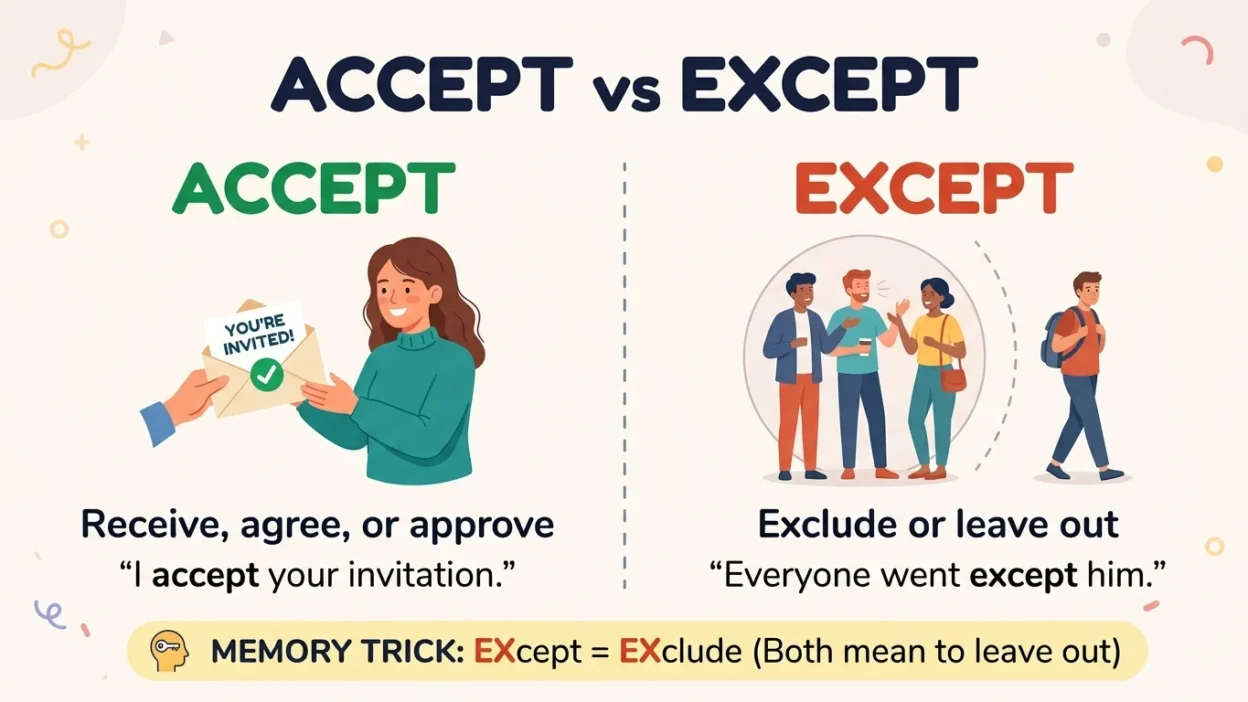
Accept is primarily a verb meaning to receive, agree to, approve, or recognize something as true. For example, you might accept an invitation, accept an apology, or accept responsibility. Except, by contrast, most commonly means excluding or apart from someone or something.
Understanding the difference is important because replacing one with the other can completely change a sentence. “Everyone accepted the invitation” means everyone agreed to receive it, while “everyone except John received the invitation” excludes John from the group.
Fortunately, there is an easy way to remember the distinction: accept is about receiving or agreeing, while except is about excluding. This guide covers definitions, pronunciation, grammar, examples, common mistakes, and memory tricks.
Quick Answer
Accept usually means to receive, agree to, approve, or acknowledge something, as in “I accept your offer.” Except usually means excluding or apart from, as in “Everyone came except Ali.” Remember: accept = receive or agree; except = exclude.
Accept vs Except Definition and Meaning
The main difference between accept and except is their meaning and grammatical function.
Accept is primarily a verb. It describes receiving something willingly, agreeing to something, or recognizing something as true or valid.
Examples:
- accept a gift
- accept an offer
- accept responsibility
- accept the truth
Except most commonly indicates exclusion. It can function as a preposition or conjunction, and it also has a less common verb use.
Examples:
- Everyone except Sarah attended.
- The shop opens every day except Sunday.
- I like everything except the ending.
A simple distinction is:
Accept = take or agree
Except = leave out or exclude
Understanding this basic contrast prevents most errors.
Why People Confuse Accept and Except
People often confuse accept vs except because the words have similar spellings and, in some accents or rapid speech, their pronunciations can sound fairly close.
Both words also appear frequently in everyday communication, making spelling mistakes more noticeable.
Consider:
“I accept everyone except him.”
Both words appear naturally in the same sentence, but they perform completely different jobs.
Accept tells us that someone receives or approves of something.
Except removes someone or something from a group.
Writers may also rely too heavily on sound rather than meaning when choosing between them. A better approach is to ask whether the sentence involves receiving/agreement or exclusion.
If it involves receiving or agreeing, use accept. If something is being excluded, use except.
What Does Accept Mean?
Accept is a verb with several closely related meanings. One of its most common meanings is to willingly receive something.
For example:
“She accepted the gift.”
It can also mean agreeing to an offer, invitation, proposal, or request:
“He accepted the job offer.”
Another meaning is acknowledging something as true or unavoidable:
“We must accept the reality of the situation.”
You can also accept responsibility:
“She accepted responsibility for the mistake.”
Common combinations include:
- accept an invitation
- accept payment
- accept responsibility
- accept an apology
- accept an offer
- accept the truth
- accept a challenge
The central idea usually involves receiving, agreeing, approving, or acknowledging something.
What Does Except Mean?
Except most commonly means excluding, apart from, or other than.
For example:
“Everyone attended except David.”
This means David did not attend, while the other people did.
Another example:
“The store is open every day except Sunday.”
Sunday is excluded from the days when the store is open.
Except can also function as a conjunction:
“I would go, except that I have to work.”
Less commonly, except can function as a verb meaning to exclude something from a category or rule.
However, everyday learners will encounter its exclusion meaning most often.
An easy synonym test is to replace except with excluding or apart from. If the sentence still makes sense, except is probably correct.
Accept vs Except Comparison Table
| Feature | Accept | Except |
|---|---|---|
| Most common role | Verb | Preposition/conjunction |
| Main meaning | Receive or agree to | Exclude or leave out |
| Shows agreement? | Yes | No |
| Shows exclusion? | No | Yes |
| Example | I accept your offer. | Everyone except Tom agreed. |
| Common phrase | Accept responsibility | Everyone except me |
| Memory clue | Accept = agree | Except = exclude |
The easiest distinction is to remember the two key ideas:
Accept → receive
Except → exclude
Accept vs Except Pronunciation Guide
The pronunciation of accept and except can be similar, which contributes to confusion.
Accept is commonly pronounced approximately:
uhk-SEPT
Except is commonly pronounced approximately:
ik-SEPT
The first syllable differs, although the distinction may become less obvious in fast speech or depending on the speaker’s accent.
Because pronunciation alone is not always a reliable guide, focus on meaning.
For example:
“I accept your explanation.”
The meaning is I acknowledge or agree with your explanation.
“Everyone except John understood.”
The meaning is John is excluded.
When writing, the sentence’s meaning provides a much stronger clue than the sound of the word.
Accept Grammar Rules Explained
Accept is primarily a verb, so it changes form according to tense and sentence structure.
Common forms include:
- accept
- accepts
- accepted
- accepting
Examples:
“I accept your apology.”
“She accepts online payments.”
“They accepted our proposal.”
“He is accepting applications.”
Because accept is a verb, it frequently follows a subject and is followed by an object:
Subject + accept + object
“She accepted the invitation.”
The noun form is acceptance:
“His acceptance of the offer surprised everyone.”
The adjective acceptable means satisfactory or suitable:
“This solution is acceptable.”
Recognizing these related forms can make the spelling and meaning of accept easier to remember.
Except Grammar Rules Explained
Except can perform several grammatical roles.
As a preposition, it introduces something excluded:
“Everyone except Maria attended.”
As a conjunction:
“I would help, except that I am busy.”
It can also have a verb use, although this is much less common in everyday conversation.
For most learners, the important pattern is:
general group + except + excluded item
For example:
“All students except Daniel passed.”
Daniel is excluded from the group of students who passed.
Another pattern is:
“Everything is ready except the food.”
Here, the food is the one thing excluded from what is ready.
Whenever the sentence means excluding, apart from, or other than, except is likely the right choice.
When to Use Accept
Use accept when someone receives, agrees to, approves, acknowledges, or takes something willingly.
For example:
“I accept your apology.”
Here, the speaker acknowledges and receives the apology.
Use it with offers:
“She accepted the job offer.”
Use it with invitations:
“He accepted our invitation.”
Use it with responsibility:
“The manager accepted responsibility for the error.”
Use it when recognizing reality:
“You have to accept that things have changed.”
You can also accept payments, applications, conditions, challenges, explanations, and decisions.
A quick test is to substitute receive, agree to, or acknowledge. If one of these meanings fits naturally, accept is usually correct.
When to Use Except
Use except when you want to exclude someone or something from a statement.
For example:
“Everyone except me ordered coffee.”
This means all members of the group ordered coffee, but the speaker did not.
Another example:
“The museum is open every day except Monday.”
Monday is excluded.
You can also use except when introducing a limitation:
“The movie was excellent except for the ending.”
Useful expressions include:
- except for
- everyone except
- everything except
- all except
- nothing except
Ask yourself:
Am I leaving something or someone out?
If yes, except is probably correct.
Think except = exclude.
When to Use Each Word
The choice between accept and except becomes straightforward when you identify the intended meaning.
Use accept for:
- receiving something
- agreeing to something
- approving an offer
- acknowledging the truth
- taking responsibility
Use except for:
- excluding something
- leaving someone out
- identifying an exception
- meaning “apart from”
Compare:
“I accept your decision.”
“Everyone except James accepted the decision.”
The first sentence uses accept because someone acknowledges the decision. The second uses except to exclude James.
Remember:
Accept adds or receives.
Except excludes or removes.
Accept vs Except Examples
Here are 15 examples showing the difference clearly:
- I accept your apology.
- Everyone except John arrived early.
- She accepted the job offer.
- The restaurant opens every day except Monday.
- He refused to accept the explanation.
- Everyone except me ordered dessert.
- We accept credit cards.
- I enjoyed everything except the ending.
- She accepted responsibility for the mistake.
- All students except one passed the exam.
- Please accept this gift.
- The room was empty except for one chair.
- He finally accepted the truth.
- Everyone was invited except Mark.
- The company accepted our proposal.
Notice the pattern: accept involves receiving or agreeing, while except involves exclusion.
Accept an Offer vs Except an Offer
The standard expression is accept an offer when you mean to agree to an offer.
Correct:
“She accepted the offer.”
This means she agreed to what was proposed.
Writing:
“She excepted the offer”
would normally communicate a very different and unusual meaning, because the verb except can mean to exclude.
The same principle applies to:
- accept a proposal
- accept a job
- accept an invitation
- accept an agreement
- accept a challenge
Whenever you mean say yes to, agree to, or receive willingly, use accept.
A useful substitution is:
“She agreed to the offer.”
If agreed to expresses your intended meaning, accept is the correct choice.
Accept Responsibility vs Except Responsibility
The correct phrase is normally accept responsibility.
For example:
“The employee accepted responsibility for the mistake.”
This means the employee acknowledged that the responsibility belonged to them.
Another example:
“Leaders should be willing to accept responsibility for their decisions.”
Using except would change the meaning toward exclusion rather than acknowledgment.
The same rule applies to similar expressions:
- accept blame
- accept criticism
- accept consequences
- accept responsibility
- accept accountability
The key idea is acknowledgment.
If someone recognizes something as their duty, obligation, or consequence, they accept it.
Remember:
Accept responsibility = acknowledge responsibility.
Except For Meaning and Usage
Except for is a common expression meaning apart from, excluding, or with the exception of.
For example:
“The room was empty except for a table.”
This means the table was the only thing in the room.
Another example:
“Everyone was ready except for Michael.”
Michael was the exception.
You can also say:
“The trip was perfect except for the weather.”
The trip was generally excellent, but the weather was a negative exception.
Except for is particularly useful when describing one thing that differs from an otherwise general statement.
Whenever you can naturally substitute apart from, except for may be appropriate.
Everyone Except vs Everyone Accept
The correct phrase is usually everyone except when you want to identify someone excluded from a group.
For example:
“Everyone except Sarah attended.”
This means Sarah did not attend.
Compare:
“Everyone accepted the invitation.”
Here, accepted is a verb telling us what everyone did.
These structures illustrate the grammatical difference:
Everyone except Sarah…
Here, except Sarah identifies an exclusion.
Everyone accepted…
Here, accepted describes an action.
If a person’s name or object is being removed from a larger group, use except.
If people are agreeing to or receiving something, use accept.
Accept vs Except in Real Life Usage
Imagine that you receive an invitation to a birthday party.
You might say:
“I accept the invitation.”
This means you agree to attend.
Later, someone might say:
“Everyone is coming except David.”
This means David is excluded from the group of people attending.
At a store, you might see:
“We accept credit cards.”
At a restaurant:
“We are open every day except Tuesday.”
These real-life examples reveal the distinction clearly.
Accept is associated with receiving, allowing, or agreeing.
Except creates an exception.
If you remember those two concepts rather than relying only on spelling, choosing the correct word becomes much easier.
Accept vs Except in Business English
Both words are common in professional communication.
You may accept:
- a proposal
- an offer
- a payment
- an application
- responsibility
- terms and conditions
For example:
“The company accepted our proposal.”
Except is used when something is excluded:
“All departments except marketing approved the plan.”
Another example:
“The office operates every weekday except Friday.”
Confusing these words in business emails or reports can make a sentence unclear or even change its meaning.
Compare:
“We accept all payment methods except checks.”
This single sentence demonstrates both words perfectly. The business accepts payment methods generally, while checks are excepted from—or, more naturally, excluded from—the accepted options.
Accept vs Except in Academic Writing
Both words can appear in academic contexts, but their functions remain different.
Accept may describe recognizing a theory, argument, conclusion, assumption, or result:
“Researchers generally accept this explanation.”
It may also appear when discussing whether a hypothesis should be accepted, depending on the field and methodology.
Except identifies an exclusion:
“All variables except age were statistically controlled.”
Another example:
“The pattern appeared in every group except the control group.”
Academic writing requires precision, so confusing the two can significantly affect meaning.
A simple proofreading technique is to replace accept with acknowledge and except with excluding. If the replacement preserves the intended meaning, you probably chose correctly.
Formal vs Informal Use
Both accept and except are standard words suitable for formal and informal English.
Informal:
“I accept your apology.”
Formal:
“The committee accepted the proposed changes.”
Informal:
“Everyone except Jake came.”
Formal:
“All participants except those in the control group completed the second assessment.”
The difference does not depend on how formal your writing is. It depends on meaning and grammatical function.
You should therefore apply the same basic rule in text messages, emails, essays, business reports, academic papers, and professional documents:
Accept = receive, agree, or acknowledge.
Except = exclude or leave out.
This distinction remains reliable across different writing styles.
American vs British English
The basic difference between accept and except is the same in American and British English.
In both varieties, accept commonly means to receive, agree to, or acknowledge something.
American English:
“They accepted the offer.”
British English:
“They accepted the offer.”
Likewise, except indicates exclusion in both varieties:
“Everyone except Peter attended.”
Although American and British English differ in spelling and vocabulary in many areas, there is no major regional difference you need to learn for this pair.
The same memory rule works for international English:
Accept = agree or receive
Except = exclude
This makes the distinction useful for learners regardless of which major English variety they use.
Synonyms and Alternatives
Synonyms can help clarify the difference between accept and except.
Depending on context, synonyms for accept include:
- receive
- agree to
- approve
- acknowledge
- recognize
- take
For except, possible alternatives include:
- excluding
- apart from
- other than
- with the exception of
Compare:
“Everyone except Sam attended.”
“Everyone apart from Sam attended.”
The meaning remains similar.
Likewise:
“She accepted the offer.”
“She agreed to the offer.”
If agree to or receive fits, choose accept. If excluding or apart from fits, choose except. This synonym test is one of the easiest ways to check your writing.
Common Sentences With Accept and Except
Here are some natural sentences using both words:
- Please accept my apology.
- I cannot accept that explanation.
- She accepted the invitation.
- We accept cash and credit cards.
- He accepted responsibility.
- Everyone except me agreed.
- The office is open every day except Sunday.
- I like all vegetables except onions.
- Nothing changed except the date.
- Everyone except Tom was ready.
- They accepted our application.
- The hotel accepts most cards except one.
Learning these common sentence patterns can help you develop an instinct for the correct word rather than stopping to think about the rule every time.
Common Mistakes With Accept and Except
One common mistake is using except when someone agrees to something.
Incorrect:
❌ “I except your apology.”
Correct:
✅ “I accept your apology.”
Another mistake is using accept for exclusion:
❌ “Everyone accept Sarah attended.”
Correct:
✅ “Everyone except Sarah attended.”
Other examples:
❌ We except credit cards.
✅ We accept credit cards.
❌ Everyone accept him was invited.
✅ Everyone except him was invited.
These errors often occur because the words sound similar. Instead of relying on pronunciation, focus on meaning.
Ask whether the sentence means receive/agree or exclude. That single question will solve most cases.
Memory Trick for Accept vs Except
A very simple spelling trick is:
EXcept = EXclude
Both except and exclude begin with EX.
So whenever something is being left out, think:
EXcept → EXclude
For accept, think:
ACCEPT = AGREE
Both ideas involve saying yes to or receiving something.
For example:
“I accept your offer.”
means:
“I agree to your offer.”
And:
“Everyone except Ali came.”
means:
“Everyone came, excluding Ali.”
So remember:
Accept = Agree
Except = Exclude
This short memory trick works in most everyday situations and makes the spelling difference much easier to recall.
Expert Tips for Choosing Accept or Except
When you are unsure, use a replacement test.
Try replacing the word with receive or agree to.
“I ___ your offer.”
“I agree to your offer.”
That works, so choose:
“I accept your offer.”
Now try replacing the word with excluding:
“Everyone ___ Lisa attended.”
“Everyone excluding Lisa attended.”
The meaning works, so choose:
“Everyone except Lisa attended.”
You can also remember their grammatical tendencies. Accept is primarily an action verb, while except often introduces the person or thing excluded from a larger group.
Using both meaning and grammar together provides a reliable way to choose correctly.
Mistakes to Avoid
Avoid assuming the words are interchangeable just because they sound similar.
Incorrect:
❌ Please except my apology.
Correct:
✅ Please accept my apology.
Incorrect:
❌ Everyone accept me received a ticket.
Correct:
✅ Everyone except me received a ticket.
Also pay attention to word forms:
accept → accepted → accepting → acceptance
except → exception → exceptional
Although accept and except look similar, their related words can help reveal their meanings.
Think of acceptance as receiving or approval.
Think of an exception as something excluded from the general rule.
These word-family connections provide another useful way to avoid spelling mistakes.
Related Confusing Words
If accept vs except is difficult, you may also want to learn these commonly confused pairs:
- affect vs effect
- advice vs advise
- beside vs besides
- complement vs compliment
- principal vs principle
- than vs then
- loose vs lose
- assure vs ensure
- farther vs further
- breath vs breathe
Like accept and except, many of these words look or sound similar while performing different jobs.
The best learning strategy is to connect each word with a simple meaning and memorable example.
For this pair, remember:
Accept an invitation.
Everyone except John.
These two short examples capture the essential difference.
FAQs About Accept vs Except
What is the difference between accept and except?
Accept usually means to receive, agree to, or acknowledge something. Except means excluding, apart from, or other than.
Is it accept or except an apology?
Use accept an apology. For example: “I accept your apology.”
Is it everyone accept or everyone except?
When excluding someone, use everyone except. For example: “Everyone except Anna attended.”
Is it accept or except responsibility?
The standard phrase is accept responsibility, meaning to acknowledge or take responsibility.
Is accept a verb?
Yes. Accept is primarily a verb. Examples include accept an offer, accept payment, and accept the truth.
Is except a verb?
Except can function as a verb, but its more familiar everyday uses are as a preposition or conjunction expressing exclusion.
What is an easy trick for accept vs except?
Remember EXcept = EXclude. Both begin with EX. Use accept when you mean receive, agree to, or acknowledge.
Can accept and except appear in the same sentence?
Yes. For example: “We accept every payment method except checks.” Here, accept means receive, while except introduces the excluded payment method.
Final Verdict on Accept vs Except
The difference between accept vs except is easy to understand once you connect each word with its core meaning. Accept is primarily a verb meaning to receive, agree to, approve, or acknowledge. You can accept an invitation, accept an apology, accept responsibility, or accept the truth.
Except most commonly indicates exclusion. You can invite everyone except one person, open every day except Sunday, or enjoy everything except one part. When you are unsure, remember the simple rule: accept = agree or receive; except = exclude. The shared EX in except and exclude provides an easy spelling clue that can help you choose the correct word every time.
Remember This
The easiest rule is:
ACCEPT = receive or agree
“I accept your offer.”
EXCEPT = exclude or leave out
“Everyone except John attended.”
Use this memory trick:
EXcept → EXclude
If something is being excluded, choose except. If something is being received, approved, or agreed to, choose accept.

Kevin Brian is a passionate author at BiblyWord, dedicated to sharing the message of the Bible through thoughtful and inspiring content. He focuses on creating clear and meaningful writings that help readers understand scripture, strengthen their faith, and find guidance in everyday life through God’s Word.