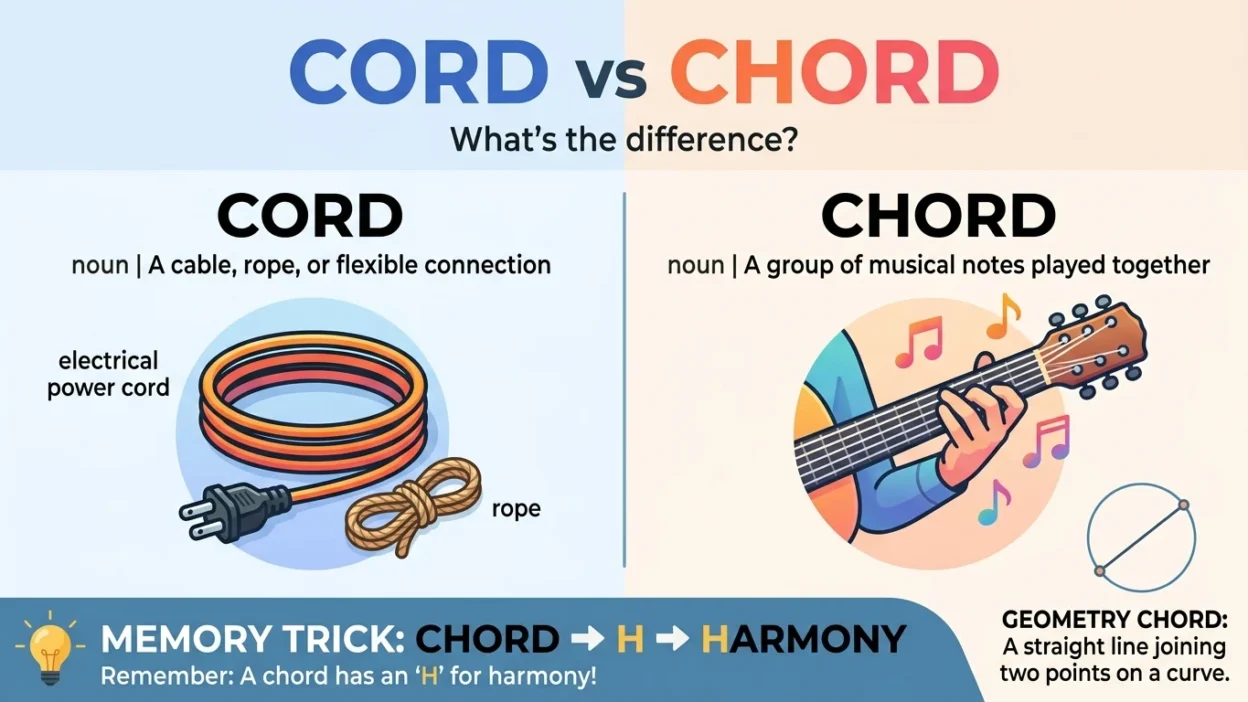
The words cord and chord are easy to confuse because they sound the same in standard English, yet their meanings are quite different. Cord usually refers to a rope, cable, flexible electrical wire, or a similar long, thin object. You might use a power cord to connect a computer or tie something together with a cord. Chord, meanwhile, is most commonly associated with music, where it means a group of notes played together.
However, the difference between cord vs chord goes beyond cables and music. Cord appears in terms such as vocal cords and spinal cord, while chord also has specialized meanings in mathematics and geometry. Because pronunciation cannot help you distinguish these homophones, understanding their meanings and contexts is essential. This guide explains their definitions, grammar, pronunciation, examples, common mistakes, and simple memory tricks so you can confidently choose the correct spelling.
Quick Answer
Cord usually means a rope, cable, flexible electrical wire, or cordlike anatomical structure, as in power cord and spinal cord. Chord usually refers to multiple musical notes sounded together, but it also has a geometric meaning. Remember: cord connects or ties; chord commonly belongs to music or geometry.
Cord vs Chord Definition and Meaning
The basic difference between cord and chord comes from meaning rather than pronunciation.
A cord is commonly a long, thin, flexible material used for tying, connecting, or carrying electricity.
Examples include:
- power cord
- extension cord
- telephone cord
- drawstring cord
- spinal cord
A chord is best known as a musical term. It describes notes sounded together to create harmony.
For example:
“She played a chord on the piano.”
In geometry, a chord is a line segment whose endpoints lie on a curve, especially a circle.
Therefore, choosing between the words depends on context. If you are discussing cables, ropes, or certain anatomical structures, cord is usually correct. For musical harmony or the geometric term, choose chord.
Why People Confuse Cord and Chord
People confuse cord vs chord primarily because they are homophones. They have different spellings and meanings but are pronounced alike in standard English.
If someone says:
“I need to replace the cord.”
you cannot determine the spelling from pronunciation alone. Context tells you that the person is probably talking about a cable or wire.
Similarly:
“He played the chord beautifully.”
The musical context tells you that chord is required.
The silent h in chord creates additional spelling difficulty. Writers may wonder whether the h belongs in both words or neither.
The easiest solution is to associate chord with music and geometry, while remembering cord for cables, ropes, and anatomical expressions such as spinal cord.
What Does Cord Mean?
Cord is primarily a noun, although it can also appear as a verb in particular contexts. As a noun, it often describes a long, thin, flexible material made from twisted strands or a flexible cable used to connect electrical equipment.
Common examples include:
- electrical cord
- power cord
- extension cord
- telephone cord
- window-blind cord
For example:
“Plug the power cord into the wall outlet.”
The word also appears in anatomical terminology. The spinal cord is part of the central nervous system, while vocal cords are structures involved in producing sound.
Another specialized meaning relates to a measured quantity of firewood.
Despite these varied uses, the central idea often involves something long, narrow, or cordlike.
What Does Chord Mean?
Chord is a noun most commonly encountered in music. A musical chord consists of notes sounded together and is an essential part of harmony.
For example:
“The guitarist played a C major chord.”
Chords are fundamental to many types of music. Guitarists, pianists, composers, and other musicians regularly use terms such as:
- major chord
- minor chord
- seventh chord
- chord progression
- chord structure
The word chord also has a mathematical meaning. In geometry, a chord is a straight line segment connecting two points on a curve, particularly a circle.
Therefore:
“She learned three guitar chords.”
and:
“Draw a chord across the circle.”
are both correct, despite referring to completely different subjects.
Cord vs Chord Comparison Table
| Feature | Cord | Chord |
|---|---|---|
| Pronunciation | “cord” | “cord” |
| Main meaning | Rope, cable, flexible wire | Musical notes sounded together |
| Music term | Generally no | Yes |
| Electrical use | Yes | No |
| Geometry term | No | Yes |
| Anatomy | Spinal cord, vocal cords | Generally no |
| Example | Plug in the cord. | Play the chord. |
| Easy clue | Cable or rope | Music or geometry |
The quickest distinction is to look at the subject. Cord is usually physical and cablelike, whereas chord commonly appears in music and geometry.
Cord vs Chord Pronunciation Guide
Cord and chord are pronounced the same way in standard English.
The h in chord is silent.
That means pronunciation cannot tell you which spelling to choose. You need to rely on meaning and context instead.
Compare:
“The cord is damaged.”
“The chord sounds beautiful.”
When spoken aloud, cord and chord sound identical. When written, their different spellings communicate their different meanings.
This makes them homophones—words that share the same pronunciation but differ in spelling and meaning.
Other familiar homophones include:
- right and write
- sea and see
- pair and pear
- brake and break
Learning cord and chord as a homophone pair makes the distinction easier to remember.
Cord vs Chord Grammar Rules Explained
Both cord and chord are primarily nouns, so the difference is mostly semantic rather than grammatical.
The plural of cord is cords:
“I organized the electrical cords.”
The plural of chord is chords:
“She practiced several guitar chords.”
Both can also appear in compound terms.
With cord:
- power cord
- extension cord
- spinal cord
- vocal cords
With chord:
- guitar chord
- major chord
- minor chord
- chord progression
Because both words can occupy similar grammatical positions, sentence structure alone may not reveal the answer. Instead, examine what the noun refers to.
Cable, rope, or anatomical structure? Use cord.
Musical notes or geometry? Use chord.
When to Use Cord
Use cord when referring to a rope, stringlike material, flexible cable, electrical connection, or certain anatomical structures.
Examples:
“The lamp’s cord is too short.”
“He tied the package with a cord.”
“The extension cord reaches across the room.”
“The spinal cord carries important signals between the brain and body.”
You will frequently encounter cord when discussing household electronics because many appliances have power cords.
The word also appears in medicine and anatomy, especially in spinal cord and umbilical cord.
A useful question is:
Am I describing something resembling a cable, rope, string, or flexible connecting structure?
If yes, cord is probably the word you need.
When to Use Chord
Use chord when talking about music or the corresponding mathematical concept.
In music:
“He played the opening chord.”
“She is learning basic guitar chords.”
“The song uses a simple chord progression.”
A chord typically involves notes sounded together, creating harmony.
In geometry:
“The teacher asked us to draw a chord of the circle.”
A geometric chord connects two points on a curve.
The word also appears figuratively in the expression strike a chord, meaning to create a strong emotional response or feeling of recognition.
For example:
“Her speech struck a chord with the audience.”
If your sentence involves musical harmony, geometry, or the idiom strike a chord, chord is the correct spelling.
When to Use Each Word
Choosing between cord and chord becomes easy when you identify the subject of your sentence.
Use cord for:
- ropes
- cables
- electrical wires
- spinal cord
- umbilical cord
- vocal cords
Use chord for:
- musical harmony
- guitar chords
- piano chords
- chord progressions
- geometry
- the expression strike a chord
Compare:
“Unplug the cord before moving the television.”
“Play the chord again.”
“The doctor examined the spinal cord.”
“The song begins with a major chord.”
One letter—the silent h—changes the meaning completely, so always check the context before choosing the spelling.
Cord vs Chord Examples
Here are more examples showing the difference clearly:
- Please unplug the cord before cleaning the machine.
- The guitar chord was difficult to play.
- He tied the curtains with a decorative cord.
- She learned a new chord on the piano.
- The extension cord is in the garage.
- The musician changed the chord progression.
- Be careful not to damage the power cord.
- Draw a chord connecting two points on the circle.
- The message struck a chord with many readers.
- The cord was wrapped around the box.
- He practiced several guitar chords.
- The charger cord is too short.
- That final chord gave the song a dramatic ending.
- Doctors examined the patient’s spinal cord.
- She replaced the damaged electrical cord.
The surrounding context makes the correct word clear in every example.
Cord vs Chord in Music
When discussing musical notes and harmony, chord is the correct spelling.
A chord is created when notes are sounded together in a way that forms a harmonic unit. Musicians may discuss major chords, minor chords, seventh chords, diminished chords, and many other varieties.
Examples:
“Play a G major chord.”
“The song has an easy chord progression.”
“She memorized the piano chords.”
A chord progression is a sequence of chords used within a piece of music.
Be careful not to write:
❌ guitar cord
when you mean:
✅ guitar chord
However, a guitar can also have a cord if you are talking about an electrical cable connected to equipment. Context determines which spelling is appropriate.
Guitar Cord vs Guitar Chord
This is a particularly interesting comparison because both expressions can make sense, depending on what you mean.
A guitar chord is a musical combination of notes:
“He learned a new guitar chord.”
A guitar cord can refer informally to a physical cable used to connect an electric guitar to equipment, although guitar cable or instrument cable is often clearer.
Therefore:
“She practiced the guitar chord.”
means she practiced music.
“He replaced the guitar cord.”
could mean he replaced a physical cable.
The words sound identical, but context changes everything. When discussing notes, finger positions, harmony, or progressions, the spelling you want is chord.
Power Cord vs Power Chord
Both power cord and power chord are correct expressions, but they mean entirely different things.
A power cord is a cable supplying electricity to a device.
Example:
“The computer’s power cord is damaged.”
A power chord is a musical term commonly associated with guitar playing, particularly rock music. It is typically built from a root note and its fifth, often with the root doubled.
Example:
“The guitarist played a heavy power chord.”
This pair perfectly demonstrates why spelling matters.
Power cord = electrical cable
Power chord = musical sound/shape
One silent h moves the phrase from electronics into music.
Cord vs Chord in Anatomy
When referring to several familiar anatomical structures, the correct spelling is cord.
Examples include:
- spinal cord
- umbilical cord
- vocal cords
The spinal cord is a major component of the central nervous system.
The umbilical cord connects a developing fetus to the placenta during pregnancy.
The term vocal cords is widely used for structures involved in voice production, although vocal folds is also a standard anatomical term.
The spelling chord should not replace cord in these expressions.
Correct:
“spinal cord”
Incorrect:
“spinal chord”
A useful rule is that anatomical structures described with this term generally use cord, not the musical spelling chord.
Cord vs Chord in Geometry
In geometry, chord has a specific mathematical meaning.
A chord of a circle is a line segment whose two endpoints lie on the circle.
The diameter is a special type of chord because both of its endpoints lie on the circle and it passes through the center.
For example:
“Draw a chord between points A and B.”
The word can also be used with other curves in mathematical contexts.
Do not write:
❌ cord of a circle
when referring to this geometric concept.
Write:
✅ chord of a circle
This mathematical meaning may be less familiar than the musical one, but it is important for students and anyone working with geometry.
What Does Strike a Chord Mean?
The expression strike a chord means to create a strong emotional response, sense of recognition, or personal connection.
For example:
“The speaker’s story struck a chord with the audience.”
This means the story connected emotionally with the listeners.
Another example:
“The film struck a chord with young viewers.”
The phrase comes from music, where striking or sounding notes can create a chord.
Because the expression has musical origins, the correct spelling is:
✅ strike a chord
not:
❌ strike a cord
Whenever you mean that something deeply resonates with people, remember the musical spelling with h.
Cord vs Chord in Real Life Usage
Both words appear regularly in everyday life, but in very different situations.
At home, you might say:
“The vacuum cleaner’s cord does not reach the outlet.”
At a music lesson:
“Practice this chord until your fingers become comfortable with it.”
At school:
“Draw a chord across the circle.”
During a conversation:
“Her comments really struck a chord with me.”
At a technology store:
“I need a replacement power cord.”
These examples show why context matters. Cord frequently relates to physical connections, while chord appears in music, geometry, and figurative expressions connected with emotional resonance.
Once you associate each spelling with its common contexts, the distinction becomes much easier.
Common Mistakes With Cord and Chord
One of the most common mistakes is writing cord when discussing music.
Incorrect:
❌ “She played a beautiful cord.”
Correct:
✅ “She played a beautiful chord.”
Another common error occurs with anatomy:
❌ spinal chord
✅ spinal cord
Writers also sometimes misspell the idiom:
❌ strike a cord
✅ strike a chord
Geometry creates another possible error:
❌ cord of a circle
✅ chord of a circle
Finally, remember that electrical cables use cord:
❌ extension chord
✅ extension cord
The best way to prevent these errors is to identify the subject first: cables and anatomical cords use cord; music, geometry, and “strike a chord” use chord.
Cord and Chord in Formal vs Informal English
Both cord and chord are standard English words suitable for formal and informal communication.
In everyday conversation:
“Where’s my charger cord?”
In more formal writing:
“Inspect the electrical cord for signs of damage.”
Similarly, chord works in both casual and technical musical contexts:
“I love that chord.”
“The composition uses an unusual chord progression.”
In mathematics, chord is a standard technical term and should be used precisely.
The distinction does not depend on formality. A cord does not become a chord simply because a sentence is formal or technical.
Instead, meaning determines the spelling in every context.
American vs British English
The main distinction between cord and chord is essentially the same in American and British English.
In both varieties:
Cord can refer to ropes, cables, and structures such as the spinal cord.
Chord is used for musical combinations of notes and the geometric concept.
The expression strike a chord also uses chord in both American and British English.
Although vocabulary can differ between American and British English in many areas, you do not need to memorize separate basic rules for this pair.
Whether your audience is American, British, or international, remember:
cord = cable/rope/anatomical term
chord = music/geometry
That distinction will work in standard English across regions.
Synonyms and Alternatives for Cord and Chord
The best synonym depends on context.
Possible alternatives for cord include:
- rope
- string
- cable
- lead
- line
For example:
“Connect the power cord.”
could sometimes be expressed as:
“Connect the power cable.”
Chord is more specialized, particularly in music, so direct synonyms are limited. Depending on the context, words such as harmony or harmonic combination may communicate a related idea, but they are not always exact replacements.
For the figurative phrase strike a chord, alternatives include:
- resonate
- connect emotionally
- feel relatable
- touch someone emotionally
Always choose alternatives based on the exact meaning rather than treating synonyms as perfectly interchangeable.
Common Sentences With Cord and Chord
Here are some natural sentences to help reinforce the difference:
- The electrical cord needs replacing.
- She tied the bag with a cord.
- The charger cord is beside the desk.
- His spinal cord was examined.
- The guitarist played a minor chord.
- This chord sounds beautiful.
- Practice the chord progression slowly.
- Draw a chord across the circle.
- Her story struck a chord with me.
- The final chord ended the song dramatically.
- Please untangle the extension cord.
- The power cord is behind the computer.
Notice the pattern: physical cables and cordlike structures usually take cord, while music and geometry require chord.
Memory Trick for Cord vs Chord
A simple spelling trick can help you remember cord vs chord.
Think:
CHord = Harmony
The word chord contains an H, and harmony also starts with H.
So:
CHORD → H → HARMONY
That helps you remember the musical spelling.
For cord, think:
CORD → cable
Both are short words describing physical objects that can connect things.
You can also memorize these examples:
Power cord = cable
Power chord = music
If you remember that single contrast, you can often reconstruct the broader rule whenever you forget which spelling belongs to which meaning.
Expert Tips for Choosing Cord or Chord
Instead of trying to remember every possible definition, classify the context first.
Ask yourself:
Is this a cable, rope, or anatomical structure?
Choose cord.
Is this about musical notes or harmony?
Choose chord.
Is this a geometry problem involving a circle or curve?
Choose chord.
Does the phrase mean emotionally resonate?
Choose chord, as in strike a chord.
You can also use the H = harmony memory trick whenever music is involved.
These contextual clues are much more reliable than pronunciation because the two words sound the same. Meaning—not sound—is what determines the correct spelling.
Similar Words and Homophones
Cord and chord are part of a larger group of English homophones that sound alike but have different spellings and meanings.
Other examples include:
- brake vs break
- complement vs compliment
- principal vs principle
- stationary vs stationery
- flour vs flower
- right vs write
- hear vs here
- pair vs pear
- plain vs plane
Homophones are particularly difficult in writing because pronunciation provides little or no help.
The best strategy is to learn each word in context rather than memorizing spelling alone.
For cord vs chord, remember a few strong associations: power cord, spinal cord, guitar chord, chord progression, and strike a chord.
FAQs About Cord vs Chord
What is the main difference between cord and chord?
Cord usually refers to a rope, cable, flexible wire, or certain anatomical structures. Chord most commonly refers to musical notes sounded together and also has a geometric meaning.
Is it guitar cord or guitar chord?
Use guitar chord when referring to musical notes or a fingering that produces them. A physical cable connected to an electric guitar may be called a guitar cord, though instrument cable or guitar cable is often clearer.
Is it power cord or power chord?
Both expressions exist. A power cord supplies electricity to equipment, while a power chord is a musical term associated especially with guitar playing.
Is it spinal cord or spinal chord?
Spinal cord is correct. Spinal chord is incorrect.
Is it vocal cords or vocal chords?
The standard spelling is vocal cords. The term vocal folds is also commonly used in anatomy.
Is it strike a cord or strike a chord?
Strike a chord is correct. The idiom means to create an emotional response or strong sense of recognition.
Is cord or chord used in geometry?
Chord is the correct geometric term. A chord is a line segment connecting two points on a curve, particularly a circle.
Do cord and chord sound the same?
Yes. In standard English, cord and chord are homophones and are pronounced the same way.
Final Verdict on Cord vs Chord
The difference between cord vs chord comes down to meaning. Use cord when referring to a rope, cable, flexible electrical connection, or anatomical structures such as the spinal cord and umbilical cord. A power cord, extension cord, and charger cord all use the spelling without an h.
Use chord when discussing musical harmony, chord progressions, the geometric concept, or the expression strike a chord. Since both words sound alike, pronunciation cannot guide you. Instead, remember the simple connection: the H in chord can remind you of harmony. Once you connect each spelling with its common contexts, choosing the right word becomes much easier.
Remember This
The simplest way to remember the difference is:
Cord = cable, rope, or cordlike structure
“Plug in the power cord.”
Chord = music or geometry
“Play the first chord.”
Strike a chord = create an emotional connection
And remember the spelling trick:
CHORD has H → H stands for HARMONY.

Kevin Brian is a passionate author at BiblyWord, dedicated to sharing the message of the Bible through thoughtful and inspiring content. He focuses on creating clear and meaningful writings that help readers understand scripture, strengthen their faith, and find guidance in everyday life through God’s Word.