The words sneaked and snuck are both past tense forms of the verb sneak, but they often confuse learners because both are used in English. Many people wonder which one is correct and whether one is more formal than the other.
Understanding sneaked vs snuck helps you choose the right word depending on context, tone, and region. While both forms are accepted, they differ slightly in usage and style. In this guide, you’ll learn their meanings, grammar rules, examples, and easy tips to use them correctly.
Quick Answer
Both sneaked and snuck are correct past tense forms of sneak.
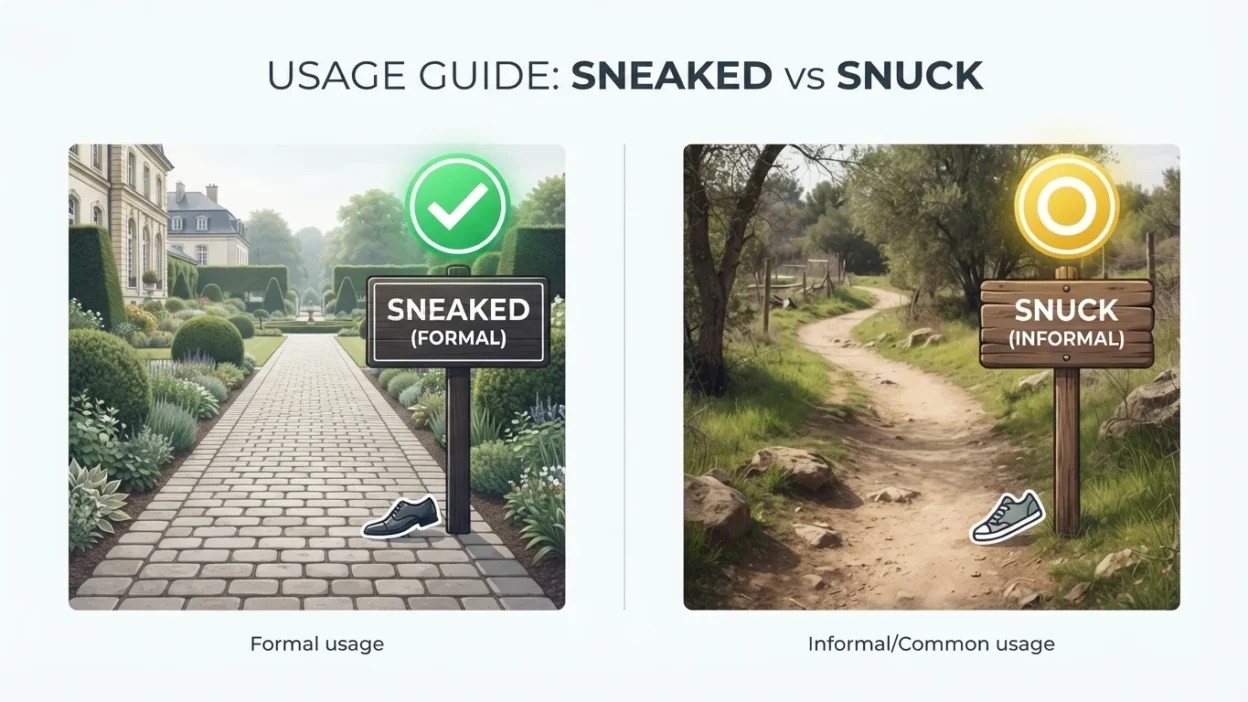
Sneaked is more traditional and formal.
Snuck is more common in informal American English.
Definition and Meaning
The verb sneak means to move quietly or secretly.
Both sneaked and snuck mean the same thing:
- Moved quietly or secretly
Why People Confuse It
The confusion happens because:
- English usually has one standard past tense
- Both forms are widely used
- Different regions prefer different forms
First Form: Sneaked
Sneaked is the original and regular past tense form.
Examples:
- He sneaked into the room.
- She sneaked out quietly.
It is more common in formal writing.
Second Form: Snuck
Snuck is an irregular past tense form.
Examples:
- He snuck into the building.
- She snuck out at night.
It is widely used in everyday speech.
Grammar Rules Explained
- Sneaked follows regular verb rules (add -ed)
- Snuck is an irregular form
Both are grammatically correct.
Comparison Table
| Feature | Sneaked | Snuck |
|---|---|---|
| Type | Regular verb | Irregular verb |
| Formality | More formal | Informal |
| Usage | Traditional | Common in speech |
| Meaning | Same | Same |
When to Use Each
Use sneaked when:
- Writing formally
- Following traditional grammar
Use snuck when:
- Speaking casually
- Writing informally
Real Life Usage
Both forms are widely used in daily English.
Snuck is very common in American conversation.
Sneaked is often preferred in formal writing.
Formal vs Informal Use
Sneaked = formal and standard
Snuck = informal and conversational
Pronunciation Guide
- Sneaked: /sniːkt/
- Snuck: /snʌk/
Synonyms and Alternatives
For both:
- Slipped
- Crept
- Moved quietly
Common Sentences
Examples:
- He sneaked into the room.
- He snuck into the room.
- She sneaked out quietly.
- She snuck out quietly.
Examples
Here are 10 examples:
- He sneaked into the house.
- She sneaked out at night.
- They sneaked past the guard.
- He snuck into the party.
- She snuck out without telling anyone.
- The cat snuck into the room.
- He sneaked behind the door.
- She snuck away quietly.
- They sneaked into the building.
- He snuck past security.
Common Mistakes
A common mistake is thinking one form is incorrect.
Both are correct, but context matters.
Mistakes to Avoid
Avoid:
- Assuming “snuck” is wrong
- Using informal forms in formal writing
Memory Trick
Remember:
Sneaked = standard rule
Snuck = casual speech
American vs British English
Snuck is more common in American English.
Sneaked is preferred in British English and formal contexts.
Similar Words
Other examples:
- Dreamed vs Dreamt
- Learned vs Learnt
- Burned vs Burnt
Related Confusing Words
More examples:
- Affect vs Effect
- Advice vs Advise
- Accept vs Except
Expert Tips
Use sneaked in formal writing.
Use snuck in casual conversation.
When Does It Apply
Use these forms when:
- Writing stories
- Describing actions
- Speaking naturally
Final Verdict
Both sneaked and snuck are correct.
Choose based on tone and context.
FAQs
1. Is snuck correct?
Yes.
2. Which is more formal?
Sneaked.
3. Which is more common?
Snuck in casual speech.
4. Can I use both?
Yes.
5. Is snuck American English?
More common there.
6. How do I choose?
Depends on context.
Remember This
Sneaked = formal
Snuck = informal
Both are correct.
Conclusion
The difference between sneaked and snuck is not about correctness but about style and usage. Both words are accepted past tense forms of sneak, with sneaked being more traditional and formal, and snuck being more common in casual speech, especially in American English.
By understanding the context and tone, you can easily choose the right form. With practice, using sneaked and snuck appropriately will become natural, helping you communicate more effectively.

Kevin Brian is a passionate author at BiblyWord, dedicated to sharing the message of the Bible through thoughtful and inspiring content. He focuses on creating clear and meaningful writings that help readers understand scripture, strengthen their faith, and find guidance in everyday life through God’s Word.