The words breath and breathe are commonly confused because they look similar and relate to the same idea—air and breathing. However, they belong to different parts of speech, and using the wrong one can make your sentence grammatically incorrect.
Understanding breath vs breathe is essential for clear writing and speaking. One is a noun, and the other is a verb. Once you know this basic rule, choosing the correct word becomes easy. In this guide, you’ll learn meanings, grammar rules, examples, and memory tricks to master these two words.
Quick Answer
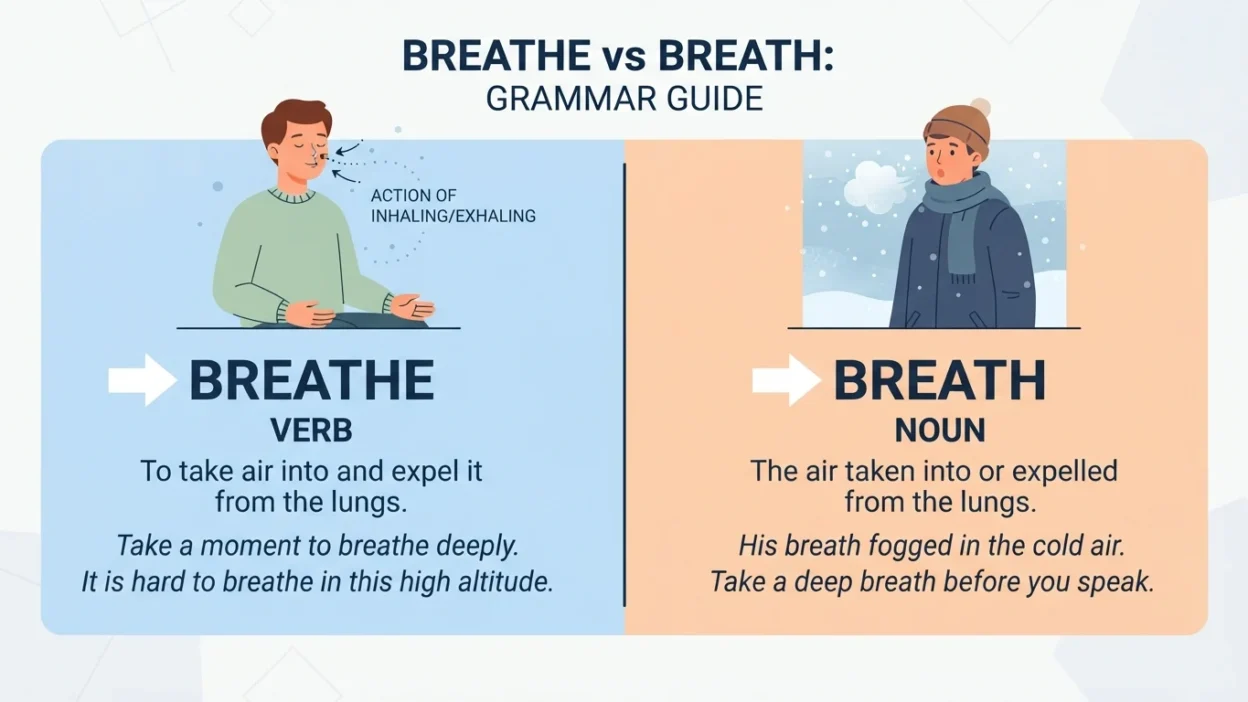
Breath is a noun (the air you take in or out).
Breathe is a verb (the action of inhaling and exhaling).
Use breath for things and breathe for actions.
Definition and Meaning
Breath refers to the air you inhale or exhale.
Breathe means to take air into and out of your lungs.
So:
- Breath = thing (noun)
- Breathe = action (verb)
Why People Confuse It
The confusion happens because:
- The words look almost identical
- Both relate to the same concept
- The only difference is the letter “e” at the end
First Word: Breath
Breath is a noun.
Examples:
- Take a deep breath.
- I was out of breath.
It refers to air or a single inhalation.
Second Word: Breathe
Breathe is a verb.
Examples:
- Try to breathe slowly.
- I can’t breathe properly.
It describes the action of breathing.
Grammar Rules Explained
Use breath when:
- You need a noun
Use breathe when:
- You need a verb
Comparison Table
| Feature | Breath | Breathe |
|---|---|---|
| Type | Noun | Verb |
| Meaning | Air taken in/out | Action of breathing |
| Example | Take a breath | Breathe deeply |
When to Use Each
Use breath when:
- Referring to air
- Talking about a thing
Use breathe when:
- Talking about the action
- Describing a process
Real Life Usage
Both words are very common in everyday language.
They are used in:
- Health contexts
- Conversations
- Writing
Formal vs Informal Use
Both words are used in formal and informal contexts.
Pronunciation Guide
- Breath: /brɛθ/
- Breathe: /briːð/
The ending sound is different:
- Breath → “th”
- Breathe → “th” with a voiced sound
Synonyms and Alternatives
For breath:
- Air
- Inhale
For breathe:
- Inhale
- Exhale
Common Sentences
Examples:
- Take a deep breath.
- Try to breathe calmly.
- He lost his breath.
- She couldn’t breathe.
Examples
Here are 10 examples:
- Take a deep breath before speaking.
- He held his breath underwater.
- She was out of breath after running.
- Catch your breath for a moment.
- I need a breath of fresh air.
- Try to breathe slowly.
- He couldn’t breathe properly.
- She learned to breathe deeply.
- Breathe in and out slowly.
- It’s hard to breathe in this heat.
Common Mistakes
A common mistake is using breath as a verb.
Example:
❌ I can’t breath
✔ I can’t breathe
Mistakes to Avoid
Avoid:
- Using “breath” as an action
- Forgetting the “e” in verbs
Memory Trick
Remember:
Breath = noun (no “e”)
Breathe = verb (with “e”)
The “e” stands for action.
American vs British English
There is no difference in usage between American and British English.
Similar Words
Other similar pairs:
- Advice vs Advise
- Device vs Devise
- Practice vs Practise
Related Confusing Words
More examples:
- Affect vs Effect
- Accept vs Except
- Then vs Than
Expert Tips
Check your sentence:
- Is it an action? → breathe
- Is it a thing? → breath
When Does It Apply
Use these words when:
- Talking about health
- Describing actions
- Writing clearly
Final Verdict
Breath is a noun.
Breathe is a verb.
Use them correctly to avoid mistakes.
FAQs
1. What is the difference between breath and breathe?
Breath is a noun; breathe is a verb.
2. Why are they confusing?
Because of similar spelling.
3. Which is used in action?
Breathe.
4. How do I remember?
Breathe has an “e.”
5. Can I use breath as a verb?
No.
6. Are they pronounced differently?
Yes.
Remember This
Breath = thing
Breathe = action
Simple rule.
Conclusion
The difference between breath and breathe is simple but essential. Breath is a noun that refers to air, while breathe is a verb that describes the action of inhaling and exhaling. Even though they look similar, their roles in a sentence are completely different.
By remembering that “breathe has an extra ‘e’ for action,” you can easily avoid confusion. With practice, using these words correctly will become natural, improving your writing and communication skills.

Kevin Brian is a passionate author at BiblyWord, dedicated to sharing the message of the Bible through thoughtful and inspiring content. He focuses on creating clear and meaningful writings that help readers understand scripture, strengthen their faith, and find guidance in everyday life through God’s Word.