The words past and passed sound almost identical, which makes them one of the most commonly confused word pairs in English. However, they have completely different grammatical roles and meanings. Past can work as a noun, adjective, adverb, or preposition, while passed is usually the past tense and past participle of the verb pass. Knowing this difference can help you avoid common spelling and grammar mistakes in everyday writing.
Whether you are writing an email, an essay, a social media post, or a professional document, choosing past or passed correctly matters. The good news is that the distinction is easy once you understand what each word does in a sentence. This guide explains past vs passed in simple English, with grammar rules, comparison tables, real-life examples, common mistakes, and an easy memory trick.
Quick Answer
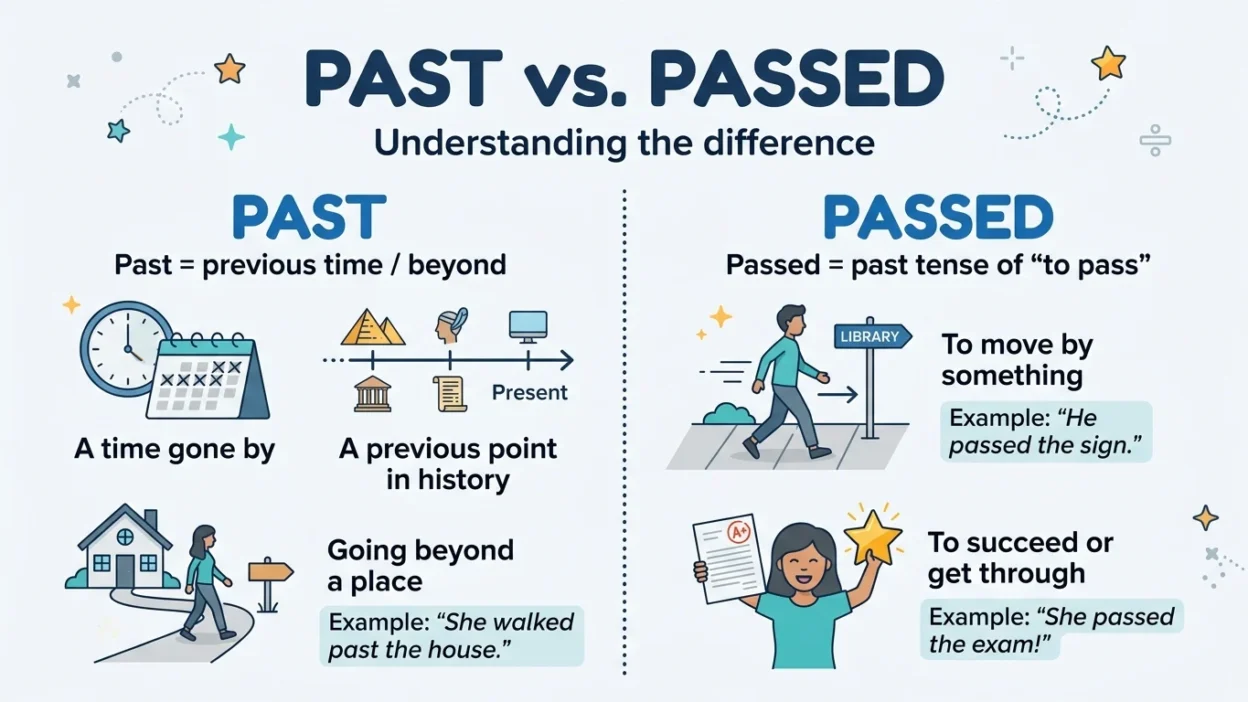
Past usually refers to a previous time, something beyond a point, or something that has already happened. Passed is the past tense of pass, meaning moved beyond something, succeeded, handed something over, or went by. If you can replace the word with went by or moved, passed is often correct.
Definition and Meaning
Past is mainly connected with time, position, or something that has already happened.
Examples:
- I learned from my past.
- We walked past the store.
- The meeting started in the past hour.
Passed is a form of the verb pass.
Examples:
- She passed the exam.
- He passed me on the road.
- Time passed quickly.
A useful distinction is:
Past = a time, place, or period
Passed = an action
Why People Confuse It
The biggest reason people confuse past and passed is pronunciation. In many accents, the two words sound almost exactly the same.
Their meanings are also related to movement and time, which makes the confusion even easier.
Compare:
- We walked past the house.
- We passed the house.
Both sentences can describe movement, but they use different grammar.
In the first sentence, past describes the movement in relation to the house. In the second, passed is the verb describing the action.
First Word: Past
Past has several grammatical functions.
It can be a:
- Noun
- Adjective
- Adverb
- Preposition
Examples:
- We should learn from the past.
- She has a past experience in teaching.
- He walked past me.
- The time is past midnight.
The central idea behind past is something that is earlier, previous, or beyond a particular point.
Second Word: Passed
Passed is the past tense and past participle of the verb pass.
It can mean:
- Moved beyond something
- Went by
- Succeeded
- Handed something to someone
- Completed or went through something
Examples:
- She passed the test.
- He passed the ball.
- The car passed us.
- Several years passed.
Because passed is a verb, it describes an action.
Grammar Rules Explained
The easiest grammar rule is:
Past is generally used as a noun, adjective, adverb, or preposition.
Passed is a verb form.
Compare:
- We walked past the school.
- We passed the school.
In the first sentence, past functions as a preposition.
In the second sentence, passed is the verb.
Another useful test is to replace passed with another action verb such as moved, went, or succeeded. If the sentence still makes sense, passed may be the correct choice.
Comparison Table
| Feature | Past | Passed |
|---|---|---|
| Main role | Noun, adjective, adverb, preposition | Verb |
| Main meaning | Earlier time or beyond | Moved, succeeded, went by, handed |
| Refers to time? | Often | Sometimes, as an action |
| Example | The past was difficult. | Time passed quickly. |
| Example | Walk past the building. | We passed the building. |
When to Use Each
Use past when talking about:
- Previous time
- History
- Something beyond a point
- Movement beyond something when used as a preposition/adverb
Examples:
- In the past, people traveled differently.
- Walk past the bank.
Use passed when describing an action:
- She passed the exam.
- The bus passed our house.
- Time passed quickly.
Real Life Usage
Both words appear frequently in everyday English.
You might say:
- I walked past your office.
- I passed your office on my way home.
- Let’s forget the past.
- Three hours passed before he arrived.
- She passed the interview.
- He has a difficult past.
The correct choice depends on whether the word is functioning as a description of time/place or as an action.
Formal vs Informal Use
Both past and passed are standard words used in formal and informal English.
In formal writing, confusing them can make a sentence look careless because they perform different grammatical functions.
For example:
❌ She past the exam.
✔ She passed the exam.
Here, passed must be used because the sentence needs a verb.
Similarly:
❌ We walked passed the building.
✔ We walked past the building.
Here, past is used to describe the movement beyond the building.
Pronunciation Guide
The pronunciation of past and passed can vary slightly depending on accent, but they are often pronounced very similarly.
Past: /pæst/
Passed: /pæst/
Because they can sound identical, pronunciation is not always a reliable way to choose between them.
Instead, focus on grammar and meaning.
Ask yourself:
Is this word describing a past time/place, or is it an action?
Synonyms and Alternatives
Useful alternatives for past include:
- Previous
- Former
- Earlier
- History
- Before
- Beyond
Useful alternatives for passed include:
- Moved
- Went by
- Succeeded
- Crossed
- Handed
- Completed
The best synonym depends on the sentence.
Common Sentences
Here are some common sentences with past:
- We should learn from the past.
- He walked past my house.
- Forget about the past.
- She has a difficult past.
- It is half past five.
Common sentences with passed:
- She passed her exam.
- The car passed us.
- Time passed quickly.
- He passed me the salt.
- The train passed the station.
Examples
Here are 12 examples to make the difference clear:
- I walked past the library.
- I passed the library on my way home.
- She passed her driving test.
- We should learn from the past.
- Two hours passed before they arrived.
- He ran past the finish line.
- The years passed quickly.
- She doesn’t like talking about her past.
- Please walk past the reception desk.
- He passed the message to his manager.
- It is half past seven.
- The car passed the truck on the highway.
Common Mistakes
One of the most common mistakes is using past when a verb is needed.
❌ She past the exam.
✔ She passed the exam.
Another common mistake is using passed after the verb walk when the intended meaning is movement beyond something.
❌ We walked passed the store.
✔ We walked past the store.
Remember that walked passed is generally incorrect because walked is already the main verb.
Mistakes to Avoid
Watch out for these common errors:
- ❌ He past the test.
- ✔ He passed the test.
- ❌ We drove passed the house.
- ✔ We drove past the house.
- ❌ In the passed, people lived differently.
- ✔ In the past, people lived differently.
- ❌ Time past quickly.
- ✔ Time passed quickly.
The spelling depends on the grammatical job of the word.
Memory Trick
Use this simple trick:
Passed = an action
Think:
Passed = Pass + ed
If someone passes something, the past form is passed.
Examples:
- pass an exam → passed an exam
- pass a car → passed a car
- pass the ball → passed the ball
Past = previous time or beyond
Think:
Past = history or before
Examples:
- the past
- in the past
- walk past the store
American vs British English
The distinction between past and passed is essentially the same in American and British English.
Both varieties use:
- past for previous time or position
- passed as the past form of pass
For example:
- She passed the exam.
- He walked past the house.
Pronunciation can vary between accents, but the spelling and grammatical distinction remain important in both forms of English.
Similar Words
Some other English words can cause similar confusion because they sound alike or have closely related meanings.
Examples include:
- Affect vs effect
- Advice vs advise
- Then vs than
- Their vs there vs they’re
- Your vs you’re
- Principle vs principal
Learning the grammatical role of each word is often more useful than relying on pronunciation.
Related Confusing Words
Past can also be confused with:
- Previous
- Former
- Before
- History
Passed can be confused with:
- Went
- Moved
- Succeeded
- Crossed
For example, passed the exam means succeeded in the exam, while past exam could refer to an exam from an earlier time.
Expert Tips
Here are three easy ways to choose correctly:
Tip 1: If it is an action, consider passed.
Tip 2: If it refers to previous time or something beyond a point, consider past.
Tip 3: Look at the word before it.
For example:
walked past
drove past
ran past
But:
passed the test
passed the car
passed the ball
These patterns make the difference much easier to remember.
Past vs Passed in Time Expressions
Past is commonly used in expressions involving time.
Examples:
- half past five
- ten minutes past noon
- in the past
- the past few years
- the past decade
However, passed can also describe time moving forward.
Example:
- Several years passed.
So remember:
past = a point or period in time
passed = time moving by
Past vs Passed in Movement
Both words can describe movement, which is why this area causes confusion.
Compare:
We walked past the shop.
Here, past means beyond the shop.
We passed the shop.
Here, passed is the action performed by “we.”
Both sentences can be grammatically correct, but their structures are different.
How to Choose Past or Passed
When you’re unsure, follow these steps:
- Identify the main verb.
- Ask whether the word describes an action.
- If it means moved, went by, or succeeded, use passed.
- If it means previous, earlier, or beyond, use past.
For example:
She passed the exam.
“Passed” means succeeded, so it is correct.
She walked past the school.
“Past” means beyond the school, so it is correct.
Final Verdict
The difference between past and passed is mainly grammatical.
Past describes previous time, something earlier, or something beyond a particular point. It can function as a noun, adjective, adverb, or preposition.
Passed is the past tense and past participle of pass. It describes an action such as moving beyond something, succeeding, handing something over, or going by.
The easiest rule is:
Past = previous or beyond.
Passed = an action.
FAQs
Is it “walked past” or “walked passed”?
The correct phrase is walked past.
Example:
We walked past the store.
Is it “passed the house” or “past the house”?
Both can be correct depending on sentence structure.
We passed the house.
We walked past the house.
Is “past” a verb?
Usually, no. Past can be a noun, adjective, adverb, or preposition.
Is “passed” always a verb?
Passed is a form of the verb pass, so it functions as a verb in standard uses.
Is it “in the passed” or “in the past”?
The correct phrase is in the past.
Is it “half passed five” or “half past five”?
The correct expression is half past five.
How can I remember the difference?
Remember: passed = pass + ed, so it describes an action. Past usually refers to previous time or something beyond a point.
Remember This
Keep this simple rule in mind:
Past = previous time or beyond.
Passed = the action of passing.
Examples:
- In the past
- Walk past the store
- Passed the exam
- Passed the car
- Time passed
If you remember this distinction, you’ll avoid most past vs passed mistakes.
Conclusion
Although past and passed sound very similar, they have different grammatical functions. Past is connected with previous time, history, or movement beyond a point, while passed is the past form of the verb pass and describes an action.
When you’re unsure, ask yourself what the word is doing in the sentence. If it means previous, earlier, or beyond, choose past. If it means moved, succeeded, handed, or went by, choose passed. With this simple rule and a little practice, choosing between the two becomes much easier.

Kevin Brian is a passionate author at BiblyWord, dedicated to sharing the message of the Bible through thoughtful and inspiring content. He focuses on creating clear and meaningful writings that help readers understand scripture, strengthen their faith, and find guidance in everyday life through God’s Word.