
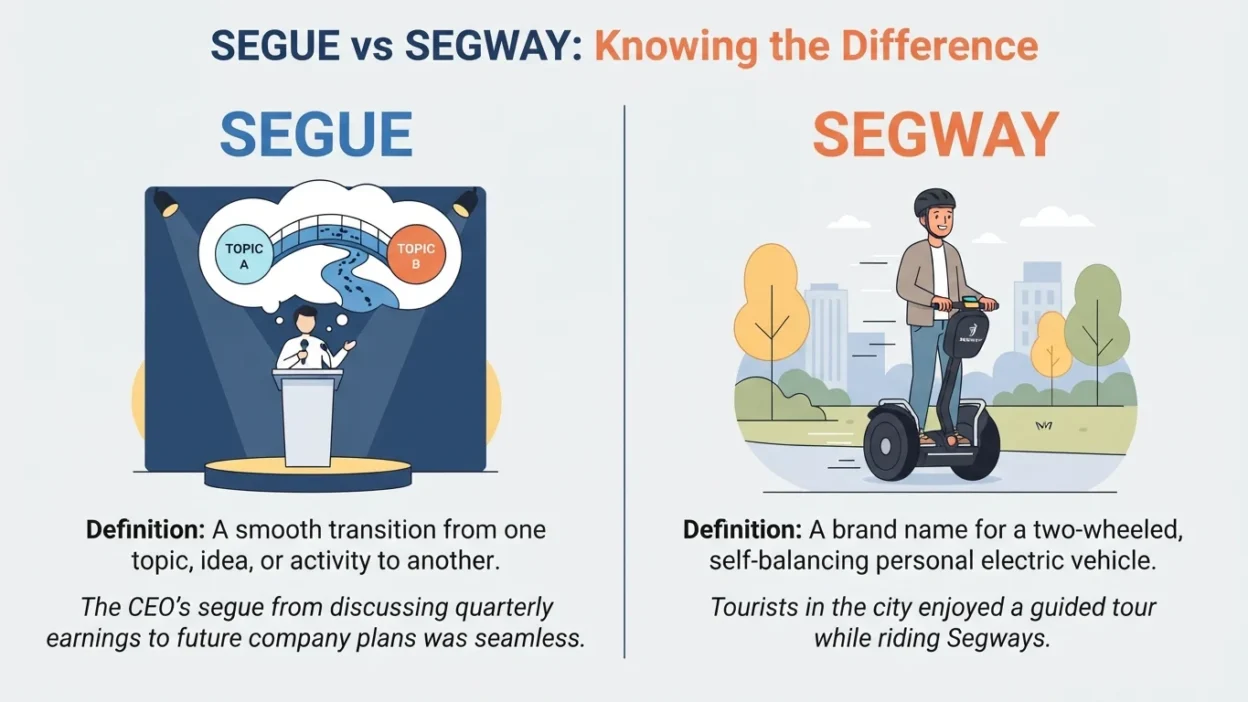
The words Segway and segue sound exactly the same, but they have completely different meanings and uses. Many people mix them up, especially in writing, because the spelling difference is not obvious when spoken.
Understanding segway vs segue is important for clear communication. One is a brand name for a personal transport device, while the other is a verb or noun used in writing and speech to describe a smooth transition. In this guide, you’ll learn their meanings, grammar rules, examples, and simple tricks to use them correctly.
Quick Answer
Segue means a smooth transition from one idea or topic to another.
Segway is a brand name for a two-wheeled electric vehicle.
Use segue in writing and speaking, and Segway only for the device.
Definition and Meaning
Segue is a verb and noun meaning to transition smoothly.
Segway is a proper noun referring to a self-balancing scooter.
So:
- Segue = transition
- Segway = vehicle
Why People Confuse It
The confusion happens because:
- Both words are pronounced the same (/ˈsɛɡweɪ/)
- “Segway” looks simpler and more familiar
- Many people are unaware that “segue” exists
First Word: Segue
Segue is used in writing and speech.
It means moving smoothly from one idea to another.
Examples:
- Let me segue into the next topic.
- The speaker segued into a new discussion.
Second Word: Segway
Segway is a brand name.
It refers to a personal transportation device.
Examples:
- He rode a Segway through the park.
- Tourists used Segways for sightseeing.
Grammar Rules Explained
Segue:
- Verb and noun
- Used in communication and writing
Segway:
- Proper noun
- Always capitalized
Comparison Table
| Feature | Segue | Segway |
|---|---|---|
| Meaning | Transition | Vehicle |
| Type | Verb/Noun | Proper noun |
| Usage | Writing/speech | Transportation |
| Example | Segue into topic | Ride a Segway |
When to Use Each
Use segue when:
- Talking about transitions
- Writing or speaking
Use Segway when:
- Referring to the vehicle
- Talking about transport
Real Life Usage
Segue is common in:
- Presentations
- Writing
- Conversations
Segway is used in:
- Travel
- Technology
- Tourism
Formal vs Informal Use
Segue is used in both formal and informal contexts.
Segway is used in specific contexts related to the device.
Pronunciation Guide
Both words are pronounced the same:
/ˈsɛɡweɪ/
This is why confusion occurs.
Synonyms and Alternatives
For segue:
- Transition
- Move
- Shift
For Segway:
- Electric scooter (general description)
Common Sentences
Examples:
- Let’s segue into the next topic.
- He rode a Segway in the city.
- The article segues smoothly.
Examples
Here are 10 examples:
- She segued into a new idea.
- The speaker used a segue to connect topics.
- He segued from one story to another.
- The movie segues into a dramatic scene.
- Let’s segue into the conclusion.
- He rented a Segway for the tour.
- Tourists rode Segways around the park.
- She learned how to ride a Segway.
- The city offers Segway tours.
- He bought a Segway last year.
Common Mistakes
A common mistake is writing Segway when you mean segue.
This happens because of identical pronunciation.
Mistakes to Avoid
Avoid:
- Using “Segway” in writing about transitions
- Forgetting capitalization for the brand name
Memory Trick
Remember:
Segue = speech (both start with “s”)
Segway = way (movement/device)
American vs British English
There is no difference in usage between American and British English.
Similar Words
Other confusing pairs:
- Affect vs Effect
- Advice vs Advise
- Accept vs Except
Related Confusing Words
More examples:
- Compliment vs Complement
- Principal vs Principle
- Lose vs Loose
Expert Tips
If you are writing or speaking about ideas, use segue.
If you are talking about a vehicle, use Segway.
When Does It Apply
Use these words when:
- Writing essays
- Giving presentations
- Talking about transport
Final Verdict
Segue is used for smooth transitions.
Segway is a brand name for a vehicle.
Choose based on context.
FAQs
1. What is the difference between segue and Segway?
Segue is a transition; Segway is a vehicle.
2. Why are they confusing?
Because they sound the same.
3. Is Segway a proper noun?
Yes.
4. Can I use Segway in writing?
Only for the vehicle.
5. How do I remember the difference?
Segue = speech; Segway = way.
6. Are they pronounced differently?
No.
Remember This
Segue = transition
Segway = vehicle
Simple and clear.
Conclusion
The difference between segue and Segway is simple once you understand their meanings. Segue is used to describe a smooth transition between ideas, while Segway refers to a specific type of electric vehicle. Even though they sound the same, their usage is completely different.
By remembering simple associations like “segue for speech” and “Segway for movement,” you can avoid confusion easily. With practice, you’ll use the correct word naturally in both writing and conversation.

Carol Amanda is a passionate writer and faith-driven author dedicated to sharing the wisdom of the Bible. At BiblyWord, she creates inspiring and meaningful content that encourages spiritual growth and daily reflection. Her work focuses on helping readers connect with God’s Word and find guidance, peace, and strength in their faith journey.