The words whos and whose are often confused because they look almost identical. However, there is an important spelling and grammar difference between them. Knowing which form is correct can help you avoid common mistakes in emails, essays, social media posts, and everyday writing.
The key point is simple: whose is the correct standard English word, while whos is generally not a standard word. Whose is used to ask about or describe possession, such as who owns something. It can also be used to connect information about a person or thing. Once you understand this rule, choosing between whos vs whose becomes easy.
Quick Answer
Whose is the correct word and is used to ask or tell who something belongs to. Whos is not the standard form of either whose or who’s. Remember: whose = possession, while who’s = who is or who has.
Definition and Meaning
Whose is a pronoun or determiner used to show possession or ownership.
For example:
- Whose phone is this?
- The student whose book was lost found it.
Whos is generally considered an incorrect spelling in standard English.
There is another word that often causes confusion: who’s with an apostrophe. Who’s is a contraction of who is or who has.
Therefore:
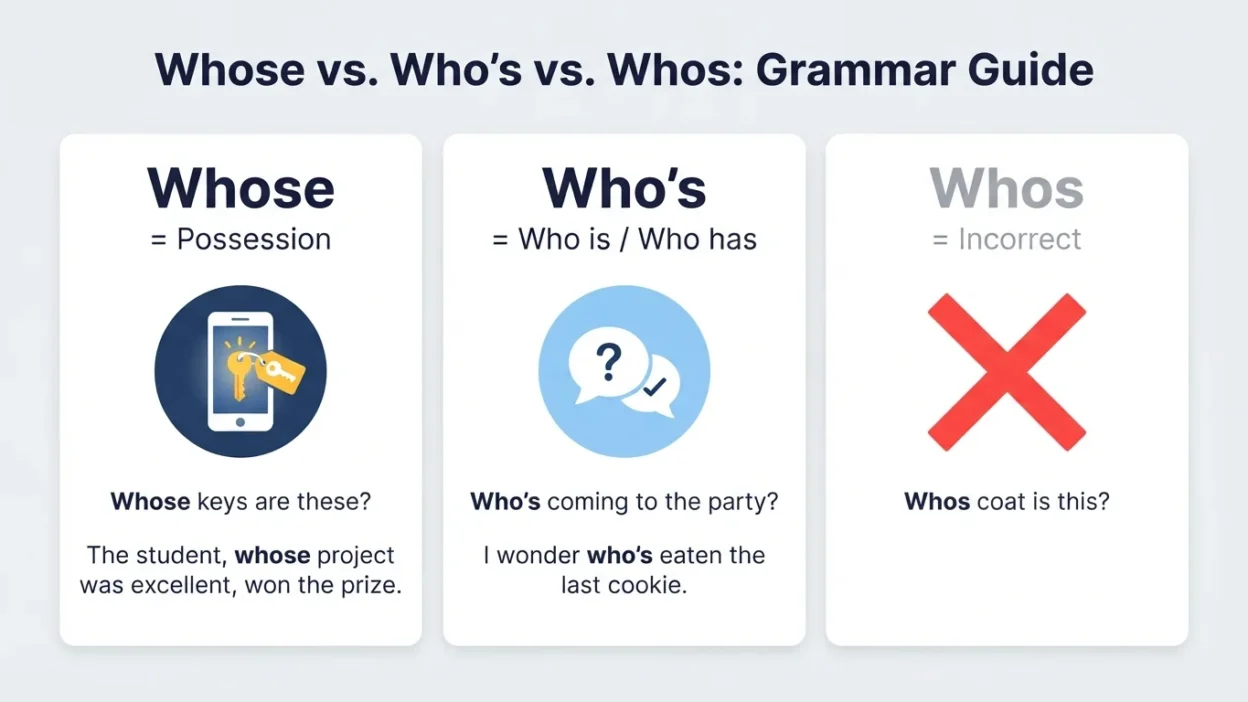
- Whose = possession
- Who’s = who is / who has
- Whos = incorrect in standard English
Why People Confuse It
The main reason for confusion is pronunciation.
Whose and who’s are normally pronounced the same. Because apostrophes often indicate contractions, writers sometimes mistakenly remove or add the apostrophe.
For example:
❌ Whos car is this?
✔ Whose car is this?
Another common mistake is confusing whose with who’s.
Remember that whose asks about ownership, while who’s means who is or who has.
First Word: Whos
Whos without an apostrophe is not the standard spelling used in normal English.
If you want to ask about possession, use whose.
If you mean who is or who has, use who’s.
For example:
❌ Whos coming to the party?
✔ Who’s coming to the party?
Here, who’s means who is.
Second Word: Whose
Whose is the correct word when you are talking about possession.
Examples:
- Whose bag is this?
- Whose idea was it?
- Whose car is parked outside?
It can also introduce a relative clause:
- The woman whose phone rang left the room.
Grammar Rules Explained
Use whose when you need to identify ownership.
Examples:
- Whose jacket is this?
- Do you know whose keys these are?
Use who’s when you can replace it with who is or who has.
Examples:
- Who’s there? → Who is there?
- Who’s finished the work? → Who has finished the work?
Never use whos as a replacement for either form.
Comparison Table
| Word | Meaning | Correct? | Example |
|---|---|---|---|
| Whose | Shows possession | Yes | Whose book is this? |
| Who’s | Who is / who has | Yes | Who’s coming today? |
| Whos | Not a standard form | No | ❌ Whos book is this? |
When to Use Each
Use whose when asking or describing who owns something.
- Whose phone is ringing?
- I know the person whose phone is ringing.
Use who’s when you mean who is or who has.
- Who’s at the door?
- Who’s finished the assignment?
Do not use whos in standard English.
Real Life Usage
Whose is extremely common in everyday questions.
You might ask:
- Whose keys are these?
- Whose turn is it?
- Whose responsibility is this?
- Whose car should we take?
Who’s is equally common in conversation because contractions are natural in informal English.
For professional writing, both whose and who’s are perfectly acceptable when used correctly.
Formal vs Informal Use
Whose is appropriate in both formal and informal English.
For example:
- Formal: The employee whose application was approved will receive an email.
- Informal: Whose jacket is this?
Who’s is also standard English, although some formal writing may prefer the expanded forms who is or who has.
Whos, however, should be avoided.
Pronunciation Guide
Whose and who’s are pronounced the same:
/huːz/
The pronunciation does not tell you which spelling to use.
Instead, look at the meaning.
If the sentence is about ownership, use whose.
If it means who is or who has, use who’s.
Synonyms and Alternatives
There is no exact synonym for whose, but you can sometimes rewrite the sentence.
For example:
Whose book is this?
can become:
Who owns this book?
For who’s, simply use the full form:
- Who’s = who is
- Who’s = who has
Common Sentences
Here are some useful sentences with whose:
- Whose phone is ringing?
- Whose shoes are these?
- Whose idea was this?
- Whose responsibility is it?
- Whose house are we visiting?
And with who’s:
- Who’s coming with us?
- Who’s responsible for this?
- Who’s already finished?
- Who’s at the door?
- Who’s going to help?
Examples
Here are 10 real-life examples using whose correctly:
- Whose bag is on the chair?
- Whose phone are you using?
- Do you know whose car this is?
- Whose idea was it to start the project?
- Whose keys did you find?
- She is the woman whose son won the competition.
- I met a student whose work was excellent.
- The company whose products we use is expanding.
- Whose responsibility is it to complete the report?
- Do you know whose book this is?
Common Mistakes
One of the most common mistakes is writing whos when you mean whose.
For example:
❌ Whos phone is this?
✔ Whose phone is this?
Another mistake is confusing whose and who’s.
For example:
❌ Whose coming to dinner?
✔ Who’s coming to dinner?
Here, who’s means who is.
Mistakes to Avoid
Keep these three forms separate:
- Whose → possession
- Who’s → who is / who has
- Whos → incorrect
A useful test is to replace who’s with who is or who has.
If the replacement works, use who’s.
If you’re asking about ownership, use whose.
Memory Trick
Use this simple trick:
Whose = owns
Both relate to ownership.
Think:
Whose = Who owns it?
For who’s, remember:
Who’s = Who is / Who has
This makes the difference much easier to remember.
American vs British English
There is no meaningful difference between American and British English in this rule.
Both varieties use:
- whose for possession
- who’s for who is or who has
- whos as an incorrect standard spelling
The grammar rule remains the same.
Similar Words
Several English words follow a similar pattern:
- Its vs it’s
- Your vs you’re
- Their vs they’re
- Whose vs who’s
In each case, the apostrophe is important because it can indicate a contraction.
For example:
Its = possession
It’s = it is / it has
Similarly:
Whose = possession
Who’s = who is / who has
Related Confusing Words
The most closely related confusion is whose vs who’s.
Other commonly confused forms include:
- Your vs you’re
- Its vs it’s
- Their vs there vs they’re
- Then vs than
- Affect vs effect
Learning these pairs can significantly improve your everyday English writing.
Expert Tips
Before choosing the spelling, ask yourself one question:
Am I talking about ownership?
If yes, use whose.
If you can replace the word with who is or who has, use who’s.
For example:
Who’s at the door?
→ Who is at the door? ✔
Whose coat is this?
→ Who owns this coat? ✔
This quick test can prevent most mistakes.
When Does It Apply
Use whose when:
- Asking who owns something
- Showing possession
- Connecting a person with something they possess
Examples:
- Whose laptop is this?
- The man whose car was stolen called the police.
Use who’s when:
- Asking who is doing something
- Saying who has done something
Examples:
- Who’s waiting outside?
- Who’s completed the assignment?
Final Verdict
Whose is the correct word when you are talking about possession or ownership.
Who’s is a contraction meaning who is or who has.
Whos without an apostrophe is not the standard spelling.
The easiest rule is:
Whose = possession
Who’s = who is / who has
Whos = incorrect
FAQs
Is “whos” a correct word?
No. Whos is not the standard English spelling. Depending on what you mean, you probably need whose or who’s.
What is the difference between whose and who’s?
Whose shows possession, while who’s means who is or who has.
Is “whose” possessive?
Yes. Whose is used to ask or indicate who something belongs to.
Is “who’s” always short for “who is”?
No. Who’s can mean either who is or who has.
Which is correct: “Whos car” or “Whose car”?
Whose car is correct because the sentence asks who owns the car.
Which is correct: “Whose coming” or “Who’s coming”?
Who’s coming is correct because it means who is coming.
Can “whose” be used for people and things?
Yes. Whose can be used with people and, in many contexts, things or organizations.
Remember This
Whose = ownership
Who’s = who is / who has
Whos = incorrect
When you see whose, think “Who owns it?”
When you see who’s, try expanding it to “who is” or “who has.”
Conclusion
The difference between whos and whose is straightforward once you remember that whose is the correct possessive form. If you are asking who owns something, use whose, as in “Whose phone is this?” The spelling whos should be avoided in standard English.
It is also important not to confuse whose with who’s. While whose expresses possession, who’s is a contraction of who is or who has. Keeping these three forms separate will make your writing more accurate and professional.

Donald Andrew is a dedicated author at BiblyWord, passionate about sharing biblical teachings in a clear and inspiring way. He creates meaningful content that helps readers understand scripture, reflect on their faith, and apply God’s Word in daily life. His work supports spiritual growth, guidance, and a deeper connection with biblical wisdom.