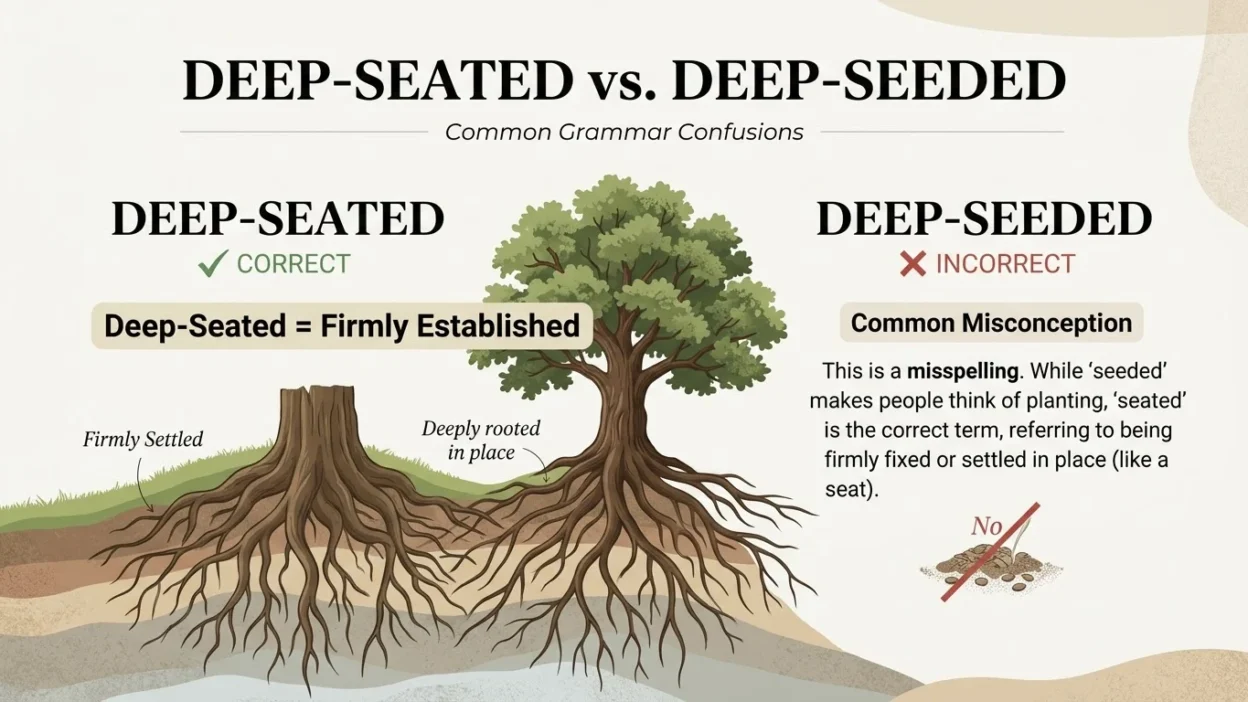
Deep seated and deep seeded are commonly confused expressions because they sound almost identical when spoken. Many people assume that deep seeded is correct because “seeded” suggests something planted deeply, but standard English uses deep seated when describing a firmly established belief, feeling, problem, or attitude.
The word seated in this expression comes from the idea of something being firmly settled or established in a particular position. For example, you can have a deep seated fear, deep seated belief, or deep seated resentment. Understanding this distinction is useful for academic writing, professional communication, journalism, and everyday English. In this guide, we’ll explain deep seated vs deep seeded, why people confuse them, how to use the correct phrase, and plenty of examples to make the difference easy to remember.
Quick Answer
Deep seated is the standard and correct expression when you mean something that is firmly established, deeply rooted, or difficult to change. Deep seeded is generally considered a misspelling or mistaken form of deep seated. Say deep seated belief, deep seated fear, or deep seated problem.
Definition and Meaning
Deep-seated means something that is firmly established, deeply rooted, or strongly fixed.
It is commonly used for:
- Beliefs
- Feelings
- Attitudes
- Fears
- Resentment
- Problems
- Opinions
- Habits
Examples:
- She has a deep-seated fear of failure.
- The organization has a deep-seated problem.
- He has a deep-seated belief in fairness.
Deep-seeded is not the standard expression for these meanings.
Why People Confuse It
The confusion comes mainly from the word seeded.
A seed is planted deep in soil, so deep-seeded seems logical. People naturally associate the idea of something being deeply planted with something that is firmly established.
However, the established English idiom is deep-seated.
Think of seated as meaning firmly settled or established, rather than literally sitting on a chair.
First Word: Deep-Seated
Deep-seated is the standard expression.
It describes something that has existed for a long time or has become firmly established.
Examples:
- a deep-seated fear
- a deep-seated belief
- deep-seated anger
- deep-seated prejudice
- a deep-seated problem
The phrase is especially common when talking about emotions, attitudes, beliefs, and long-standing problems.
Second Word: Deep-Seeded
Deep-seeded is generally a mistaken version of deep-seated.
Although the spelling may seem logical because seeds can be planted deeply, it is not the standard idiom when describing something firmly established.
For example:
❌ He has a deep-seeded fear of flying.
✔ He has a deep-seated fear of flying.
If you mean that something is firmly rooted in someone’s mind, emotions, or behavior, use deep-seated.
Grammar Rules Explained
Deep-seated is a compound adjective.
It usually appears before a noun:
- a deep-seated belief
- a deep-seated fear
- a deep-seated problem
It can also appear after a linking verb:
- Her fear is deep-seated.
- The problem is deep-seated.
The phrase is generally hyphenated when it functions as a compound adjective.
Comparison Table
| Feature | Deep-Seated | Deep-Seeded |
|---|---|---|
| Standard expression? | Yes | Generally no |
| Meaning | Firmly established or deeply rooted | Usually a mistaken form |
| Common usage | Beliefs, fears, problems, attitudes | Not standard for this meaning |
| Example | Deep-seated fear | ❌ Deep-seeded fear |
| Recommended? | ✅ Yes | ❌ No |
When to Use Each
In standard English, use deep-seated when describing something that is firmly established.
Examples:
- deep-seated anxiety
- deep-seated mistrust
- deep-seated beliefs
- deep-seated resentment
- deep-seated social problems
You generally should not replace deep-seated with deep-seeded simply because something feels “planted deeply.”
Real Life Usage
Deep-seated appears frequently in news articles, academic writing, business discussions, and everyday conversation.
Examples:
- The community has a deep-seated concern about the issue.
- The company needs to address its deep-seated problems.
- He has a deep-seated belief that hard work matters.
- Her deep-seated fear prevented her from speaking publicly.
These examples all describe something that is strongly established and not easily changed.
Formal vs Informal Use
Deep-seated is appropriate in both formal and informal English.
It is especially common in formal contexts involving:
- Psychology
- Politics
- Education
- Business
- Social issues
- Personal beliefs
For example:
Formal:
The organization faces several deep-seated structural problems.
Everyday:
She has a deep-seated fear of dogs.
The expression works naturally in both situations.
Pronunciation Guide
Deep-seated is pronounced approximately:
deep-SEE-tid
The second part sounds like seated, not seeded.
The pronunciation can be easy to misunderstand in fast speech, which is one reason the incorrect spelling deep-seeded appears frequently.
When writing, remember the phrase as:
deep + seated
Synonyms and Alternatives
Depending on context, you can replace deep-seated with:
- Deep-rooted
- Strongly held
- Firmly established
- Entrenched
- Long-standing
- Persistent
- Deeply rooted
- Strong
For example:
Deep-seated belief
→ Deep-rooted belief
Deep-seated problem
→ Long-standing problem
Deep-seated resentment
→ Deep-rooted resentment
Common Sentences
Here are some natural sentences using deep-seated:
- She has a deep-seated fear of heights.
- He holds a deep-seated belief in equality.
- The organization has a deep-seated problem.
- They are trying to overcome deep-seated mistrust.
- His deep-seated resentment affected their relationship.
- The issue is caused by deep-seated social problems.
- She has a deep-seated desire to succeed.
- The community has deep-seated concerns about the plan.
Examples
Here are 12 examples to help you understand the correct usage:
- She has a deep-seated fear of public speaking.
- He has a deep-seated belief in honesty.
- The company has a deep-seated problem with communication.
- They struggled with deep-seated mistrust.
- His deep-seated resentment eventually affected their friendship.
- The country faces deep-seated social problems.
- She has a deep-seated desire to help others.
- The issue is connected to deep-seated attitudes.
- He developed a deep-seated dislike of unfair treatment.
- The team has deep-seated disagreements about the strategy.
- Her deep-seated insecurity made her hesitant.
- The conflict reflects deep-seated tensions within the community.
Common Mistakes
The most common mistake is writing deep-seeded instead of deep-seated.
❌ The problem is deep-seeded.
✔ The problem is deep-seated.
Another mistake is assuming that deep-seeded must be correct because seeds can be planted deeply.
The expression is not about literal seeds. It is an idiom describing something that is firmly established or deeply rooted.
Mistakes to Avoid
Avoid these forms when you mean a firmly established belief, feeling, or problem:
- ❌ deep-seeded belief
- ❌ deep-seeded fear
- ❌ deep-seeded resentment
- ❌ deep-seeded problem
Use:
- ✔ deep-seated belief
- ✔ deep-seated fear
- ✔ deep-seated resentment
- ✔ deep-seated problem
Also remember to use the hyphen when the phrase functions as a compound adjective before a noun.
Memory Trick
Here’s an easy way to remember it:
Deep-SEATED = firmly SEATED in your mind.
Imagine a belief sitting firmly in someone’s mind like a person sitting in a chair.
Deep-seated belief = a belief firmly settled in the mind.
You can also remember:
SEATED = SETTLED
So:
Deep-seated = deeply settled
This makes it easier to avoid the tempting but incorrect deep-seeded spelling.
American vs British English
The standard expression is deep-seated in both American and British English.
There is no major regional difference in the preferred spelling.
Examples in both varieties include:
- deep-seated belief
- deep-seated fear
- deep-seated problem
- deep-seated resentment
Deep-seeded may appear in informal writing or as a common spelling error, but it is not the standard form of the idiom.
Similar Words
Several expressions have meanings similar to deep-seated:
- Deep-rooted
- Long-standing
- Firmly established
- Entrenched
- Persistent
- Strongly held
For example:
Deep-seated belief
and
deep-rooted belief
can often communicate a similar idea.
Related Confusing Words
English contains many phrases that are commonly misspelled because their pronunciation or structure can be misleading.
Examples include:
- All intents and purposes vs all intensive purposes
- Could have vs could of
- For all intensive purposes vs for all intents and purposes
- Nip it in the bud vs nip it in the butt
- Whet your appetite vs wet your appetite
Learning the correct form of common idioms can significantly improve your writing.
Deep-Seated in Different Contexts
Deep-seated can describe many different things.
Emotions
- deep-seated anger
- deep-seated fear
- deep-seated resentment
Beliefs
- deep-seated belief
- deep-seated conviction
- deep-seated opinion
Problems
- deep-seated corruption
- deep-seated conflict
- deep-seated problems
Attitudes
- deep-seated prejudice
- deep-seated mistrust
- deep-seated hostility
The common idea is always something strongly established and difficult to change.
Expert Tips
When you see deep-seated, think of something that has been settled deeply and firmly.
If you’re writing about:
- A fear → deep-seated fear
- A belief → deep-seated belief
- A problem → deep-seated problem
- Resentment → deep-seated resentment
- A social issue → deep-seated issue
Use deep-seated.
If you’re talking about actual seeds being planted in soil, then seeded can be a completely normal word—but that is a different literal meaning and not the standard idiom deep-seated.
Is Deep-Seeded Ever Correct?
Seeded is a real English word, but deep-seeded is generally not the standard expression used to describe firmly established feelings, beliefs, or problems.
For example:
❌ She has a deep-seeded fear of water.
✔ She has a deep-seated fear of water.
The word seeded can be used in other contexts, such as:
- The tournament was seeded with top players.
- The farmer seeded the field.
These meanings are unrelated to the idiom deep-seated.
Deep-Seated vs Deep-Rooted
Deep-seated and deep-rooted are often interchangeable.
Both can describe something firmly established.
Examples:
- a deep-seated belief
- a deep-rooted belief
- a deep-seated problem
- a deep-rooted problem
However, deep-rooted uses a plant metaphor, while deep-seated emphasizes something being firmly established or settled.
Final Verdict
The correct expression is deep-seated, not deep-seeded, when you mean something firmly established, deeply rooted, or difficult to change.
Use deep-seated for beliefs, fears, attitudes, emotions, problems, and other long-standing conditions.
The easiest memory trick is:
Deep-seated = deeply settled.
So write:
✔ deep-seated belief
✔ deep-seated fear
✔ deep-seated problem
✔ deep-seated resentment
Avoid:
❌ deep-seeded belief
❌ deep-seeded fear
FAQs
Is deep-seated or deep-seeded correct?
Deep-seated is the standard expression. Deep-seeded is generally a mistaken spelling when referring to firmly established beliefs, feelings, or problems.
Why is it called deep-seated?
The expression conveys the idea of something being firmly settled or established, as though it is securely “seated” in a particular place.
Is deep-seated one word?
No. It is normally written as deep-seated, with a hyphen when used as a compound adjective.
Can I say deep-rooted instead?
Yes. Deep-rooted is a common alternative and often has nearly the same meaning.
Is deep-seated formal?
Yes. It is suitable for both everyday and formal writing.
Is deep-seeded ever correct?
Seeded is a legitimate word in other contexts, but deep-seeded is not the standard form of the idiom meaning firmly established.
What is a deep-seated belief?
A deep-seated belief is an opinion or conviction that is strongly established and difficult to change.
What is the easiest way to remember deep-seated?
Think “deeply settled.” Something that is deeply settled is deep-seated.
Remember This
DEEP-SEATED = firmly established or deeply rooted.
Think:
SEATED → SETTLED
So:
- deep-seated fear ✅
- deep-seated belief ✅
- deep-seated problem ✅
- deep-seated resentment ✅
But:
- deep-seeded fear ❌
- deep-seeded belief ❌
When you mean a strong, long-standing feeling, belief, attitude, or problem, choose deep-seated.
Conclusion
The confusion between deep-seated and deep-seeded comes from the fact that “seeded” seems to make sense when we think about something being planted deeply. However, the established English expression is deep-seated, meaning something that is firmly established, deeply rooted, or difficult to change.
Whether you are talking about a deep-seated fear, belief, resentment, attitude, or problem, the correct spelling is deep-seated. Remember the simple connection “seated = settled,” and you will have an easy way to remember the correct expression whenever you write it.

Carol Amanda is a passionate writer and faith-driven author dedicated to sharing the wisdom of the Bible. At BiblyWord, she creates inspiring and meaningful content that encourages spiritual growth and daily reflection. Her work focuses on helping readers connect with God’s Word and find guidance, peace, and strength in their faith journey.