The phrases per se and per say often confuse English learners because they sound exactly the same. However, only one of them is correct in standard English. Using the wrong form can make your writing look unprofessional or incorrect.
Understanding per se vs per say is important, especially in formal writing and discussions. In this guide, you’ll learn the correct meaning, usage rules, examples, and simple tricks to avoid this common mistake.
Quick Answer
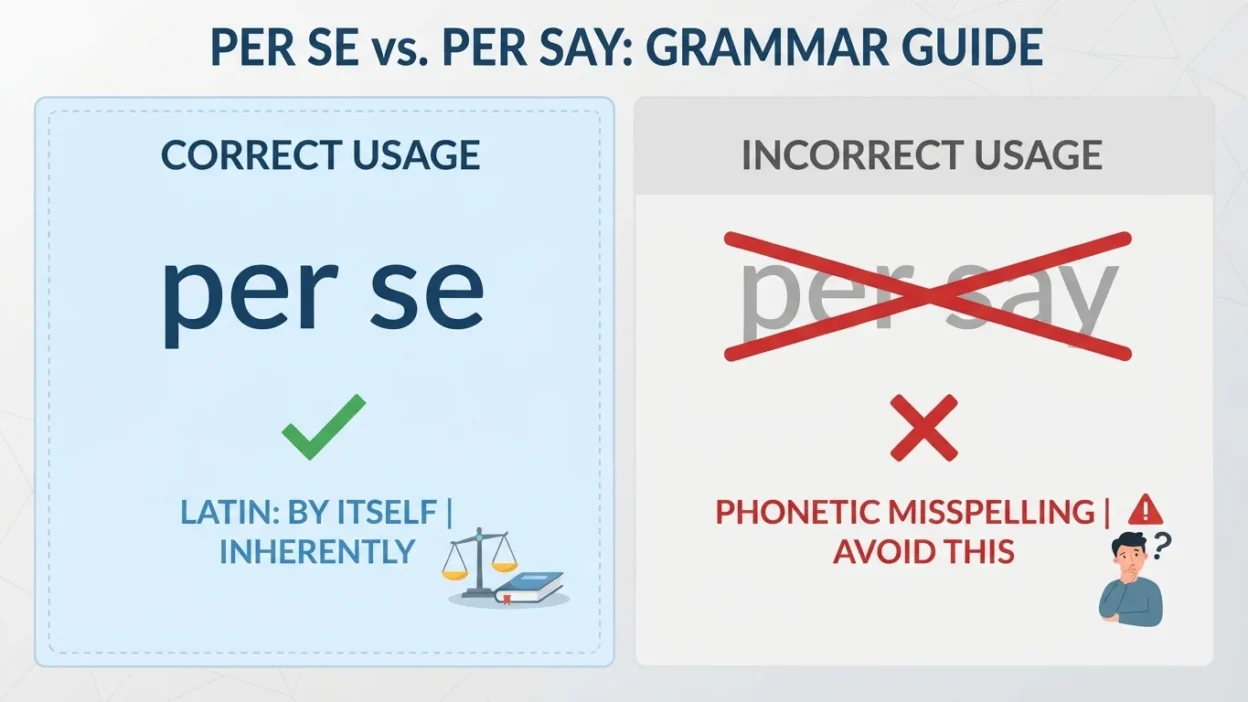
Per se is correct and means “by itself” or “in itself.”
Per say is incorrect and should never be used.
Always write it as per se.
Definition and Meaning
Per se is a Latin phrase meaning “by itself” or “intrinsically.”
Per say is not a correct English phrase.
So:
- Per se = correct
- Per say = incorrect
Why People Confuse It
The confusion happens because:
- Both sound identical
- “Per say” looks more natural in English spelling
- Many people are unaware of the Latin origin
First Form: Per Se
Per se is used to clarify that something is being considered alone or in its true nature.
Examples:
- The idea is not wrong per se.
- Money isn’t bad per se.
It is common in formal writing and speech.
Second Form: Per Say
Per say is incorrect.
It is a spelling mistake and should not be used.
Grammar Rules Explained
Per se is a fixed phrase.
It cannot be changed or spelled differently.
Always use it exactly as per se.
Comparison Table
| Feature | Per Se | Per Say |
|---|---|---|
| Correct usage | Yes | No |
| Meaning | By itself | Incorrect |
| Origin | Latin | Not valid |
| Example | Not bad per se | ❌ Wrong |
When to Use Each
Use per se when:
- Clarifying meaning
- Referring to something alone
Never use per say.
Real Life Usage
Per se is used in:
- Academic writing
- Professional discussions
- Formal speech
Formal vs Informal Use
Per se is more common in formal contexts.
It can also appear in everyday conversation.
Pronunciation Guide
Per se is pronounced /pər ˈseɪ/
This is why it is often misspelled as “per say.”
Synonyms and Alternatives
For per se:
- In itself
- By itself
- Essentially
Common Sentences
Examples:
- It’s not a problem per se.
- The plan isn’t bad per se.
Examples
Here are 10 examples:
- The method isn’t wrong per se.
- It’s not illegal per se.
- The idea isn’t bad per se.
- He’s not lazy per se.
- The issue isn’t serious per se.
- It’s not harmful per se.
- The concept isn’t new per se.
- The plan isn’t perfect per se.
- The design isn’t flawed per se.
- The result isn’t surprising per se.
Common Mistakes
A common mistake is writing per say instead of per se.
This happens due to pronunciation confusion.
Mistakes to Avoid
Avoid:
- Writing “per say”
- Changing the spelling
- Misusing the phrase
Memory Trick
Remember:
Per se = Latin phrase (correct)
Think: “se” is the correct ending.
American vs British English
There is no difference.
Both use per se as the correct form.
Similar Words
Other similar pairs:
- At least vs Atleast
- Any time vs Anytime
- A lot vs Alot
Related Confusing Words
More examples:
- Affect vs Effect
- Advice vs Advise
- Accept vs Except
Expert Tips
If you mean “in itself,” use per se.
Never write per say.
When Does It Apply
Use per se when:
- Clarifying meaning
- Writing formally
- Explaining ideas
Final Verdict
Per se is correct.
Per say is incorrect.
Always use per se.
FAQs
1. Is “per say” correct?
No.
2. What does “per se” mean?
By itself.
3. Why is it confusing?
Because of pronunciation.
4. Can I use it in writing?
Yes.
5. Is it formal?
Mostly.
6. How do I remember?
Se is correct.
Remember This
Per se = correct
Per say = wrong
Always use per se.
Conclusion
The difference between per se and per say is simple but important. Per se is the correct phrase used to mean “by itself” or “in itself,” while per say is a common spelling mistake that should always be avoided. Because they sound the same, many people write the incorrect version without realizing it.
By remembering that “per se” is a Latin phrase and the only correct form, you can easily avoid this mistake. With practice, using per se correctly will become natural, improving your writing and communication skills.

Steven Mark is the administrator and a dedicated author at BiblyWord, responsible for managing the platform and maintaining high-quality content. Alongside his administrative role, he writes insightful biblical articles that inspire faith, reflection, and spiritual growth. His work supports the mission of sharing God’s Word in a clear and meaningful way.