The words discrete and discreet are among the most commonly confused English words because they look and sound very similar. However, they have completely different meanings. Discrete means separate, distinct, or individually different, while discreet means careful, tactful, and unlikely to attract attention. Choosing the wrong word can change the meaning of a sentence, especially in professional, academic, and formal writing.
Understanding discrete vs discreet becomes much easier when you connect each spelling with its meaning. You might describe several discrete categories when the categories are separate from one another, but you would describe a person as discreet if they know how to keep private information confidential. In this guide, you’ll learn the definitions, grammar rules, pronunciation, examples, common mistakes, and simple memory tricks that will help you use these words correctly.
Quick Answer
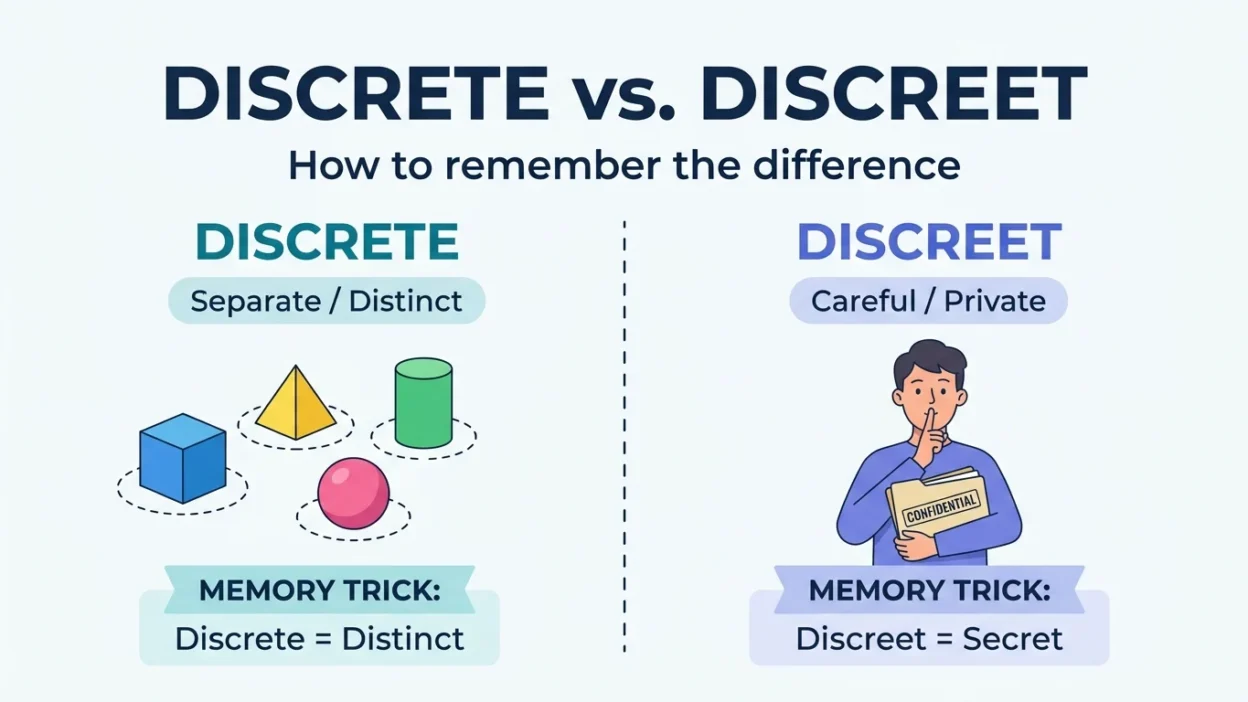
Discrete means separate, distinct, or individually identifiable. Discreet means careful, tactful, and good at keeping things private or avoiding unwanted attention. Remember: discrete = separate, while discreet = careful and private.
Definition and Meaning
Discrete describes things that are separate or clearly different from one another.
Examples:
- The study divided participants into three discrete groups.
- The machine has several discrete components.
Discreet describes someone or something that behaves carefully and avoids attracting attention.
Examples:
- She was discreet about the confidential information.
- Please be discreet when discussing the matter.
The easiest distinction is:
Discrete = separate
Discreet = tactful or private
Why People Confuse It
The two words are confusing because they are almost identical in spelling and pronunciation.
Compare:
- discrete
- discreet
The only difference is the position of the two vowels near the end:
- discrete
- discreet
Their pronunciations can also be very similar, so simply listening to someone say the word may not tell you which spelling they mean.
The meanings, however, are very different.
First Word: Discrete
Discrete means separate, distinct, or individually different.
It is often used when talking about:
- Categories
- Groups
- Units
- Objects
- Stages
- Systems
- Data
Examples:
- The project has five discrete stages.
- The data was divided into discrete categories.
- These are two discrete issues.
Think of discrete as meaning separate from other things.
Second Word: Discreet
Discreet means careful, tactful, and respectful of privacy.
A discreet person knows how to avoid embarrassing situations or revealing confidential information.
Examples:
- He was discreet about the private conversation.
- She made a discreet inquiry.
- Please be discreet with this information.
Think of discreet as meaning careful and private.
Grammar Rules Explained
Both discrete and discreet are adjectives.
They describe nouns.
Examples:
Discrete:
- discrete units
- discrete categories
- discrete stages
Discreet:
- discreet behavior
- discreet conversation
- discreet person
The grammatical difference is therefore not the main issue. The important difference is meaning.
Use discrete for separation and distinction.
Use discreet for tact, privacy, and avoiding attention.
Comparison Table
| Feature | Discrete | Discreet |
|---|---|---|
| Part of speech | Adjective | Adjective |
| Meaning | Separate or distinct | Careful, tactful, private |
| Common context | Groups, units, categories | Information, behavior, people |
| Example | Discrete categories | Discreet conversation |
| Memory word | Separate | Secret/careful |
When to Use Each
Use discrete when you mean:
- Separate
- Distinct
- Individual
- Clearly different
Example:
The system consists of several discrete components.
Use discreet when you mean:
- Tactful
- Careful
- Private
- Unobtrusive
Example:
The manager was discreet about the employee’s personal situation.
Real Life Usage
Both words appear in professional and everyday English.
Discrete is common in:
- Mathematics
- Science
- Technology
- Business
- Research
Examples:
- discrete variables
- discrete units
- discrete categories
Discreet is common in:
- Workplace communication
- Personal relationships
- Confidential situations
- Customer service
Examples:
- discreet service
- discreet inquiry
- discreet conversation
Formal vs Informal Use
Both words are appropriate in formal and informal writing, but discrete is particularly common in technical and academic contexts.
For example:
Academic:
The experiment examined three discrete variables.
Professional:
Please be discreet when discussing the client’s information.
In casual conversation, you may hear discreet when someone wants to emphasize privacy.
Pronunciation Guide
The pronunciation of the two words is very similar.
Discrete: /dɪˈskriːt/
Discreet: /dɪˈskriːt/
They are generally pronounced as homophones, meaning they sound alike but have different meanings and spellings.
Because pronunciation cannot reliably distinguish them, you need to remember their meanings.
Synonyms and Alternatives
Synonyms for discrete include:
- Separate
- Distinct
- Individual
- Independent
- Different
- Detached
Synonyms for discreet include:
- Tactful
- Careful
- Circumspect
- Confidential
- Private
- Unobtrusive
- Diplomatic
Choose the synonym based on the intended meaning.
Common Sentences
Examples with discrete:
- The report contains four discrete sections.
- The machine has several discrete parts.
- We identified three discrete problems.
- The data falls into discrete categories.
Examples with discreet:
- She was discreet about the situation.
- He made a discreet request.
- Please be discreet with the information.
- The hotel provides discreet service.
Examples
Here are 12 examples showing the difference:
- The researchers identified five discrete groups.
- The machine consists of several discrete components.
- The course is divided into discrete modules.
- These are two discrete problems.
- The data contains several discrete categories.
- The manager was discreet about the complaint.
- Please be discreet with this information.
- She made a discreet inquiry.
- He was discreet when discussing the issue.
- The assistant provided discreet service.
- They discussed the matter in a discreet manner.
- The researcher studied several discrete variables.
Common Mistakes
A common mistake is writing:
❌ Please be discrete about this information.
If you mean “careful and private,” the correct word is:
✔ Please be discreet about this information.
Another mistake is:
❌ The experiment contains several discreet categories.
If you mean separate categories, use:
✔ The experiment contains several discrete categories.
Mistakes to Avoid
Remember these common corrections:
❌ discrete conversation
✔ discreet conversation
❌ discreet categories
✔ discrete categories
❌ discreet groups
✔ discrete groups
❌ discrete behavior
✔ discreet behavior
The key is to identify the meaning before choosing the spelling.
Memory Trick
Here’s an easy trick:
Discrete = Separate
Think of the “t” in discrete as a tiny separate unit.
Or simply remember:
Discrete = distinct
Both words begin with dis and relate to things being different or separate.
Discreet = Secret
Notice that discreet contains “secret” in the sound and spelling pattern.
Think:
Discreet = secret/private
So:
Discrete = separate
Discreet = secret/careful
American vs British English
The meanings and spellings of discrete and discreet are the same in American and British English.
Both varieties use:
- discrete = separate or distinct
- discreet = tactful or private
There is no major regional difference in the standard meanings.
Similar Words
Some useful words related to discrete include:
- Distinct
- Separate
- Individual
- Independent
Words related to discreet include:
- Tactful
- Diplomatic
- Careful
- Private
- Unobtrusive
These alternatives can sometimes help you determine which word you need.
Related Confusing Words
English has many pairs that look or sound similar but have different meanings.
Examples include:
- Affect vs effect
- Advice vs advise
- Compliment vs complement
- Principal vs principle
- Stationary vs stationery
- Dessert vs desert
- Personal vs personnel
Learning these pairs can greatly improve spelling and vocabulary.
Discrete vs Discreet in Business English
In business writing, both words can appear frequently.
Discrete is useful when discussing separate business units, departments, categories, or processes.
Example:
The company operates through several discrete divisions.
Discreet is useful when discussing confidential information or professional behavior.
Example:
Employees are expected to be discreet when handling customer information.
Using the correct word helps make business communication precise and professional.
Discrete vs Discreet in Technology and Science
Discrete is especially common in technical fields.
You may encounter phrases such as:
- discrete data
- discrete variables
- discrete signals
- discrete values
- discrete systems
- discrete mathematics
In these contexts, discrete generally refers to separate or individually identifiable values or units.
Discreet is generally unrelated to this technical meaning.
Expert Tips
When you’re unsure, replace the word with a synonym.
If separate works, choose:
discrete
Example:
The system has three separate parts.
→ The system has three discrete parts.
If careful or private works, choose:
discreet
Example:
She was careful about the information.
→ She was discreet about the information.
This substitution trick is one of the fastest ways to choose correctly.
How to Remember Discrete vs Discreet
Use this two-word rule:
DISCRETE = DISTINCT
Both relate to being separate or different.
DISCREET = SECRET
Both remind you of privacy and keeping information quiet.
So remember:
Discrete things are separate.
Discreet people are careful.
This simple association can prevent most mistakes.
Final Verdict
The difference between discrete and discreet is easy once you focus on meaning.
Discrete means separate, distinct, or individually different. It is common when discussing groups, categories, units, systems, and data.
Discreet means careful, tactful, private, or unobtrusive. It is commonly used when discussing confidential information or sensitive situations.
The easiest rule is:
Discrete = distinct/separate.
Discreet = secret/careful.
FAQs
What is the difference between discrete and discreet?
Discrete means separate or distinct, while discreet means careful, tactful, or private.
Is discreet the same as discrete?
No. They sound the same but have different meanings.
Is it discrete or discreet information?
Usually discreet information if you mean information that should be handled carefully or privately.
Is it discrete or discreet groups?
Use discrete groups because the groups are separate or distinct.
Is discreet a positive word?
Usually, yes. Calling someone discreet often suggests that they are tactful, respectful, and trustworthy with private matters.
What is a simple synonym for discrete?
Separate or distinct.
What is a simple synonym for discreet?
Careful, tactful, or private.
How do I remember the difference?
Remember: discrete = distinct, while discreet = secret.
Remember This
Keep this simple rule in mind:
DISCRETE = SEPARATE
DISCREET = CAREFUL / PRIVATE
Examples:
- discrete categories ✅
- discrete groups ✅
- discreet conversation ✅
- discreet behavior ✅
Think:
Discrete → distinct
Discreet → secret
Once you remember these two connections, you’ll rarely confuse the words again.
Conclusion
Although discrete and discreet sound exactly or almost exactly alike, their meanings are completely different. Discrete describes things that are separate, distinct, or individually identifiable, while discreet describes people or actions that are careful, tactful, private, or unobtrusive.
The best way to remember them is to connect discrete with distinct and discreet with secret. Whether you’re writing an academic paper, business email, report, or everyday message, this simple distinction will help you choose the correct word confidently.

Donald Andrew is a dedicated author at BiblyWord, passionate about sharing biblical teachings in a clear and inspiring way. He creates meaningful content that helps readers understand scripture, reflect on their faith, and apply God’s Word in daily life. His work supports spiritual growth, guidance, and a deeper connection with biblical wisdom.