The words coaches and coachs may look similar, but only one is correct in standard English. This is a common spelling mistake, especially when forming plurals of nouns ending in certain letters.
Understanding coaches vs coachs is important for writing correctly and professionally. In this guide, you’ll learn the correct plural form, grammar rules, examples, and easy memory tricks to avoid this mistake.
Quick Answer
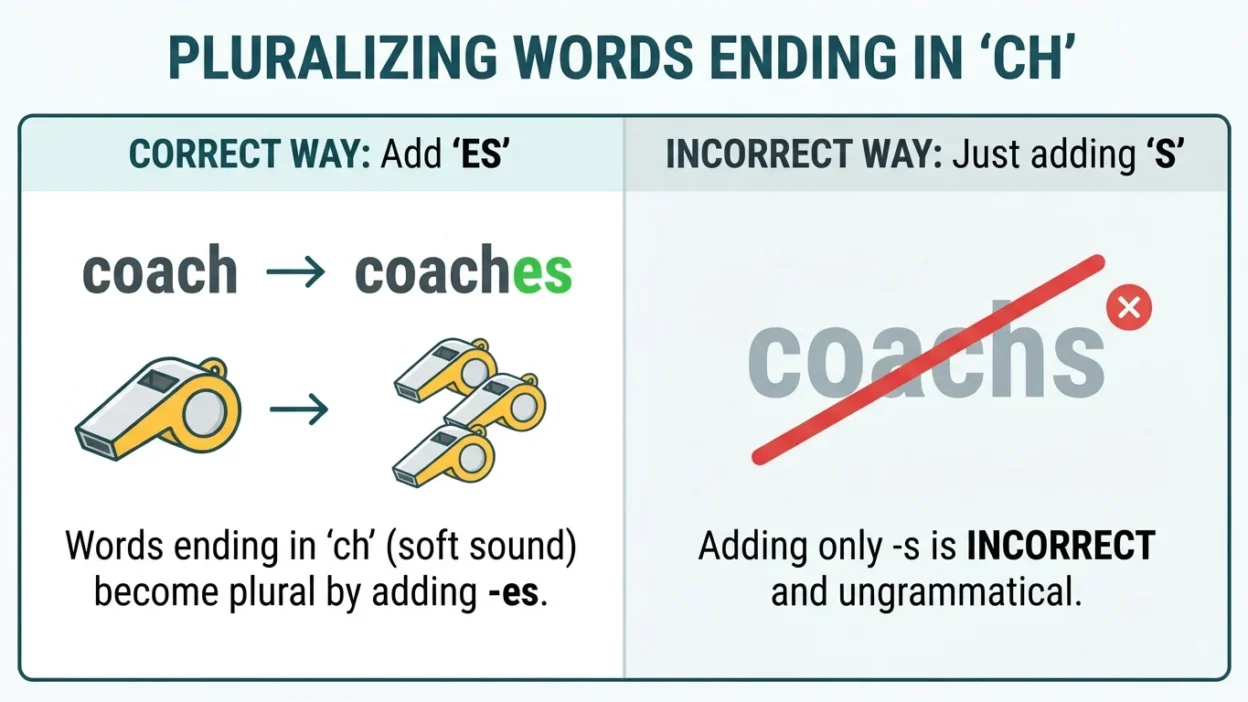
Coaches is the correct plural of coach.
Coachs is incorrect and should never be used.
Always add -es to nouns ending in ch.
Definition and Meaning
Coach is a noun that can mean:
- A sports trainer
- A type of vehicle
- A person who teaches or guides
The correct plural form is coaches.
Why People Confuse It
The confusion happens because:
- Many nouns form plurals by adding “s”
- People forget special spelling rules
- Fast typing leads to errors
However, nouns ending in -ch follow a different rule.
First Form: Coaches
Coaches is the correct plural form.
It follows the grammar rule for nouns ending in -ch.
Examples:
- The coaches are preparing the team.
- Several coaches attended the meeting.
Second Form: Coachs
Coachs is incorrect.
It does not follow English plural rules.
Avoid using it in all situations.
Grammar Rules Explained
For nouns ending in:
- ch, sh, s, x, z
Add -es to form the plural.
So:
- Coach → Coaches
Comparison Table
| Feature | Coaches | Coachs |
|---|---|---|
| Correct usage | Yes | No |
| Grammar rule | Add -es | Incorrect |
| Example | Many coaches | ❌ Wrong |
When to Use Each
Use coaches when:
- Referring to more than one coach
Never use coachs.
Real Life Usage
Coaches is commonly used in:
- Sports
- Education
- Professional training
Formal vs Informal Use
Coaches is correct in both formal and informal writing.
Coachs is always incorrect.
Pronunciation Guide
- Coaches: /ˈkoʊtʃɪz/
The “-es” adds an extra syllable.
Synonyms and Alternatives
For coach:
- Trainer
- Instructor
- Mentor
Common Sentences
Examples:
- The coaches are planning a strategy.
- All coaches attended the seminar.
Examples
Here are 10 examples:
- The coaches met before the game.
- All coaches supported the decision.
- The team has experienced coaches.
- Several coaches joined the program.
- The coaches trained the players well.
- New coaches were hired this year.
- The coaches discussed the plan.
- The coaches guided the students.
- Many coaches attended the workshop.
- The coaches improved the team’s performance.
Common Mistakes
A common mistake is writing coachs instead of coaches.
This happens when people forget the “-es” rule.
Mistakes to Avoid
Avoid:
- Writing “coachs”
- Ignoring spelling rules
- Rushing while typing
Memory Trick
Remember:
Words ending in “ch” → add “-es”
Coach → Coaches
American vs British English
There is no difference.
Both use coaches as the correct plural.
Similar Words
Other examples:
- Watch → Watches
- Match → Matches
- Church → Churches
Related Confusing Words
More examples:
- Affect vs Effect
- Advice vs Advise
- Accept vs Except
Expert Tips
Always check the ending of the word.
If it ends in ch, add -es, not just “s”.
When Does It Apply
Use this rule when:
- Writing plurals
- Improving spelling
- Avoiding grammar mistakes
Final Verdict
Coaches is correct.
Coachs is incorrect.
Always use coaches.
FAQs
1. What is the plural of coach?
Coaches.
2. Is coachs correct?
No.
3. Why do we add -es?
Because it ends in “ch”.
4. Is this rule common?
Yes.
5. Are there exceptions?
Rarely.
6. How do I remember?
Ch → es.
Remember This
Coach → Coaches
Not coachs
Simple rule.
Conclusion
The difference between coaches and coachs is simple but important. Coaches is the correct plural form of coach, while coachs is incorrect and should never be used. This follows a basic English rule where words ending in “ch” take “-es” in the plural form.
By remembering this rule and practicing it, you can avoid this common mistake. Using the correct spelling will improve your writing and make your communication more professional.

Carol Amanda is a passionate writer and faith-driven author dedicated to sharing the wisdom of the Bible. At BiblyWord, she creates inspiring and meaningful content that encourages spiritual growth and daily reflection. Her work focuses on helping readers connect with God’s Word and find guidance, peace, and strength in their faith journey.