Have you ever confused foreword with forward? These two English words look similar and sound alike in many accents, but they have very different meanings. One is commonly found at the beginning of a book, while the other relates to moving ahead, direction, or progress. Using the wrong word can change the meaning of your sentence and make your writing less clear.
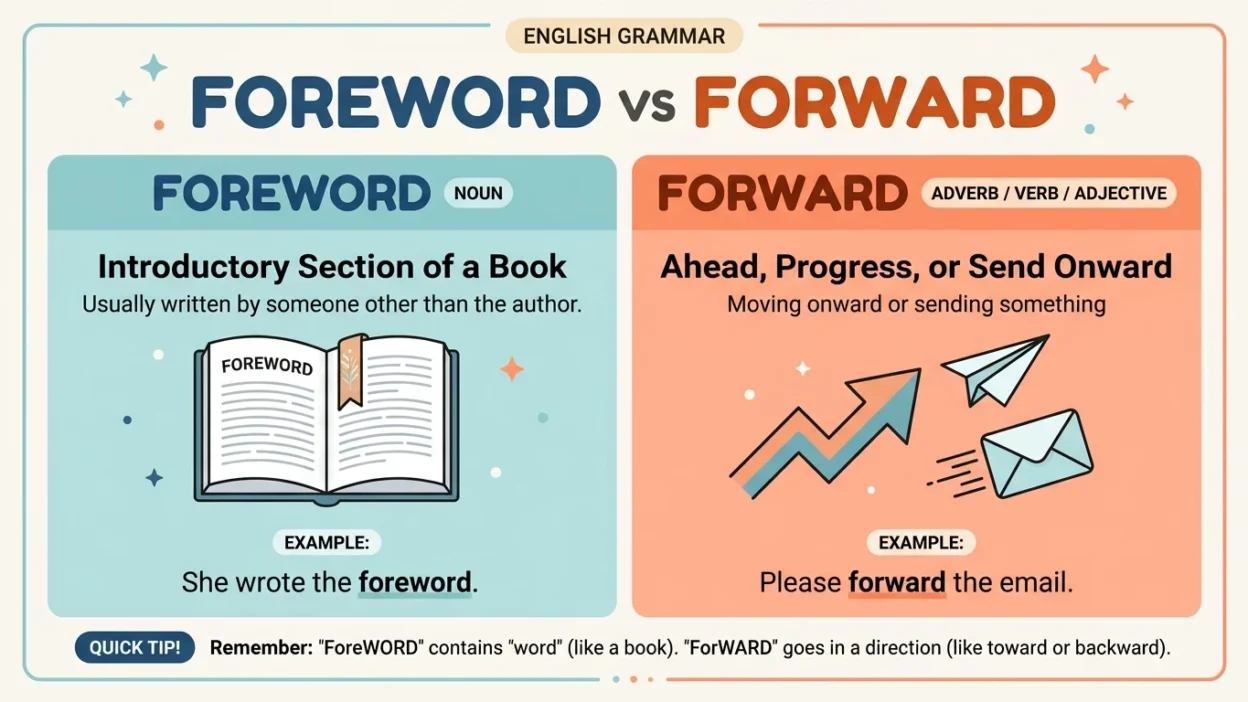
The difference becomes simple once you understand how each word works. A foreword is a short introductory section in a book, usually written by someone other than the author. Forward can describe movement toward the front, progress, or sending something onward.
It can also be used as a verb, as in forwarding an email. In this guide, you will learn their definitions, grammar rules, common uses, real-life examples, and easy memory tricks to help you choose the correct word confidently.
Quick Answer
Foreword is an introductory section at the beginning of a book, often written by someone other than the author. Forward means toward the front, onward, or ahead. For example, “The author’s mentor wrote the foreword” is correct, while “Please move forward” describes movement or progress.
Definition and Meaning
The words foreword and forward have different meanings and grammatical uses.
A foreword is a short introductory statement in a book. It is often written by a respected person who introduces the author, explains the book’s importance, or recommends it to readers.
Example: The professor wrote the foreword to the new book.
Forward usually means toward the front or ahead. It can also refer to progress, future plans, or sending something to another person.
Examples:
- Please move forward.
- We need to look forward to the future.
- She forwarded the email to her manager.
The main difference is that a foreword is a specific part of a book, while forward is a much more versatile word used in everyday communication.
Why People Confuse Foreword and Forward
People often confuse these words because their spellings are similar. Both contain the letters “for” and end with a sound resembling “word.”
Their pronunciations are also identical or very similar in many English accents, making the difference difficult to hear.
However, their meanings are unrelated in modern everyday usage.
For example:
- The writer included a foreword in the book.
- Please move forward to the next room.
The first sentence refers to a book’s introductory section. The second describes movement toward a position ahead.
Readers sometimes also confuse “foreword” with “forward” because a foreword appears before the main text. Remembering that connection can make the correct spelling easier to recall.
First Word: Foreword
Foreword is a noun that means an introductory section placed at the beginning of a book, before the main text.
A foreword is often written by someone other than the book’s author. This person may be an expert, a colleague, a mentor, or another respected figure who explains why the book is valuable.
For example:
- The famous author wrote the foreword.
- I enjoyed reading the foreword before starting the first chapter.
- Her teacher contributed a foreword to her published work.
A foreword may introduce the author, explain the book’s background, or tell readers why the work deserves attention.
It is important not to confuse a foreword with a preface or an introduction. These sections can serve similar purposes, but a foreword is traditionally written by someone other than the author.
Second Word: Forward
Forward is a versatile word that can function as an adverb, adjective, or verb, depending on the sentence.
As an adverb, it means toward the front or ahead.
Example: The soldiers marched forward.
As an adjective, it can describe a position, direction, or movement toward the front.
Example: The forward section of the vehicle was damaged.
As a verb, forward means to send something onward to another person or destination.
Example: Please forward the document to the director.
The word also appears in expressions such as “look forward to,” which means to feel pleased or excited about something that is expected to happen.
Example: I look forward to meeting you.
Unlike “foreword,” forward is used in many everyday, professional, and technical situations.
Grammar Rules Explained
The easiest way to distinguish these words is to identify their grammatical roles.
Foreword is a noun. It names a particular section of a book.
Example: The foreword explains why the author wrote the book.
Forward has several grammatical uses.
- Adverb: She stepped forward.
- Adjective: The forward movement stopped.
- Verb: He forwarded the message.
- Part of an expression: We look forward to your reply.
A useful grammar test is to ask whether the sentence refers to a book’s opening section. If it does, “foreword” may be correct.
If the sentence describes movement, progress, direction, or sending something onward, “forward” is generally the right choice.
Remember that the verb form normally takes -ed in the past tense: “forwarded.”
Comparison Table
| Feature | Foreword | Forward |
|---|---|---|
| Main meaning | Introductory section of a book | Ahead, onward, or toward the front |
| Part of speech | Noun | Adverb, adjective, or verb |
| Common context | Books and publishing | Movement, progress, emails, directions |
| Example | She wrote the foreword. | Please move forward. |
| Verb form | Not normally used as a verb | Forwarded |
| Related expression | Book foreword | Look forward to |
| Can refer to email delivery? | No | Yes |
When to Use Foreword
Use foreword when referring to the introductory section of a book, particularly one written by a person other than the author.
You may encounter a foreword in:
- Biographies
- Academic books
- Memoirs
- Professional guides
- Collections of essays
- Historical publications
Examples:
- The historian wrote the foreword to the biography.
- Her mentor agreed to write a foreword for her first book.
- I read the foreword before beginning the first chapter.
A foreword can establish the book’s significance and give readers useful background information.
If you are writing about a book’s opening pages, make sure you understand whether the section is a foreword, preface, or introduction. These terms are related but are not always interchangeable.
When to Use Forward
Use forward when referring to movement ahead, progress, direction, or sending something onward.
Examples:
- Please step forward.
- The team is moving forward with the project.
- Could you forward this email to me?
- We should look forward to new opportunities.
In business communication, “forward” is particularly common when sending emails, documents, invitations, and other information to another person.
It also appears in expressions about progress, such as “moving forward” and “looking forward.”
Whenever you are describing something going ahead or being sent onward, forward is usually the correct word.
Foreword vs Forward in Real Life
Imagine you have purchased a new biography. Before the first chapter, you see a page written by a well-known historian praising the author’s work. That section is the foreword.
Now imagine your manager sends you an email and asks you to share it with your colleagues. You can forward the email to them.
Here are two more examples:
- The celebrity wrote the foreword for the memoir.
- The project will move forward after the meeting.
In the first sentence, “foreword” names a section of a publication. In the second, “forward” describes progress.
Understanding the situation helps you select the correct word naturally without relying only on spelling.
Formal vs Informal Use
Both words are used in formal and informal English, but they appear in different contexts.
Foreword is most common in publishing and literary contexts. It may appear in academic books, professional publications, biographies, and memoirs.
Example: The researcher contributed a foreword to the textbook.
Forward is much more common in everyday communication. People use it when giving directions, discussing plans, sending messages, or describing progress.
Examples:
- Please move forward in the line.
- I will forward the report this afternoon.
- We look forward to working with you.
In formal emails, “I look forward to hearing from you” is a standard closing expression. “Foreword” would be appropriate only when discussing a book or a similar publication.
Pronunciation Guide
In many English accents, foreword and forward are pronounced identically or almost identically.
A common pronunciation for both is approximately /ˈfɔːrwərd/, although vowel sounds vary by accent.
This similarity explains why people may use the wrong spelling when writing from memory.
For example, someone may hear “foreword” in a conversation about a book and mistakenly write “forward.”
The best way to avoid this mistake is to focus on meaning:
- A book’s introductory section: foreword.
- Movement, progress, or sending something onward: forward.
Because pronunciation is not always enough to distinguish the words, learning their definitions is more reliable than relying on sound alone.
Synonyms and Alternatives
The words have different meanings, so their synonyms are different too.
Alternatives to foreword include:
- Opening note
- Introductory note
- Preliminary statement
- Book introduction, depending on context
These expressions are related, but they do not always mean exactly the same thing. In publishing, a foreword has a more specific conventional role.
Alternatives to forward depend on how it is used.
For movement:
- Ahead
- Onward
- Toward the front
For sending information:
- Send on
- Pass along
- Redirect
For progress:
- Advance
- Proceed
- Make progress
Always select an alternative that fits the sentence. For example, “advance the project” may work in place of “move the project forward,” but it cannot replace “foreword” when naming a book section.
Common Sentences Using Foreword
Here are some natural examples of foreword in a sentence:
- The author’s mentor wrote the foreword.
- I read the foreword before starting the book.
- The foreword explains the book’s importance.
- A respected scientist contributed the foreword.
- The biography begins with a thoughtful foreword.
- The editor asked her colleague to write the foreword.
- His foreword praised the author’s research.
- The foreword introduces readers to the book’s main themes.
- The publisher included a foreword by a well-known historian.
- The foreword provides useful background information.
In every example, “foreword” refers to an introductory section of a book or similar publication.
Examples of Forward in Sentences
Here are ten examples showing how to use forward correctly:
- Please move forward slowly.
- We need to move forward with the plan.
- She forwarded the email to her supervisor.
- I look forward to seeing you.
- The car moved forward a few feet.
- The company is looking forward to future growth.
- He leaned forward to hear the speaker.
- Please forward the document to the accounts department.
- The team took a major step forward.
- We will discuss the next steps moving forward.
These examples demonstrate how flexible the word “forward” is. It can describe physical movement, progress, the sending of information, or anticipation of a future event.
Common Mistakes
One frequent mistake is using “forward” when talking about a book’s introductory section.
Incorrect: The historian wrote the forward to the book.
Correct: The historian wrote the foreword to the book.
Another mistake is using “foreword” to describe movement.
Incorrect: Please move foreword.
Correct: Please move forward.
People may also confuse the words when discussing emails.
Incorrect: Can you foreword this email to me?
Correct: Can you forward this email to me?
The solution is to check the intended meaning before writing. If you mean a book section, use “foreword.” If you mean moving ahead or sending something onward, use “forward.”
Mistakes to Avoid
Keep these common errors in mind:
- Incorrect: She wrote the forward of the book.
- Correct: She wrote the foreword of the book.
More naturally: She wrote the foreword to the book. - Incorrect: We need to move foreword.
- Correct: We need to move forward.
- Incorrect: Please foreword me the report.
- Correct: Please forward me the report.
- Incorrect: I look foreword to meeting you.
- Correct: I look forward to meeting you.
The last example is particularly common in professional emails. The phrase is always look forward to, not “look foreword to.”
One additional tip: after “look forward to,” use a noun or an -ing verb form. For example, “I look forward to meeting you,” not “I look forward to meet you.”
Memory Trick
Here is a simple way to remember the difference.
Foreword = a word before the main text.
Think of the prefix “fore-” as meaning before or at the front. A foreword appears near the beginning of a book.
Forward = moving ahead.
Think of walking forward, moving a project forward, or forwarding an email.
Remember these examples:
- The writer included a foreword in the book.
- Please move forward.
- I look forward to your reply.
- She forwarded the email.
The key is to connect “foreword” with books and “forward” with movement, progress, or sending information. This memory trick works in most everyday writing situations.
American vs British English
The distinction between foreword and forward is essentially the same in American and British English.
In both varieties, “foreword” refers to an introductory section of a book, and “forward” refers to movement, progress, direction, or sending something onward.
Examples in American English:
- The professor wrote the foreword.
- Please forward the message.
Examples in British English:
- The professor wrote the foreword.
- Please forward the message.
Neither word has a major regional spelling difference in these meanings. The important distinction is based on meaning rather than location.
Whether you are writing an academic paper, a business email, or a book review, the same basic rule applies.
Foreword vs Preface vs Introduction
These three terms are related, but they are not always interchangeable.
A foreword is usually written by someone other than the book’s author. It often recommends the work or explains the author’s importance.
A preface is generally written by the author and explains the book’s purpose, background, or how it came to be written.
An introduction introduces the subject matter and helps readers understand the material that follows. Depending on the book, it may be written by the author or another contributor.
For example:
- The historian wrote the foreword.
- The author explained her research process in the preface.
- The introduction outlines the book’s main arguments.
These conventions can vary by publication, but knowing the typical distinctions helps you describe book sections accurately.
Forward in Emails and Business Communication
Forward is commonly used as a verb in professional communication. It means sending an email, document, or message that you received to another person.
Examples:
- Please forward the invoice to the finance team.
- I forwarded your message to the project manager.
- Could you forward the meeting invitation to everyone involved?
The word also appears in polite email expressions.
For example: “I look forward to hearing from you.”
This means that you anticipate receiving a response.
A common spelling error is writing “foreword” in these situations because the two words sound alike. Remember that a book has a foreword, while an email is forwarded.
In professional writing, using the correct spelling helps your message look clear and polished.
Forward as a Direction and as Progress
The word forward can describe both physical movement and figurative progress.
Physical movement:
- The child took a step forward.
- The car moved forward slowly.
- Lean forward to see the screen.
Figurative progress:
- The negotiations are moving forward.
- The team made progress moving forward.
- We need a clear plan to move forward.
The word can also refer to a direction toward the front of something, as in “the forward seats” or “the forward section of the ship.”
These uses all share the general idea of being ahead, progressing, or being toward the front.
Unlike “foreword,” none of these meanings involves a book’s introductory section.
Expert Tips for Correct Usage
Use these practical tips to avoid confusing the words:
1. Think about books. If you are discussing a special introductory section, choose “foreword.”
2. Think about movement. If something is moving ahead, use “forward.”
3. Check for email context. When sending an email or document onward, use “forward” or “forwarded.”
4. Remember common phrases. Write “move forward,” “look forward to,” and “forward an email.”
5. Check the sentence’s meaning. Replacing the word with “book introduction” or “ahead” can help you identify the correct choice.
For example, “I look forward to meeting you” makes sense because it refers to anticipation. “I look foreword to meeting you” does not.
How to Choose the Correct Word
When you are unsure, ask yourself what you want the word to mean.
Does it refer to a section at the beginning of a book?
Use foreword.
Example: The author’s friend wrote the foreword.
Does it mean ahead, onward, or toward the front?
Use forward.
Example: Please move forward.
Does it mean sending something to another person?
Use forward.
Example: Forward the email to your colleague.
Does it appear in the expression “look forward to”?
Use forward.
Example: I look forward to your response.
This quick meaning-based test is usually enough to make the right choice.
Final Verdict
The difference between foreword and forward comes down to their meanings.
Foreword is a noun that refers to an introductory section of a book, often written by someone other than the author.
Forward can mean ahead, onward, or toward the front. It can also be a verb meaning to send something onward, as in forwarding an email.
Remember the simple rule: a book may have a foreword, but you move forward, look forward to something, and forward messages to other people.
FAQs
Is it foreword or forward of a book?
The correct word is foreword when referring to the introductory section of a book.
What does foreword mean?
A foreword is an introductory section of a book, often written by someone other than the author to introduce or recommend the work.
What does forward mean?
“Forward” can mean ahead or onward. It can also mean to send something to another person, as in “forward an email.”
Are foreword and forward pronounced the same?
They are pronounced identically or very similarly in many English accents, which is one reason people confuse their spellings.
Is “I look forward to hearing from you” correct?
Yes. “I look forward to hearing from you” is a standard expression used in professional and personal communication.
Can I use forward as a verb?
Yes. For example, “Please forward the message to your manager.”
Who usually writes a foreword?
A foreword is often written by someone other than the author, such as a respected expert, colleague, mentor, or public figure.
What is the difference between a foreword and a preface?
A foreword is usually written by someone other than the author, while a preface is generally written by the author to explain the book’s purpose or background.
Remember This
Keep these meanings in mind:
- Foreword = an introductory section of a book.
- Forward = ahead, onward, or send onward.
Correct examples:
- The author invited a historian to write the foreword.
- Please move forward.
- I look forward to your reply.
- She forwarded the email to her colleague.
The words may sound alike, but their meanings are different. Connect “foreword” with books and “forward” with movement, progress, and sending messages.
Conclusion
Although foreword and forward look and sound similar, they serve different purposes in English. A foreword is a special introductory section found at the beginning of a book, while forward describes movement, direction, progress, or the act of sending information onward. Understanding this distinction will help you avoid common spelling errors in everyday and professional writing.
Whenever you are unsure, think about the context. If you are discussing a book’s opening section, use foreword. If you mean moving ahead, making progress, or sending an email, use forward. With this simple rule and a little practice, you can use both words accurately and confidently.

Carol Amanda is a passionate writer and faith-driven author dedicated to sharing the wisdom of the Bible. At BiblyWord, she creates inspiring and meaningful content that encourages spiritual growth and daily reflection. Her work focuses on helping readers connect with God’s Word and find guidance, peace, and strength in their faith journey.