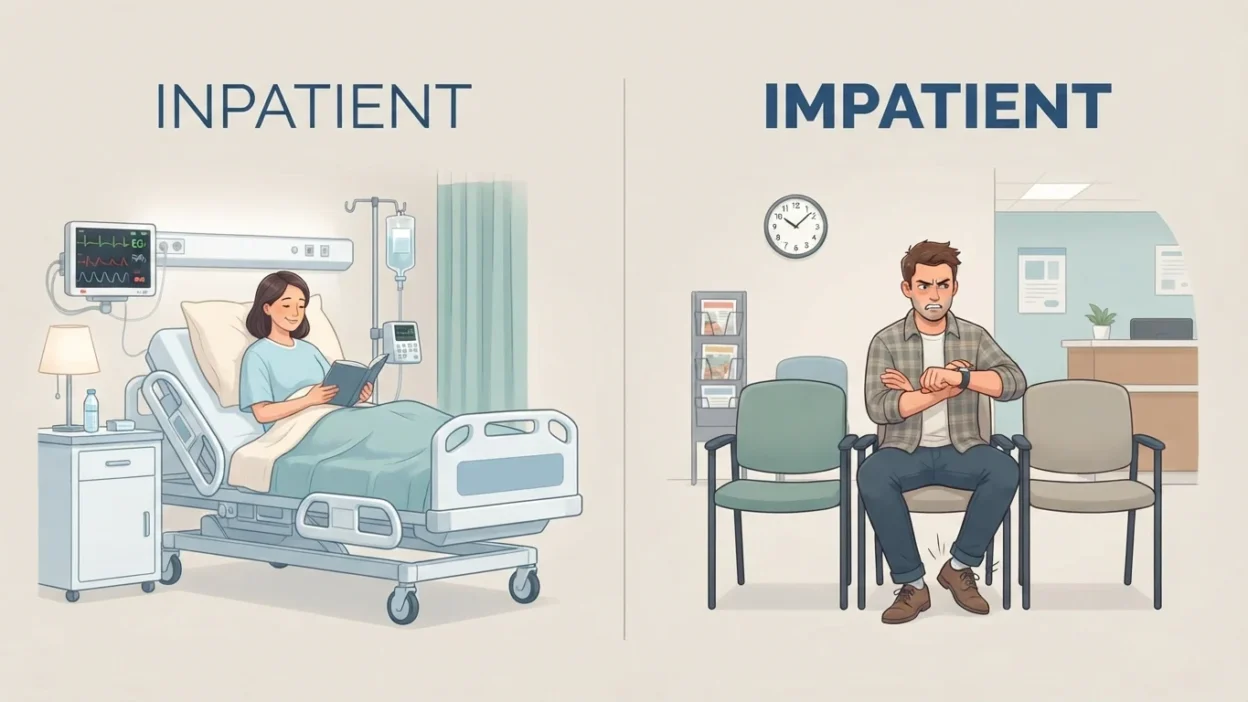
The words inpatient and impatient may look almost identical, but they have completely different meanings. This small spelling difference can easily lead to confusion, especially in writing. However, using the wrong word can change your sentence entirely.
Understanding inpatient vs impatient is important for clear communication. One word is used in medical contexts, while the other describes a person’s behavior or attitude. In this guide, you’ll learn their meanings, grammar rules, examples, and simple memory tricks to use them correctly every time.
Quick Answer
Inpatient is a noun referring to a hospital patient who stays overnight.
Impatient is an adjective describing someone who lacks patience.
Use inpatient for medical contexts and impatient for behavior.
Definition and Meaning
Inpatient is a person who is admitted to a hospital and stays there for treatment.
Impatient means feeling restless, annoyed, or unable to wait calmly.
So:
- Inpatient = hospital patient
- Impatient = lacking patience
Why People Confuse It
The confusion happens because:
- Both words look very similar
- Only one letter (n vs m) changes
- They sound somewhat alike
But their meanings are completely different.
First Word: Inpatient
Inpatient is a noun used in medical settings.
Examples:
- The hospital admitted him as an inpatient.
- She is an inpatient receiving treatment.
It refers to someone staying in a hospital.
Second Word: Impatient
Impatient is an adjective describing a feeling or behavior.
Examples:
- He became impatient while waiting.
- She is impatient with delays.
It describes a lack of patience.
Grammar Rules Explained
Inpatient:
- Noun
- Refers to a person
Impatient:
- Adjective
- Describes a person or feeling
Comparison Table
| Feature | Inpatient | Impatient |
|---|---|---|
| Meaning | Hospital patient | Lacking patience |
| Type | Noun | Adjective |
| Usage | Medical context | Behavior/emotion |
| Example | An inpatient in hospital | An impatient person |
When to Use Each
Use inpatient when:
- Talking about hospitals
- Referring to admitted patients
Use impatient when:
- Describing behavior
- Talking about feelings
Real Life Usage
Inpatient is used in:
- Hospitals
- Medical reports
Impatient is used in:
- Daily conversations
- Emotional descriptions
Formal vs Informal Use
Inpatient is more formal and technical.
Impatient is used in both formal and informal contexts.
Pronunciation Guide
- Inpatient: /ˈɪnˌpeɪʃənt/
- Impatient: /ɪmˈpeɪʃənt/
The stress and sound differ slightly.
Synonyms and Alternatives
For inpatient:
- Hospital patient
- Admitted patient
For impatient:
- Restless
- Irritable
- Anxious
Common Sentences
Examples:
- He is an inpatient at the hospital.
- She became impatient during the delay.
- The inpatient is recovering well.
- He was impatient with the process.
Examples
Here are 10 examples:
- The inpatient required constant care.
- She is an inpatient in the hospital.
- The doctor checked on the inpatient.
- He was admitted as an inpatient.
- The inpatient is improving daily.
- She became impatient waiting in line.
- He is impatient with slow service.
- They grew impatient during the meeting.
- The child became impatient quickly.
- She felt impatient about the delay.
Common Mistakes
A common mistake is using inpatient instead of impatient in sentences about behavior.
Another is confusing the spelling due to similarity.
Mistakes to Avoid
Avoid:
- Mixing meanings
- Using the wrong spelling
- Ignoring context
Memory Trick
Remember:
Inpatient = in hospital
Impatient = no patience
This simple trick helps a lot.
American vs British English
There is no difference in usage between American and British English.
Similar Words
Other confusing pairs:
- Affect vs Effect
- Advice vs Advise
- Accept vs Except
Related Confusing Words
More examples:
- Lose vs Loose
- Quiet vs Quite
- Then vs Than
Expert Tips
Check the context:
- Medical setting → inpatient
- Emotion or behavior → impatient
When Does It Apply
Use these words when:
- Writing about health
- Describing emotions
- Communicating clearly
Final Verdict
Inpatient is a hospital patient.
Impatient describes a lack of patience.
Choose based on context to avoid confusion.
FAQs
1. What is the difference between inpatient and impatient?
Inpatient is a hospital patient; impatient means lacking patience.
2. Are they interchangeable?
No, they have different meanings.
3. Why are they confusing?
Because of similar spelling.
4. How do I remember the difference?
Inpatient = in hospital.
5. Is impatient an adjective?
Yes.
6. Is inpatient a noun?
Yes.
Remember This
Inpatient = hospital
Impatient = no patience
Simple and clear.
Conclusion
The difference between inpatient and impatient is small in spelling but significant in meaning. Inpatient refers to a person receiving treatment in a hospital, while impatient describes someone who cannot wait calmly. Confusing these words can lead to misunderstandings.
By remembering simple connections like “inpatient means in hospital” and “impatient means no patience,” you can easily avoid mistakes. With practice, using the correct word will become natural and improve your communication skills.

Carol Amanda is a passionate writer and faith-driven author dedicated to sharing the wisdom of the Bible. At BiblyWord, she creates inspiring and meaningful content that encourages spiritual growth and daily reflection. Her work focuses on helping readers connect with God’s Word and find guidance, peace, and strength in their faith journey.