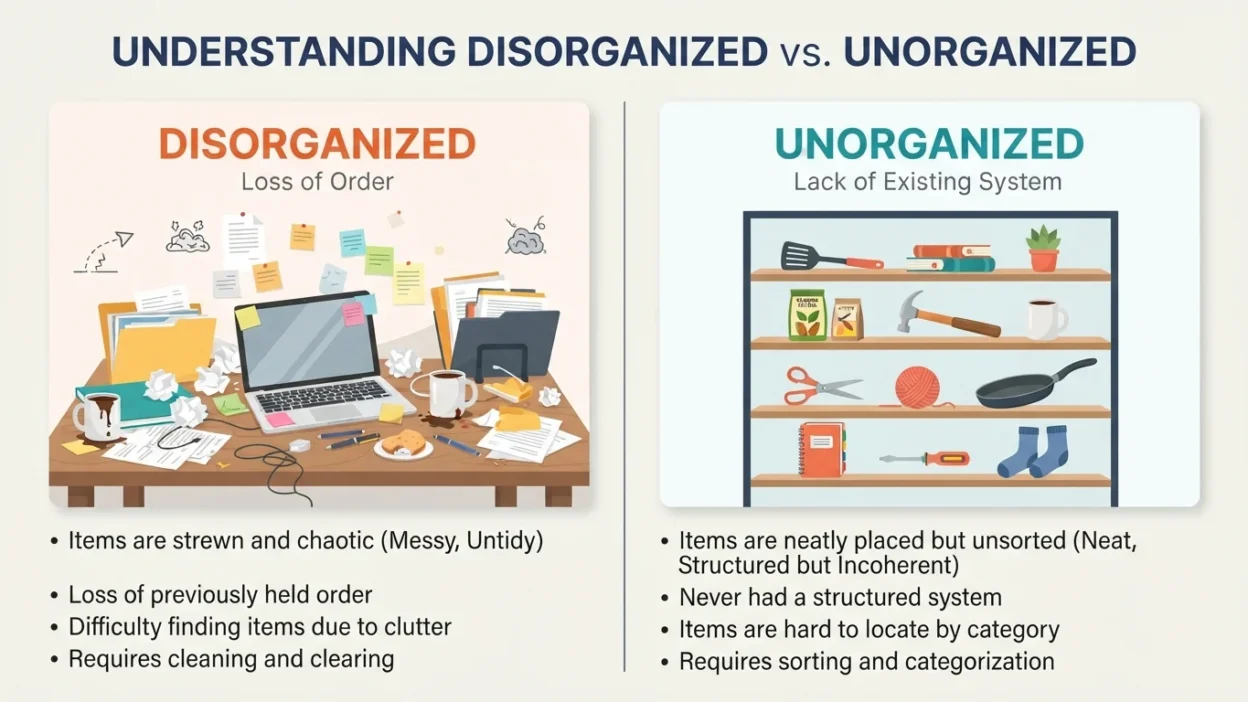
The words disorganized and unorganized seem very similar, and in many cases, they can be used interchangeably. However, there is a subtle difference between them that can improve the clarity of your writing and speaking.
Understanding disorganized vs unorganized helps you choose the right word depending on context. One suggests disorder or messiness, while the other often means something has not yet been arranged. In this guide, you’ll learn clear meanings, examples, grammar rules, and simple tricks to use both words correctly.
Quick Answer
Disorganized means messy, chaotic, or poorly arranged.
Unorganized means not yet organized or lacking structure.
Use disorganized for disorder and unorganized for something not arranged yet.
Definition and Meaning
Disorganized describes something that was organized but is now messy or lacks order.
Unorganized describes something that has not been organized yet.
So:
- Disorganized = messy or chaotic
- Unorganized = not arranged yet
Why People Confuse It
The confusion happens because:
- Both words are negative forms of “organized”
- They sound similar
- They are sometimes used interchangeably
However, their nuance is slightly different.
First Word: Disorganized
Disorganized is used when something is messy or chaotic.
Examples:
- His desk is very disorganized.
- The event was disorganized and confusing.
It often implies poor management or disorder.
Second Word: Unorganized
Unorganized is used when something has not been arranged yet.
Examples:
- The files are still unorganized.
- The group remains unorganized.
It does not always imply chaos, just lack of structure.
Grammar Rules Explained
Both words are adjectives.
They describe the state of something:
- Disorganized → implies disorder
- Unorganized → implies absence of organization
Comparison Table
| Feature | Disorganized | Unorganized |
|---|---|---|
| Meaning | Messy, chaotic | Not yet organized |
| Tone | Negative | Neutral |
| Usage | Disorder | Lack of arrangement |
| Example | Disorganized desk | Unorganized files |
When to Use Each
Use disorganized when:
- Something is messy
- There is confusion or chaos
Use unorganized when:
- Something has not been arranged
- There is no structure yet
Real Life Usage
Disorganized is common in daily conversation, especially when describing people or situations.
Unorganized is less common and often used in formal or neutral descriptions.
Formal vs Informal Use
Both words can be used in formal and informal contexts.
However, disorganized is more commonly used in everyday speech.
Pronunciation Guide
- Disorganized: /dɪsˈɔːrɡənaɪzd/
- Unorganized: /ʌnˈɔːrɡənaɪzd/
Synonyms and Alternatives
For disorganized:
- Messy
- Chaotic
- Confused
For unorganized:
- Unarranged
- Unstructured
- Not prepared
Common Sentences
Examples:
- Her schedule is disorganized.
- The documents are unorganized.
- The team was disorganized.
- The data is still unorganized.
Examples
Here are 10 examples:
- His room is very disorganized.
- The meeting was disorganized and confusing.
- Her notes are completely disorganized.
- The event felt disorganized.
- His work style is disorganized.
- The files are unorganized on the desk.
- The group is still unorganized.
- The data remains unorganized.
- The project is unorganized at this stage.
- The materials are unorganized for now.
Common Mistakes
A common mistake is using both words as exact synonyms in all contexts.
While they can overlap, the nuance matters in formal writing.
Mistakes to Avoid
Avoid:
- Ignoring context
- Using disorganized when you mean not arranged yet
- Using unorganized when you mean chaotic
Memory Trick
Remember:
Disorganized = disorder
Unorganized = not organized yet
“Dis” suggests something went wrong.
American vs British English
There is no significant difference in usage between American and British English.
Similar Words
Other similar pairs:
- Incomplete vs Unfinished
- Disconnected vs Unconnected
- Irregular vs Unusual
Related Confusing Words
More examples:
- Affect vs Effect
- Advice vs Advise
- Accept vs Except
Expert Tips
If something is messy or chaotic, use disorganized.
If it simply hasn’t been arranged yet, use unorganized.
When Does It Apply
Use these words when:
- Describing people or work
- Talking about systems or data
- Writing clearly and precisely
Final Verdict
Disorganized means messy or chaotic.
Unorganized means not yet arranged.
Choose based on whether you mean disorder or lack of organization.
FAQs
1. What is the difference between disorganized and unorganized?
Disorganized means messy; unorganized means not arranged.
2. Can they be used interchangeably?
Sometimes, but not always.
3. Which is more common?
Disorganized is more common.
4. Is unorganized incorrect?
No, but it is less common.
5. How do I remember the difference?
Disorganized = disorder.
6. Are both adjectives?
Yes.
Remember This
Disorganized = messy
Unorganized = not arranged
Simple and clear.
Conclusion
The difference between disorganized and unorganized is subtle but useful. Disorganized describes something messy or chaotic, often implying poor structure or confusion. Unorganized, on the other hand, simply means something has not yet been arranged or structured, without necessarily being messy.
By remembering that “disorganized means disorder” and “unorganized means not organized yet,” you can easily choose the right word. With practice, using these words correctly will help you communicate more clearly and effectively.

Kevin Brian is a passionate author at BiblyWord, dedicated to sharing the message of the Bible through thoughtful and inspiring content. He focuses on creating clear and meaningful writings that help readers understand scripture, strengthen their faith, and find guidance in everyday life through God’s Word.