The words elude and allude look and sound similar, but they have completely different meanings. Many people confuse them because of their spelling and pronunciation, yet using the wrong one can change your sentence entirely.
Understanding elude vs allude is essential for clear and accurate communication. One word is about escaping or avoiding something, while the other is about referring to something indirectly. In this guide, you’ll learn simple definitions, grammar rules, real-life examples, and memory tricks to use both words correctly with confidence.
Quick Answer
Elude means to escape or avoid something.
Allude means to refer to something indirectly.
Use elude for avoiding and allude for indirect reference.
Definition and Meaning
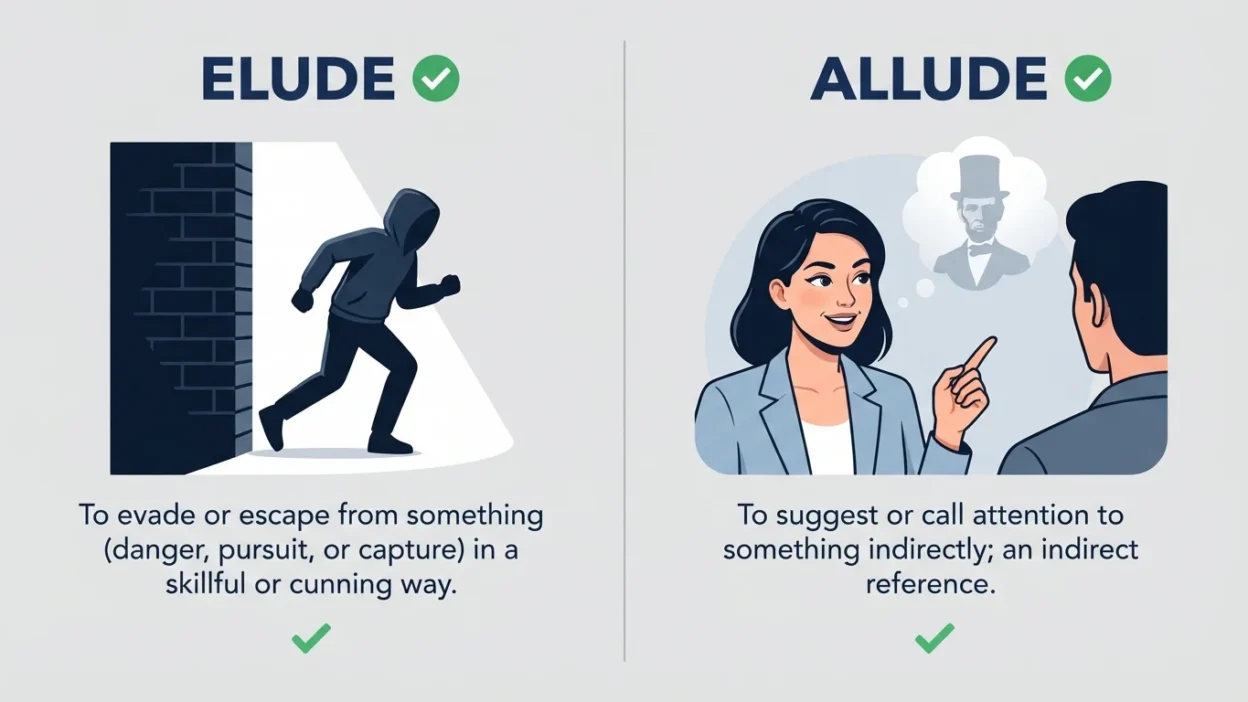
Elude means to escape from or avoid something, often skillfully.
Allude means to mention or refer to something indirectly.
So:
- Elude = escape or avoid
- Allude = hint or refer indirectly
Why People Confuse It
The confusion happens because:
- Both words sound similar
- They have similar spelling
- They are often used in formal contexts
However, their meanings are very different.
First Word: Elude
Elude is used when someone escapes or avoids something.
Examples:
- The thief managed to elude the police.
- The answer continues to elude me.
It often implies difficulty or skill in avoiding.
Second Word: Allude
Allude is used when referring to something indirectly.
Examples:
- He alluded to a past event.
- She alluded to the problem without naming it.
It is often used in writing or speech.
Grammar Rules Explained
Both elude and allude are verbs.
They are used in different contexts:
- Elude takes an object (what is avoided)
- Allude is often followed by “to”
Example:
- He alluded to the issue.
Comparison Table
| Feature | Elude | Allude |
|---|---|---|
| Meaning | Escape or avoid | Refer indirectly |
| Usage | Avoiding | Hinting |
| Grammar | Verb | Verb (often with “to”) |
| Example | Elude capture | Allude to a topic |
When to Use Each
Use elude when:
- Talking about escape
- Avoiding something
Use allude when:
- Referring indirectly
- Hinting at something
Real Life Usage
Elude is common in:
- Crime stories
- Problem-solving contexts
Allude is common in:
- Writing
- Speeches
- Literature
Formal vs Informal Use
Both words are more common in formal or semi-formal English.
They are less common in casual speech.
Pronunciation Guide
- Elude: /ɪˈluːd/
- Allude: /əˈluːd/
The beginning sound differs slightly.
Synonyms and Alternatives
For elude:
- Escape
- Avoid
- Evade
For allude:
- Refer
- Hint
- Mention indirectly
Common Sentences
Examples:
- The solution eluded him.
- She alluded to the issue.
- He eluded capture.
- They alluded to the problem.
Examples
Here are 10 examples:
- The suspect eluded the police.
- The meaning eluded her.
- He eluded capture for years.
- The answer eluded the students.
- She alluded to her past.
- He alluded to the mistake.
- They alluded to the problem indirectly.
- The speaker alluded to history.
- The truth continued to elude him.
- She alluded to a hidden message.
Common Mistakes
A common mistake is using allude when you mean escape.
Another is using elude when referring indirectly.
Mistakes to Avoid
Avoid:
- Mixing meanings
- Ignoring context
- Using the wrong verb
Memory Trick
Remember:
Elude = evade (both start with “e”)
Allude = allude to (think “a” for “about”)
American vs British English
There is no difference between American and British English in usage.
Similar Words
Other confusing pairs:
- Affect vs Effect
- Advice vs Advise
- Accept vs Except
Related Confusing Words
More examples:
- Compliment vs Complement
- Principal vs Principle
- Lose vs Loose
Expert Tips
Check the meaning:
- Escape → elude
- Refer → allude
Also remember that allude is often followed by “to.”
When Does It Apply
Use these words when:
- Writing formally
- Explaining ideas
- Describing actions
Final Verdict
Elude is used for escaping or avoiding.
Allude is used for indirect reference.
Choosing the correct word ensures clear communication.
FAQs
1. What is the difference between elude and allude?
Elude means escape; allude means refer indirectly.
2. Can they be used interchangeably?
No, they have different meanings.
3. Why are they confusing?
Because they sound similar.
4. What comes after allude?
Usually “to.”
5. How do I remember the difference?
Elude = evade; allude = about.
6. Are they formal words?
Yes, mostly.
Remember This
Elude = escape
Allude = refer
Simple and clear.
Conclusion
The difference between elude and allude is easy once you understand their meanings. Elude is used when someone escapes or avoids something, while allude is used when referring to something indirectly. Although they look and sound similar, their uses are completely different.
By remembering simple tricks like “elude equals evade” and “allude equals refer,” you can avoid confusion. With practice, choosing the correct word will become natural, helping you communicate more clearly and effectively.

Kevin Brian is a passionate author at BiblyWord, dedicated to sharing the message of the Bible through thoughtful and inspiring content. He focuses on creating clear and meaningful writings that help readers understand scripture, strengthen their faith, and find guidance in everyday life through God’s Word.