The words relieving and reliving may look similar, but they have completely different meanings. Many people mix them up because only one letter changes, yet that small difference can totally change what you’re trying to say.
Understanding relieving vs reliving is important for clear communication. One word is about reducing stress or pain, while the other is about experiencing something again in your mind. In this guide, you’ll learn simple meanings, grammar rules, real-life examples, and memory tricks to use both words correctly and confidently.
Quick Answer
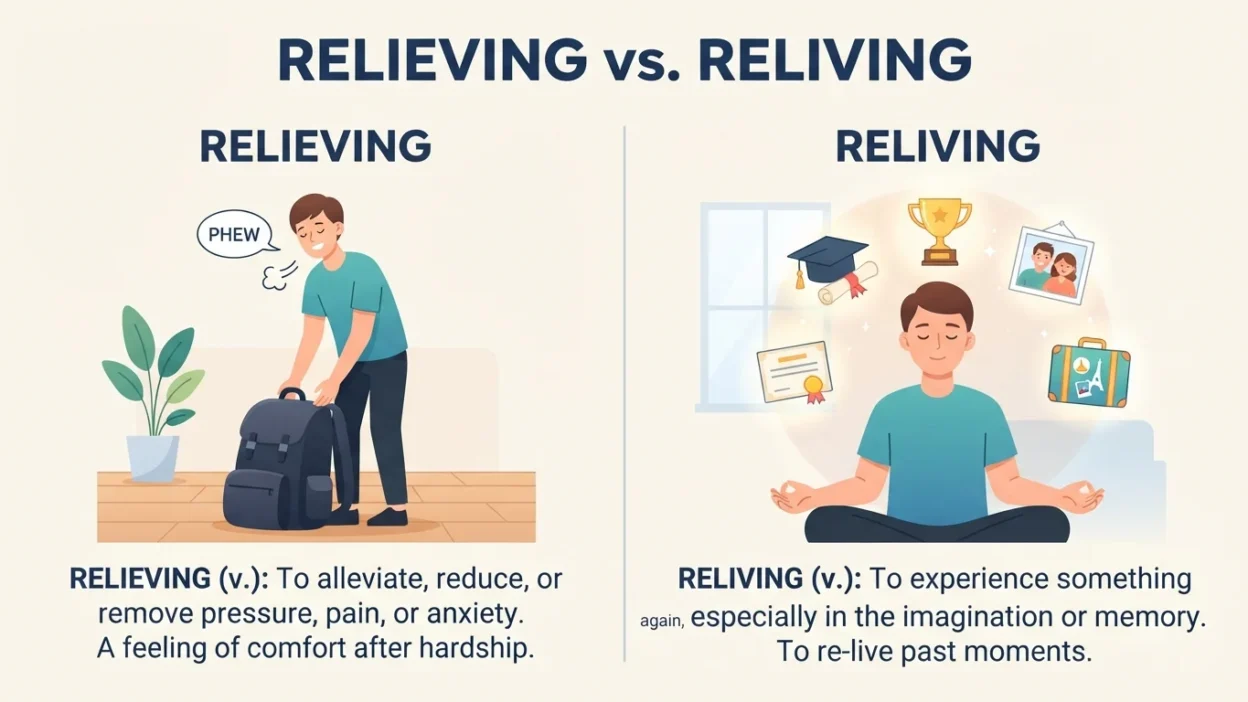
Relieving means reducing pain, stress, or discomfort.
Reliving means experiencing something again, usually a memory.
Use relieving for comfort and reliving for memories.
Definition and Meaning
Relieving comes from relieve, meaning to ease or reduce discomfort.
Reliving comes from relive, meaning to experience something again.
So:
- Relieving = easing or reducing
- Reliving = experiencing again
Why People Confuse It
The confusion happens because:
- The words look very similar
- Only one letter (e vs i) changes
- Both are verbs ending in “-ing”
However, their meanings are completely different.
First Word: Relieving
Relieving is used when something reduces pain, stress, or pressure.
Examples:
- The medicine is relieving my headache.
- It was relieving to hear good news.
It expresses comfort or relief.
Second Word: Reliving
Reliving is used when someone experiences something again, especially in memory.
Examples:
- She kept reliving the moment.
- He was reliving his childhood memories.
It often relates to emotions or past experiences.
Grammar Rules Explained
Both words are present participles (-ing forms).
They come from different base verbs:
- Relieve → relieving
- Relive → reliving
The spelling changes slightly:
- Remove “e” before adding “-ing”
Comparison Table
| Feature | Relieving | Reliving |
|---|---|---|
| Meaning | Reducing pain or stress | Experiencing again |
| Base verb | Relieve | Relive |
| Usage | Comfort | Memory |
| Example | Relieving pain | Reliving memories |
When to Use Each
Use relieving when:
- Talking about comfort
- Reducing stress or pain
Use reliving when:
- Talking about memories
- Re-experiencing events
Real Life Usage
Relieving is common in health, emotions, and daily life.
Reliving is often used in storytelling, psychology, and personal experiences.
Formal vs Informal Use
Both words can be used in formal and informal contexts.
Their usage depends on meaning, not tone.
Pronunciation Guide
- Relieving: /rɪˈliːvɪŋ/
- Reliving: /rɪˈlɪvɪŋ/
The vowel sound is slightly different.
Synonyms and Alternatives
For relieving:
- Easing
- Reducing
- Comforting
For reliving:
- Re-experiencing
- Recalling
- Remembering
Common Sentences
Examples:
- This treatment is relieving pain.
- She is reliving her past.
- It was relieving to finish the work.
- He kept reliving the accident.
Examples
Here are 10 examples:
- The medicine is relieving my pain.
- It was relieving to hear the results.
- She felt relieving calm after the talk.
- This exercise is relieving stress.
- The massage was very relieving.
- He kept reliving the happy moment.
- She is reliving her childhood memories.
- They were reliving the event in their minds.
- He couldn’t stop reliving the experience.
- She enjoys reliving old memories.
Common Mistakes
A common mistake is using reliving when you mean reducing stress.
Another is confusing both due to similar spelling.
Mistakes to Avoid
Avoid:
- Mixing up meanings
- Ignoring context
- Using the wrong base verb
Memory Trick
Remember:
Relieving = relief (comfort)
Reliving = live again (memory)
This makes it easy to distinguish.
American vs British English
There is no difference in usage between American and British English.
Similar Words
Other confusing pairs:
- Affect vs Effect
- Advice vs Advise
- Accept vs Except
Related Confusing Words
More examples:
- Lose vs Loose
- Quiet vs Quite
- Then vs Than
Expert Tips
Focus on the root word:
- Relief → relieving
- Live → reliving
This helps avoid confusion.
When Does It Apply
Use these words when:
- Talking about emotions
- Describing experiences
- Writing stories or explanations
Final Verdict
Relieving is about reducing pain or stress.
Reliving is about experiencing something again.
Choose based on meaning.
FAQs
1. What is the difference between relieving and reliving?
Relieving reduces stress; reliving means experiencing again.
2. Are they interchangeable?
No, they have different meanings.
3. Why are they confusing?
Because of similar spelling.
4. How do I remember the difference?
Relief vs live again.
5. Can both be used in writing?
Yes, in the correct context.
6. Do they sound different?
Slightly, yes.
Remember This
Relieving = comfort
Reliving = memory
Simple and clear.
Conclusion
The difference between relieving and reliving is small in spelling but big in meaning. Relieving refers to reducing pain, stress, or discomfort, while reliving refers to experiencing something again, usually through memory or emotion. Mixing them up can change your message completely.
By remembering simple connections like “relief equals relieving” and “live again equals reliving,” you can easily avoid confusion. With practice, using the correct word will become natural, improving both your writing and communication skills.

Carol Amanda is a passionate writer and faith-driven author dedicated to sharing the wisdom of the Bible. At BiblyWord, she creates inspiring and meaningful content that encourages spiritual growth and daily reflection. Her work focuses on helping readers connect with God’s Word and find guidance, peace, and strength in their faith journey.