Many English learners and even native speakers struggle with phrases that sound alike but carry very different meanings. One of the most common mix ups is “to bad” vs “too bad.” At first glance, they look similar, but only one of them is correct in standard English usage.
This confusion often appears in casual writing, social media posts, and even professional communication. Understanding the difference can instantly improve your grammar and make your writing more polished. In this guide, you will learn exactly when to use “too bad,” why “to bad” is incorrect, and how to avoid this mistake forever.
Quick Answer
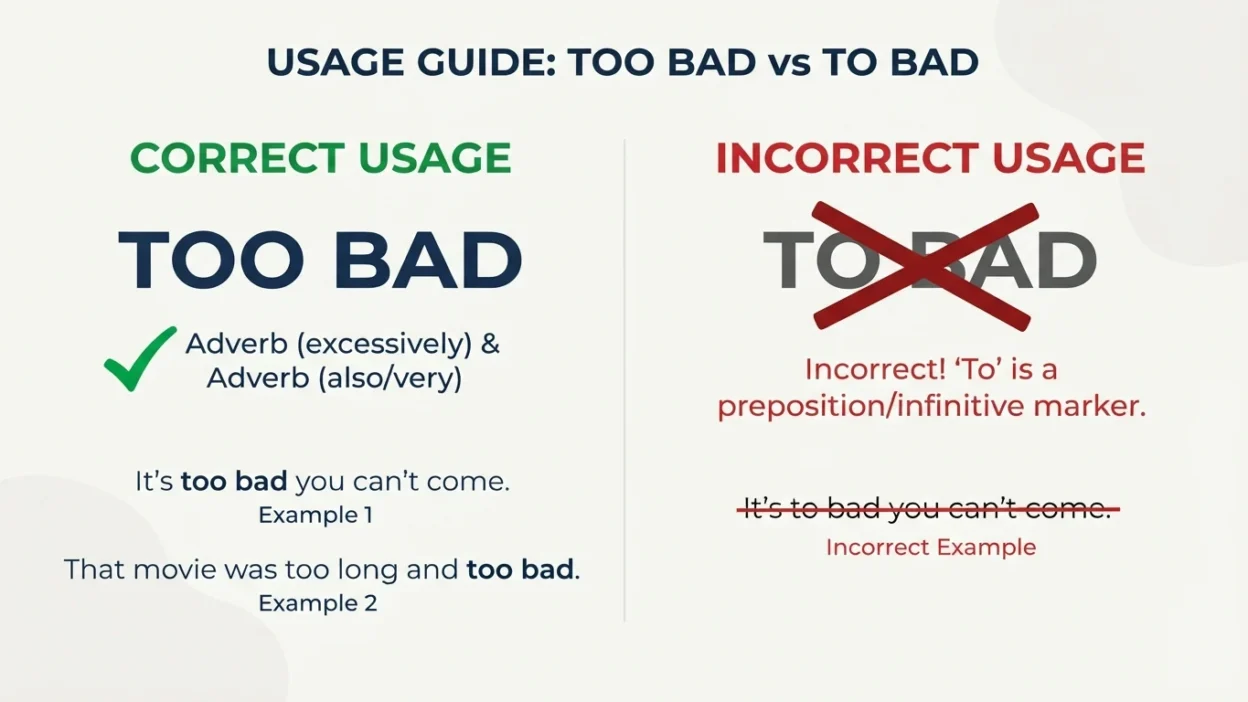
“Too bad” is the correct phrase and means “unfortunate” or “regrettable.” “To bad” is grammatically incorrect in standard English because “to” cannot directly modify “bad” in this context. Always use “too bad” when expressing disappointment or sympathy.
Why People Confuse It
The confusion between “to bad” and “too bad” mainly comes from pronunciation. Both phrases sound almost identical in spoken English, which makes it easy to mix them up when writing.
Another reason is misunderstanding the word “too.” Many people forget that “too” means “excessively” or “also.” When used in “too bad,” it emphasizes the negative situation.
In fast typing or informal communication, people may accidentally type “to bad” without noticing. However, this small mistake can affect clarity and credibility, especially in formal writing.
First Word
The word “to” is a preposition or part of an infinitive verb. It usually connects actions or shows direction.
Examples include:
- Going to school
- Want to eat
- Give it to her
“To” cannot describe adjectives like “bad” directly. That is why “to bad” does not form a correct phrase in English.
Understanding this basic rule helps you avoid many similar mistakes, not just this one.
Second Word
The word “too” has a completely different function. It means “excessively,” “very,” or “also.”
In “too bad,” the word “too” emphasizes the degree of something negative. It expresses regret, disappointment, or sympathy.
Examples:
- That is too bad you missed the event
- It is too bad we cannot meet today
Here, “too” strengthens the meaning of “bad,” making the phrase correct and meaningful.
Definition and Meaning
“Too bad” means something unfortunate, disappointing, or regrettable. It is often used to respond to a situation that did not go well.
For example:
- It is too bad the trip was canceled
The phrase expresses mild sympathy or acceptance of a negative outcome. It is commonly used in both spoken and written English.
On the other hand, “to bad” has no recognized meaning in standard grammar, which is why it should be avoided.
Pronunciation Guide
Both “to bad” and “too bad” sound the same in spoken English. This is why people often confuse them.
Pronunciation:
- Too bad sounds like “too bad”
Because there is no difference in sound, you must rely on spelling and grammar rules when writing.
Paying attention while typing is key, especially in formal communication.
Grammar Rules Explained
The main rule is simple: “too” modifies adjectives, while “to” does not.
“Too” can:
- Emphasize an adjective
- Show excess or degree
“Bad” is an adjective, so it needs “too,” not “to.”
Incorrect: to bad
Correct: too bad
Once you understand this rule, the confusion disappears completely.
Real Life Usage
“Too bad” appears frequently in everyday conversations. People use it to express sympathy or mild disappointment.
For example:
- Too bad you missed the movie
- It is too bad the shop is closed
It is a polite and simple way to react to unfortunate situations. You will hear it often in casual speech.
Formal vs Informal Use
“Too bad” works in both formal and informal contexts, but its tone is usually casual.
In formal writing, you might replace it with:
- Unfortunately
- Regrettably
However, in conversations and emails, “too bad” is perfectly acceptable.
“To bad” should never be used in either context.
Comparison Table
| Feature | Too Bad | To Bad |
|---|---|---|
| Correct usage | Yes | No |
| Meaning | Unfortunate or regrettable | No meaning |
| Grammar role | Adverb + adjective | Incorrect structure |
| Common usage | Very common | Common mistake |
When to Use Each
Use “too bad” when:
- Expressing disappointment
- Showing sympathy
- Talking about an unfortunate event
Never use “to bad” because it is not grammatically valid.
A quick test is to ask yourself if you mean “unfortunate.” If yes, use “too bad.”
Examples
Here are real examples to make it clear:
- It is too bad you could not come
- That is too bad about your exam
- Too bad we missed the train
- It is too bad the weather changed
- Too bad they canceled the show
- It is too bad he is not here
- Too bad you forgot your phone
- It is too bad the deal failed
- Too bad we cannot try again
- It is too bad she left early
All of these are correct because they use “too bad.”
Common Sentences
You will often hear “too bad” in simple responses:
- Too bad, maybe next time
- That is too bad to hear
- Too bad it did not work out
These sentences are short but express clear meaning. They are widely used in everyday English.
Common Mistakes
The most frequent mistake is writing “to bad” instead of “too bad.”
Other related errors include:
- Mixing up “to,” “too,” and “two”
- Forgetting that “too” adds emphasis
Always double check your spelling, especially in emails or assignments.
Mistakes to Avoid
Avoid these habits:
- Typing quickly without proofreading
- Ignoring small grammar differences
- Relying only on pronunciation
Instead, focus on understanding meaning and usage.
Memory Trick
Here is a simple trick:
“Too” has an extra “o,” just like it means “extra” or “more.”
So when something is “too bad,” it means “extra bad” or “very unfortunate.”
This trick makes it easy to remember the correct form.
American vs British English
Both American and British English use “too bad” in the same way.
There is no difference in spelling or meaning between the two versions.
“To bad” is incorrect in both forms of English.
Similar Words
Other commonly confused words include:
- To vs too vs two
- Your vs you are
- Their vs there vs they are
Learning these differences will improve your overall writing skills.
Synonyms and Alternatives
Instead of “too bad,” you can use:
- Unfortunately
- Sadly
- Regrettably
- That is a shame
These alternatives are useful in formal writing or when you want variety.
Related Confusing Words
Some phrases similar to this confusion include:
- Loose vs lose
- Affect vs effect
- Then vs than
These pairs also require attention to detail.
Expert Tips
- Always proofread your writing
- Learn the role of each word
- Practice with real sentences
Improving grammar takes time, but small corrections make a big difference.
Final Verdict
“Too bad” is the correct and meaningful phrase used to express disappointment or sympathy. It is simple, widely used, and easy to remember once you understand the role of “too.”
“To bad” is a common mistake that should be avoided in all forms of writing. It does not follow standard grammar rules and can weaken your communication.
FAQs
Is “to bad” ever correct?
No, it is always incorrect in standard English.
What does “too bad” mean?
It means something unfortunate or disappointing.
Can I use “too bad” in formal writing?
Yes, but alternatives like “unfortunately” may sound more formal.
Why do people confuse “to” and “too”?
Because they sound the same in speech.
Is “too bad” rude?
Not usually, but tone depends on context.
What is the easiest way to remember it?
Think of “too” as meaning “extra,” so “too bad” means “very bad.”
Remember This
Always use “too bad” when expressing disappointment. The extra “o” in “too” reminds you it adds emphasis. Never write “to bad.”
Conclusion
Understanding the difference between “to bad” and “too bad” is a small but powerful step toward better English. While they sound identical, only “too bad” carries meaning and follows correct grammar rules.
By applying simple memory tricks and paying attention to context, you can avoid this common mistake. Clear writing builds confidence, and mastering these details helps you communicate more effectively in both casual and professional situations.

Donald Andrew is a dedicated author at BiblyWord, passionate about sharing biblical teachings in a clear and inspiring way. He creates meaningful content that helps readers understand scripture, reflect on their faith, and apply God’s Word in daily life. His work supports spiritual growth, guidance, and a deeper connection with biblical wisdom.