Understanding the difference between “to that effect” and “affect” can instantly improve your writing clarity. These phrases look similar but serve completely different purposes, and mixing them up can confuse your message. Let’s break it down in a clear, practical way.
Many learners and even fluent speakers struggle with this pair because both relate to meaning or impact. However, one is a fixed phrase used in conversation and writing, while the other is a verb (and sometimes a noun) used in grammar and psychology.
By the end of this guide, you will confidently know when to use each, avoid common mistakes, and sound more natural in both formal and casual communication.
Quick Answer
“To that effect” means something similar or along those lines, often used to summarize or paraphrase a statement. “Affect” is usually a verb meaning to influence or change something. Use “to that effect” for expressing approximate meaning and “affect” when talking about impact or influence.
Why People Confuse It
Many people confuse “to that effect” and “affect” because both relate to meaning or influence. The word “effect” is part of the phrase “to that effect,” while “affect” sounds almost identical in pronunciation.
Another reason is that both appear in formal writing. When learners see “effect” and “affect,” they often assume they are interchangeable. In reality, they belong to different grammatical categories and serve different roles in a sentence.
The confusion increases when people already struggle with “affect vs effect.” Adding “to that effect” makes it even trickier. The key is to focus on usage patterns rather than spelling alone.
Definition and Meaning
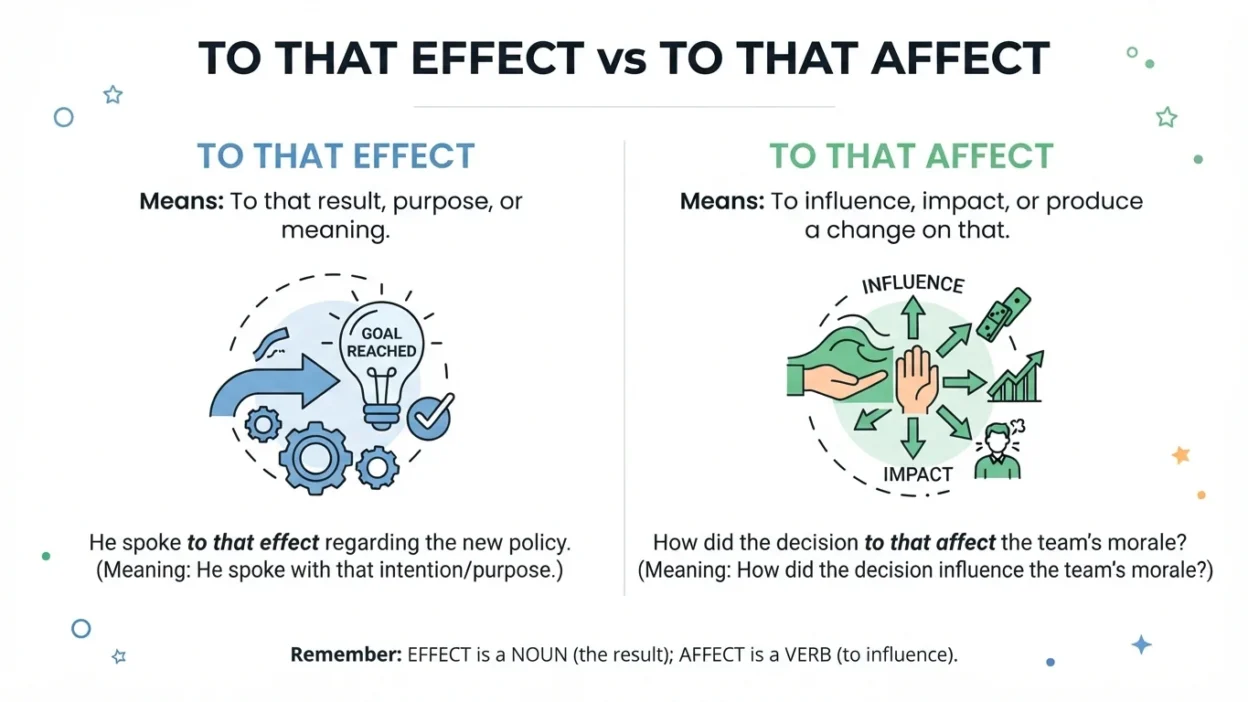
“To that effect” is an idiomatic expression. It means “something similar” or “in that sense.” It does not refer to direct impact but rather to the general idea of what was said.
“Affect,” on the other hand, is primarily a verb. It means to influence, change, or impact something. It is used when one thing causes a change in another.
Understanding this difference is essential. One expresses similarity in meaning, while the other expresses influence or change.
First Word: To That Effect
“To that effect” is a phrase used to summarize or paraphrase what someone said. It often appears in conversations, reports, or storytelling.
For example, if someone does not remember the exact words, they might say something “to that effect.” This shows approximation rather than exact quotation.
It is commonly used in both spoken and written English. You will often hear it in meetings, interviews, or informal discussions where precision is less important than meaning.
Second Word: Affect
“Affect” is mostly used as a verb. It describes how something influences or changes something else.
For example, weather can affect your mood, and decisions can affect outcomes. It focuses on cause and impact.
In psychology, “affect” can also be a noun describing emotional expression, but this is less common in everyday usage.
Grammar Rules Explained
“To that effect” functions as a phrase and does not change form. You simply place it in a sentence where you want to express approximate meaning.
“Affect” follows standard verb rules. It changes based on tense and subject. For example:
- Affect
- Affects
- Affected
- Affecting
Because “affect” behaves like a verb, it must agree with the subject and tense of the sentence.
Pronunciation Guide
“To that effect” is pronounced clearly as separate words. The emphasis is usually on “effect.”
“Affect” is pronounced with stress on the second syllable. This is one reason people confuse it with “effect.”
Listening to native speakers can help you distinguish the subtle differences in pronunciation and usage.
Comparison Table
| Feature | To That Effect | Affect |
|---|---|---|
| Type | Phrase | Verb (mostly) |
| Meaning | Something similar | To influence |
| Usage | Paraphrasing | Showing impact |
| Example | He said something to that effect | Stress can affect sleep |
This table gives a quick visual comparison to help you remember the difference.
When to Use Each
Use “to that effect” when:
- You are summarizing someone’s words
- You are not quoting exactly
- You want to express a similar idea
Use “affect” when:
- You are describing influence or impact
- You are explaining cause and effect
- You are talking about change
Choosing correctly depends on whether you are describing meaning or impact.
Real Life Usage
In everyday life, “to that effect” is often used in conversations. For example, someone might say they heard a comment “to that effect” when they cannot recall exact wording.
“Affect” is used in practical situations like health, work, and decisions. For instance, lack of sleep can affect your productivity.
Both are useful, but they belong in completely different contexts.
Examples in Sentences
Here are real examples to clarify usage:
- She said something to that effect during the meeting.
- He made a comment to that effect yesterday.
- The teacher explained it to that effect.
- They agreed to something to that effect.
- I remember him saying something to that effect.
- Stress can affect your health.
- Weather can affect travel plans.
- This decision will affect the outcome.
- Noise can affect concentration.
- Lack of sleep affects performance.
These examples show how each fits naturally into sentences.
Common Sentences
You will often hear phrases like:
- “He said something to that effect.”
- “The changes will affect everyone.”
These are standard patterns. Learning them helps you use the words naturally without overthinking.
Repeating such sentence structures can build confidence in both speaking and writing.
Common Mistakes
A frequent mistake is using “affect” when you mean “to that effect.” For example, writing “He said something affect” is incorrect.
Another mistake is trying to use “to that effect” to describe impact. This leads to confusing sentences.
To avoid errors:
- Check if you are talking about meaning or influence
- Replace the word mentally to test clarity
Mistakes to Avoid
Avoid mixing up:
- Affect and effect
- Effect and “to that effect”
Also, avoid overusing “to that effect” in formal writing. It works best when clarity is needed without exact quoting.
Keeping sentences simple will help reduce confusion.
Memory Trick
A simple trick can help:
- “Affect” starts with A, think Action or influence
- “To that effect” contains “effect,” think Expression or meaning
This mental shortcut makes it easier to choose the correct word quickly.
Formal vs Informal Use
“To that effect” works in both formal and informal settings, but it is more common in conversational or narrative writing.
“Affect” is widely used in formal writing, academic texts, and professional communication.
Understanding tone helps you decide which word fits best in your context.
Synonyms and Alternatives
Alternatives for “to that effect”:
- Something similar
- In that sense
- Along those lines
Alternatives for “affect”:
- Influence
- Impact
- Change
Using synonyms can help avoid repetition and improve writing variety.
Similar Words
Words related to “affect” include:
- Effect
- Impact
- Influence
Phrases similar to “to that effect” include:
- In other words
- Roughly speaking
- More or less
Learning these variations strengthens your vocabulary.
Expert Tips
- Always identify whether your sentence is about meaning or impact
- Practice with real sentences
- Read examples from books and articles
- Avoid guessing based on spelling alone
Consistency and practice are the best ways to master this pair.
Related Confusing Words
You might also struggle with:
- Affect vs effect
- Then vs than
- Accept vs except
These pairs often confuse learners, so practicing them together can be helpful.
Frequently Asked Questions
What does “to that effect” mean?
It means something similar or along the same lines as what was said.
Is “affect” always a verb?
Mostly yes, but it can be a noun in psychology.
Can I use “to that effect” in formal writing?
Yes, but use it carefully to maintain clarity.
What is the easiest way to remember “affect”?
Think of it as “to influence.”
Is “to that effect” the same as “effect”?
No, it is a phrase with a different meaning.
Why do people confuse these words?
Because they sound similar and both relate to meaning or impact.
Final Verdict
“To that effect” and “affect” may look similar, but they serve very different purposes. One helps you express approximate meaning, while the other describes influence or change.
Mastering this distinction will improve your writing clarity and confidence. Once you understand the context, choosing the right word becomes much easier.
Conclusion
Learning the difference between “to that effect” and “affect” is not as difficult as it seems. The key is to remember that one is a phrase used for summarizing meaning, while the other is a verb used for influence.
With practice, you will start recognizing their correct usage naturally. Keep reading, writing, and applying these rules in real situations to strengthen your understanding.
Remember This
- “To that effect” = similar meaning
- “Affect” = influence or impact
- Think meaning vs action
This quick reminder can help you avoid confusion instantly.

Carol Amanda is a passionate writer and faith-driven author dedicated to sharing the wisdom of the Bible. At BiblyWord, she creates inspiring and meaningful content that encourages spiritual growth and daily reflection. Her work focuses on helping readers connect with God’s Word and find guidance, peace, and strength in their faith journey.