Many English learners and even native speakers get confused between take effect and take affect. At first glance, both phrases seem similar, but only one is actually correct in standard English. This confusion often happens because the words effect and affect sound alike and are frequently mixed up in writing and speech.
Understanding the difference is important, especially in formal writing, academic work, and professional communication. Using the wrong phrase can make your message unclear or even incorrect. In this guide, you’ll learn the correct usage, meanings, grammar rules, and real-life examples so you can confidently use the right phrase every time.
Quick Answer
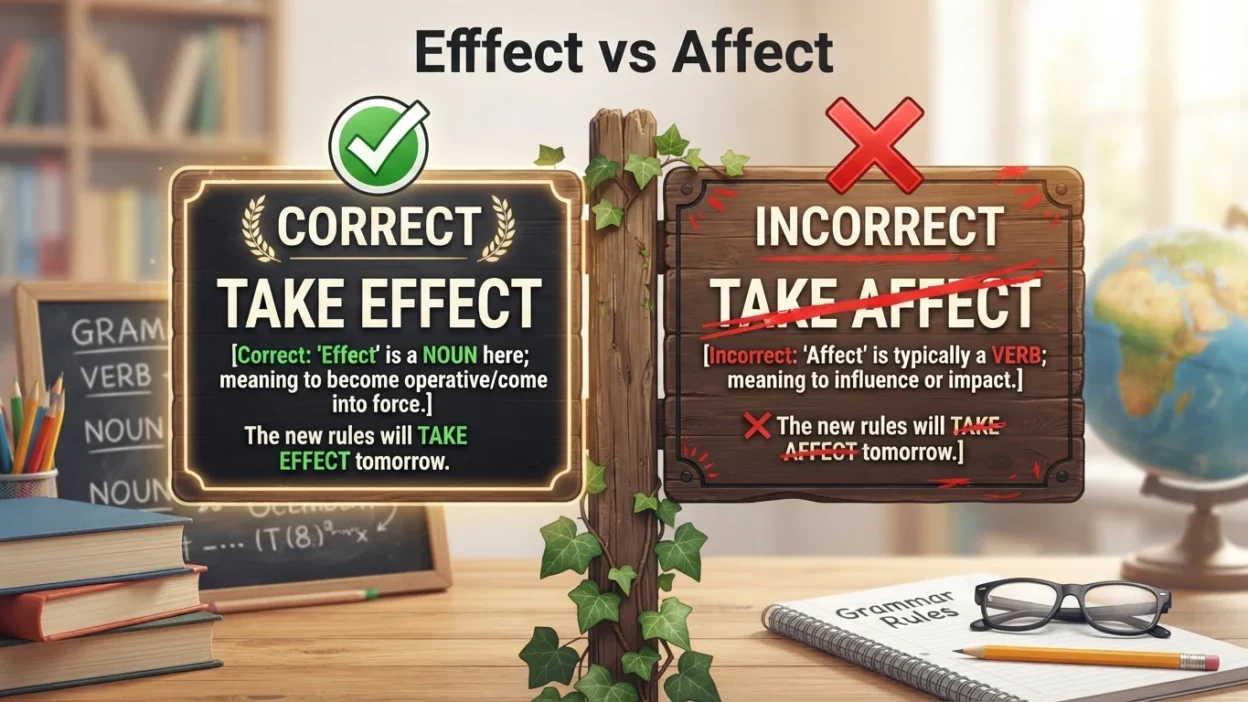
Take effect is the correct phrase, meaning “to begin to work or become active.” Take affect is incorrect in standard English usage. Always use take effect when referring to something starting to have an impact, such as laws, rules, or changes.
Definition and Meaning
Take effect means something begins to operate or produce results. It is commonly used for laws, policies, medications, and decisions.
The phrase take affect is incorrect because affect is usually a verb, not a noun. Therefore, it does not fit grammatically in this structure.
In simple terms:
- Effect is a result or outcome
- Affect is usually an action or influence
Why People Confuse It
The confusion mainly comes from pronunciation. Affect and effect sound very similar, especially in fast speech.
Another reason is their related meanings. Both words deal with change or influence, which makes them easy to mix up.
People also assume both phrases exist, but only take effect is correct. This misunderstanding leads to frequent writing errors.
First Word: Take Effect
Take effect is a standard and widely accepted phrase in English.
It is used when something officially starts working or becomes active. For example, a new law or policy “takes effect” on a certain date.
This phrase is commonly used in:
- Legal contexts
- Medical situations
- Everyday communication
Second Word: Take Affect
Take affect is not a correct phrase in English.
The word affect is usually a verb, meaning to influence something. Since take effect requires a noun, affect does not fit.
Using take affect is considered a grammatical mistake and should be avoided.
Grammar Rules Explained
The phrase structure requires a noun after “take.” That noun must represent a result or outcome.
Effect is a noun, so it works perfectly.
Example: The policy will take effect tomorrow.
Affection or affect does not function as a noun in this context, making the phrase incorrect.
Comparison Table
| Feature | Take Effect | Take Affect |
|---|---|---|
| Correct usage | Yes | No |
| Meaning | Become active or start working | Incorrect phrase |
| Word type | Effect is a noun | Affect is usually a verb |
| Common contexts | Laws, rules, medicine | None |
| Grammar | Correct | Incorrect |
When to Use Each
Use take effect when something starts working or producing results.
Examples:
- Laws taking effect
- Medicine starting to work
- Policies becoming active
Never use take affect because it is grammatically incorrect.
Real Life Usage
You will often hear take effect in real situations like government announcements or medical advice.
For example, when a new rule is announced, officials will specify when it will take effect.
Similarly, doctors may explain when a medication will take effect after consumption.
Formal vs Informal Use
Take effect is used in both formal and informal settings.
In formal writing, such as contracts or official notices, it is very common.
In casual conversation, people also use it when talking about changes or results.
Pronunciation Guide
Both words sound similar but differ slightly in stress.
- Affect: stress on the second syllable
- Effect: stress on the second syllable but softer
Listening carefully helps distinguish them over time.
Synonyms and Alternatives
Instead of take effect, you can use:
- Become active
- Start working
- Come into force
- Begin
These alternatives can help vary your writing.
Common Sentences
Here are some natural sentences:
- The new law will take effect next month.
- The changes take effect immediately.
- The medicine will take effect in 30 minutes.
These examples show how commonly the phrase is used.
Examples
Here are 10 real examples:
- The new policy will take effect tomorrow.
- The rules take effect from January.
- The medicine takes effect quickly.
- The decision will take effect soon.
- The ban takes effect next week.
- The changes take effect immediately.
- The contract takes effect today.
- The update will take effect overnight.
- The law takes effect nationwide.
- The treatment takes effect within hours.
Common Mistakes
One major mistake is writing take affect instead of take effect.
Another mistake is confusing affect and effect in general writing.
People also misuse the phrase in sentences where it does not fit logically.
Mistakes to Avoid
Avoid:
- Using affect as a noun in this phrase
- Writing based on sound instead of meaning
- Ignoring grammar rules
Always double-check your usage in formal writing.
Memory Trick
Remember this simple trick:
Effect equals end result.
Since something “taking effect” produces a result, this helps you choose the correct word.
American vs British English
There is no difference between American and British English in this case.
Both use take effect as the correct phrase.
Take affect is incorrect in all standard forms of English.
Similar Words
Words often confused with effect include:
- Affect
- Impact
- Result
- Outcome
Understanding these helps improve clarity.
Related Confusing Words
Other confusing pairs include:
- Affect vs Effect
- Accept vs Except
- Advise vs Advice
Learning these pairs improves writing accuracy.
Expert Tips
Always identify whether you need a noun or a verb.
If the phrase refers to a result starting, choose effect.
Practice writing sentences to reinforce the correct usage.
When Does Take Effect Apply
Use it when:
- Something officially starts
- A change becomes active
- A process begins
This makes your communication clear and precise.
Final Verdict
Take effect is the only correct phrase and should always be used when referring to something starting to work or become active.
Take affect is incorrect and should be avoided in all forms of writing. Mastering this distinction will improve your grammar and make your communication more professional.
FAQs
1. Is take affect ever correct?
No, it is always incorrect in standard English.
2. What does take effect mean?
It means to begin working or become active.
3. Why do people confuse affect and effect?
Because they sound similar and have related meanings.
4. Can affect be a noun?
Rarely, but not in this phrase.
5. Where is take effect commonly used?
In laws, policies, medicine, and everyday speech.
6. Is take effect formal?
It is used in both formal and informal contexts.
Remember This
Always use take effect when something begins to work.
Think: Effect equals result.
Avoid take affect completely, as it is grammatically incorrect.
Conclusion
Understanding the difference between take effect and take affect is simple once you know the roles of affect and effect. The correct phrase, take effect, is widely used to describe when something begins to operate or produce results. It appears in legal, medical, and everyday contexts, making it an essential phrase to master.
On the other hand, take affect is not correct and should never be used. By remembering that effect represents a result, you can avoid this common mistake. With practice and awareness, you will use the correct phrase naturally and confidently in all your writing.

Kevin Brian is a passionate author at BiblyWord, dedicated to sharing the message of the Bible through thoughtful and inspiring content. He focuses on creating clear and meaningful writings that help readers understand scripture, strengthen their faith, and find guidance in everyday life through God’s Word.