Have you ever stopped mid sentence and wondered if to write who’s or whose? You are not alone. These two words sound the same, but they have very different meanings.
This is a common confusion in English, even for experienced writers. The good news is that once you understand the rule, it becomes very easy to choose the right word every time.
Let’s break down who’s vs whose in a clear and simple way.
Quick Answer
Who’s means who is or who has.
Whose shows possession or ownership.
Use who’s for contractions and whose when talking about something that belongs to someone.
Why People Confuse It
The confusion happens because both words sound exactly the same when spoken.
Common reasons:
- Same pronunciation
- Mixing up apostrophes
- Not knowing the difference between contraction and possession
But their meanings are completely different.
First Word: Who’s
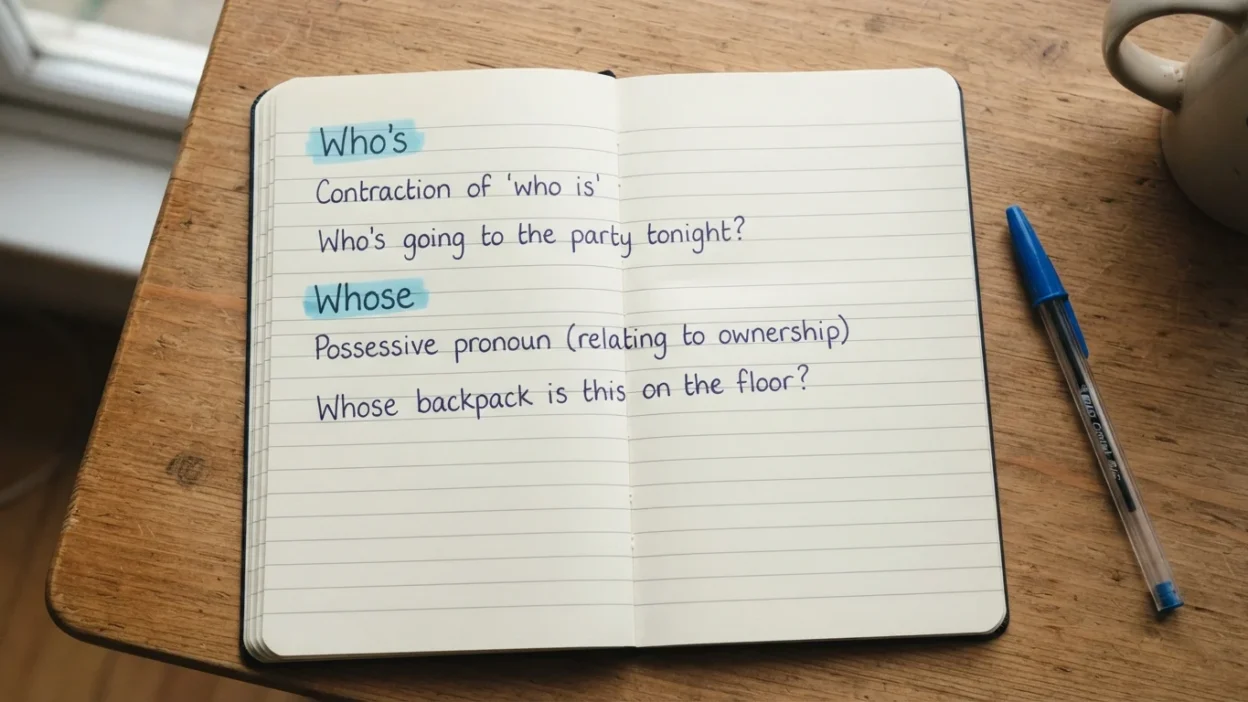
Who’s is a contraction. It is short for:
- Who is
- Who has
Examples:
- Who’s coming to the party
- Who’s finished the work
- Who’s your teacher
If you can replace it with who is or who has, then who’s is correct.
Second Word: Whose
Whose is a possessive word. It shows ownership.
Examples:
- Whose book is this
- Whose car is parked outside
- Whose idea was this
It is used when asking or talking about something that belongs to someone.
Comparison Table
| Feature | Who’s | Whose |
|---|---|---|
| Type | Contraction | Possessive |
| Meaning | Who is or who has | Belonging to someone |
| Usage | Informal and formal | Formal and informal |
| Recommendation | Use for short forms | Use for ownership |
When to Use Each
Use who’s when:
- You mean who is or who has
- Writing casual or formal sentences
Use whose when:
- Asking about ownership
- Describing something that belongs to someone
Examples
Correct examples with who’s:
- Who’s at the door
- Who’s ready to start
- Who’s been working here
- Who’s calling you
- Who’s your best friend
Correct examples with whose:
- Whose phone is ringing
- Whose bag is on the table
- Whose shoes are these
- Whose turn is it
- Whose idea was this
Incorrect example:
- Who’s book is this
Correct form:
- Whose book is this
Common Mistakes
Writers often:
- Use who’s instead of whose
- Forget that apostrophes do not show possession here
- Confuse contractions with ownership
Always check the meaning of your sentence.
Memory Trick
Think of this:
Who’s means who is, whose means ownership
If you can replace it with who is, use who’s.
If not, use whose.
American vs British English
Both American and British English use who’s and whose the same way.
There is no difference in spelling or usage.
Similar Words
Here are similar confusing pairs:
- It’s and its
- They’re and their
- You’re and your
They follow the same pattern of contraction vs possession.
Final Verdict
The difference is simple. Who’s means who is or who has.
Whose shows ownership.
Choosing the correct word makes your writing clear and correct.
FAQs
What does who’s mean
It means who is or who has.
What does whose mean
It shows ownership or belonging.
Can I use who’s for possession
No, whose is used for possession.
How do I check which one to use
Replace who’s with who is. If it fits, it is correct.
Is there a difference in British and American English
No, both use them the same way.
Why are these words confusing
Because they sound the same but have different meanings.
Conclusion
Understanding who’s vs whose is easy once you know the rule. Small grammar mistakes like this can affect clarity, but they are simple to fix.
By using the correct word, your writing becomes more accurate and professional. With practice, this choice will become natural.
Remember This
Use who’s for who is or who has.
Use whose for ownership.

Donald Andrew is a dedicated author at BiblyWord, passionate about sharing biblical teachings in a clear and inspiring way. He creates meaningful content that helps readers understand scripture, reflect on their faith, and apply God’s Word in daily life. His work supports spiritual growth, guidance, and a deeper connection with biblical wisdom.