The difference between theirs vs theres may seem small, but these spellings do not have the same grammatical status. Theirs is a correct English possessive pronoun used to show ownership. Theres, without an apostrophe, is generally incorrect in standard English. In most cases, people who write theres actually mean there’s, the contraction of there is or there has.
The confusion becomes easier to understand because theirs, there’s, and there can sound similar in everyday speech. When writing quickly, especially in texts, emails, or social media posts, it is easy to leave out the apostrophe or choose the wrong spelling. Learning what each form does in a sentence will help you avoid this common mistake. This guide explains theirs vs theres, their meanings, grammar rules, examples, pronunciation, and simple memory tricks.
Quick Answer
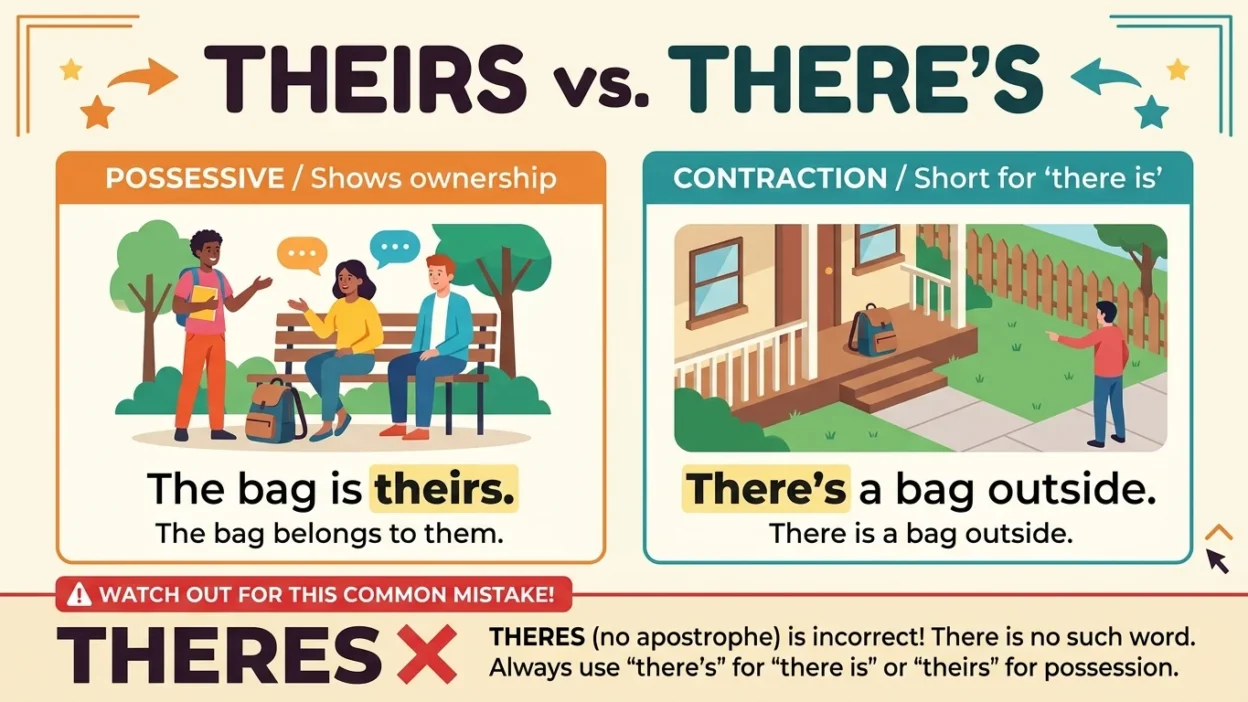
Theirs is a possessive pronoun meaning something belongs to them, as in “The house is theirs.” Theres is not a standard English word. Usually, the intended word is there’s, which is a contraction of there is or there has, as in “There’s a problem.”
Theirs vs Theres Definition and Meaning
The easiest way to understand theirs vs theres is to look at what each spelling represents.
Theirs is a standard English possessive pronoun. It indicates that something belongs to, is associated with, or relates to certain people or entities.
For example:
- The blue car is theirs.
- That decision was theirs to make.
- Our room is smaller than theirs.
Theres, on the other hand, is generally a spelling mistake in standard written English. Most writers using theres intend to write there’s.
There’s can mean:
- there is
- there has
For example, “There’s a meeting today” means “There is a meeting today.”
Why People Confuse Theirs and Theres
People often confuse theirs and theres because English contains several words that sound similar but have completely different grammatical functions.
Words such as their, theirs, there, and there’s are especially troublesome for learners because pronunciation does not always make the differences obvious.
Another reason is informal digital communication. People frequently omit apostrophes while texting or posting online. Someone may type:
“Theres nothing here.”
The intended sentence is:
“There’s nothing here.”
The similarity between theirs and there’s can create additional confusion when people rely on sound rather than grammar.
The solution is to focus on meaning. If you are talking about ownership, use theirs. If you can replace the word with there is or there has, use there’s.
What Does Theirs Mean?
Theirs is a possessive pronoun. It indicates ownership or association and refers back to people or things already understood from the context.
For example:
“The bicycles outside are theirs.”
Here, theirs tells us that the bicycles belong to them.
Unlike their, the word theirs does not normally appear directly before a noun.
Compare:
“Their bicycle is outside.”
“The bicycle outside is theirs.”
In the first sentence, their modifies the noun bicycle. In the second, theirs stands independently.
Other examples include:
- This responsibility is theirs.
- The final choice is theirs.
- My garden is smaller than theirs.
- Those seats are theirs.
If the word can mean belonging to them, theirs is probably the correct choice.
What Does Theres Mean?
Theres without an apostrophe is generally not a standard English word. When you see it in informal writing, it is usually a misspelling of there’s.
Correct:
“There’s a dog outside.”
Incorrect:
“Theres a dog outside.”
The apostrophe matters because there’s is a contraction. It usually represents there is or there has.
For example:
“There’s plenty of time.”
means:
“There is plenty of time.”
And:
“There’s been an accident.”
means:
“There has been an accident.”
Therefore, when comparing theirs vs theres, remember that theirs is a valid possessive pronoun, while theres normally needs an apostrophe to become there’s.
Theirs vs Theres Comparison Table
| Feature | Theirs | Theres |
|---|---|---|
| Standard spelling? | Yes | Generally no |
| Part of speech | Possessive pronoun | Not a standard form |
| Main meaning | Belonging to them | Usually intended as “there’s” |
| Shows ownership? | Yes | No |
| Needs an apostrophe? | No | Usually should be “there’s” |
| Example | The bags are theirs. | “Theres a problem” is incorrect |
| Correct alternative | Theirs | There’s |
The key distinction is simple: theirs shows possession, while theres is generally a misspelling of there’s.
Theirs vs There’s
A more accurate comparison is actually theirs vs there’s, because both are legitimate English forms.
Theirs means belonging to them:
“The larger apartment is theirs.”
There’s means there is or there has:
“There’s a larger apartment upstairs.”
These words perform completely different jobs.
Try expanding there’s whenever you are unsure:
“There’s someone outside.”
becomes:
“There is someone outside.”
That works perfectly.
But:
“The house is there’s.”
would become:
“The house is there is.”
That makes no sense. The correct sentence is:
“The house is theirs.”
This substitution test is one of the fastest ways to choose correctly.
Theirs vs Their
Their and theirs both indicate possession, but they occupy different positions in a sentence.
Their is a possessive determiner and normally comes before a noun:
“Their car is new.”
Theirs is a possessive pronoun and replaces the noun phrase:
“The new car is theirs.”
Compare more examples:
- Their office is upstairs.
- The upstairs office is theirs.
- Their idea won.
- The winning idea was theirs.
A useful test is to check whether a noun immediately follows the possessive word.
Use their + noun:
“their house”
Use theirs independently:
“The house is theirs.”
Never write theirs house. That construction is incorrect in standard English.
Theirs vs There
Theirs and there can also cause confusion because of their similar pronunciation.
Theirs indicates possession:
“The books are theirs.”
There generally refers to a place, position, or existence:
“Put the books over there.”
“There are three books on the table.”
The meanings are completely different.
Think of there as connected with where. Both words contain here, which can help you remember their relationship to location.
Think of theirs as connected with their. Both indicate possession.
Compare:
“Their bags are over there.”
“The bags over there are theirs.”
Seeing the words together often makes their different grammatical roles much easier to recognize.
Pronunciation Guide for Theirs and There’s
In many varieties of English, theirs and there’s sound extremely similar and may be effectively indistinguishable in ordinary speech.
That is one reason spelling mistakes happen so frequently.
Theirs is generally pronounced like “thairz.”
There’s is also generally pronounced like “thairz.”
Because pronunciation may not help you distinguish them, you need to consider the meaning and grammar of the sentence.
For example:
“The table is theirs.”
Here, ownership makes theirs correct.
“There’s a table in the kitchen.”
Here, the expression means there is, so there’s is correct.
When speaking, context communicates the difference. When writing, spelling and punctuation show which meaning you intend.
Grammar Rules Explained
The grammar behind theirs vs theres becomes simple once you understand the roles involved.
Rule 1: Use theirs to express possession without placing a noun immediately after it.
“The tickets are theirs.”
Rule 2: Do not add an apostrophe to theirs.
Incorrect: “The tickets are their’s.”
Correct: “The tickets are theirs.”
Rule 3: If you mean there is or there has, write there’s, including the apostrophe.
“There’s something unusual here.”
Rule 4: Do not normally write theres in standard edited English.
Rule 5: Use their when a noun follows.
“Their tickets are on the desk.”
These five rules cover most situations in which writers confuse these forms.
When to Use Theirs
Use theirs when you need a possessive pronoun meaning belonging to them.
For example:
“Our project is finished, but theirs is still being reviewed.”
The noun does not need to be repeated because theirs replaces the possessive noun phrase.
You can use theirs for physical possessions:
“The black suitcase is theirs.”
You can also use it for abstract things:
“The responsibility was theirs.”
“The idea was originally theirs.”
It can refer to choices, opinions, duties, achievements, spaces, possessions, and many other relationships.
Ask yourself:
Does this mean “belonging to them” or “the one belonging to them”?
If yes, theirs is likely correct.
When to Use There’s Instead of Theres
Use there’s when the expression can be expanded to there is or there has.
For example:
“There’s a package at the door.”
Expand it:
“There is a package at the door.”
The sentence still makes sense.
Another example:
“There’s been a misunderstanding.”
Expand it:
“There has been a misunderstanding.”
Again, the sentence works.
The apostrophe indicates that letters have been omitted when the two words are contracted.
Therefore:
❌ Theres a problem.
✅ There’s a problem.
❌ Theres been a change.
✅ There’s been a change.
When writing professionally, academically, or formally, remembering the apostrophe is particularly important.
When to Use Each Form
Choosing between these forms becomes much easier when you ask what you want the sentence to communicate.
Use theirs for ownership:
“The final decision is theirs.”
Use there’s for there is:
“There’s one decision left to make.”
Use there’s for there has:
“There’s been a major change.”
Do not use theres as a replacement for either one in standard writing.
A useful three-question check is:
- Does it mean belonging to them? → theirs
- Does it mean there is or there has? → there’s
- Does it refer to a place? → probably there
This quick process prevents most errors.
Theirs vs Theres Examples
Examples are one of the easiest ways to master the difference.
- The red bicycle is theirs.
- That responsibility is theirs.
- Our apartment is smaller than theirs.
- The winning proposal was theirs.
- These keys are theirs, not mine.
- There’s a bicycle outside.
- There’s something on the table.
- There’s been a change in the schedule.
- There’s no reason to worry.
- There’s a meeting tomorrow.
- The seats near the window are theirs.
- There’s someone waiting outside.
- This office is ours, and that one is theirs.
- There’s been significant improvement.
- The final decision was entirely theirs.
Notice how theirs always relates to possession, whereas there’s introduces there is or there has.
Real Life Usage
You will encounter theirs and there’s frequently in everyday communication.
Imagine two families staying at a hotel:
“Our room is on the second floor. The room upstairs is theirs.”
Here, theirs identifies which room belongs to or is assigned to the other family.
Now imagine someone pointing toward the lobby:
“There’s a coffee shop downstairs.”
Here, there’s means there is.
In a workplace, you might hear:
“The final responsibility is theirs.”
Or:
“There’s been a delay with the project.”
The words may sound alike when spoken, but their functions remain different. Context determines which form is needed, while correct spelling makes the intended meaning clear in writing.
Common Mistakes With Theirs and Theres
One common error is writing theres without an apostrophe:
❌ Theres a new restaurant nearby.
✅ There’s a new restaurant nearby.
Another mistake is adding an apostrophe to theirs:
❌ That car is their’s.
✅ That car is theirs.
Possessive pronouns such as yours, ours, hers, and theirs do not require apostrophes.
Writers may also confuse their and theirs:
❌ Theirs house is beautiful.
✅ Their house is beautiful.
But:
✅ The beautiful house is theirs.
Finally, do not confuse there with theirs:
❌ Put the package over theirs.
✅ Put the package over there.
Understanding each word’s grammatical job is more reliable than choosing based on sound.
Theirs in Formal and Informal English
Theirs is completely standard in both formal and informal English.
Informally, you might say:
“That jacket is theirs.”
In a more formal context:
“The responsibility for approving the proposal is theirs.”
The grammar remains the same.
There’s is also extremely common in conversation and ordinary writing. In highly formal prose, writers may sometimes prefer the expanded there is or there has, depending on style.
For example:
Informal:
“There’s been considerable progress.”
More formal:
“There has been considerable progress.”
The spelling theres, however, should generally be avoided in standard writing regardless of formality.
American vs British English
There is no major American–British difference in the basic rules for theirs, there, their, and there’s.
In both American and British English:
Theirs indicates possession.
“The property is theirs.”
There’s is a contraction of there is or there has.
“There’s been an improvement.”
Their appears before a noun.
“Their property is nearby.”
And there can indicate place or be used in existential constructions.
“The property is over there.”
Spelling conventions differ between American and British English in many areas, but these words follow essentially the same grammatical distinctions. Therefore, the same rules can be used whether you are writing for an American, British, or international audience.
Synonyms and Alternatives
Because theirs is a possessive pronoun, there is not always a single direct synonym. However, you can often rewrite the sentence to express the same idea.
“The house is theirs.”
Possible alternative:
“The house belongs to them.”
“The victory was theirs.”
Possible alternative:
“They achieved the victory.”
For there’s, the most obvious alternatives are its expanded forms:
there’s → there is
“There’s an opportunity.”
“There is an opportunity.”
Or:
there’s → there has
“There’s been progress.”
“There has been progress.”
Expanding contractions can be particularly useful in formal writing or whenever you are unsure whether there’s is grammatically appropriate.
Similar Words That Cause Confusion
The theirs vs theres problem belongs to a larger family of confusing English words.
Important forms include:
- their — possessive determiner
- theirs — possessive pronoun
- there — location or existential word
- there’s — contraction of there is or there has
- they’re — contraction of they are
Compare them:
“Their dog is outside.”
“The dog is theirs.”
“The dog is over there.”
“There’s a dog outside.”
“They’re taking the dog for a walk.”
All five forms can appear in ordinary English, but each has a specific grammatical purpose. Learning them as a group can help you avoid several common spelling mistakes at once.
Common Sentences With Theirs and There’s
Here are several natural sentences showing correct usage:
- The larger desk is theirs.
- The choice is entirely theirs.
- The responsibility is theirs now.
- Our results were different from theirs.
- The tickets on the counter are theirs.
- There’s plenty of food available.
- There’s someone at the front door.
- There’s no need to rush.
- There’s been a mistake.
- There’s still time to change the plan.
A simple pattern becomes visible.
Theirs often follows forms of be: is theirs, was theirs, are theirs.
There’s commonly appears near the beginning of a clause to introduce the existence or presence of something.
Theirs vs Theres in Business English
Correct grammar is particularly important in business communication because small mistakes can make emails, reports, proposals, and presentations appear less polished.
Correct:
“The final responsibility is theirs.”
Incorrect:
“The final responsibility is theres.”
Another example:
“There’s been an update to the schedule.”
Writing “Theres been an update” may be understandable, but it contains a punctuation error.
In professional communication, use theirs when discussing ownership, responsibility, or something associated with another group.
Use there’s when you mean there is or there has.
For very formal business documents, you may choose to write the full forms there is and there has instead of using contractions.
Theirs vs Theres in Academic Writing
Academic writing generally requires careful spelling and grammar, so the distinction is worth remembering.
Theirs can appear when discussing ownership, positions, theories, findings, or responsibilities.
For example:
“Our interpretation differs from theirs.”
In formal academic prose, contractions such as there’s may be avoided depending on the required style.
Instead of:
“There’s considerable evidence supporting the conclusion.”
A writer may prefer:
“There is considerable evidence supporting the conclusion.”
The important point is that theres should not replace there’s.
Proofreading for small errors involving apostrophes and homophones is valuable because spell-checking tools may not always understand exactly what you intended to say.
Memory Trick for Theirs vs Theres
Use this simple memory trick:
THEIRS = THEIR + S = possession
If something belongs to them, use theirs.
“The umbrella is theirs.”
For there’s, remember the apostrophe represents missing letters.
THERE’S = THERE IS / THERE HAS
“There’s a storm coming.”
Test it:
“There is a storm coming.”
It works, so there’s is correct.
Another useful reminder is:
No apostrophe for possession in “theirs.”
Apostrophe for the contraction “there’s.”
This may feel unusual because apostrophes sometimes indicate possession with nouns, but possessive pronouns such as his, hers, yours, ours, and theirs do not use apostrophes.
Expert Tips for Choosing the Correct Word
Do not choose the spelling based only on pronunciation. Instead, determine the grammatical meaning first.
Ask yourself what the word represents.
If you mean belonging to them, choose theirs:
“The responsibility is theirs.”
If you mean there is, choose there’s:
“There’s a responsibility we need to discuss.”
If you mean there has, choose there’s:
“There’s been a misunderstanding.”
If you mean a location, choose there:
“Leave the documents there.”
If a noun immediately follows and you want to indicate possession, choose their:
“Their documents are ready.”
Learning this decision process is more useful than memorizing isolated examples.
Mistakes to Avoid
Avoid these common mistakes:
❌ Their’s is better.
✅ Theirs is better.
❌ Theirs house is bigger.
✅ Their house is bigger.
❌ Theres someone outside.
✅ There’s someone outside.
❌ The package is over theirs.
✅ The package is over there.
❌ There car is new.
✅ Their car is new.
These mistakes usually happen because writers focus on how words sound rather than their grammatical roles.
When proofreading, expand contractions and check possession. If there’s can become there is or there has, the apostrophe is necessary. If the word means belonging to them and stands independently, theirs is correct.
Related Confusing Words
If theirs vs theres gives you trouble, several related word groups are worth studying:
Their vs there vs they’re
- Their = belonging to them
- There = place/existence
- They’re = they are
Your vs you’re
- Your = possessive
- You’re = you are
Its vs it’s
- Its = possessive
- It’s = it is or it has
Whose vs who’s
- Whose = possessive
- Who’s = who is or who has
These pairs follow an important lesson: an apostrophe often marks a contraction, while possessive pronouns generally do not take apostrophes.
FAQs About Theirs vs Theres
Is theres a correct word?
In standard English, theres without an apostrophe is generally considered incorrect. Usually, the intended form is there’s, meaning there is or there has.
Is theirs a real word?
Yes. Theirs is a standard possessive pronoun meaning belonging to them.
Is it theirs or their’s?
Theirs is correct. Do not use an apostrophe in the possessive pronoun theirs.
What is the difference between theirs and there’s?
Theirs expresses possession, while there’s is a contraction of there is or there has.
What is the difference between their and theirs?
Their comes before a noun, as in “their house.” Theirs stands independently, as in “The house is theirs.”
Can I write theres without an apostrophe?
Not in standard edited English when you mean there is or there has. Write there’s.
Is theirs singular or plural?
Theirs refers to possession associated with them. Because they can refer to multiple people or function as singular they, theirs can also occur with either plural or singular reference depending on context.
Does theirs ever need an apostrophe?
No. The possessive pronoun theirs does not take an apostrophe.
Final Verdict on Theirs vs Theres
The difference between theirs vs theres is straightforward once you focus on grammar rather than pronunciation. Theirs is a correct possessive pronoun meaning belonging to them. For example, “Those books are theirs” shows ownership without repeating the noun.
Theres, without an apostrophe, is generally incorrect in standard English. If you mean there is or there has, write there’s. Remember the simple test: ownership means theirs; there is or there has means there’s. Applying that rule will help you choose the correct spelling quickly and confidently.
Remember This
The simplest rule is:
Theirs = belonging to them
“The car is theirs.”
There’s = there is or there has
“There’s a car outside.”
Theres = generally incorrect in standard English
And remember: never write their’s. The possessive pronoun theirs does not need an apostrophe.

Donald Andrew is a dedicated author at BiblyWord, passionate about sharing biblical teachings in a clear and inspiring way. He creates meaningful content that helps readers understand scripture, reflect on their faith, and apply God’s Word in daily life. His work supports spiritual growth, guidance, and a deeper connection with biblical wisdom.