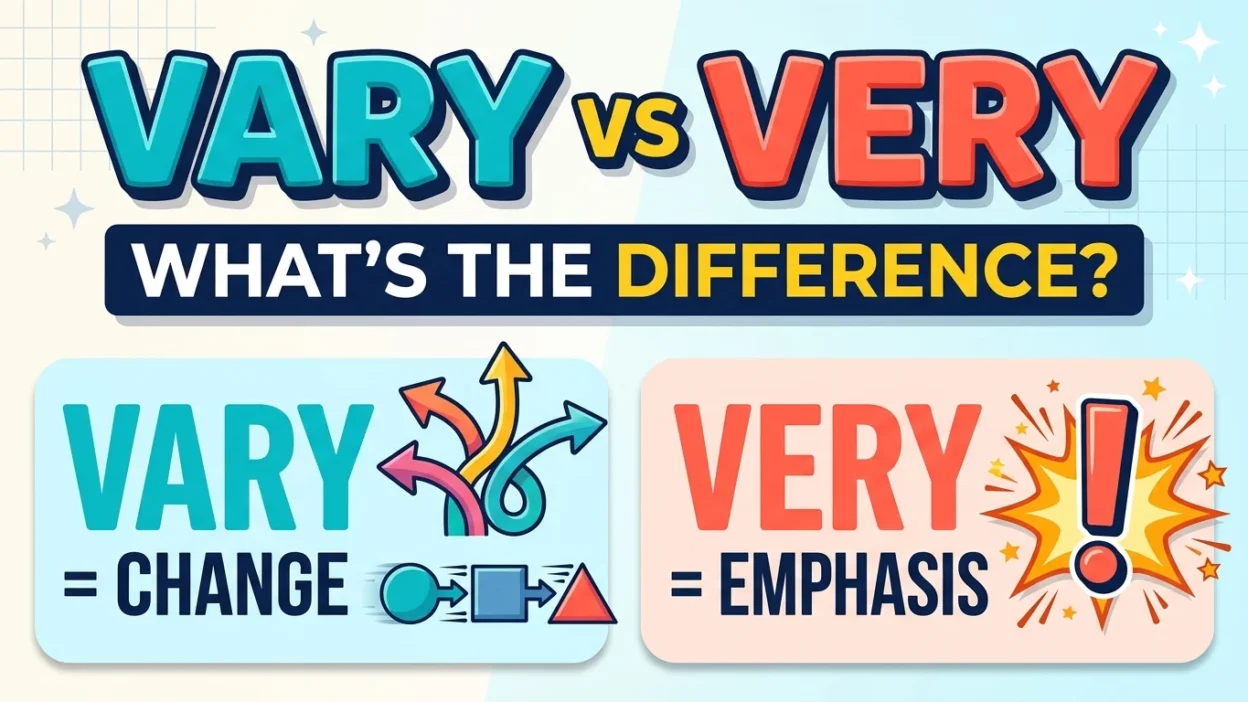
Have you ever confused vary with very while writing an English sentence? These two words look similar, but they have completely different meanings. One describes a change or difference, while the other adds emphasis to a description. Using the wrong word can change the meaning of your sentence and make your writing confusing.
Understanding the difference between vary and very is simple once you learn how each word works. Vary is a verb that means to change, differ, or become different. Very is an adverb used to emphasize an adjective or another adverb, such as “very happy” or “very quickly.”
Although the words differ by only one letter, they serve different purposes in English grammar.
In this guide, you will learn their definitions, pronunciation, grammar rules, common mistakes, and practical examples to help you use both words correctly in everyday conversations, academic writing, and professional communication.
Quick Answer: Vary vs Very
Vary means to change or be different, as in “Prices vary from store to store.” Very means to a high degree and adds emphasis, as in “The prices are very high.” Use vary when talking about differences or changes and very when emphasizing an adjective or adverb.
What Is the Difference Between Vary and Very?
The main difference between vary and very is their meaning and grammatical function. Vary is a verb that describes change or difference, whereas very is an adverb that intensifies the meaning of another word.
For example, “Weather conditions vary throughout the year” means weather conditions change over time. In contrast, “The weather is very cold today” uses very to emphasize the adjective cold.
These words are sometimes confused because they have similar spellings and differ by only one letter. However, they cannot replace each other without changing the meaning or making the sentence grammatically incorrect.
Remember this simple rule: use vary when something changes or differs, and use very when you want to emphasize how strong a quality or action is.
Why Do People Confuse Vary and Very?
People often confuse vary and very because their spellings are almost identical. Both words contain the letters v, r, and y, and only the placement of the vowel differs. This small spelling difference can lead to typing errors, especially when someone is writing quickly.
Another reason is that English learners may recognize the words by sight but not fully understand their grammatical roles. Someone who wants to write “very important” might accidentally type “vary important,” even though vary cannot perform the same function.
Pronunciation can also contribute to confusion for some learners, particularly when listening to unfamiliar accents or speaking quickly.
The best way to avoid this mistake is to learn a short example for each word: “Opinions vary” and “very important.” Practicing these expressions will help you remember their meanings.
Vary: Meaning and Definition
Vary is a verb that means to change, differ, or be different according to a particular situation, person, place, or time. It can describe changes in quantity, appearance, behavior, preferences, or conditions.
For example:
- Prices vary between different shops.
- Students vary in their learning styles.
- The temperature varies throughout the day.
- You should vary your exercise routine.
In these examples, vary describes differences or changes rather than emphasizing a quality.
Vary can also mean to make something different. For example, “The chef varies the menu every week” means the chef changes the available dishes.
The word is useful in everyday English, scientific writing, business reports, and academic discussions whenever you need to explain that something is not always the same.
Very: Meaning and Definition
Very is an adverb that usually means “to a high degree” or “extremely.” It adds emphasis to adjectives and adverbs, making their meanings stronger.
For example:
- She is very happy.
- The road is very narrow.
- He speaks very clearly.
- This lesson is very useful.
In these sentences, very strengthens the words happy, narrow, clearly, and useful.
Very can also appear before certain superlative adjectives and expressions, as in “the very best option” or “the very first day.” In these cases, it emphasizes the superlative or highlights the exact person, thing, or time being discussed.
Unlike vary, very does not describe something changing. It helps explain the degree, intensity, or emphasis of another word or expression.
Comparison Table: Vary vs Very
| Feature | Vary | Very |
|---|---|---|
| Part of speech | Verb | Adverb and, in some uses, an adjective |
| Main meaning | To change or differ | To a high degree; used for emphasis |
| Purpose | Describes differences or changes | Strengthens descriptions |
| Common pattern | Vary by, vary from, vary between | Very good, very fast, very important |
| Example | Results vary by age. | The results are very interesting. |
| Related forms | Varies, varied, varying, variation | Very much, the very best |
| Can describe change? | Yes | No, not in its usual intensifying use |
| Common mistake | “The results very.” | “This is vary useful.” |
When Should You Use Vary?
Use vary when you want to describe something that changes, differs, or is not the same in every situation.
For example, you might write, “Delivery times vary depending on your location.” This means delivery times are different for different locations.
Vary is also common when discussing personal preferences, prices, results, and scientific measurements. Consider the sentence, “People vary in their responses to stress.” It explains that individuals do not all respond in the same way.
You can use vary in several patterns:
- Vary by location.
- Vary from person to person.
- Vary between different groups.
- Vary according to the circumstances.
Whenever the main idea involves difference or change, vary is usually the appropriate word.
When Should You Use Very?
Use very when you want to emphasize an adjective, an adverb, or a particular expression.
For example, “The exam was very difficult” means the exam was difficult to a high degree. Similarly, “She completed the task very quickly” emphasizes the speed of the action.
Very is common in conversations, emails, essays, reviews, and descriptions. You might say, “Thank you very much” to express appreciation or “This is a very important meeting” to highlight the meeting’s importance.
Common combinations include:
- Very good
- Very happy
- Very difficult
- Very carefully
- Very important
Before using very, check whether the following word can naturally be intensified by it. For instance, “very useful” is correct, while “very vary” is not a standard expression.
Grammar Rules for Vary
Vary follows the normal grammar patterns of a regular verb. Its form changes according to the subject and tense.
Present tense: Use varies with he, she, it, or a singular subject.
Example: “The cost varies by region.”
Plural subjects: Use vary with plural nouns and I, you, we, or they.
Example: “The costs vary by region.”
Past tense: Use varied.
Example: “The prices varied last year.”
Present participle: Use varying.
Example: “We noticed varying levels of interest.”
Vary can be followed by expressions such as by, from, between, or according to. For example, “The results vary according to age.”
Remember that vary is an action or state verb. It needs to fit the subject and tense of the sentence.
Grammar Rules for Very
Very is usually an adverb of degree. It modifies adjectives and adverbs rather than acting as the main verb of a sentence.
Very + adjective: “The room is very clean.”
Very + adverb: “She works very efficiently.”
Very + much: “I appreciate your help very much.”
The very + noun or superlative expression: “This is the very place we visited” or “She gave the very best performance.”
A common mistake is placing very before a verb when the intended meaning requires a different expression. For example, “I very like this book” is not standard English. A natural version is “I really like this book” or “I like this book very much.”
Use very to intensify a suitable word or phrase, not to describe change.
Vary vs Very in Everyday English
Both words are common in everyday conversations, but they communicate different ideas.
Imagine discussing food prices with a friend. You might say, “Prices vary from one restaurant to another.” Here, vary explains that the prices are different.
If you want to describe an expensive restaurant, you could say, “The food is very expensive.” Very emphasizes the degree of expense.
Other everyday examples include:
- People’s tastes vary.
- I am very tired.
- Working hours vary by company.
- This coffee is very hot.
- Children’s interests vary with age.
- The movie was very entertaining.
Learning these everyday expressions makes the difference easier to recognize. Think about whether you are describing a change or emphasizing a quality before choosing your word.
Vary vs Very in Formal Writing
In formal writing, vary is often used to describe differences in evidence, findings, costs, methods, and conditions. For example, “The findings vary across the three study groups” clearly communicates that the results are not identical.
Very can also be used in formal writing, but writers sometimes choose more precise alternatives when they want a professional or academic tone. Instead of “The results are very important,” a writer might use “The results are highly significant,” if that wording accurately reflects the intended meaning.
However, very is not grammatically incorrect or automatically informal. Sentences such as “The process is very complex” are perfectly acceptable.
The important point is to choose the word that communicates your meaning accurately. Use vary for differences and very for emphasis, regardless of whether the writing is formal or informal.
Vary vs Very in Academic English
Academic writing often uses vary to describe differences between studies, participants, measurements, or research outcomes.
For example, “The results vary depending on the sample size” explains that findings may differ under different conditions. Similarly, “Response rates varied across the participating institutions” describes a difference observed in the past.
Very appears in academic writing when emphasis is appropriate, but researchers often prefer more specific terms. For example, “The relationship was very strong” might be expressed as “The relationship was strong,” or with a suitable precise description of its strength.
Do not replace very with technical language unless the alternative is accurate. Likewise, do not use vary when you simply want to intensify a description.
Understanding these roles helps students write clearer essays, research papers, laboratory reports, and assignments.
Common Mistakes When Using Vary and Very
One common mistake is writing vary before an adjective that needs an intensifier.
Incorrect: “The movie was vary interesting.”
Correct: “The movie was very interesting.”
Another mistake is using very when the sentence needs a verb describing change.
Incorrect: “Prices very from shop to shop.”
Correct: “Prices vary from shop to shop.”
A third mistake is forgetting verb agreement.
Incorrect: “The price vary every month.”
Correct: “The price varies every month.”
Also, avoid writing “I very like it.” In standard English, “I really like it” or “I like it very much” is more natural.
To prevent these errors, check the sentence’s meaning and grammar. If the word describes a difference or change, use vary. If it strengthens a description, use very.
Real-Life Examples of Vary vs Very
Here are 14 examples showing how to use both words correctly.
- Prices vary depending on the store.
- This book is very interesting.
- Working hours vary from company to company.
- I am very happy with my results.
- The colors vary slightly between the two designs.
- She speaks very confidently.
- The weather can vary throughout the week.
- That was a very difficult question.
- Children’s needs vary with their age.
- The room was very quiet.
- The results varied from one experiment to another.
- He is very good at mathematics.
- Food quality may vary between restaurants.
- Thank you very much for your help.
Notice that vary describes differences or changes, while very emphasizes a description or expression. These examples cover school, work, shopping, weather, and everyday conversation.
Vary vs Very in Business English
In business communication, vary is useful when explaining differences in prices, services, performance, or customer needs.
Examples:
- Shipping costs vary by destination.
- Customer preferences vary across markets.
- Sales figures varied during the previous quarter.
Very can emphasize the importance, urgency, or quality of something.
Examples:
- This is a very important client.
- The deadline is very close.
- We are very pleased with the results.
In professional writing, clarity is more important than making every sentence sound forceful. For example, “Costs vary by location” is more precise than saying costs are “very different” when you can explain how they differ.
Choose vary for differences and very for emphasis. This distinction will help you write clearer emails, business reports, presentations, and customer communications.
Vary vs Very in American and British English
The basic meanings and grammatical uses of vary and very are the same in American and British English.
Both varieties use vary to describe change or difference. For example, “Prices vary by region” is correct in both American and British English.
Likewise, both varieties use very to intensify adjectives and adverbs. “The weather is very cold” is standard in either variety.
There may be differences in accent and pronunciation, but there is no major regional grammar rule that changes the distinction between these words.
If you are preparing for an English exam, writing an academic assignment, or communicating internationally, you can apply the same basic rule in both varieties: vary means to change or differ, and very adds emphasis.
Pronunciation Guide for Vary and Very
Vary and very have different vowel sounds in standard pronunciations, although exact sounds can vary by accent.
Vary is commonly pronounced with a long “air” sound in the first syllable, while very generally has a short “e” sound in its first syllable. The ending of vary may also sound different from the ending of very depending on the speaker’s accent.
To practice, read these sentences aloud:
- “Opinions vary.”
- “It is very important.”
Pay attention to the first vowel sound and the context in which each word appears. Pronunciation practice can help you distinguish the words when speaking or listening.
However, spelling and grammar remain important when writing. Even if the words sound similar to you, their meanings are different, so check the sentence before choosing one.
Synonyms and Alternatives for Vary
Depending on the sentence, several words can replace vary.
- Change: The schedule may change.
- Differ: Results differ between groups.
- Fluctuate: Prices fluctuate throughout the year.
- Diverge: Their opinions diverge on this issue.
- Alter: The company altered its approach.
These alternatives are not interchangeable in every situation. Fluctuate often suggests repeated rises and falls, while differ emphasizes a lack of sameness. Alter usually means to change something deliberately.
For example, “Prices vary by location” can be rewritten as “Prices differ by location.” Both are natural, although the emphasis may differ slightly.
Choose the alternative that best fits your intended meaning rather than replacing vary simply to avoid repetition.
Synonyms and Alternatives for Very
Several words and expressions can replace very when you want to emphasize a description.
- Extremely: The test was extremely difficult.
- Highly: She is highly skilled.
- Really: That was really helpful.
- Especially: This point is especially important.
- Remarkably: The team performed remarkably well.
The best alternative depends on the sentence and tone. Really is common in conversation, while highly is often suitable for professional descriptions. Extremely can express a stronger degree of intensity.
For example, “The weather is very cold” could become “The weather is extremely cold.” However, the alternative may make the statement sound stronger.
Remember that these words cannot always replace very directly. Choose an expression that fits the grammar and communicates the intended level of emphasis.
Memory Trick to Remember Vary vs Very
Use this simple memory trick:
Vary = variation. Very = emphasis.
The word vary is related to variation, which means a difference or change. If something changes between people, places, or times, vary is likely the correct word.
Example: “Prices vary by location.”
Very is used to strengthen a description.
Example: “The prices are very high.”
You can also remember two short phrases:
- Things vary.
- Things are very different.
The first sentence uses vary to describe change or difference. The second uses very to emphasize the adjective different.
Practice these patterns in your own sentences. Connecting each word with its meaning will help you remember the correct spelling and avoid common typing mistakes.
How to Choose Between Vary and Very
Follow these simple steps whenever you are unsure which word to use.
Step 1: Check the meaning. Are you describing change or difference? Choose vary. Are you emphasizing a quality? Choose very.
Step 2: Check the grammar. Vary usually functions as a verb, as in “Results vary.” Very usually modifies an adjective or adverb, as in “very useful” or “very carefully.”
Step 3: Check the sentence structure. “The prices vary” is correct. “The prices are very high” is also correct, but it expresses a different idea.
Step 4: Read your sentence again. Ask whether the word communicates the meaning you intended.
With a little practice, you will be able to distinguish vary from very in conversations, emails, essays, and professional documents.
Frequently Asked Questions About Vary vs Very
1. What is the main difference between vary and very?
Vary is a verb meaning to change or differ. Very is an adverb that emphasizes an adjective or adverb, usually meaning “to a high degree.”
2. Is vary a verb or an adjective?
Vary is a verb. For example, “Opinions vary.” Its related adjective is various, as in “various options.”
3. Is very a verb?
No. Very is usually an adverb of degree, as in “very happy.” It can also function as an adjective in expressions such as “the very person I wanted to meet.”
4. Is “very important” or “vary important” correct?
“Very important” is correct because very intensifies the adjective important. “Vary important” is incorrect in standard English.
5. Is it “prices vary” or “prices very”?
“Prices vary” is correct because vary is the verb describing differences in prices. Very cannot serve as the main verb in this sentence.
6. What is another word for vary?
Depending on the context, alternatives include change, differ, fluctuate, alter, and diverge. Each has a slightly different meaning.
7. What is another word for very?
Common alternatives include extremely, highly, really, especially, and remarkably. Choose one that fits the sentence and the intended degree of emphasis.
8. How can I remember vary vs very?
Remember that vary is related to variation and means to change or differ. Very adds emphasis, as in “very good” or “very useful.”
Final Verdict: Vary vs Very
The difference between vary and very is simple once you understand their grammatical roles. Vary is a verb that means to change or differ, while very is mainly an adverb used to emphasize adjectives and adverbs. Although the two words look similar, they express different ideas and should not be used interchangeably.
For example, “Prices vary by location” describes differences in prices, while “Prices are very high” emphasizes how expensive they are. Remembering these two patterns will help you write more accurately and communicate your ideas clearly.
Remember This
- Vary: to change or differ.
- Very: to a high degree; used for emphasis.
- Correct: The results vary.
- Correct: The results are very interesting.
- Incorrect: The results very.
- Incorrect: The results are vary interesting.
Use vary for change and difference, and very for emphasis. With regular practice, you can avoid this common spelling confusion and improve your everyday English.

Kevin Brian is a passionate author at BiblyWord, dedicated to sharing the message of the Bible through thoughtful and inspiring content. He focuses on creating clear and meaningful writings that help readers understand scripture, strengthen their faith, and find guidance in everyday life through God’s Word.