Have you ever wondered if to use either or whether in a sentence? These two English words may look similar in some contexts, but they serve different grammatical purposes. Choosing the wrong word can make your sentence confusing or unnatural, especially when discussing choices, possibilities, or alternatives.
The good news is that understanding the difference between either and if is easier than it seems. Either usually refers to one of two choices, while whether introduces a choice, doubt, or alternative that needs to be considered.
Once you learn their meanings and common sentence patterns, you can use both words confidently in everyday conversations, academic writing, emails, and professional communication.
Quick Answer: Either vs Whether
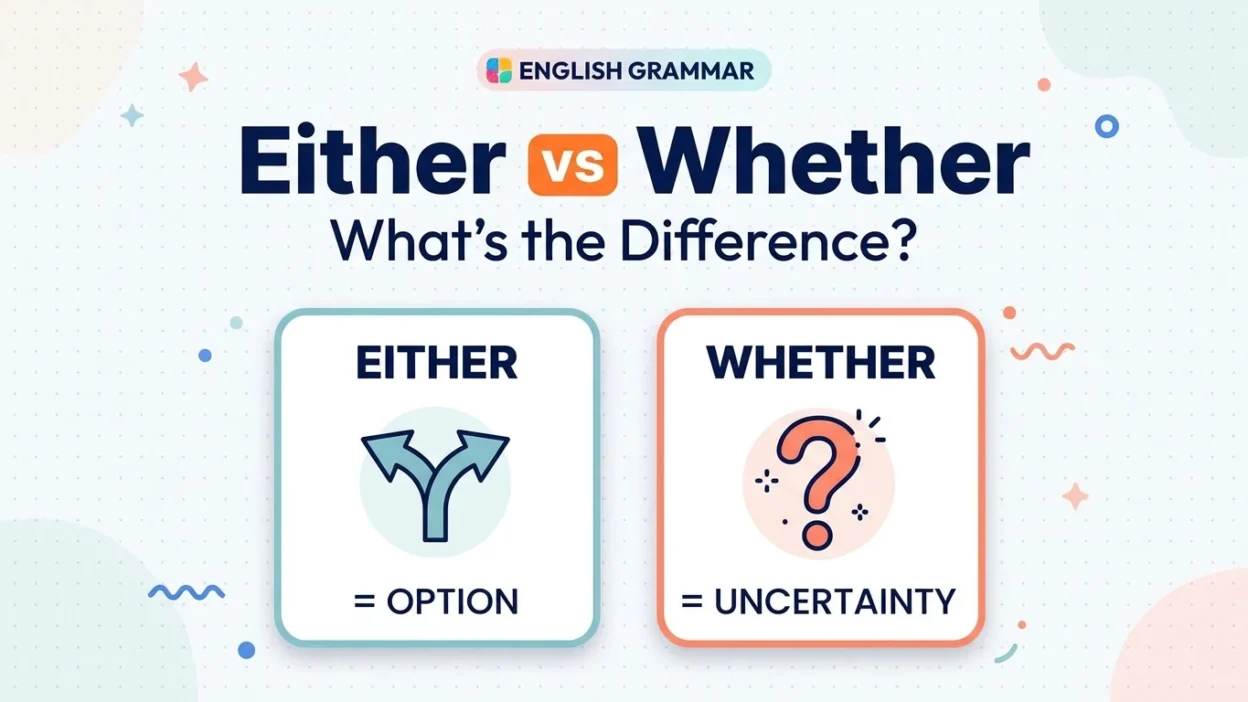
Either means one or the other of two options, as in “You can choose either dress.” Whether introduces a question, uncertainty, or alternative, as in “I don’t know whether she will come.” Use either when selecting an option and whether when expressing uncertainty or considering possibilities.
What Is the Difference Between Either and Whether?
The main difference between either and whether is their function in a sentence. Either identifies one option from two possibilities, while whether introduces a choice or expresses uncertainty about what is true or what will happen.
For example, “You can take either road” means both roads are available, and you may choose one. In contrast, “I wonder whether this road is safe” expresses uncertainty about the road’s safety.
These words sometimes appear in similar sentences because both can relate to alternatives. However, they are not interchangeable in every situation. Understanding the sentence structure is the easiest way to choose the correct word.
Why Do People Confuse Either and Whether?
People often confuse either and whether because both words are associated with choices and alternatives. They can appear in sentences involving two possibilities, which makes their meanings seem similar.
For example, consider “You can have either tea or coffee” and “I cannot decide whether to have tea or coffee.” Both sentences mention tea and coffee, but the first offers a choice, while the second expresses uncertainty about that choice.
Another reason for confusion is that English learners may translate both words into the same word in their native language. This can make it difficult to recognize their different grammatical roles.
The simplest solution is to remember that either usually selects an option, while whether introduces a question or uncertainty.
Either: Meaning and Definition
Either is a word used to refer to one of two people, things, or possibilities. It commonly appears when offering choices or explaining that either of two options is acceptable.
Examples include:
- You can choose either book.
- Either answer is acceptable.
- We can travel by either bus or train.
- Either of the candidates could win.
Either is also used in negative sentences to mean “also not.”
For example, “I don’t like coffee, and my brother doesn’t like it either.” In this sentence, either does not present a choice. Instead, it adds a negative agreement.
The exact meaning of either depends on its position and the structure of the sentence.
Whether: Meaning and Definition
Whether is a conjunction used to introduce uncertainty, an indirect question, or alternatives. It commonly appears when someone is considering two possibilities or does not know which situation is true.
Examples include:
- I don’t know whether he is coming.
- She asked whether the office was open.
- We must decide whether to stay or leave.
- Tell me whether you agree.
Whether can introduce alternatives using the structure “whether…or.” It can also appear without an explicit second option when the alternative is understood from the context.
For example, “I wonder whether it will rain” expresses uncertainty about the possibility of rain. The sentence does not require the writer to state the alternative “or not.”
What Does Either Mean in Everyday English?
In everyday English, either often helps people make decisions, offer options, or explain that two choices are acceptable.
For instance, a teacher might say, “You can submit either a printed assignment or a digital copy.” This means students may choose one of the two formats.
A friend might say, “Either restaurant is fine with me.” This indicates that both restaurants are acceptable options.
Either can also appear at the end of a negative sentence. For example, “I don’t want to go either.” Here, the speaker means that they also do not want to go.
Recognizing these common patterns will help you use either naturally in conversation and writing.
What Does Whether Mean in Everyday English?
Whether is useful when discussing uncertainty, asking indirect questions, or deciding between possibilities.
For example, “I don’t know whether the shop is open” means the speaker is unsure about the shop’s status. Similarly, “She asked whether I needed help” reports an indirect question without using a direct question mark.
Whether is also common when making decisions. Consider the sentence, “We need to decide whether to buy a new laptop.” The speaker is considering whether buying the laptop is the right decision.
In professional and academic writing, whether is especially useful for presenting alternatives clearly and objectively.
Comparison Table: Either vs Whether
| Feature | Either | Whether |
|---|---|---|
| Main meaning | One or the other of two options | Expresses uncertainty or alternatives |
| Common use | Choosing between options | Considering possibilities |
| Grammar | Determiner, pronoun, or adverb | Conjunction |
| Example | Choose either color. | I wonder whether this color is suitable. |
| With “or” | Either tea or coffee | Whether to stay or leave |
| In negative sentences | I don’t like it either. | I don’t know whether I like it. |
| Expresses uncertainty | Not usually by itself | Yes, commonly |
| Can stand alone as a choice word | Often, depending on structure | Usually introduces a clause |
When Should You Use Either?
Use either when you mean one of two available options or when you want to show that both options are acceptable.
Common patterns include:
- Either + singular noun: Either option works.
- Either…or: You can either walk or take a taxi.
- Either of + plural noun or pronoun: Either of the answers is correct.
- Negative sentence + either: I don’t watch television either.
For example, if a manager tells an employee, “You may work from either office,” the employee can choose one of the two offices.
Remember that either is not always limited to a simple choice between two nouns. It can also appear in negative statements to express agreement with another negative idea.
When Should You Use Whether?
Use whether when expressing uncertainty, introducing an indirect question, or discussing alternatives that need to be considered.
Common patterns include:
- Whether + clause: I don’t know whether he is available.
- Whether…or: She couldn’t decide whether to laugh or cry.
- Whether or not: We will continue whether or not it rains.
- Whether + to-infinitive: They are deciding whether to move.
For example, “Please confirm whether you received the email” asks someone to confirm if the email arrived.
Whether is especially appropriate when the sentence focuses on finding out, deciding, or considering something rather than directly choosing an item.
Can You Use Either and Whether in the Same Sentence?
Yes, either and whether can appear in the same sentence because they perform different grammatical functions.
For example: “I don’t know whether either candidate has the required experience.”
In this sentence, whether introduces uncertainty, while either refers to one of the two candidates.
Another example is: “Please tell me whether either of these dates works for you.” The speaker is asking whether one or both of the dates are suitable.
These examples demonstrate why the words cannot always replace each other. A sentence may need both words to express its meaning accurately.
Either vs Whether in Questions
Either and whether can both appear in sentences related to questions, but their roles differ.
Either is used to present or refer to options:
- Would you like either of these shirts?
- Can either student answer the question?
Whether is used to introduce an indirect question or express uncertainty:
- I wonder whether he knows the answer.
- Could you check whether the door is locked?
Notice that indirect questions normally use statement word order. For example, “I wonder whether he is ready” is correct, while “I wonder whether is he ready” is incorrect.
Understanding this difference helps you avoid common grammar mistakes.
Either vs Whether With “Or”
Both words can appear with or, but they create different sentence patterns.
Either…or presents two alternatives, usually showing that one option or the other is available.
Example: “You can either call me or send a message.”
Whether…or introduces alternatives being considered, questioned, or included in a statement.
Example: “I don’t know whether to call him or send a message.”
Another example is “Whether you agree or disagree, we need to make a decision.” Here, whether introduces two possible positions.
A useful rule is to use either…or when presenting a choice and whether…or when discussing alternatives, uncertainty, or a situation that applies regardless of the outcome.
Either vs Whether in Formal Writing
Both words are appropriate in formal writing, but they serve different purposes.
Use either when specifying acceptable options in reports, instructions, or professional emails. For example, “Applicants may submit either a passport or a national identity card.”
Use whether when discussing uncertainty, reporting questions, or presenting conditions for consideration. For example, “The committee will determine whether the application meets the eligibility requirements.”
In academic writing, whether can introduce a research question or an issue being investigated. Either can identify one of two methods, explanations, or outcomes.
The best choice depends on the intended meaning, not simply on whether the writing is formal or informal.
Either vs Whether in Business English
In business communication, either is useful for presenting choices, while whether is useful for discussing decisions and confirming information.
Examples of either:
- You can attend either meeting.
- Please send the document in either PDF or Word format.
- Either department can assist you.
Examples of whether:
- Please confirm whether the payment has been received.
- We need to determine whether the proposal is financially practical.
- The manager will decide whether to approve the request.
Using the correct word makes business emails, reports, and instructions easier to understand. When presenting a choice, use either if you want to identify the available options. When asking about a situation or decision, whether is generally the better choice.
Grammar Rules for Either
Either follows several common grammatical patterns.
1. Either + singular noun
“Either answer is acceptable.”
2. Either of + plural noun or pronoun
“Either of the options is suitable.”
In formal standard English, either of is generally followed by a singular verb when it functions as the subject, although plural agreement occurs in informal usage.
3. Either…or
“Either Sarah or Ahmed will lead the meeting.”
When the subjects connected by either…or differ in number, traditional guidance often recommends matching the verb to the nearer subject. Recasting the sentence can make it clearer.
4. Negative agreement
“I haven’t visited that city either.”
These patterns cover most everyday uses of either.
Grammar Rules for Whether
Whether introduces a clause or a choice-related expression.
1. Whether + subject + verb
“I don’t know whether she understands.”
2. Whether…or
“We must decide whether we should wait or leave.”
3. Whether or not
“Whether or not you attend, please send your response.”
4. Whether + to-infinitive
“He is unsure whether to accept the offer.”
5. Whether or if
In many indirect yes-or-no questions, whether and if are both possible: “I don’t know whether she is ready” and “I don’t know if she is ready.”
However, whether is generally preferred before an infinitive, before or not in certain constructions, and when explicitly presenting alternatives with or.
Common Mistakes When Using Either and Whether
One common mistake is using either when the sentence actually expresses uncertainty.
Incorrect: “I don’t know either he will come.”
Correct: “I don’t know whether he will come.”
Another mistake is using whether when simply presenting two choices.
Awkward: “You can choose whether dress.”
Correct: “You can choose either dress.”
A third mistake is forgetting the correct structure with or.
Correct: “You can either stay or leave.”
Correct: “I don’t know whether to stay or leave.”
Finally, avoid confusing indirect questions with direct questions. Write “She asked whether I was ready,” not “She asked whether was I ready.”
The best way to avoid these errors is to identify whether your sentence presents a choice or expresses uncertainty.
Real Life Examples of Either vs Whether
Here are 12 examples showing how to use both words correctly.
- You can choose either the blue shirt or the black shirt.
- I don’t know whether the bus has arrived.
- Either answer will receive full credit.
- Please tell me whether you need additional time.
- We can meet on either Monday or Tuesday.
- She wondered whether her application had been accepted.
- Either of these keys should open the door.
- The teacher asked whether everyone understood the lesson.
- You may use either method to solve the problem.
- He couldn’t decide whether to study medicine or engineering.
- I haven’t watched that movie either.
- We need to check whether the information is accurate.
Notice how either generally identifies or accepts an option, while whether introduces uncertainty, an indirect question, or alternatives under consideration.
Either vs Whether in Academic English
Academic writing frequently uses whether to introduce research questions, possibilities, and conditions.
For example, “The study investigates whether regular exercise improves concentration.” The word whether introduces the issue being investigated.
Either can be useful when describing two methods or possible explanations. For example, “Either approach may be appropriate, depending on the research objectives.”
A sentence such as “The researchers examined whether either method produced better results” uses both words correctly. Whether introduces the research question, and either refers to one of the two methods.
In essays and research papers, choosing the right word helps readers distinguish between an option and a question being investigated. This distinction is especially valuable when explaining results, interpreting evidence, or discussing limitations.
Either vs Whether in American and British English
The basic meanings of either and whether are the same in American and British English. There is no major regional difference that changes the central grammar rule.
Both varieties use either to identify alternatives and whether to introduce uncertainty or indirect questions.
For example, an American writer might say, “You can choose either option,” while a British writer could use the same sentence. Likewise, “I wonder whether it will rain” is correct in both varieties.
Pronunciation may vary slightly by speaker and accent, but the choice between these words depends primarily on grammar and meaning rather than geography.
If you are learning English for school, work, or international communication, you can follow the same rules in both American and British English.
Pronunciation Guide for Either and Whether
Either is commonly pronounced in two ways: EE-thər or EYE-thər. Both pronunciations are accepted in standard English, although preferences vary by region and speaker.
Whether is commonly pronounced WETH-ər, with the first syllable sounding like “weth.”
The two words are not generally pronounced the same, which can help some learners distinguish them when listening. However, fast speech and unfamiliar accents may still make them difficult to recognize.
Practice saying these sentences aloud:
- “You can choose either option.”
- “I don’t know whether it is correct.”
Focus on both pronunciation and sentence meaning. Even if you occasionally hesitate while speaking, understanding the grammatical role of each word will help you choose the correct one when writing.
Synonyms and Alternatives for Either
Depending on the context, several expressions can replace either.
- One or the other: You may choose one or the other.
- Any one of the two: Any one of the two options is acceptable.
- Both are acceptable: Both choices will work.
- Also not: I don’t want to go, and she doesn’t want to go either.
These expressions are not perfect substitutes in every sentence. For example, “either answer” is concise, while “one or the other answer” may sound less natural depending on the context.
When using either in a negative sentence, words such as also or too may sometimes communicate a similar idea, but the sentence may need restructuring.
Always select an alternative that preserves the intended meaning and sounds natural in context.
Synonyms and Alternatives for Whether
Whether can sometimes be replaced with other expressions, although the sentence structure may change.
- If: I don’t know if she is coming.
- Whether or not: Regardless of whether she agrees.
- The question of whether: The question of whether the plan will work remains.
- If or not: This is possible in some constructions, but whether or not is often clearer and more natural.
In indirect yes-or-no questions, if often works as an alternative to whether. For example, “Please ask if the office is open” and “Please ask whether the office is open” are both correct.
However, whether is generally the safer choice when presenting explicit alternatives or using a to-infinitive, as in “whether to go.”
Memory Trick to Remember Either vs Whether
Use this simple memory trick:
Either = option. Whether = wondering.
When you are choosing between two things, think of either.
Example: “You can choose either cake.”
When you are unsure about something or considering a question, think of whether.
Example: “I wonder whether there is any cake left.”
You can also remember these two patterns:
- Either…or = presents a choice.
- Whether…or = considers alternatives.
For negative agreement, remember that either can mean “also not,” as in “I don’t like it either.”
Practicing these short patterns is more effective than memorizing long grammar definitions. Whenever you are unsure, ask yourself whether the sentence is selecting an option or expressing uncertainty.
How to Choose Between Either and Whether
Follow these steps to choose the correct word.
Step 1: Identify the meaning. Are you talking about one of two options, or are you expressing uncertainty?
Step 2: Check the sentence pattern. If you see either…or, you are probably presenting alternatives. If you see “I don’t know,” “I wonder,” or “decide,” whether may be appropriate.
Step 3: Read the sentence aloud. Check whether the word communicates the intended meaning naturally.
Step 4: Review the grammar. “You can take either route” is correct, while “You can take whether route” is not. “I don’t know whether he is ready” is correct, while “I don’t know either he is ready” is not.
These steps will help you make the right choice in emails, essays, conversations, and examinations.
Frequently Asked Questions About Either vs Whether
1. Is either the same as whether?
No. Either usually refers to one of two options or means “also not” in negative sentences. Whether introduces uncertainty, indirect questions, or alternatives being considered.
2. Can I use either instead of whether?
Not in most sentences. For example, “I don’t know whether she is coming” is correct. “I don’t know either she is coming” is incorrect in standard English.
3. Is it either or whether?
Both are correct words, but they serve different purposes. Use either…or to present a choice and whether…or to discuss alternatives or uncertainty.
4. Is “whether or not” correct?
Yes. “Whether or not” is a standard expression. For example, “We will continue whether or not it rains.”
5. Can whether be used with if?
Yes. In many indirect yes-or-no questions, whether and if can be used interchangeably. For example, “I don’t know whether he is home” and “I don’t know if he is home” are both correct.
6. Can either be used in a negative sentence?
Yes. Either can mean “also not” in a negative sentence. For example, “I don’t eat meat, and my sister doesn’t eat it either.”
7. Which word is more formal, either or whether?
Neither word is inherently more formal. Both are appropriate in formal and informal English. The correct choice depends on what you mean.
8. What is an easy way to remember the difference?
Remember: either means an option, while whether means wondering or considering possibilities. This simple rule works for many everyday sentences.
Final Verdict: Either vs Whether
The difference between either and if becomes clear when you focus on their grammatical functions. Either usually identifies one of two options, indicates that either choice is acceptable, or expresses negative agreement. Whether introduces uncertainty, an indirect question, or alternatives that someone is considering.
For example, “You can choose either route” offers a choice, while “I don’t know whether this route is safe” expresses uncertainty. Although both words can appear with or, their meanings and sentence structures are different.
Remember This
- Either: one or the other of two options, or “also not” in a negative sentence.
- Whether: uncertainty, an indirect question, or alternatives under consideration.
- Either…or: presents a choice.
- Whether…or: introduces alternatives or a question about possibilities.
Keep these rules in mind, and you will find it much easier to use either and whether correctly in everyday English.

Kevin Brian is a passionate author at BiblyWord, dedicated to sharing the message of the Bible through thoughtful and inspiring content. He focuses on creating clear and meaningful writings that help readers understand scripture, strengthen their faith, and find guidance in everyday life through God’s Word.