Spelling mistakes can quietly weaken your message, especially when two words look almost identical. A common confusion is between “reinforce” and “reenforce.” While both may appear logical, only one is correct in standard English.
This mistake often appears in academic writing, business communication, and everyday messages. Since the word is frequently used to express strengthening ideas, support, or structures, using the wrong spelling can affect clarity and professionalism. The good news is that once you understand the correct form and pattern, this confusion becomes easy to avoid.
Let’s explore the difference in a clear and practical way so you can use the right word with confidence every time.
Quick Answer
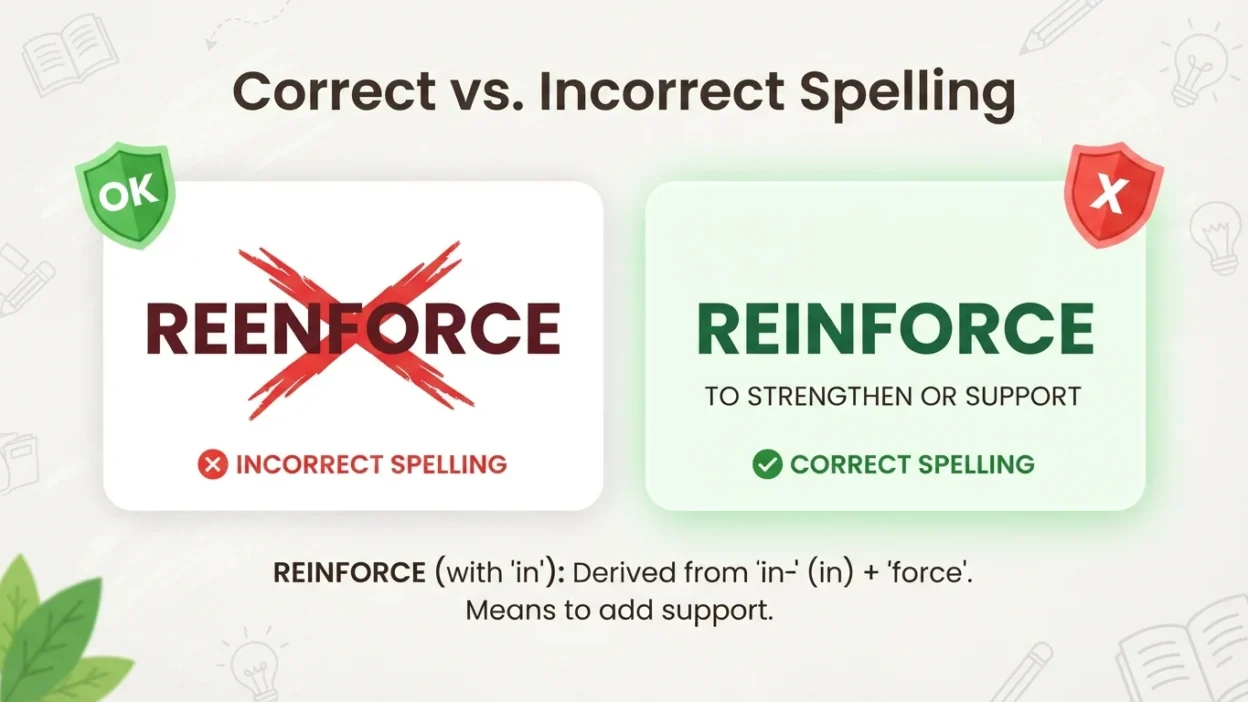
“Reinforce” is the correct spelling and means to strengthen or support something. “Reenforce” is incorrect and should never be used in standard English writing.
Definition and Meaning
“Reinforce” means to make something stronger, more effective, or more secure. It can apply to physical objects, ideas, behaviors, or systems. For example, you can reinforce a building with materials or reinforce a concept through repetition.
The word is commonly used in education, psychology, construction, and communication. It helps express the idea of adding strength or support to something that already exists.
“Reenforce” has no recognized meaning in standard English. It is simply a misspelling that comes from misunderstanding how the prefix works.
Understanding the correct meaning of “reinforce” helps you use it accurately in different contexts.
Why People Confuse It
People often confuse “reinforce” and “reenforce” because they assume the prefix “re” always stands alone. This leads them to write “reenforce” instead of combining it correctly.
Another reason is pronunciation. When spoken, the word may sound like it has two separate “e” sounds, which can mislead writers into adding an extra “e.”
Typing quickly without proofreading also contributes to this mistake. Many people rely on sound instead of structure, which leads to incorrect spelling.
Once you learn how prefixes work in English, this confusion becomes much easier to avoid.
First Word
“Reenforce” is incorrect and should not be used in any type of writing. It is not listed in dictionaries and does not follow proper spelling rules.
This form usually appears when people try to separate the prefix “re” from the base word incorrectly. However, English often blends prefixes smoothly without repeating letters unnecessarily.
Using “reenforce” can make your writing look careless and unprofessional. It may also confuse readers who expect standard spelling.
To maintain clarity and accuracy, always avoid using this incorrect form.
Second Word
“Reinforce” is the correct spelling and is widely used in all forms of English. It clearly expresses the idea of strengthening or supporting something.
This word fits naturally in many contexts, including education, business, and everyday communication. It can describe both physical strength and abstract support.
For example, you can reinforce a habit, reinforce a message, or reinforce a structure. The word is flexible and widely understood.
Using “reinforce” correctly improves the quality of your writing and ensures your message is clear and professional.
Grammar Rules Explained
“Reinforce” is formed by combining the prefix “re” with the root “inforce,” which comes from older forms related to strength. Over time, the spelling evolved into “reinforce.”
In English, prefixes often merge with base words without repeating letters. This is why “re” does not become “ree” in this case.
The word functions mainly as a verb and follows regular verb patterns. You can use it in present, past, and continuous forms without changing its core spelling.
Understanding how prefixes work helps you avoid similar mistakes in other words.
Pronunciation Guide
“Reinforce” is pronounced as “ree in fors.” The sound flows smoothly, which can sometimes make it seem like there are extra letters.
Even though the pronunciation may suggest a double “e,” the correct spelling uses only one “e” after “r.” This is a common feature in English spelling.
Practicing the pronunciation along with the correct spelling can help you remember it more easily. Linking sound and structure is a useful learning method.
Comparison Table
| Word | Correct | Meaning | Usage |
|---|---|---|---|
| Reinforce | Yes | Strengthen or support | Always use |
| Reenforce | No | Incorrect spelling | Never use |
This table clearly shows that “reinforce” is the only correct option.
When to Use Each
Use “reinforce” whenever you want to describe strengthening something. This can include ideas, behaviors, structures, or systems.
The word is suitable for both formal and informal writing. It is commonly used in education, business, and everyday communication.
Do not use “reenforce” in any situation. It has no valid use and should always be avoided.
Keeping this simple rule in mind will help you write with confidence and accuracy.
Examples
Here are real life examples using “reinforce” correctly:
- The teacher used examples to reinforce the lesson.
- Steel bars reinforce the structure.
- Positive feedback can reinforce good behavior.
- The coach reinforced the importance of practice.
- The message was reinforced through repetition.
- Workers reinforced the bridge for safety.
- Parents reinforce values at home.
- Training helps reinforce skills.
- The design reinforces stability.
- The policy reinforces company standards
These examples show how versatile the word is.
Common Sentences
“Reinforce” is commonly used in everyday sentences. It often appears when describing support, strength, or repetition.
People use it to explain how something becomes stronger or more effective. It is especially common in teaching, coaching, and communication.
Using the correct spelling ensures your sentences sound natural and professional. Avoid replacing it with incorrect forms.
Real Life Usage
“Reinforce” is widely used in real life across many fields. In education, teachers reinforce learning through repetition. In construction, materials reinforce buildings.
In psychology, positive actions reinforce behavior. In business, strategies reinforce goals and performance.
Because the word is used in so many areas, correct spelling is important. It helps maintain clarity and professionalism in your communication.
Formal vs Informal Use
“Reinforce” works well in both formal and informal contexts. In formal writing, it adds clarity and precision. In informal communication, it remains simple and easy to understand.
You can use it in reports, essays, emails, and conversations without any issue. The word adapts easily to different tones.
“Reenforce” is not acceptable in any context and should always be avoided.
Common Mistakes
A common mistake is adding an extra “e” and writing “reenforce.” This usually happens due to misunderstanding prefixes or relying on pronunciation.
Another mistake is not proofreading writing carefully. Small spelling errors can go unnoticed and affect the overall quality.
To avoid these mistakes, focus on learning correct patterns and reviewing your work before finalizing it.
Mistakes to Avoid
Avoid using incorrect forms like “reenforce” in any type of writing. This error can reduce clarity and make your work appear less professional.
Do not rely only on how the word sounds. English spelling often follows rules that are not obvious from pronunciation.
Always take a moment to check your spelling, especially in important documents.
Memory Trick
A simple trick is to think of “reinforce” as “re plus in force.” This reminds you that the word already contains the correct structure without needing an extra “e.”
Visualizing the word as one smooth unit can help you remember its correct spelling. Practicing this trick makes it easier to recall quickly.
American vs British English
There is no difference between American and British English for this word. Both use “reinforce” as the correct spelling.
The pronunciation may vary slightly depending on accent, but the spelling remains the same. This makes it easier to remember across regions.
“Reenforce” is incorrect everywhere.
Similar Words
Several words follow similar prefix patterns, such as “rebuild,” “rewrite,” and “recreate.” These words also combine “re” with a base word without unnecessary repetition.
Learning these patterns can improve your understanding of English spelling. It helps you recognize correct forms more easily.
By comparing similar words, you can strengthen your spelling skills.
Synonyms and Alternatives
You can use alternatives like “strengthen,” “support,” or “boost” depending on the context. These words convey similar meanings but may fit different situations.
However, “reinforce” is often the most precise choice when describing added strength or repeated support.
Choosing the right word depends on your sentence, but correct spelling remains essential.
Expert Tips
To improve your spelling, focus on understanding how prefixes and roots work together. This helps you avoid common mistakes.
Practice writing regularly and read more English content to see correct usage in context. This builds familiarity and confidence.
Experts recommend reviewing your work carefully to catch small errors before they become habits.
Related Confusing Words
Other similar confusions include “reenter” and “re enter,” or “rebuild” and “rebild.” These errors also involve misunderstanding prefixes.
In each case, the correct form follows standard spelling rules without unnecessary repetition.
Learning these patterns helps you avoid multiple mistakes and improves your overall writing accuracy.
Final Verdict
“Reinforce” is the correct spelling and should always be used. “Reenforce” is incorrect and must be avoided in all forms of writing.
By understanding how prefixes work, you can easily remember the correct form and improve your writing.
FAQs
Is reenforce ever correct
No, it is always incorrect in standard English
What is the correct spelling
The correct spelling is reinforce
Why do people write reenforce
Because they misunderstand how the prefix works
Can I use reenforce informally
No, it is incorrect in all contexts
What does reinforce mean
It means to strengthen or support something
Are there similar words like reinforce
Yes, such as rebuild and rewrite
Conclusion
Understanding the difference between “reinforce” and “reenforce” is simple once you know the correct rule. While the incorrect form may seem logical, it is not accepted in standard English.
Using “reinforce” correctly improves clarity and professionalism in your writing. Small spelling details like this can make a big difference in how your message is received.
Remember This
Always use “reinforce” with one “e” after “r”
“Reenforce” is wrong and should never be used

Kevin Brian is a passionate author at BiblyWord, dedicated to sharing the message of the Bible through thoughtful and inspiring content. He focuses on creating clear and meaningful writings that help readers understand scripture, strengthen their faith, and find guidance in everyday life through God’s Word.