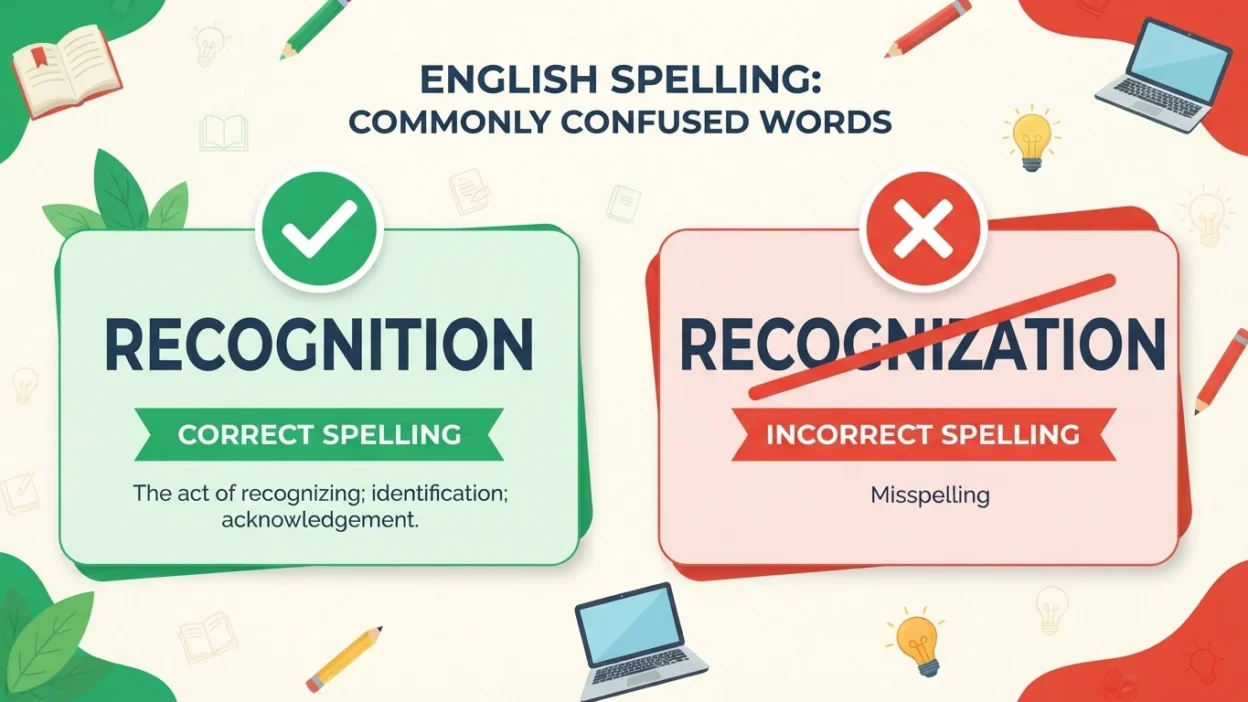
Spelling mistakes can easily confuse readers, especially when two words look very similar. One common confusion is between “recognization” and “recognition.” At first glance, both may seem acceptable, but only one is correct in standard English.
This mistake often appears in academic writing, job applications, and everyday communication. Since the word is frequently used to describe acknowledgment, understanding, or appreciation, using the wrong form can affect clarity and professionalism. The good news is that this confusion is easy to fix once you understand the correct pattern.
Let’s break it down clearly so you can confidently use the right word every time.
Quick Answer
“Recognition” is the correct spelling and means acknowledgment or identification. “Recognization” is incorrect and should never be used in standard English writing.
Definition and Meaning
“Recognition” refers to the act of identifying something or someone, or giving acknowledgment and appreciation. It is widely used in both personal and professional contexts.
For example, you may recognize a face, or someone may receive recognition for their achievements. The word carries meanings related to awareness, approval, and respect.
“Recognization” has no accepted meaning in standard English. It is a mistaken form created by adding the wrong suffix to the verb “recognize.”
Understanding the correct meaning of “recognition” helps you use it naturally and accurately in your writing.
Why People Confuse It
Many people confuse “recognition” with “recognization” because they assume all verbs ending in “ize” form nouns by adding “ation.” While this works for some words, it does not apply here.
Another reason is familiarity with words like “organization” or “realization,” which follow a different pattern. This leads writers to mistakenly form “recognization.”
Pronunciation also plays a role. When spoken quickly, the difference may not be obvious, causing confusion in spelling.
Once you learn the correct suffix pattern, this mistake becomes easy to avoid.
First Word
“Recognization” is incorrect and should never be used. It is not found in standard dictionaries and does not follow proper English word formation rules.
This form appears when people apply the wrong suffix to the base word “recognize.” However, English often uses different endings that must be learned individually.
Using “recognization” can make your writing look unprofessional and may confuse readers. It is considered a clear spelling and vocabulary error.
To maintain accuracy and clarity, always avoid this incorrect form in all types of writing.
Second Word
“Recognition” is the correct and accepted spelling. It is widely used in formal and informal English.
The word fits naturally in many contexts, including education, business, and everyday communication. It can refer to identifying something or giving credit for achievements.
For example, employees may receive recognition for their work, or a system may use facial recognition technology.
Using “recognition” correctly improves the quality of your writing and ensures your message is clear and professional.
Grammar Rules Explained
“Recognition” is formed from the verb “recognize,” but instead of adding “ation,” it uses the suffix “ition.” This is a common pattern in English for certain verbs.
Other examples include “cognize” becoming “cognition.” These patterns show that English word formation is not always uniform and must be learned carefully.
The word functions as a noun and does not change form except for plural usage. It remains consistent in different contexts.
Understanding these grammar patterns helps you avoid similar mistakes and strengthens your language skills.
Pronunciation Guide
“Recognition” is pronounced as “rek uhg nish un.” The sound flows smoothly, which can sometimes make it hard to identify the correct spelling.
The middle part “nish” reflects the “ition” ending, not “ization.” This is an important clue for correct spelling.
Practicing pronunciation along with spelling helps build a strong connection between how the word sounds and how it is written.
This makes it easier to remember the correct form.
Comparison Table
| Word | Correct | Meaning | Usage |
|---|---|---|---|
| Recognition | Yes | Acknowledgment or identity | Always use |
| Recognization | No | Incorrect spelling | Never use |
This table clearly shows that “recognition” is the only correct choice.
When to Use Each
Use “recognition” whenever you refer to identifying something or giving acknowledgment. It is suitable for both formal and informal writing.
You can use it in contexts such as awards, achievements, technology, and personal awareness. The word is flexible and widely understood.
Do not use “recognization” in any situation. It has no valid use in English.
Keeping this rule in mind will help you write with confidence.
Examples
Here are real life examples using “recognition” correctly:
- She received recognition for her hard work
- Facial recognition is widely used today
- He gained recognition as a talented artist
- The company values employee recognition
- The award brought her recognition
- Recognition of effort is important
- The system uses voice recognition
- He deserves recognition for his contribution
- Public recognition motivates employees
- The event gave him global recognition
These examples show how versatile the word is.
Common Sentences
“Recognition” appears in many everyday sentences. People use it to talk about appreciation, identity, and awareness.
It is common in phrases related to success and achievement. It is also used in technology and psychology.
Using the correct spelling ensures your sentences are clear and professional. Avoid replacing it with incorrect forms.
Real Life Usage
“Recognition” is widely used in real life. In workplaces, employees receive recognition for their performance. In technology, systems use recognition to identify faces or voices.
In daily life, people seek recognition for their efforts and achievements. The word helps express acknowledgment clearly.
Because it is used in many contexts, correct spelling is very important. It ensures your message is understood properly.
Formal vs Informal Use
“Recognition” works well in both formal and informal writing. In formal contexts, it adds clarity and professionalism.
In informal communication, it remains simple and easy to understand. The word fits naturally into conversations and messages.
“Recognization” is not acceptable in any context and should always be avoided.
Using the correct form improves your writing quality.
Common Mistakes
A common mistake is adding the wrong suffix and writing “recognization.” This happens when people apply general rules without checking exceptions.
Another mistake is relying on similar words like “organization,” which follow a different pattern.
To avoid these errors, focus on learning correct word forms and reviewing your writing carefully.
Mistakes to Avoid
Avoid using “recognization” in any type of writing. This error can reduce clarity and make your work appear less professional.
Do not assume all words follow the same pattern. English has many exceptions that must be learned individually.
Always take time to proofread your work before finalizing it.
Memory Trick
A simple way to remember is to focus on “recognition” ending with “ition.” Think of it as similar to “condition” or “position.”
This connection helps you recall the correct suffix quickly. Visualizing the word structure can make it easier to remember.
Practicing this trick a few times will help you avoid confusion.
American vs British English
There is no difference between American and British English for this word. Both use “recognition” as the correct spelling.
The pronunciation may vary slightly depending on accent, but the spelling remains the same.
“Recognization” is incorrect everywhere.
Similar Words
Words with similar patterns include “condition,” “position,” and “cognition.” These words also use the “ition” ending.
Learning these patterns can improve your understanding of English spelling. It helps you recognize correct forms more easily.
Comparing similar words strengthens your language skills.
Synonyms and Alternatives
You can use alternatives like “acknowledgment,” “appreciation,” or “identification” depending on the context.
Each synonym has a slightly different meaning, but all relate to the idea of recognition.
Choosing the right word depends on your sentence, but correct spelling is always essential.
Expert Tips
To improve your spelling, focus on learning common suffix patterns like “ition” and “ation.” This helps you avoid confusion between similar words.
Reading regularly and practicing writing can strengthen your memory of correct forms. Using spelling tools can also help.
Experts recommend reviewing your work carefully to catch small errors.
Related Confusing Words
Other similar confusions include “realization” and “realisation,” or “organization” and “organisation.” These involve different spelling rules.
However, “recognition” does not follow the “ization” pattern, which is why “recognization” is incorrect.
Learning these differences helps you avoid multiple mistakes.
Final Verdict
“Recognition” is the correct spelling and should always be used. “Recognization” is incorrect and must be avoided in all forms of writing.
By understanding the correct suffix pattern, you can easily remember the right form and improve your writing.
FAQs
Is recognization ever correct
No, it is always incorrect in standard English
What is the correct spelling
The correct spelling is recognition
Why do people write recognization
Because they apply the wrong suffix pattern
Can I use recognization informally
No, it is incorrect in all contexts
What does recognition mean
It means acknowledgment or identification
Are there similar words like recognition
Yes, such as condition and position
Conclusion
Understanding the difference between “recognization” and “recognition” is simple once you learn the correct pattern. While the incorrect form may seem logical, it is not accepted in English.
Using “recognition” correctly improves clarity and professionalism in your writing. Small spelling details like this can make a big difference in how your message is received.
Remember This
Always use “recognition” with the “ition” ending
“Recognization” is wrong and should never be used

Donald Andrew is a dedicated author at BiblyWord, passionate about sharing biblical teachings in a clear and inspiring way. He creates meaningful content that helps readers understand scripture, reflect on their faith, and apply God’s Word in daily life. His work supports spiritual growth, guidance, and a deeper connection with biblical wisdom.