Spelling errors can quietly damage the quality of your writing, especially when two words look almost identical. One common confusion is between “proceed” and “procede.” At first glance, both may seem correct, but only one is accepted in standard English.
This mistake appears often in emails, formal documents, and everyday writing. Since the word is frequently used in instructions, communication, and professional settings, using the wrong spelling can affect clarity and credibility. The good news is that this confusion is easy to fix once you understand the correct form and pattern.
Let’s explore the difference in a clear and practical way so you can use the right word with confidence every time.
Quick Answer
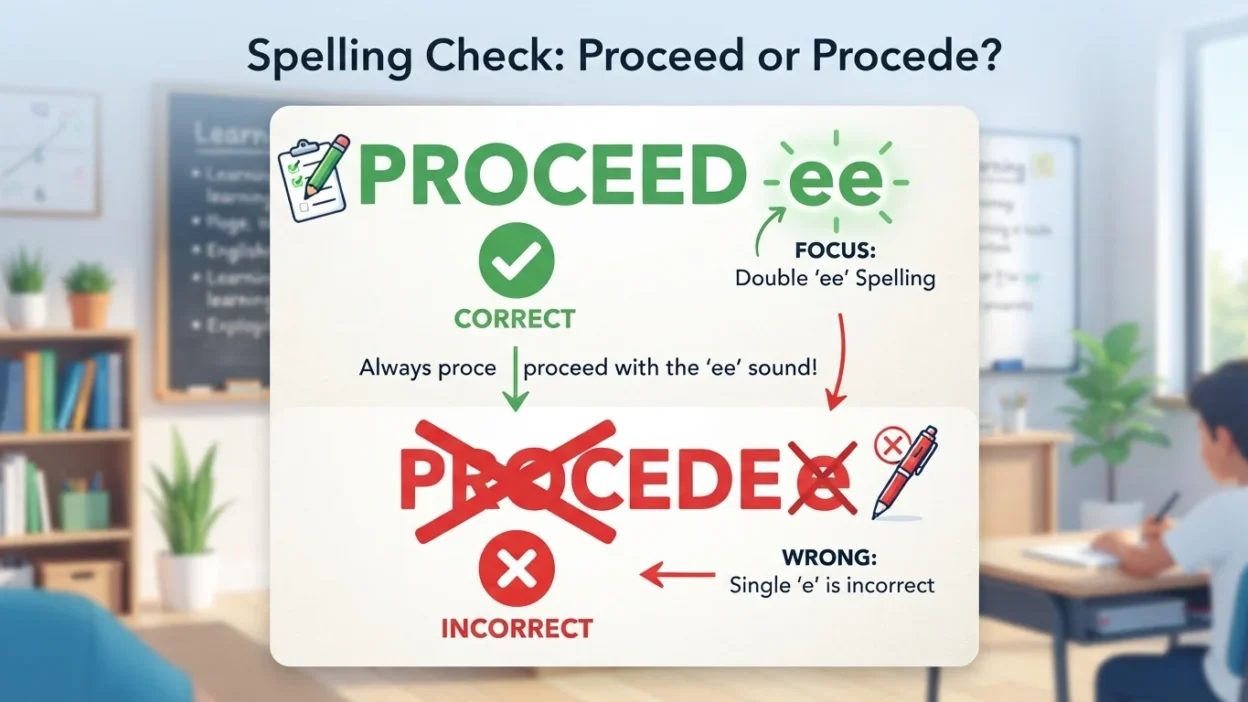
“Proceed” is the correct spelling and means to move forward or continue. “Procede” is incorrect and should never be used in proper English writing.
Definition and Meaning
The word “proceed” means to move ahead, continue an action, or carry on with a process. It is commonly used in both formal and everyday communication. You will often see it in instructions, meetings, and professional writing.
For example, someone may say, “Please proceed with the plan,” which means to continue or move forward. It can also appear in step by step directions, where each action follows the previous one in a logical sequence.
“Procede,” on the other hand, has no meaning in English. It is simply a misspelling of “proceed.” Even though it may look similar, it is not recognized in dictionaries and should never be used in any context.
Why People Confuse It
Many people confuse “proceed” and “procede” because of how the word sounds when spoken. The long vowel sound in the middle can make it unclear how many letters are needed when writing it down.
Another reason is that English spelling does not always match pronunciation. People often rely on how a word sounds rather than how it is correctly spelled. This leads to dropping one of the “e” letters and forming “procede.”
Fast typing and lack of proofreading also play a role. When writing quickly, it is easy to miss a letter. Once you understand that “proceed” contains a double “e,” the confusion becomes much easier to avoid in daily writing.
First Word
“Proceed” is the correct and standard spelling used in English. It is widely accepted in formal, informal, academic, and professional communication. This word is essential because it appears frequently in instructions and conversations.
You can use “proceed” when talking about continuing an action or moving forward. For example, “After the meeting, we will proceed with the project.” In this case, it clearly shows progression or continuation.
Another common use is in directions, such as “Proceed to the next step.” This indicates that the next action should follow. Because of its frequent use, learning the correct spelling of “proceed” is important for clear and confident communication.
Second Word
“Procede” is incorrect and should never be used in any form of writing. It does not exist in standard English and is considered a spelling error. Even though it may appear logical based on pronunciation, it is still wrong.
Using “procede” can make your writing look careless or unprofessional. This is especially important in formal situations like business emails, academic papers, or official documents, where accuracy matters.
If you accidentally write “procede,” it is best to correct it immediately. Always replace it with “proceed” to ensure your writing remains clear and grammatically correct.
Grammar Rules Explained
“Proceed” is a regular verb, which means it follows standard grammar patterns when changing tense. Understanding its forms helps you use it correctly in different situations.
The base form is “proceed.” The past tense is “proceeded,” and the present participle is “proceeding.” For example, “They proceeded with the plan” shows past action, while “They are proceeding with the plan” shows ongoing action.
The key spelling rule to remember is the double “e” in the middle of the word. This is not optional and must always be included. Removing one “e” creates an incorrect form. Learning this structure ensures you use the word accurately in all contexts.
Pronunciation Guide
“Proceed” is pronounced as pro seed. The word is divided into two clear parts, which makes it easier to say and remember. The first part sounds like “pro,” and the second part sounds like “seed.”
The long “ee” sound in the second part is important because it reflects the double “e” in spelling. This connection between sound and spelling can help you remember the correct form.
Many people make mistakes because they do not connect pronunciation with spelling. Practicing the word out loud and noticing the long vowel sound can reinforce the correct spelling in your memory.
Comparison Table
| Word | Correct | Meaning | Usage |
|---|---|---|---|
| Proceed | Yes | To continue or move forward | Always use |
| Procede | No | Incorrect spelling | Never use |
This table clearly shows that “proceed” is the only correct option. “Procede” should always be avoided in writing.
When to Use Each
You should use “proceed” whenever you want to describe continuing an action or moving forward. It is commonly used in instructions, plans, and formal communication.
For example, “You may proceed with the application” tells someone to continue. Similarly, “Let us proceed to the next topic” indicates moving forward in a discussion.
“Procede” has no correct use at all. It is not acceptable in any situation. Remembering this simple rule will help you avoid mistakes and keep your writing accurate.
Examples
Here are real life examples using “proceed” correctly:
- Please proceed with the registration process.
- We will proceed after approval.
- The team proceeded with the project.
- You can proceed to the next step.
- They proceeded without delay.
- She decided to proceed carefully.
- Let us proceed with the plan.
- He proceeded to explain the idea.
- The meeting proceeded smoothly.
- We are proceeding as planned
These examples show how naturally the word fits into different contexts.
Common Sentences
You will often see “proceed” in everyday sentences. It is commonly used in instructions and conversations where actions move step by step.
Examples include “Please proceed to checkout,” “You may proceed now,” and “Let us proceed further.” These sentences are simple but very common in daily communication.
Using the correct spelling in such sentences ensures clarity and professionalism. Even a small mistake like writing “procede” can confuse readers or reduce the impact of your message.
Real Life Usage
“Proceed” is widely used in real life situations. In business, it appears in emails and reports when giving instructions or continuing tasks. In technology, it is used in software messages like “Proceed with installation.”
In education, teachers use it when guiding students through steps. In travel, you may hear announcements like “Passengers may proceed to boarding.” This shows how common the word is across different areas of life.
Because it appears so often, correct spelling is essential. Using “proceed” correctly helps ensure your communication is clear and effective.
Formal vs Informal Use
“Proceed” works well in both formal and informal writing. In formal contexts, it is often used in reports, official instructions, and professional communication.
In informal settings, it appears in conversations, messages, and casual writing. For example, a friend might say, “Go ahead and proceed,” during a discussion or activity.
“Procede” is incorrect in all contexts. It does not matter if the writing is formal or informal. It should always be avoided to maintain correct grammar.
Common Mistakes
Many people make simple mistakes with this word. One of the most common is dropping one “e” and writing “procede.” This usually happens بسبب fast typing or relying on pronunciation.
Another mistake is forgetting that “proceed” has a double “e” in the middle. Some writers assume a simpler spelling, which leads to errors.
To avoid these mistakes, always double check your spelling. Practicing the correct form regularly will help you remember it and use it confidently in your writing.
Mistakes to Avoid
There are a few key mistakes you should avoid when using this word. First, never write “procede” in any type of document. It is always incorrect.
Second, do not rely only on how the word sounds. English spelling can be different from pronunciation, so it is important to learn the correct form.
Finally, avoid skipping proofreading. A quick review of your writing can help catch small errors like this before they become a problem.
Memory Trick
A simple trick can help you remember the correct spelling. Think of the word “seed” inside “proceed.” Since “seed” has double “e,” “proceed” also has double “e.”
This mental connection makes it easier to recall the correct form. Whenever you are unsure, just remember “pro plus seed equals proceed.”
Using this trick regularly will make the correct spelling stick in your memory.
American vs British English
There is no difference between American and British English for this word. Both forms use “proceed” as the correct spelling.
This makes it easier because you do not need to learn different versions for different regions. The rule stays the same everywhere.
“Procede” is incorrect in all forms of English, so it should always be avoided.
Similar Words
There are other words with similar patterns that can help reinforce your understanding. Examples include “exceed,” “succeed,” and “indeed.”
These words also use double “e,” which can help you remember the spelling of “proceed.” Recognizing patterns like this makes learning easier.
By practicing these words together, you can strengthen your spelling skills and avoid common mistakes.
Synonyms and Alternatives
Depending on context, you can use other words instead of “proceed.” Some common alternatives include “continue,” “advance,” “move forward,” and “carry on.”
Each of these words has a slightly different tone, but they can often replace “proceed” in sentences. For example, “Continue with the plan” has a similar meaning.
However, “proceed” remains one of the most formal and widely used options, especially in professional communication.
Expert Tips
To master this word, focus on patterns and repetition. Practice writing “proceed” in different sentences to build confidence.
Reading regularly also helps because you will see the correct spelling used in context. Over time, this reinforces your memory.
Experts suggest slowing down when typing and reviewing your work. Paying attention to small details like spelling can greatly improve your overall writing quality.
Related Confusing Words
Many words create similar confusion due to spelling patterns. Examples include “receive” and “recieve,” “believe” and “beleive,” and “achieve” and “acheive.”
In each case, only one spelling is correct. Learning these patterns helps you avoid multiple mistakes at once.
By focusing on commonly confused words, you can improve your accuracy and confidence in English writing.
Final Verdict
“Proceed” is the correct spelling and should always be used. “Procede” is incorrect and must be avoided in all situations.
Once you understand the double “e” pattern and practice using the word, the confusion disappears. Using the correct spelling will make your writing clearer and more professional.
FAQs
Is procede ever correct
No, it is always incorrect and should never be used
What is the correct spelling
The correct spelling is proceed
Why do people write procede
Because they rely on pronunciation and drop one “e”
Can I use procede informally
No, it is incorrect in all contexts
What does proceed mean
It means to continue or move forward
Are there similar words like proceed
Yes, such as exceed and succeed
Conclusion
Understanding the difference between “proceed” and “procede” is simple once you learn the correct spelling. English may seem tricky at times, but patterns like double vowels make learning easier.
By practicing regularly and paying attention to spelling, you can avoid this common mistake. Whether you are writing an email, report, or message, using “proceed” correctly will improve your communication and make your writing more effective.
Remember This
“Proceed” always has double “e”
“Procede” is wrong and should never be used

Donald Andrew is a dedicated author at BiblyWord, passionate about sharing biblical teachings in a clear and inspiring way. He creates meaningful content that helps readers understand scripture, reflect on their faith, and apply God’s Word in daily life. His work supports spiritual growth, guidance, and a deeper connection with biblical wisdom.