Spelling mistakes often happen when we try to shorten words or guess their forms. A common confusion is between “equipt” and “equipped.” At first glance, both may seem logical, but only one is correct in standard English.
This mistake appears in emails, assignments, and professional writing, especially when people try to form past tense quickly. Since the word relates to preparation and readiness, using the correct form is important for clear communication. Once you understand the rule behind it, this confusion becomes very easy to fix.
Let’s explore the difference in a simple and practical way so you never make this mistake again.
Quick Answer
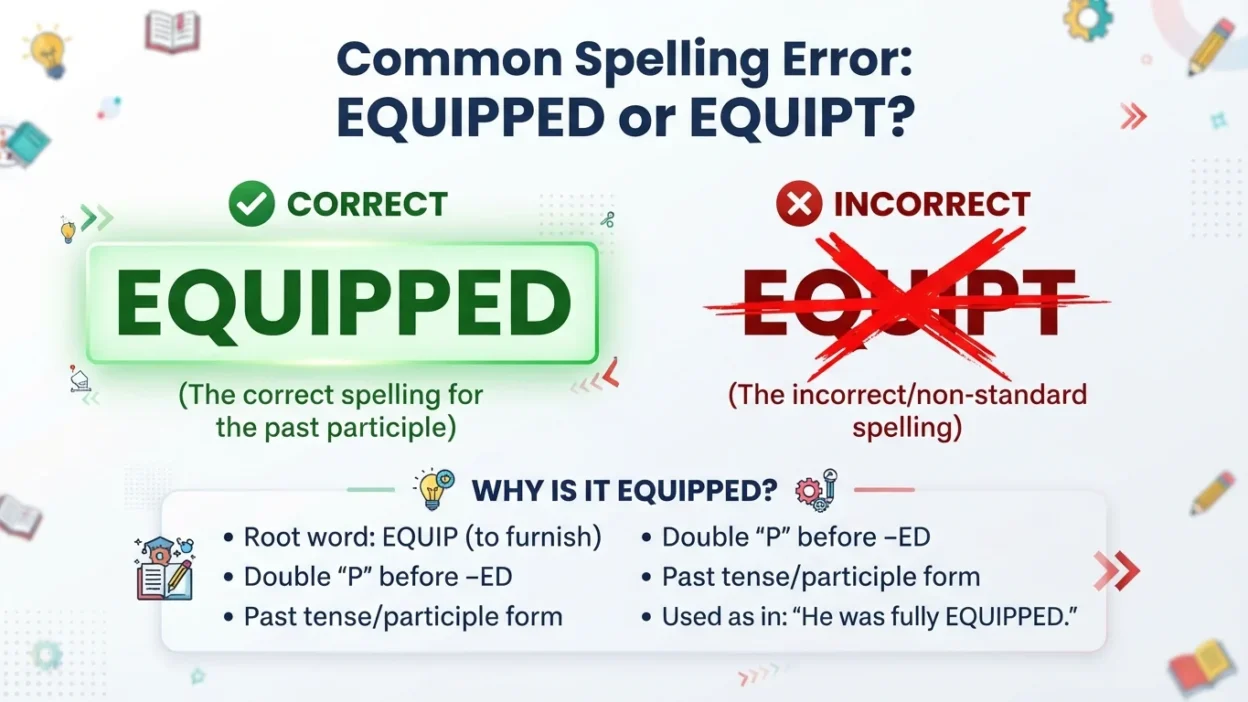
“Equipped” is the correct spelling and is the past tense of “equip.” “Equipt” is incorrect and should never be used in standard English writing.
Definition and Meaning
The word “equip” means to provide someone or something with the necessary tools, skills, or resources. It is commonly used in education, business, and daily life contexts.
When we talk about something already prepared, we use the past form “equipped.” This shows that the action has been completed and the person or object is ready for use.
“Equipt” has no meaning in English. It is simply a misspelling that often appears when people try to shorten the word incorrectly.
Understanding the meaning of “equipped” helps you use it correctly in both formal and informal communication.
Why People Confuse It
Many people confuse “equipt” and “equipped” because they try to apply simple spelling logic without knowing the full rule. English verbs often add “ed” to form the past tense, but some require extra changes.
Another reason is pronunciation. When spoken quickly, “equipped” may sound like “equipt,” which leads to spelling errors. This happens especially when writing fast or without proofreading.
Also, some learners assume that dropping letters makes the word simpler, but this creates incorrect forms. Once you learn the correct pattern, the confusion disappears easily.
First Word
“Equipt” is incorrect and should not be used in any form of writing. It does not follow English spelling rules and is not recognized in dictionaries.
This form usually appears because people try to shorten “equipped” or write based on sound rather than structure. However, English spelling often requires doubling certain letters, which cannot be ignored.
Using “equipt” can make your writing look unprofessional and careless. It may also confuse readers because it is not a valid word.
To maintain clarity and correctness, always avoid using “equipt” in emails, essays, or any written communication.
Second Word
“Equipped” is the correct past tense and past participle of “equip.” It is widely accepted and used in all forms of English writing.
This word describes something that has been prepared or supplied with what is needed. It is commonly used in sentences related to readiness, ability, and preparation.
For example, a student can be equipped with knowledge, or a team can be equipped with tools. The word fits naturally in both everyday and professional contexts.
Using “equipped” correctly ensures your writing is clear, accurate, and easy to understand. It also shows a strong command of grammar.
Grammar Rules Explained
The verb “equip” follows a common English rule for forming past tense. When a verb ends with a consonant and has a stressed final syllable, the last consonant is doubled before adding “ed.”
In “equip,” the final letter “p” is doubled, and then “ed” is added to form “equipped.” This is why the correct form includes two “p” letters.
This rule is important because it applies to many similar verbs. Ignoring it leads to incorrect spellings like “equipt.”
Learning this pattern helps you form correct past tense verbs and improves your overall writing accuracy.
Pronunciation Guide
“Equip” is pronounced as “ih kwip,” while “equipped” is pronounced as “ih kwipt.” The added “ed” creates a slightly sharper ending sound.
Although the pronunciation may sound close to “equipt,” the spelling must still follow the correct rule. English often has differences between sound and spelling.
Practicing pronunciation along with spelling helps reinforce the correct form in your memory. This makes it easier to avoid mistakes in both speaking and writing.
Comparison Table
| Word | Correct | Meaning | Usage |
|---|---|---|---|
| Equipped | Yes | Prepared or supplied | Always use |
| Equipt | No | Incorrect spelling | Never use |
This simple comparison shows that “equipped” is the only correct option.
When to Use Each
Use “equipped” when describing something that has already been prepared or provided with necessary items. It works in many contexts, including education, business, and daily life.
You can use it for people, tools, systems, or environments that are ready for a purpose. The word adds clarity by showing that preparation is complete.
Do not use “equipt” in any situation. It has no valid use in English and should always be avoided.
Keeping this rule in mind will help you write with confidence and accuracy.
Examples
Here are real life examples using “equipped” correctly:
- The classroom is equipped with modern technology.
- She is well equipped to handle the task.
- The team was equipped for the journey.
- He equipped himself with new skills.
- The car is equipped with safety features.
- Students are equipped with knowledge.
- The office is fully equipped.
- They equipped the lab with tools.
- The soldier was equipped for battle.
- The program equipped workers with training
These examples show how flexible and useful the word is.
Common Sentences
You will often see “equipped” used in everyday sentences. It appears in both spoken and written English, especially when describing readiness.
People use it to explain that someone has what they need to succeed. It is also common in descriptions of places, machines, or systems that are prepared for use.
Using “equipped” correctly makes your sentences sound natural and professional. Avoid replacing it with incorrect forms like “equipt,” which can weaken your message.
Real Life Usage
“Equipped” is widely used in real life situations across different fields. In education, students are equipped with knowledge and skills. In business, teams are equipped with tools and resources.
In daily life, people talk about being equipped for challenges or opportunities. The word helps express readiness and preparation clearly.
Because it is so commonly used, spelling it correctly is important. A small mistake can affect how your message is understood by others.
Formal vs Informal Use
“Equipped” works well in both formal and informal writing. In formal contexts like reports and academic work, it shows professionalism and accuracy.
In informal communication such as messages or conversations, it still sounds natural and clear. The word fits easily into different tones without any issue.
“Equipt,” however, is not acceptable in either context. It should always be avoided to maintain correctness and clarity in your writing.
Common Mistakes
Many people make mistakes with this word because they forget to double the final letter. Writing “equipt” instead of “equipped” is one of the most common errors.
Another mistake is relying on pronunciation alone. Since the word sounds shorter, writers may drop letters incorrectly. This leads to spelling errors.
To avoid these mistakes, focus on learning the rule and practicing correct spelling. Regular reading and writing can also help reinforce the correct form.
Mistakes to Avoid
Avoid writing “equipt” in any type of content, especially in professional or academic work. This mistake can reduce the quality of your writing.
Do not assume that shorter spellings are correct. English often requires specific patterns that must be followed carefully.
Always take a moment to review your writing before submitting it. This simple habit can help you catch and correct errors quickly.
Memory Trick
A simple way to remember the correct spelling is to think of the word “equip” and add “ped” with an extra “p.” This reminds you that the letter “p” must be doubled.
You can also connect it with similar words that follow the same pattern. This mental association makes it easier to recall the correct form.
Practicing this trick a few times will help you remember the spelling automatically.
American vs British English
There is no difference between American and British English for this word. Both use “equipped” as the correct form.
This makes it easier to remember because you do not need to learn separate spellings. The rule stays the same in all regions.
“Equipt” is incorrect everywhere and should not be used in any version of English.
Similar Words
Several words follow the same pattern as “equip.” These include verbs where the final consonant is doubled before adding “ed.”
Examples include “stop” becoming “stopped” and “plan” becoming “planned.” These words follow the same rule, which helps reinforce the pattern.
Learning these similar words can improve your understanding of English spelling and make it easier to avoid mistakes.
Synonyms and Alternatives
Instead of “equipped,” you can use words like “prepared,” “ready,” or “supplied,” depending on the context. These alternatives can add variety to your writing.
However, “equipped” remains the most precise word when referring to providing tools or resources. It clearly shows that something has been made ready.
Choosing the right synonym depends on your sentence, but always ensure the spelling is correct.
Expert Tips
To improve your spelling, focus on understanding rules rather than memorizing individual words. This helps you apply the same pattern to many situations.
Practice writing regularly and pay attention to common errors. Reading books and articles can also expose you to correct spelling naturally.
Experts recommend reviewing your work carefully to catch small mistakes before they become habits.
Related Confusing Words
Other words can create similar confusion due to spelling patterns. Examples include “stoped” and “stopped,” or “planed” and “planned.”
In each case, the correct form requires doubling the final consonant before adding “ed.” This shows how consistent the rule is across different words.
Learning these patterns helps you avoid multiple spelling mistakes at once.
Final Verdict
“Equipped” is the correct spelling and should always be used. “Equipt” is incorrect and must be avoided in all forms of writing.
By understanding the rule of doubling the final consonant, you can easily remember the correct form. This small detail can greatly improve your writing quality.
FAQs
Is equipt ever correct
No, it is always incorrect in standard English
What is the correct spelling
The correct spelling is “equipped”
Why is the letter p doubled
Because the verb follows a rule that doubles the final consonant before adding ed
Can I use equipt informally
No, it is incorrect in all contexts
What does equipped mean
It means prepared or provided with necessary tools or resources
Are there similar words like equipped
Yes, such as stopped and planned
Conclusion
Understanding the difference between “equipt” and “equipped” is simple once you learn the rule. While “equipt” may seem logical, it is not a valid word in English.
Using “equipped” correctly improves your writing and ensures your message is clear. Whether you are writing an email, report, or message, small spelling details matter.
Remember This
Always double the final “p” and use “equipped”
“Equipt” is wrong and should never be used

Kevin Brian is a passionate author at BiblyWord, dedicated to sharing the message of the Bible through thoughtful and inspiring content. He focuses on creating clear and meaningful writings that help readers understand scripture, strengthen their faith, and find guidance in everyday life through God’s Word.