Spelling mistakes can quietly weaken your writing, especially when two words look almost the same. One of the most common errors is confusing “presense” with “presence.” At a quick glance, both may appear correct, but only one is accepted in standard English.
This mistake shows up in emails, essays, and professional documents. Since the word is often used to describe importance, existence, or impact, using the wrong spelling can reduce clarity and credibility. The good news is that this is an easy mistake to fix once you understand the correct form and pattern.
Let’s explore the difference in a simple and practical way so you can write with confidence.
Quick Answer
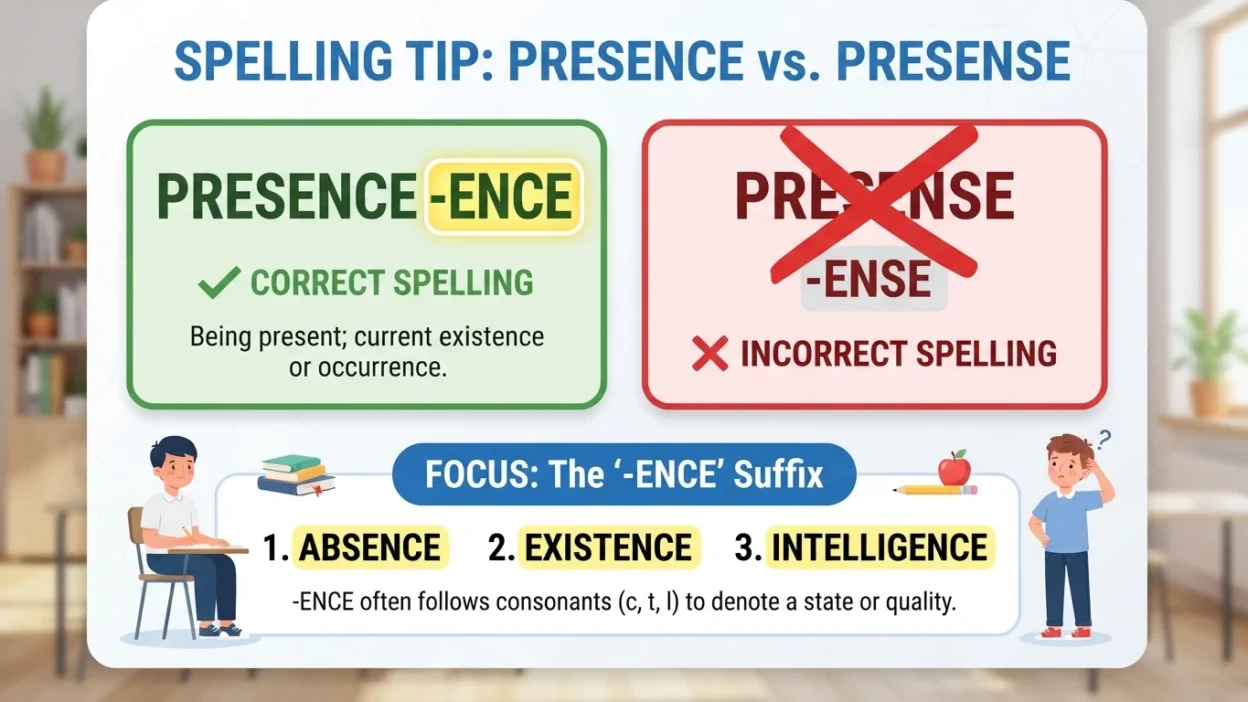
“Presence” is the correct spelling and means the state of being present or existing. “Presense” is incorrect and should never be used in proper English writing.
Definition and Meaning
The word “presence” refers to the state of being in a place or the quality of having a noticeable effect. It can describe physical location or a strong influence. For example, a person can have a powerful presence in a room.
It is also used in abstract ways. You might talk about someone’s presence in a meeting, which means they are there and contributing. In writing, it can show importance or attention.
“Presense” has no meaning because it is not a real English word. It is simply a spelling mistake that comes from confusion about vowel patterns.
Why People Confuse It
People often confuse “presence” and “presense” because the pronunciation does not clearly show the correct spelling. The middle sound can feel like it should be written with an “s” instead of a “c.”
Another reason is that English has many words with similar endings. Words like “sense” make people think “presense” could be correct, even though it is not.
Fast typing and lack of proofreading also lead to this mistake. Once you understand the correct spelling pattern, the confusion becomes much easier to avoid.
First Word
“Presense” is incorrect and should never be used in any form of writing. It is not listed in dictionaries and does not follow standard spelling rules.
Using this incorrect form can make your writing look careless. Readers may question your attention to detail when they see such errors.
Even in casual writing, it is better to use the correct form. Avoiding “presense” helps you maintain clarity and professionalism in every situation.
Second Word
“Presence” is the correct spelling and is widely used in English. It is suitable for both formal and informal writing.
For example, you might say someone has a strong presence in a meeting. This means they stand out and influence others. You can also say a person’s presence made you feel comfortable.
Using “presence” correctly improves your communication. It ensures your message is clear and your writing appears polished and reliable.
Grammar Rules Explained
“Presence” is a noun formed from the word “present.” The spelling changes slightly when forming the noun.
Instead of keeping the “t,” the word uses “ce” at the end. This is a common pattern in English where verbs or adjectives change form when becoming nouns.
For example, “absent” becomes “absence.” This pattern helps explain why “presence” uses “ce” instead of “se.”
Understanding this rule makes it easier to remember the correct spelling.
Pronunciation Guide
“Presence” is pronounced as “prez uh ns.” The middle sound is soft and quick, which can confuse spelling.
The ending “ce” produces a soft “s” sound. This is why it may sound like it should be spelled with “se,” even though that is incorrect.
Practicing the pronunciation while remembering the spelling helps reinforce the correct form. Saying it slowly can make the structure clearer.
Comparison Table
| Word | Correct | Meaning | Usage |
|---|---|---|---|
| Presence | Yes | State of being present | Always use |
| Presense | No | Incorrect spelling | Never use |
This table clearly shows that “presence” is the only correct option.
When to Use Each
Use “presence” whenever you want to describe someone being present or having influence. It works in both physical and abstract contexts.
For example, you can talk about a teacher’s presence in a classroom. You can also describe someone’s online presence, which means their activity on the internet.
“Presense” should never be used. It has no valid role in English, so avoiding it is essential.
Examples
Here are real life examples using “presence” correctly:
- Her presence made the event special
- He has a strong presence in meetings
- The teacher’s presence keeps students focused
- She felt his presence in the room
- The brand has a global presence
- His presence brings confidence
- The leader’s presence inspired the team
- She noticed a calming presence nearby
- The company increased its online presence
- His presence was comforting
These examples show how flexible and useful the word is.
Common Sentences
You will often hear sentences like these in everyday English. They show how “presence” fits naturally into communication.
People say things like someone’s presence was felt strongly in a room. This highlights emotional or social impact. Another common sentence is about having a strong online presence.
Using correct spelling in these sentences keeps your writing clear. It also helps your message sound natural and professional.
Real Life Usage
“Presence” is used in many real life situations. In business, it refers to how visible a company is in the market. In social settings, it describes how noticeable or influential a person is.
In digital spaces, online presence is very important. It shows how active and visible someone is on platforms like websites or social media.
Because it is used in so many areas, spelling it correctly is essential. It helps you communicate effectively in every context.
Formal vs Informal Use
“Presence” works well in both formal and informal writing. In formal settings, it appears in reports, presentations, and professional emails.
In informal situations, it is used in conversations, messages, and social posts. The meaning remains the same across all contexts.
“Presense” is incorrect everywhere. It should never be used, regardless of the situation.
Common Mistakes
One of the most common mistakes is writing “presense” instead of “presence.” This usually happens due to confusion about spelling patterns.
Another mistake is relying only on pronunciation. Since the word sounds simple, people assume the spelling is straightforward.
To avoid these errors, focus on learning the correct form. Practice writing the word and check your work carefully.
Mistakes to Avoid
Avoid using “presense” in any type of writing. This includes emails, assignments, and professional documents.
Do not guess the spelling based on how the word sounds. English spelling often does not match pronunciation exactly.
Always take a moment to review your writing. A quick check can prevent simple but noticeable errors.
Memory Trick
A simple trick can help you remember the correct spelling. Think of the word “present” inside “presence.”
Both words share the same root. When you remember “present,” it becomes easier to spell “presence” correctly.
This connection makes the spelling more logical and easier to recall.
American vs British English
There is no difference between American and British English for this word. Both use “presence” as the correct spelling.
“Presense” is incorrect in all regions. This makes the rule simple and consistent.
No matter where you are writing, you can confidently use “presence.”
Similar Words
Many words follow a similar pattern. Examples include “absence,” “essence,” and “science.”
These words also use “ce” instead of “se.” Learning these patterns can help improve your spelling skills.
By recognizing these similarities, you can avoid making similar mistakes in other words.
Synonyms and Alternatives
Depending on context, you can use alternatives like “existence,” “appearance,” or “influence.”
Each synonym has a slightly different meaning. Choosing the right one depends on what you want to express.
However, “presence” remains the most direct and widely used option.
Expert Tips
To improve your spelling, focus on patterns rather than memorizing individual words. This helps you learn faster and remember longer.
Reading regularly can also strengthen your understanding. Seeing words used correctly reinforces proper spelling.
Practice writing difficult words and review them often. This builds confidence and accuracy over time.
Related Confusing Words
Other words create similar confusion. Examples include “difference” and “diffrence,” or “separate” and “seperate.”
These mistakes often come from misunderstanding spelling patterns. Learning the correct forms helps you avoid them.
By paying attention to details, you can improve your overall writing quality.
Final Verdict
“Presence” is the correct spelling and should always be used. “Presense” is incorrect and must be avoided.
Understanding the pattern and practicing the correct form will help you avoid this mistake. With time, it will become natural to use “presence” correctly.
FAQs
Is presense ever correct
No, it is always incorrect
What is the correct spelling
The correct spelling is presence
Why do people write presense
Because of confusion with pronunciation
Can I use presense informally
No, it is incorrect in all contexts
What does presence mean
It means the state of being present or having influence
Are there similar words like presence
Yes, such as absence and essence
Conclusion
Spelling mistakes like “presense” instead of “presence” are common, but they are easy to fix. Once you understand the correct pattern, you can avoid this error completely.
Using correct spelling improves your writing and makes it more professional. It shows attention to detail and helps your message stand out clearly.
With practice and awareness, you can confidently use “presence” in all your writing.
Remember This
Always use “presence” with “ce” at the end
“Presense” is wrong and should never be used

Kevin Brian is a passionate author at BiblyWord, dedicated to sharing the message of the Bible through thoughtful and inspiring content. He focuses on creating clear and meaningful writings that help readers understand scripture, strengthen their faith, and find guidance in everyday life through God’s Word.