The phrases me either and me neither often confuse English learners because they appear similar but are used in different situations. Using the wrong one can make your sentence sound unnatural or grammatically incorrect.
Both expressions are used to agree with someone, but the key difference lies in whether the original statement is positive or negative. Once you understand this rule, choosing between me either vs me neither becomes simple. In this guide, you’ll learn clear meanings, grammar rules, examples, and easy tricks to use both phrases correctly.
Quick Answer
Use me neither to agree with a negative statement.
Use me either in informal speech to agree with a negative statement, but it is less formal.
Me neither is the safer and more grammatically correct choice.
Definition and Meaning
Both me either and me neither are used to agree with someone.
However:
- Me neither is the standard and correct form for negative agreement.
- Me either is informal and less accepted in formal English.
Why People Confuse It
The confusion comes from the word either, which is often used in negative sentences.
Because of this, people assume “me either” is correct in all cases.
However, grammar rules prefer me neither.
First Phrase: Me Either
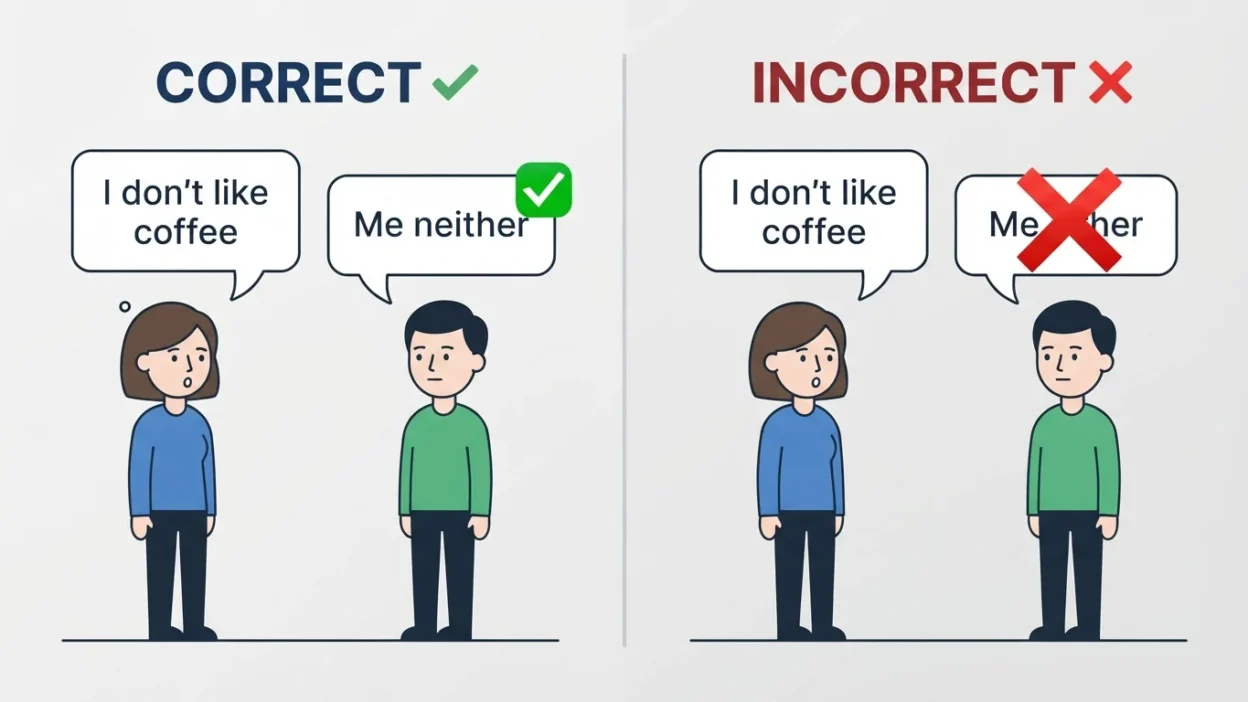
Me either is used informally to agree with a negative statement.
Examples:
- “I don’t like coffee.”
“Me either.”
It is common in casual speech but not preferred in formal writing.
Second Phrase: Me Neither
Me neither is the correct and standard phrase.
It is used to agree with negative statements.
Examples:
- “I don’t understand this.”
“Me neither.”
Grammar Rules Explained
Use me neither after a negative statement.
Use me either only in informal conversation.
Better alternatives:
- “Neither do I.” (formal)
- “I don’t either.” (informal)
Comparison Table
| Feature | Me Either | Me Neither |
|---|---|---|
| Correct usage | Informal | Standard |
| Meaning | Agree with negative | Agree with negative |
| Context | Casual speech | Formal and informal |
| Example | Me either | Me neither |
When to Use Each
Use me neither when:
- Writing formally
- Speaking correctly
Use me either when:
- Speaking casually
- In informal conversations
Real Life Usage
In everyday conversations, both phrases are used.
However, me neither is more widely accepted and considered correct.
Formal vs Informal Use
Me neither is acceptable in all contexts.
Me either is mainly used in informal speech.
Pronunciation Guide
- Me either: /miː ˈaɪðər/
- Me neither: /miː ˈnaɪðər/
Synonyms and Alternatives
Alternatives include:
- Neither do I
- I don’t either
These are more grammatically complete.
Common Sentences
Examples:
- I don’t like tea. Me neither.
- I can’t swim. Me neither.
- I don’t want to go. Me either.
Examples
Here are 10 examples:
- “I don’t like spicy food.” “Me neither.”
- “I can’t come today.” “Me neither.”
- “I don’t watch TV.” “Me neither.”
- “I don’t understand this.” “Me neither.”
- “I don’t eat meat.” “Me neither.”
- “I don’t like coffee.” “Me either.”
- “I don’t enjoy cold weather.” “Me either.”
- “I don’t want to leave.” “Me neither.”
- “I don’t play games.” “Me neither.”
- “I don’t like noise.” “Me either.”
Common Mistakes
A common mistake is using me either in formal writing.
Another is using these phrases after positive statements.
Mistakes to Avoid
Avoid:
- Using “me either” in formal contexts
- Using these phrases after positive statements
- Ignoring sentence tone
Memory Trick
Remember:
Neither = negative agreement
Think: “N” in neither = negative.
American vs British English
There is no major difference.
Both prefer me neither in standard English.
Similar Words
Other related pairs:
- Either vs Neither
- Too vs Either
- So do I vs Neither do I
Related Confusing Words
More examples:
- Affect vs Effect
- Advice vs Advise
- Accept vs Except
Expert Tips
Use me neither to be safe.
If you want to sound more formal, use:
- “Neither do I.”
When Does It Apply
Use these phrases when:
- Agreeing with negative statements
- Having conversations
- Writing dialogue
Final Verdict
Me neither is correct and widely accepted.
Me either is informal and less preferred.
Choose based on context, but me neither is safer.
FAQs
1. Which is correct: me either or me neither?
Me neither is correct.
2. Can I use me either?
Yes, but only informally.
3. What is a better alternative?
Neither do I.
4. Can I use them after positive sentences?
No.
5. Why is this confusing?
Because of the word “either.”
6. How do I remember it?
Neither = negative.
Remember This
Me neither = correct.
Me either = informal.
Use neither for negative agreement.
Conclusion
The difference between me either and me neither comes down to correctness and formality. Me neither is the standard and widely accepted way to agree with a negative statement, while me either is commonly used in informal speech but is not preferred in formal writing.
By remembering that “neither means negative agreement,” you can easily choose the correct phrase. With practice, you’ll naturally use me neither in the right situations, improving your grammar and communication skills.

Donald Andrew is a dedicated author at BiblyWord, passionate about sharing biblical teachings in a clear and inspiring way. He creates meaningful content that helps readers understand scripture, reflect on their faith, and apply God’s Word in daily life. His work supports spiritual growth, guidance, and a deeper connection with biblical wisdom.