The phrases any time and anytime may look almost identical, but they are used differently in English. Many people mix them up because they sound the same and both relate to time. However, one is a noun phrase, and the other is an adverb.
Understanding the difference between any time vs anytime will help you write more clearly and avoid common grammar mistakes. In this guide, you’ll learn their meanings, rules, examples, and easy tricks to use them correctly every time.
Quick Answer
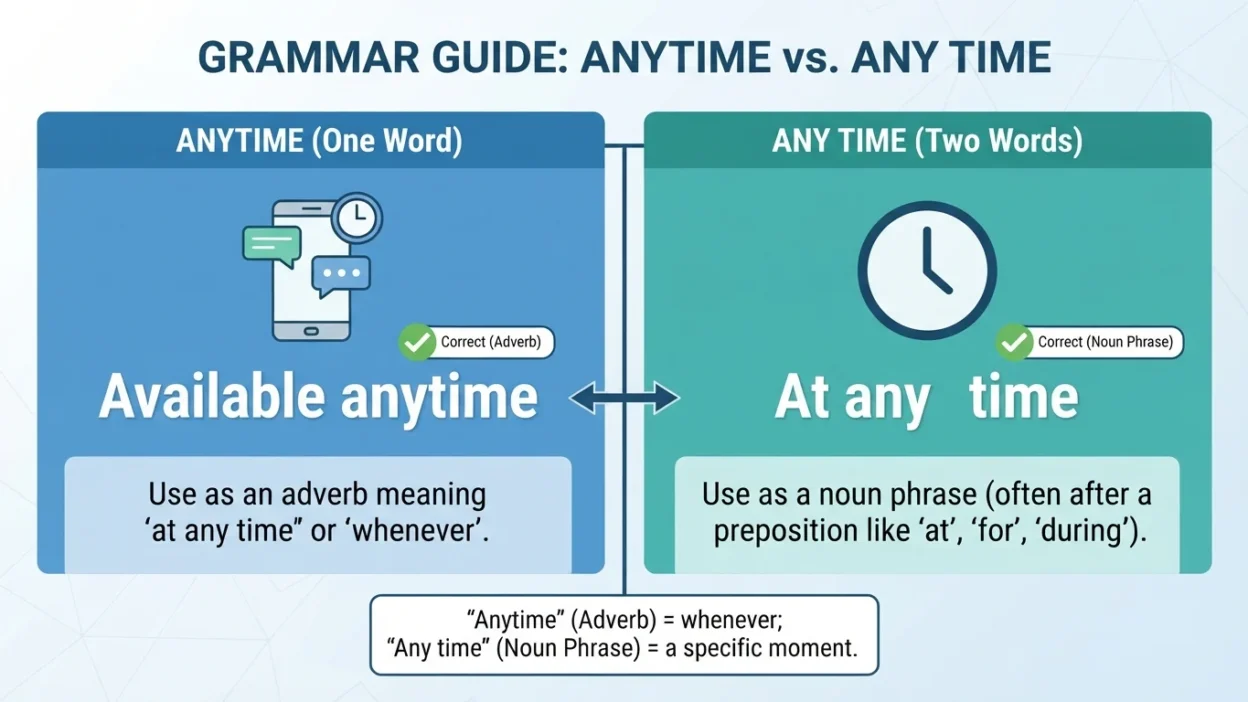
Anytime is an adverb meaning “whenever.”
Any time is a noun phrase meaning “any amount of time.”
Use anytime without a preposition and any time after prepositions like at or for.
Definition and Meaning
Anytime is an adverb used to mean “at any moment” or “whenever.”
Any time is a noun phrase where time is a noun, often used with prepositions.
So:
- Anytime = adverb
- Any time = noun phrase
Why People Confuse It
The confusion comes from identical pronunciation and similar meaning.
Also, many English phrases become one word over time, so people assume both forms are interchangeable.
However, grammar rules require different usage.
First Word: Anytime
Anytime is an adverb.
It means “whenever” and does not need a preposition.
Examples:
- You can call me anytime.
- Visit us anytime you want.
Second Word: Any Time
Any time is a noun phrase.
It is usually used after a preposition.
Examples:
- You can call me at any time.
- I don’t have any time today.
Grammar Rules Explained
Use anytime when no preposition is needed.
Use any time when:
- It follows a preposition
- It refers to a quantity of time
Examples:
- Come anytime.
- Come at any time.
Comparison Table
| Feature | Anytime | Any Time |
|---|---|---|
| Type | Adverb | Noun phrase |
| Meaning | Whenever | Any amount of time |
| Preposition | Not needed | Often needed |
| Example | Call anytime | Call at any time |
When to Use Each
Use anytime:
- Without prepositions
- As an adverb
Use any time:
- After prepositions
- When referring to time as a noun
Ask:
- Is there a preposition? → any time
- No preposition? → anytime
Real Life Usage
In everyday speech, both forms are common.
However, correct usage is important in formal writing.
Using them properly improves clarity and professionalism.
Formal vs Informal Use
Both anytime and any time are acceptable in formal and informal contexts.
Correct usage depends on grammar, not tone.
Pronunciation Guide
Both forms are pronounced the same: /ˈeniˌtaɪm/
This is why they are often confused.
Synonyms and Alternatives
For anytime:
- Whenever
- At any moment
For any time:
- Any amount of time
- At any point
Common Sentences
Examples:
- Call me anytime.
- Call me at any time.
- I don’t have any time today.
- Visit anytime you like.
Examples
Here are 10 examples:
- You can visit anytime.
- Call me anytime you need help.
- I don’t have any time right now.
- You can come at any time.
- Feel free to stop by anytime.
- She didn’t have any time to rest.
- Contact us anytime.
- You may arrive at any time.
- He doesn’t have any time today.
- Come anytime you want.
Common Mistakes
A common mistake is using anytime after a preposition.
Another is using any time when an adverb is needed.
Mistakes to Avoid
Avoid:
- Saying “at anytime” (use “at any time”)
- Ignoring sentence structure
Memory Trick
Remember:
Anytime = one word, no preposition
Any time = two words, needs a preposition
American vs British English
Both forms are used similarly in American and British English.
However, any time is sometimes preferred in more formal writing.
Similar Words
Other similar pairs:
- Awhile vs A while
- Setup vs Set up
- Anytime vs Any day
Related Confusing Words
More examples:
- Affect vs Effect
- Advice vs Advise
- Accept vs Except
Expert Tips
Check for prepositions like at, for, or in.
If present, use any time.
Otherwise, use anytime.
When Does It Apply
Use these forms when:
- Talking about time
- Writing invitations
- Communicating availability
Final Verdict
Anytime is an adverb used without a preposition.
Any time is a noun phrase used with a preposition or when referring to time as a quantity.
Understanding this difference makes your writing clearer and more accurate.
FAQs
1. What is the difference between anytime and any time?
Anytime is an adverb, while any time is a noun phrase.
2. Can I say “at anytime”?
No, use “at any time.”
3. Is anytime one word or two?
It depends on usage.
4. Which is more formal?
Both are correct when used properly.
5. Why are they confusing?
Because they sound the same.
6. How do I remember the difference?
Check for prepositions.
Remember This
Anytime = no preposition.
Any time = with preposition.
One word vs two words rule.
Conclusion
The difference between any time and anytime comes down to grammar and sentence structure. Anytime is an adverb used without a preposition, while any time is a noun phrase that typically follows one or refers to a quantity of time. Even though they sound identical, their usage depends on how they function in a sentence.
By remembering the simple rule about prepositions, you can easily choose the correct form. With practice, using anytime and any time correctly will become natural, improving both your writing clarity and confidence

Carol Amanda is a passionate writer and faith-driven author dedicated to sharing the wisdom of the Bible. At BiblyWord, she creates inspiring and meaningful content that encourages spiritual growth and daily reflection. Her work focuses on helping readers connect with God’s Word and find guidance, peace, and strength in their faith journey.