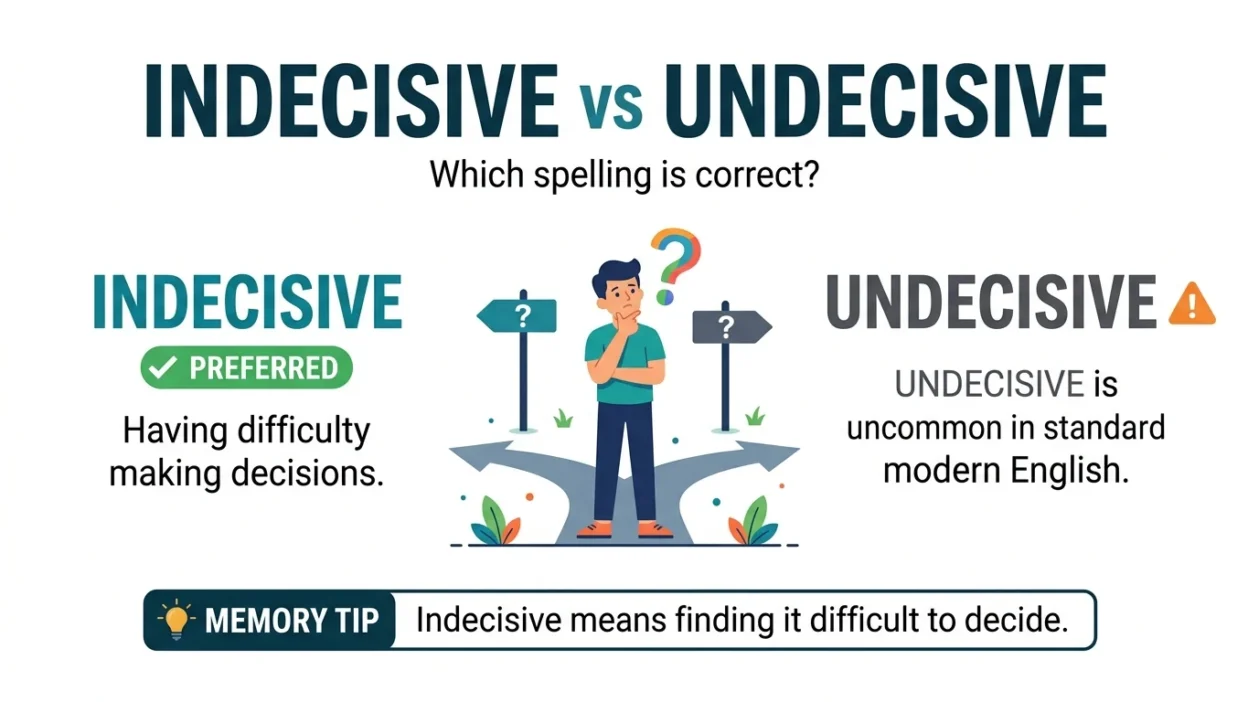
Choosing between indecisive and undecisive can be confusing because both words appear to express the opposite of being decisive. However, they are not equally common or accepted in standard English.
Indecisive is the established and widely accepted adjective used to describe someone who struggles to make decisions, hesitates between options, or finds it difficult to choose. For example, “I am indecisive when shopping for clothes” means that choosing an outfit is difficult.
Undecisive is much less common and is generally not the preferred word in modern standard English. Although readers may understand what it is intended to mean, indecisive is the natural choice in everyday conversation, professional writing, academic work, and formal communication.
If you are unsure which spelling to use, choose indecisive. Remember this simple rule: indecisive is the standard word for someone who has difficulty making decisions.
Quick Answer
Indecisive is the standard English adjective for someone who struggles to make decisions or choose between options. Undecisive is uncommon and generally not recommended in standard modern English. For essays, emails, work documents, and everyday writing, use indecisive.
Indecisive vs Undecisive Definition and Meaning
Indecisive means unable or reluctant to make a decision quickly or confidently.
For example:
“She was indecisive about which university to attend.”
This means she struggled to choose between her options.
Undecisive is a rare or nonstandard alternative in ordinary modern usage. Most English speakers would use indecisive instead.
For example, instead of writing:
“He is undecisive about his future.”
Write:
“He is indecisive about his future.”
The distinction is primarily about standard usage rather than two clearly separate meanings.
Remember:
INDECISIVE is the preferred standard word.
Why People Confuse Indecisive and Undecisive
People confuse these words because English uses several prefixes to create opposites.
For example, unhappy means not happy, while inaccurate means not accurate.
Because un and in can both express negation, it may seem reasonable to use undecisive as the opposite of decisive.
However, English word formation does not always allow these prefixes to be exchanged freely. Established vocabulary and common usage determine which form sounds natural.
The accepted adjective is indecisive.
For example:
“She is indecisive about her career.”
Although undecisive may be understandable, it is uncommon and is usually replaced by indecisive in edited English.
What Does Indecisive Mean?
Indecisive describes someone who has difficulty choosing, making decisions, or committing to a particular option.
An indecisive person may repeatedly compare alternatives, worry about making the wrong choice, or change their mind frequently.
Examples:
“He is indecisive about what to eat.”
“She felt indecisive about accepting the job offer.”
“My indecisive friend spent an hour choosing a movie.”
Being indecisive does not necessarily mean someone lacks intelligence or knowledge. Sometimes, a person simply has too many options, feels uncertain about the consequences, or wants to make the perfect choice.
The word is commonly used in conversations about personality, shopping, relationships, careers, and everyday decisions.
What Does Undecisive Mean?
Undecisive is an uncommon form that some readers may interpret as meaning not decisive.
However, it is not the normal, widely accepted adjective used in contemporary standard English for someone who struggles to make decisions.
In most situations, writers should choose indecisive.
For example:
Less natural: “The manager was undecisive.”
Preferred: “The manager was indecisive.”
If you want to express a different idea, you can also use phrases such as:
“unable to decide”
“uncertain about the choice”
“hesitant to make a decision”
These alternatives are often clearer than using the uncommon word undecisive.
Indecisive vs Undecisive Comparison
Indecisive
Grammatical role: Adjective
Meaning: Having difficulty making decisions
Usage: Standard and widely accepted
Example: “She is indecisive about which car to buy.”
Undecisive
Grammatical role: Intended as an adjective
Meaning: Usually intended to mean not decisive
Usage: Rare and generally not preferred in modern standard English
Example: Replace “He is undecisive” with “He is indecisive.”
The key difference is that indecisive is the established word you should normally use.
Indecisive vs Undecisive Pronunciation Guide
Indecisive is pronounced approximately:
“in dih SY siv”
The main stress falls on the syllable SY.
Undecisive, when used, is generally pronounced approximately:
“un dih SY siv”
Pronunciation can vary, but pronunciation is not the main issue with this pair.
The important difference is standard usage.
If you are speaking or writing and want to describe someone who struggles to choose, use indecisive.
Example:
“He is indecisive about moving to another city.”
Remember that choosing the established word helps your writing sound natural and clear.
Grammar Rules for Indecisive and Undecisive
Indecisive is an adjective.
It can appear before a noun:
“She is an indecisive shopper.”
It can also follow a linking verb:
“He seems indecisive.”
“You are being indecisive.”
Common patterns include:
“indecisive about something”
“indecisive when choosing”
“indecisive in making decisions”
Examples:
“I am indecisive about my career.”
“She becomes indecisive when faced with several choices.”
The uncommon form undecisive is generally best avoided in these constructions. Use indecisive instead.
When to Use Indecisive
Use indecisive when describing someone who struggles to make a decision or commit to an option.
Examples:
“She is indecisive about her future.”
“He became indecisive when choosing a university.”
“My brother is indecisive about which phone to buy.”
“The committee seemed indecisive.”
The word can describe a temporary situation or a more general habit.
For example, someone may be indecisive about one major purchase without being indecisive in every area of life.
Use the word carefully when describing people because it can sound critical. In sensitive situations, a phrase such as “still considering the options” may sound more neutral.
When to Use Undecisive
In ordinary modern English, it is best to avoid undecisive when you mean that someone struggles to make decisions.
Use indecisive instead.
For example:
Less natural: “I feel undecisive about the offer.”
Better: “I feel indecisive about the offer.”
You could also write:
“I have not decided yet.”
“I am uncertain about the offer.”
“I am still weighing my options.”
These alternatives may be especially useful when you want to describe a situation rather than label someone’s personality.
The practical rule is straightforward: choose indecisive for standard writing.
When to Use Each Word
For everyday communication, professional writing, and academic work, indecisive is the recommended choice.
Use it when someone:
Has difficulty choosing
Hesitates between alternatives
Frequently changes their mind
Struggles to commit to a decision
Examples:
“She is indecisive about where to live.”
“He remained indecisive throughout the discussion.”
Undecisive is uncommon and does not offer a useful distinction in ordinary modern English. Unless you are quoting a source or discussing unusual word usage, replace it with indecisive.
Indecisive vs Undecisive Examples
Here are 15 examples showing the preferred word in context.
- I am indecisive about what to order.
- She is indecisive when choosing clothes.
- He felt indecisive about accepting the offer.
- My friend is indecisive about which movie to watch.
- The manager seemed indecisive during the meeting.
- They were indecisive about where to spend their holiday.
- I become indecisive when I have too many options.
- The student was indecisive about choosing a major.
- She remained indecisive about moving abroad.
- He is sometimes indecisive about small purchases.
- The committee appeared indecisive about the proposal.
- My brother is indecisive when buying a new phone.
- She was indecisive about which job to accept.
- The team seemed indecisive about its next step.
- If you are indecisive, compare the advantages and disadvantages before choosing.
Is Indecisive a Real Word?
Yes. Indecisive is a standard English adjective.
It describes someone who struggles to make decisions or has difficulty choosing between alternatives.
Example:
“He is indecisive about his career.”
The related words include:
decide
decision
decisive
indecisive
indecision
These words belong to the same word family.
For example:
“Her indecision delayed the project.”
“The manager made a decisive choice.”
Understanding this word family makes it easier to recognize and use indecisive correctly.
Is Undecisive a Real Word?
Undecisive is occasionally encountered, but it is rare and is not the usual choice in contemporary standard English.
Most dictionaries and ordinary edited writing favor indecisive for the meaning of struggling to make decisions.
If you encounter undecisive in a text, the intended meaning may be understandable from context. However, that does not make it the best choice for your own writing.
For example:
Preferred: “The answer was indecisive.”
Depending on the intended meaning, an even clearer sentence might be:
“The answer showed uncertainty.”
“The response did not make a clear decision.”
When in doubt, use the more established word or choose a more precise phrase.
Indecisive Meaning in Daily Life
In everyday life, indecisive often describes difficulty choosing among several reasonable options.
For example, someone might spend a long time choosing a restaurant, deciding what to wear, or selecting a holiday destination.
Example:
“My sister is indecisive about where we should eat.”
The word can also describe larger decisions:
“He is indecisive about changing careers.”
Being indecisive is not always a permanent personality trait. People can feel uncertain because they lack information, face pressure, or worry about consequences.
If you want a gentler expression, say:
“She is taking time to consider her options.”
This communicates uncertainty without sounding overly judgmental.
Indecisive in Business English
In business, indecisive can describe a person, leader, team, or organization that struggles to make a choice.
Examples:
“The manager appeared indecisive during negotiations.”
“The company was indecisive about its expansion plans.”
“An indecisive leadership team may delay important decisions.”
However, the word can sound negative in professional settings.
When describing a real person, consider whether a more neutral expression is appropriate.
For example:
“The team is still evaluating its options.”
“The manager has not yet reached a final decision.”
These phrases describe the situation without making a broad judgment about someone’s personality.
Indecisive in Academic Writing
Indecisive can be used in academic writing when it accurately describes uncertainty or difficulty making decisions.
Example:
“The participants reported feeling indecisive when choosing between the available options.”
Another example:
“Indecisive leadership can delay organizational change.”
However, academic writing should be precise.
If you mean that evidence is inconclusive, do not automatically use indecisive.
For example:
“The results are inconclusive” means the evidence does not support a definite conclusion.
“The researcher was indecisive” means the researcher struggled to make a decision.
These phrases describe different situations.
Indecisive vs Decisive
Decisive describes someone who can make decisions firmly and confidently.
Indecisive describes someone who struggles to choose or commit to a decision.
Compare:
“She is decisive and chooses quickly.”
“She is indecisive and takes a long time to choose.”
Other examples:
“A decisive leader made a clear choice.”
“An indecisive leader kept postponing the decision.”
Remember:
Decisive means able or willing to decide.
Indecisive means having difficulty deciding.
This comparison also explains why indecisive is the established word rather than undecisive.
Indecisive vs Uncertain
Indecisive and uncertain are related, but they do not always mean exactly the same thing.
Indecisive emphasizes difficulty choosing or making a decision.
Example:
“She is indecisive about which house to buy.”
Uncertain emphasizes doubt, lack of confidence, or lack of knowledge.
Example:
“She is uncertain whether the house is affordable.”
Someone can be uncertain without being indecisive. They may simply need more information.
Likewise, someone may understand the available options but still struggle to choose between them.
Choose the word that best expresses the intended meaning.
Indecisive vs Indecision
Indecisive is an adjective.
Example:
“He is indecisive.”
Indecision is a noun referring to the state or act of struggling to decide.
Example:
“His indecision delayed the project.”
Compare:
“She is indecisive about the job.”
“Her indecision about the job lasted several weeks.”
The first describes the person or their behavior.
The second names the difficulty itself.
Both words are standard and belong to the same word family.
Indecisive vs Hesitant
Indecisive means struggling to choose between options or make a decision.
Hesitant means slow or reluctant to act, speak, or proceed because of uncertainty, nervousness, or caution.
Examples:
“She was indecisive about which course to take.”
“She was hesitant to speak in front of the audience.”
Someone can be hesitant without having multiple options to choose from. They might know what they want to say but feel nervous about saying it.
Similarly, a person can be indecisive because several choices seem equally attractive.
Choose indecisive for difficulty deciding and hesitant for reluctance or delay in taking action.
Indecisive vs Uncertain vs Undecisive
These words should not be treated as equally established alternatives.
Indecisive is the standard adjective for difficulty making a decision.
Uncertain describes doubt or lack of confidence about something.
Undecisive is uncommon and generally not recommended in standard modern English.
Examples:
“She is indecisive about which job to accept.”
“She is uncertain whether the job is right for her.”
Instead of:
“She is undecisive about the job.”
Prefer:
“She is indecisive about the job.”
or:
“She has not decided about the job yet.”
The best word depends on whether you mean difficulty choosing or simply a lack of certainty.
Formal vs Informal Use
Indecisive works in both formal and informal English.
Informal example:
“I am so indecisive about what to eat.”
Formal example:
“The committee appeared indecisive about the proposed changes.”
In formal writing, you can sometimes replace the adjective with a more specific description.
For example:
“The committee delayed its decision while considering the available alternatives.”
This explains what happened rather than simply labeling the committee.
Undecisive is generally best avoided in both formal and informal contexts because indecisive is the established alternative.
American vs British English
The basic distinction is the same in American and British English.
Both varieties use indecisive to describe someone who struggles to make decisions.
The spelling undecisive remains uncommon and is not the preferred standard form in either variety.
Examples:
American English: “She is indecisive about the offer.”
British English: “She is indecisive about the offer.”
There is no meaningful regional spelling difference for this pair.
One related difference is the spelling of decisive, which is the same in both varieties.
For standard writing, choose indecisive.
Common Mistakes With Indecisive and Undecisive
A common mistake is assuming that every word beginning with un can be used as the opposite of its base word.
English prefixes do not work that way in every case.
For example, unhappy is standard, but that does not mean undecisive is the preferred form.
Use:
“She is indecisive about the offer.”
Avoid using undecisive when you mean that someone cannot choose.
Another common mistake is confusing indecision with uncertainty.
If someone cannot choose between two options, indecisive may fit.
If someone does not know whether a statement is true, uncertain may be more accurate.
Memory Trick for Indecisive vs Undecisive
Use this simple memory trick:
INDECISIVE contains DECIDE.
Think:
“An indecisive person cannot easily decide.”
The word is directly connected to decide, decision, and decisive.
Remember these examples:
“She is indecisive.”
“She struggles to decide.”
“Her indecision caused a delay.”
Do not rely on choosing a prefix by guessing whether in or un means “not.”
Instead, memorize the established word:
INDECISIVE is the standard choice.
Expert Tips for Choosing Indecisive or Undecisive
Use indecisive whenever you want to describe someone who struggles to make decisions.
If you are unsure whether the word fits, try replacing it with:
“having difficulty deciding”
“unable to choose”
“hesitant between options”
If the sentence keeps its intended meaning, indecisive is likely appropriate.
Use uncertain when the issue is doubt or lack of knowledge rather than difficulty choosing.
Avoid undecisive in standard writing unless you are quoting a source or discussing unusual usage.
The best writing is not just grammatically correct. It also uses the clearest and most natural word for the intended meaning.
Mistakes to Avoid
Do not assume indecisive and undecisive are equally common.
Use indecisive in standard English.
Do not confuse indecisive with uncertain in every context. They overlap, but their meanings differ.
Do not describe a person as indecisive when you simply mean that they need more information.
For example:
Less precise: “The researcher was indecisive about the results.”
More precise: “The researcher was uncertain about how to interpret the results.”
Finally, remember that undecisive is uncommon and is usually better replaced with indecisive.
Similar Words
Several words can help express related ideas:
Decisive: Able to make decisions firmly.
Indecisive: Having difficulty making decisions.
Indecision: The state of struggling to decide.
Uncertain: Not sure about something.
Hesitant: Reluctant or slow to act.
Doubtful: Feeling doubt or lacking confidence in a conclusion.
Undecided: Not having made a final choice.
For example:
“She is undecided about which course to take.”
This is a natural alternative to:
“She is indecisive about which course to take.”
The words overlap, but each emphasizes a slightly different idea.
Related Confusing Words
If you are learning commonly confused English words, these pairs may also help:
indecisive vs uncertain
decisive vs indecisive
undecided vs indecisive
affect vs effect
advice vs advise
accept vs except
farther vs further
discreet vs discrete
ensure vs insure
laying vs lying
wore vs worn
hale vs hail
Understanding the difference between similar words helps make your writing clearer and more natural.
FAQs About Indecisive vs Undecisive
Is indecisive or undecisive correct?
Indecisive is the standard and widely accepted word. Undecisive is uncommon and generally not recommended in modern standard English.
What does indecisive mean?
It means having difficulty making decisions, choosing between options, or committing to a choice.
Is undecisive a real word?
It is occasionally encountered, but it is rare. In ordinary modern English, indecisive is the preferred form.
Why is it indecisive and not undecisive?
English prefixes are not always interchangeable. The established adjective for struggling to make decisions is indecisive.
What is another word for indecisive?
Depending on the context, alternatives include hesitant, undecided, uncertain, and unable to choose. These words are related but not always interchangeable.
What is the noun form of indecisive?
The noun is indecision.
Example: “Her indecision delayed the project.”
What is the opposite of indecisive?
The most direct opposite is decisive, meaning able to make decisions firmly and confidently.
Is indecisive acceptable in formal writing?
Yes. Indecisive is standard in formal, academic, professional, and everyday English.
Final Verdict on Indecisive vs Undecisive
The main difference between indecisive and undecisive is standard usage. Indecisive is the established English adjective for someone who struggles to make decisions, hesitates between alternatives, or finds it difficult to choose. For example, “She is indecisive about which job to accept” is correct and natural.
Undecisive is uncommon and is generally not the preferred form in modern standard English. If you want to describe someone who has difficulty choosing, use indecisive. If you mean that someone simply lacks information or confidence, uncertain may be more precise. Remember the key rule: indecisive is the standard word, while undecisive is best avoided in ordinary writing.
Remember This
INDECISIVE
Standard adjective
Meaning: Having difficulty making a decision
Example:
“She is indecisive about her future.”
UNDECISIVE
Uncommon and generally not preferred in standard English
Better choice:
“She is indecisive about her future.”
The easiest memory sentence is:
An indecisive person finds it difficult to decide.

Donald Andrew is a dedicated author at BiblyWord, passionate about sharing biblical teachings in a clear and inspiring way. He creates meaningful content that helps readers understand scripture, reflect on their faith, and apply God’s Word in daily life. His work supports spiritual growth, guidance, and a deeper connection with biblical wisdom.